Category: Spiritual Insight

  • When Dharma Bows Before Battle: Yudhishthira’s Sacred Humility and the Ethics of Kurukshetra

    When Dharma Bows Before Battle: Yudhishthira’s Sacred Humility and the Ethics of Kurukshetra

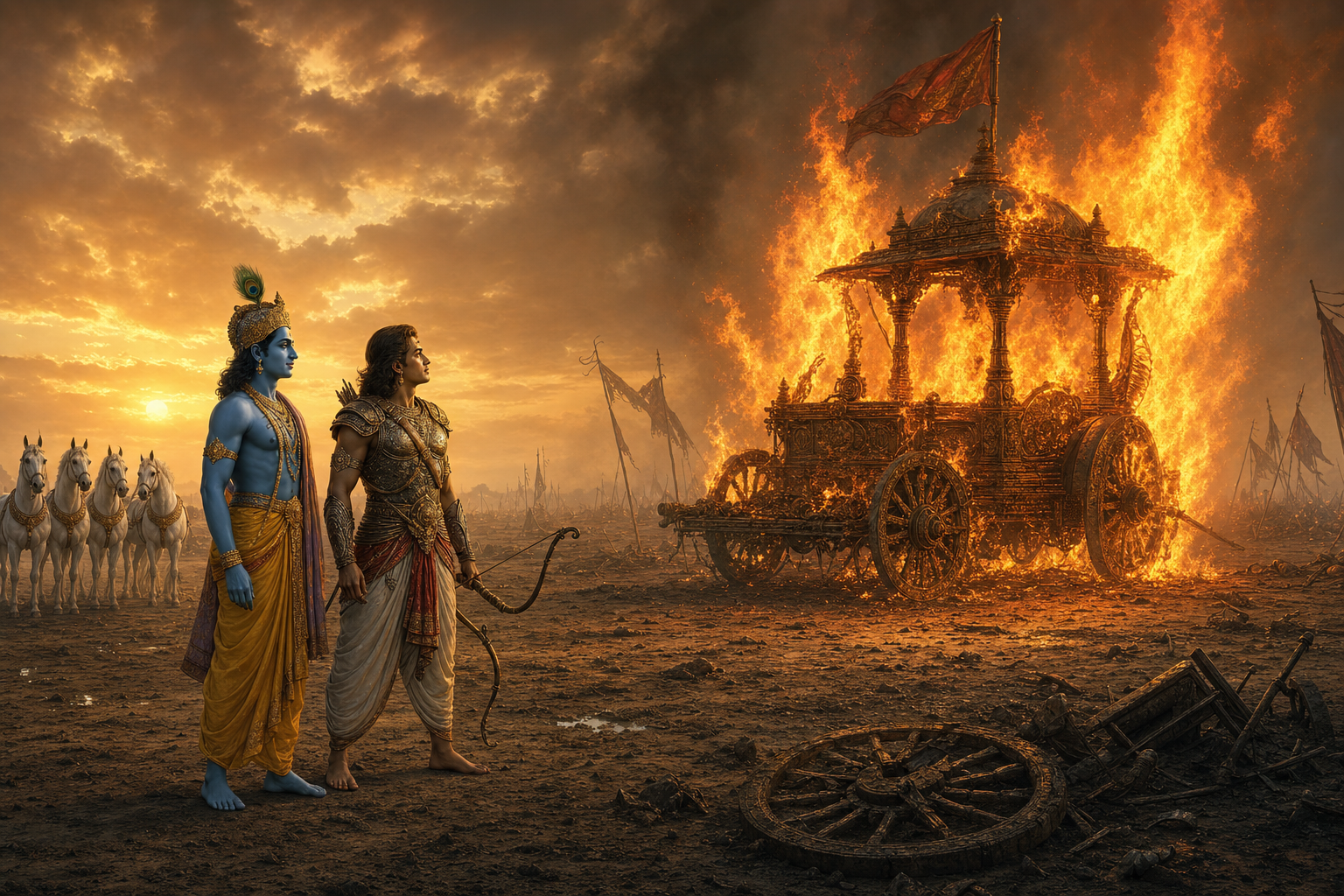
    Before the first arrow flies at Kurukshetra, the Mahabharata pauses for an indelible act of humility: Yudhishthira lays down his arms and seeks blessings from elders on both sides. This ethical rite aligns rajadharma and kshatra-dharma, signaling that even warfare must be governed by Dharma-Yuddha. The gesture affirms the guru–shishya tradition, anchors strength in reverence,…

  • Why Total Mind Control Eludes Beginners: A Vedic Ladder to Mastery and Inner Freedom

    Why Total Mind Control Eludes Beginners: A Vedic Ladder to Mastery and Inner Freedom

    Complete control of the mind is unrealistic at the outset; Vedic psychology and Yoga philosophy present a stepwise ladder to genuine mastery. Grounded in the Bhagavad Gita, the Upanishads, and Patañjali’s guidance on abhyasa and vairagya, this article explains why early turbulence is diagnostic rather than discouraging. It integrates insights from Hinduism, Buddhism, Jainism, and…

  • He Is Myself and I Am He: Timeless Vedanta on Atman-Brahman Unity and Liberation

    He Is Myself and I Am He: Timeless Vedanta on Atman-Brahman Unity and Liberation

    This article unpacks the Vedantic insight behind “He is myself and I am He,” explaining how the Upanishads reveal the identity of atman and Brahman. It surveys Advaita Vedanta alongside Vishishtadvaita, Dvaita, Gaudiya Vaishnavism, and Kashmir Shaivism to show complementary ways of understanding unity and difference. It bridges Hindu philosophy with related aims in Buddhism,…

  • Science of Sacrifice: Dharmic principles to practice tyaga, seva, and everyday yajna wisely

    Science of Sacrifice: Dharmic principles to practice tyaga, seva, and everyday yajna wisely

    Sacrifice in a dharmic sense is intelligent, freely chosen renunciation that serves a higher, shared good. This comprehensive guide defines tyaga in relation to dana, tapas, seva, and yajna, and shows how sattva, rajas, and tamas shape the quality of any offering. It unifies insights from Hinduism, Buddhism, Jainism, and Sikhism—linking loka-sangraha, dana, Aparigraha, and…

  • Unquenchable Spiritual Thirst: A Dharmic Path of Bhakti, Japa, Seva, and Inner Realization

    Unquenchable Spiritual Thirst: A Dharmic Path of Bhakti, Japa, Seva, and Inner Realization

    Spiritual thirst is a disciplined, one-pointed aspiration for ultimate truth, cultivated through listening, singing, remembrance, mantra-japa, and ethical living. Across Hinduism, Buddhism, Jainism, and Sikhism, it matures when aspiration is yoked to steady practice, community support, and responsible conduct. The Varkari tradition exemplifies how sustained kirtan, abhangas, and pilgrimage transform longing into culture. Vedānta names…

  • Who Is the Real Father? ISKCON and Gita on the Soul, Death, and the Supreme Source

    Who Is the Real Father? ISKCON and Gita on the Soul, Death, and the Supreme Source

    This essay explores the Hare Krishna (ISKCON) understanding of who the “real father” is by distinguishing bodily from spiritual parenthood through the lens of the Bhagavad Gita. It explains why everyday bereavement language—“he has gone”—implicitly recognizes the self (ātmā) as distinct from the body. Drawing on key verses (Gita 14.4, 2.13, 2.20, 15.7), it shows…

  • Divine Touch and Sacred Grace: What Bhakti Teaches About Service, Liberation, and Unity

    Divine Touch and Sacred Grace: What Bhakti Teaches About Service, Liberation, and Unity

    Divine touch in Hindu spirituality—anugraha or grace—signifies a transformative contact that sanctifies life and aligns it with dharma. Drawing on Upanishadic insight and Purāṇic narratives, this exploration analyzes how devotion, humility, and service dispose seekers to receive grace. Case studies of Sage Bhrigu, Markandeya, Periyalvar, Malayathvaja Pandiyan, and Akaasaraja show how sacred touch operates in…

  • Idle Mind Is the Devil’s Workshop: A Dharmic, Scientific Guide to Focus and Virtue

    Idle Mind Is the Devil’s Workshop: A Dharmic, Scientific Guide to Focus and Virtue

    This article reframes the proverb ‘An idle mind is the devil’s workshop’ through a dharmic and scientific lens, unifying insights from Hinduism, Buddhism, Jainism, and Sikhism with contemporary psychology. It distinguishes restorative rest from unstructured idleness and shows how right effort, seva, and mindfulness reduce rumination and impulsivity. Readers gain a practical framework: align purpose…

  • Legacy of Love: How Vrindavan’s ISKCON Book Distribution Unites Dharma Through Seva

    Legacy of Love: How Vrindavan’s ISKCON Book Distribution Unites Dharma Through Seva

    In Vrindavan, ISKCON’s book distribution thrives as a dignified practice of seva rooted in transparency, study, and respect. Parasuram das’s reflections and Rasada Prabhu’s legacy funds anchor a program that is historically informed, ethically rigorous, and operationally sound. The effort focuses on accessible texts, multilingual curation, and non-coercive dialogue, aligning with municipal norms and temple…

  • End People‑Pleasing: Evidence‑Based Practices to Rebuild Self‑Trust and Calm Your Nervous System

    End People‑Pleasing: Evidence‑Based Practices to Rebuild Self‑Trust and Calm Your Nervous System

    This analysis explains why people-pleasing often begins as a nervous-system strategy to stay safe and how it quietly erodes self-trust, agency, and joy. It presents evidence-based practices—interoceptive scanning, breath-led regulation, and low‑stakes exposure to voicing preferences—that rebuild inner guidance without overwhelming the system. It clarifies the difference between healthy cooperation and self‑abandonment, and offers language…

  • Moksha in Mimamsa Darsana: Unraveling Liberation through Dharma, Ritual, and Knowledge

    Moksha in Mimamsa Darsana: Unraveling Liberation through Dharma, Ritual, and Knowledge

    Mimamsa, celebrated for its Vedic hermeneutics, also offers a precise and compelling account of moksha as the cessation of suffering and the self’s release from embodied limitation. Rooted in the Jaimini Mimamsa Sutras and elaborated by Śabara, Kumārila, and Prabhākara, the system distinguishes ritual’s finite results from liberation’s non-binding freedom. It explains karma through the…

  • Balarāma’s Poised Silence: Unpacking Śrīmad-Bhāgavatam 10.16 and Kṛṣṇa’s Saving Power

    Balarāma’s Poised Silence: Unpacking Śrīmad-Bhāgavatam 10.16 and Kṛṣṇa’s Saving Power

    Śrīmad-Bhāgavatam 10.16.1–16 frames the Kāliya episode through Balarāma’s calm smile and eloquent silence, signaling realized trust in Kṛṣṇa’s saving power. The narrative contrasts the Vrajavāsīs’ anxiety with Balarāma’s stabilizing presence, revealing guru-tattva and the supportive role of Saṅkarṣaṇa. Read alongside Gauḍīya Vaiṣṇava commentaries, the passage shows how silence can be genuine instruction (māuna-upadeśa), cultivating communal…

  • Born of Sacred Fire: Draupadi’s Yajna Origins and the Mahabharata’s Destiny Symbolism

    Born of Sacred Fire: Draupadi’s Yajna Origins and the Mahabharata’s Destiny Symbolism

    Draupadi’s birth from the yajna fire is more than a miracle; it is the Mahabharata’s masterclass in how ritual, intention, and cosmic order interact. The narrative explains why Agni, as Vedic mediator and witness, signifies both purification and moral accountability. It clarifies how Drupada’s rājasic aim meets a higher corrective, yielding Dhṛṣṭadyumna and Draupadi as…

  • Radically Honest with Krishna: Vraja Vihari Prabhu on Real Bhakti, Courage, and Healing

    Radically Honest with Krishna: Vraja Vihari Prabhu on Real Bhakti, Courage, and Healing

    This reflection distills Vraja Vihari Prabhu’s central insight: spiritual life flourishes through a truthful relationship with Krishna rather than perfectionism. It explains why divine omniscience makes honesty safe, not risky, and anchors the point in Bhagavad Gita and Bhakti Tradition teachings. It outlines how candid disclosure during japa, kirtan, and evening reflection reduces inner resistance…

  • Yearning for Vṛndāvana, Choosing Wisdom: Caitanya-caritāmṛta Madhya 16.220–237 Unpacked

    Yearning for Vṛndāvana, Choosing Wisdom: Caitanya-caritāmṛta Madhya 16.220–237 Unpacked

    Caitanya-caritāmṛta, Madhya-līlā 16.220–237 presents a nuanced portrait of devotional longing guided by prudent counsel. Drawing on Śrīla Bhaktivinoda Ṭhākura’s Amṛta-pravāha-bhāṣya, the passage shows how Rāmānanda Rāya and Sārvabhauma Bhaṭṭācārya safeguarded Śrī Caitanya Mahāprabhu’s journey to Vṛndāvana by aligning desire with timing and public welfare. The narrative also notes the third annual pilgrimage of Bengali devotees…

  • Beyond Labels: Hindu, Buddhist, Jain, and Sikh Wisdom to Reclaim Identity and Inner Freedom

    Beyond Labels: Hindu, Buddhist, Jain, and Sikh Wisdom to Reclaim Identity and Inner Freedom

    Modern society rewards borrowed identities built on titles, metrics, and public narratives, yet Hindu wisdom—and allied dharmic perspectives—offers a precise path to inner freedom. Drawing on the Upanishads, Bhagavad Gita, Yoga Sutras, and the Pancha Kosha model, this essay distinguishes social roles from the enduring Self. It explains how avidya, maya, and the kleshas distort…

  • Ignorance Is Its Nemesis: A Definitive Advaita Vedanta Guide to Avidya, Jnana, and Moksha

    Ignorance Is Its Nemesis: A Definitive Advaita Vedanta Guide to Avidya, Jnana, and Moksha

    This long-form, academically grounded exploration clarifies how Advaita Vedanta understands avidya (ignorance) as the root of bondage and jnana (knowledge) as its precise antidote. Drawing on the Upanishads and the Bhagavad Gita, it explains key concepts—adhyasa, maya, sadhana-chatushtaya, and sravana–manana–nididhyasana—while detailing how knowledge functions as a pramana for Brahman. The discussion situates Advaita within a…

  • Dharma Paripalana Moorthy: Sri Rama’s Timeless Blueprint of Rajadharma in Rama Rajya

    Dharma Paripalana Moorthy: Sri Rama’s Timeless Blueprint of Rajadharma in Rama Rajya

    Sri Rama as Dharma Paripalana Moorthy embodies a rigorous model of ethical governance—Rama Rajya—that continues to inform discussions on justice, welfare, and leadership. Grounded in the Valmiki Ramayana, including the Uttara Kanda’s portrayal of an 11,000-year reign, the narrative articulates rajadharma as personal virtue aligned with fair institutions and compassionate law. The analysis situates this…

  • Sita Navami 2026 (Apr 25): Auspicious Puja Vidhi, Vrat Guide, Panchang Rules & Significance

    Sita Navami 2026 (Apr 25): Auspicious Puja Vidhi, Vrat Guide, Panchang Rules & Significance

    Sita Navami 2026 falls on April 25, aligning with Vaishakha Shukla Navami in the Hindu calendar. This comprehensive guide explains the festival’s scriptural foundations, cultural depth, and ecological symbolism, spotlighting Sita as an embodiment of dharma and a manifestation of Goddess Lakshmi. It clarifies Panchang-based tithi rules, the Udaya Tithi and Madhyahna approaches, and why…

  • Phone Down, Eyes Up: Reclaiming Presence from Digital Distraction to Heal Family Bonds

    Phone Down, Eyes Up: Reclaiming Presence from Digital Distraction to Heal Family Bonds

    Attention is the most valuable gift in modern family life, yet smartphones and notifications constantly divert it. This essay analyzes one family’s shift from reflexive checking to intentional presence, grounded in attention science and dharmic wisdom. It explains how intermittent rewards, attention residue, and the mere presence of a phone undermine working memory, trust, and…