
-
Yoga Dakshinamurti Unveiled: Two Sacred Postures, Agamic Iconography, and Inner Silence

Dakshinamurti, Shiva’s south-facing form, embodies the Adi Guru whose silence instructs more deeply than speech. This long-form guide decodes two canonical idol forms of the Yoga DakshinamurtiDhyana-Padmasana and Virasana/Maharajalilasanausing Agamic and Shilpa Shastra principles. Readers learn practical cues to identify each form in temples, from asana and yogapatta to mudras, attributes, and the optional presence…
-
Decoding Krikala in Advaita Vedanta: Harness the Throat’s Subtle Prana for Clarity and Calm

Advaita Vedanta locates Krikala (Krikara) in the throat as a minor prana governing hunger, thirst, and protective reflexes that make clear speech and comfortable swallowing possible. By placing Krikala within the five primary and five subsidiary pranas, the tradition shows how subtle energy integrates physiology, psychology, and practice. Gentle methods such as light ujjayi and…
-
From Brahman to Cosmos: Decoding Hindu Cosmology, Cyclic Time, and Dharmic Unity

Hindu cosmology portrays creation as emergence from an undivided reality, Brahman, rather than a one-time act ex nihilo. Drawing on the Upanishads, Sāṅkhya, Vedānta, and the Puranas, it explains how the subtle becomes gross through ordered stages, from mahat and ahaṅkāra to the five elements. Cyclic timeyugas, manvantaras, and kalpasreplaces linear beginnings with rhythmic manifestation…
-
Why Pleasure Escapes Us: Hindu Wisdom on Desire, Avidya, and the Path to Lasting Ananda

Why does pleasure fade so quickly, and why does desire return so reliably? This long-form analysis uses Hindu philosophyBhagavad Gita, Yoga Sutras, and Upanishadsto explain the psychology of craving via avidya, raga-dvesha, samskara, and the gunas. It clarifies the distinction between sukha (contact-based pleasure) and ananda (enduring joy) and situates kama within the purusharthas under…
-
Can God Be Seen? Discipline, Darshan, and the Hard-Won Freedom of True Liberation
Can God be seen? Dharmic traditions answer yesbut only when the instrument of knowing is refined by ethics, contemplation, study, service, and grace. Drawing on the Bhagavad Gita, the Upanishads, Yoga Sutras, and parallel insights from Buddhism, Jainism, and Sikhism, this essay explains why darshan is not a spectacle but a disciplined way of seeing.…
-
Dissolving Matter’s Mirage: Dharmic Wisdom on Returning to the Primordial, Nondual Source
This essay examines how dharmic traditions understand the illusion of materiality and the emergence of a primordial, nondual source through deep inquiry. Drawing on the Upanishads, Bhagavad Gita, Advaita Vedanta, and yogic practice, it explains the movement from gross to subtle via pañca-kośa and the triad of sthūla–sūkṣma–kāraṇa śarīra. It highlights complementary perspectives in Buddhism…
-
Unlocking Kosha: From the Five Sheaths of the Self to the Treasury of Hindu Statecraft

Kosha holds a powerful dual meaning in Hindu thought: the five sheaths (panchakoshas) that veil the self in Vedanta and the treasury that sustains a kingdom in classical statecraft. Grounded in the Taittiriya Upanishad and Pancha Kosha Viveka, this analysis clarifies each sheathannamaya, pranamaya, manomaya, vijnanamaya, anandamayaand maps practices from asana and pranayama to pratyahara,…
-
Why Sanskrit Calls Humans “Nara”: Deep Origins, Dharma, and the Power of Karma
The Sanskrit term “nara” does more than denote a human being; it encodes a civilizational understanding of agency, ethics, and liberation. Its deep Indo-European etymology, rich scriptural presence, and philosophical nuance explain why Hinduism treats human life as uniquely suited to dharma and karma. Classical distinctionssañcita, prārabdha, and kriyamāṇa karmashow how present choices reshape experience.…
-
Disarming the Ego: A Cross-Dharmic, Science-Backed Guide to Self-Realization and Freedom

Ego is the single greatest barrier to self-realization because it fuses awareness with passing roles and narratives, a pattern Dharmic traditions diagnose with remarkable agreement. This essay integrates Vedanta, Buddhism, Jainism, and Sikhism with cognitive science to explain how Avidya and identity habits formand how to unwind them. Readers gain a precise map of the…
-
From Humble Beginnings to Enduring Eminence: Scholarship, Faith, and Dharmic Unity

This essay maps the path from humble beginnings to enduring eminence through the dharmic lenses of scholarship, faith, struggle, legacy, and inspiration. It shows how the Guru-Shishya Tradition, Nalanda-style scholastic cultures, Jain Anekantavada, Sikh Seva, and vedantic inquiry create complementary routes to excellence. Readers gain a pragmatic five-vector blueprintVidya, Sadhana, Seva, Sangha, and Shraddhafor integrating…
-
Anirvacanīya-khyāti in Advaita Vedanta: Decoding Illusion, Truth, and Liberation

Anirvacanīya-khyāti, often popularized as “Anirvachaniya Akhyati,” is Advaita Vedānta’s nuanced account of illusion: what appears in error is neither absolutely real nor absolutely unreal, but indeterminable until corrected. This theory situates everyday misrecognitionlike mistaking nacre for silver or a rope for a snakewithin Advaita’s three levels of reality and its method of sublation (bādha). It…
-
Break Free from Fragmentation: Seeking the Whole in Vedanta and Dharmic Paths for Inner Peace

This article unpacks the insight that suffering arises from fragmentation and shows how Vedanta and the broader dharmic traditions offer a precise remedy by seeking the whole. It explains avidya through the Upanishads and the Bhagavad Gita, connects Yoga’s kleshas and eightfold discipline to integration, and brings in Buddhist, Jain, and Sikh perspectives that converge…
-
Khandana Khanda Khadya: Shriharsha’s Razor and a Masterclass in Defending Advaita Vedanta

Khandana Khanda Khadya stands as a luminous 12th-century masterpiece of Advaita Vedanta, using elegant refutation to unsettle rigid categories and clear a contemplative path to nondual insight. Shriharsha’s method exposes circularities in definitions and limits in pramana theory, challenging naive realism while honoring the self-luminous nature of consciousness. The analysis reveals deep resonances with Buddhist…
-
Vedanta’s Call to Inquiry: A Rigorous, Transformative Journey through the Upanishads to Self
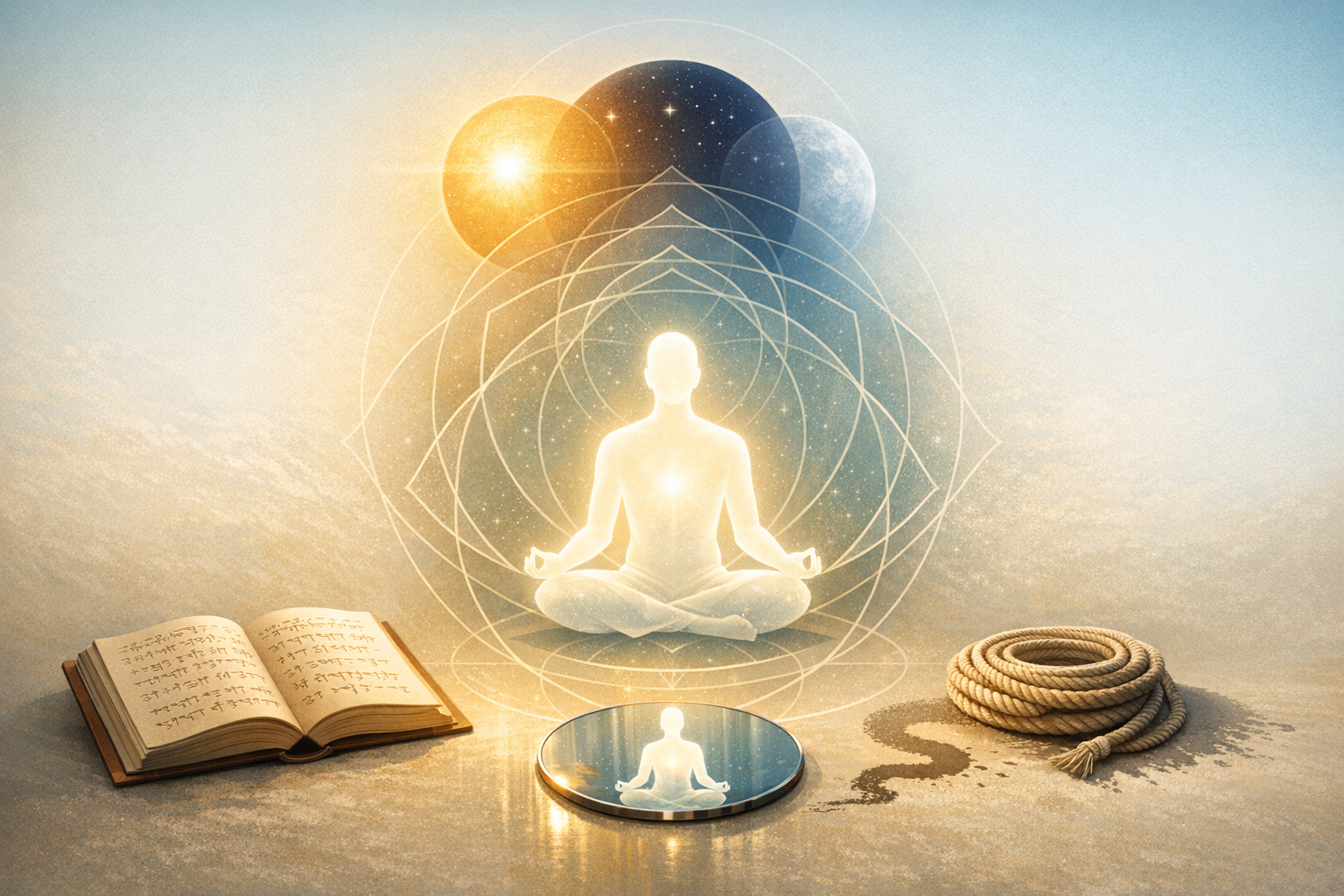
This essay presents Vedanta as a disciplined path of inquiry grounded in the Upanishads and guided by rigorous methods of knowledge. It explains pramana, and the classical triad of shravana–manana–nididhyasana, showing how contemplative assimilation transforms insight into lived clarity. It outlines practical qualifications (sadhana-chatushtaya) and core analyses such as pancha-kosha viveka, drg-drshya viveka, and avastha-traya…
-
Unmasking Myths: How Truly Enlightened Beings Live, Eat, and Speak Among Us

This essay dismantles the popular myth that enlightened beings must look or act extraordinary, showing instead how Dharmic traditions depict realization as profound normalcy. Drawing on Hindu philosophy, Buddhism, Jainism, and Sikhism, it clarifies how liberation expresses itself in everyday eating, speaking, working, and serving. It synthesizes concepts such as mokṣa, nirvāṇa, kaivalya, kevala-jñāna, and…
-
Ravana’s Abduction of Sita Revisited: Dharma, Curses, and a Deliberate Path to Moksha
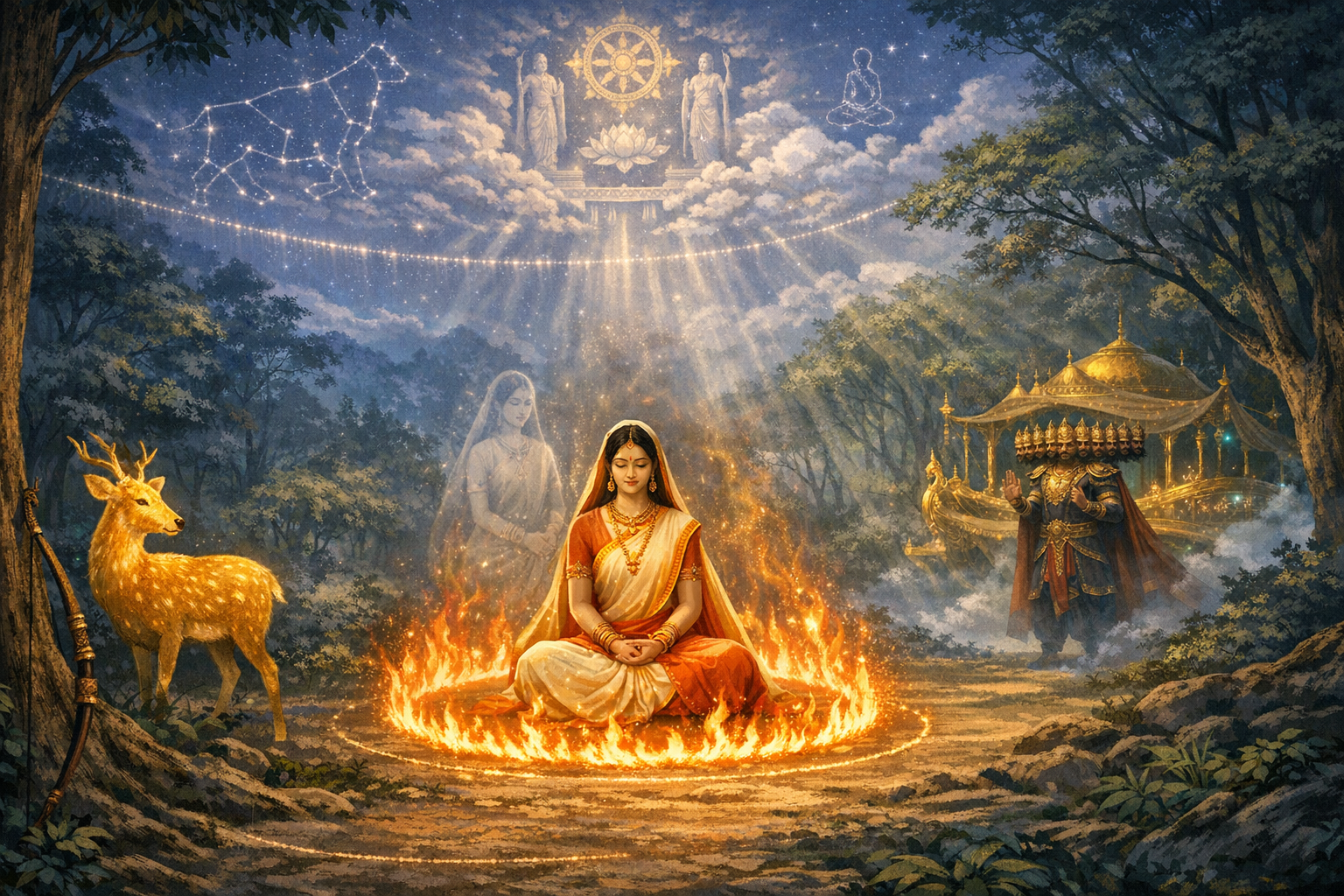
Did Ravana kidnap Sita to be slain by Sri Rama and attain moksha? A careful, text-sensitive study shows that while Valmiki’s Ramayana emphasizes Ravana’s pride and desire, later Puranic and bhakti traditions interpret his fall within a cosmic design of grace. The Jaya–Vijaya doctrine, vaira-bhakti (absorption through enmity), karmic curses, and the Maya Sita motif…
-
Stop Chasing Happiness: Dharmic Science to Light the Inner Cave of Joy and Resilience

The dharmic saying “Seeking happiness outside is like waiting for sunshine inside a deep cave” captures a precise psychology of well-being common to Hinduism, Buddhism, Jainism, and Sikhism. Rather than promising joy through acquisition, these traditions direct attention to the hṛdaya-guhathe cave of the heartwhere clarity and resilience abide. Vedanta, the Yoga Sutra, Buddhist insight,…
-
Unveiling Kena’s Dual Identity: Why It’s the Talavakara Upanishadand Why It Matters Today

The Kena Upanishad is called the Talavakara Upanishad because it is embedded in the Tālavakāra Brāhmaṇa of the Sāma Veda, reflecting its precise textual lineage. Its name “Kena” comes from the opening question“by whom?”that frames a profound inquiry into the source of mind, speech, and life. Structured in four sectionstwo metrical and two proseit advances…
-
Katha Rudra Upanishad: A Timeless, Transformative Guide to Sannyasa and Brahma-Jnana

The Katha Rudra Upanishad, affiliated with the Krishna Yajurveda, presents 47 mantras that redefine sannyasa as inner renunciation oriented to Brahma-jnana. It privileges ethical foundations like ahiṁsā and aparigraha, uniting conduct and contemplation as prerequisites for non-dual insight. By emphasizing Om, mahāvākya meditation, silence, and self-inquiry, the text converts knowledge from concept to lived clarity.…
-
Karya Karana Bhava: Unveiling Causality’s Power Across Dharmic Wisdom Traditions
Karya Karana Bhavathe principle of cause and effectoffers a clear lens for understanding reality, ethics, and spiritual growth in Hinduism. Grounded in the Vedas and Upanishads and refined by Samkhya, Nyaya, and Vedanta, it clarifies how choices shape outcomes through karma and disciplined practice. Everyday examples show how patience, consistency, and seva produce meaningful effects,…