
-
Satsang, Sangat, and Kalyāṇa-Mitra: Supercharge Spiritual Growth with True Friendship

Friendship is a structural requirement of spiritual growth across Hinduism, Buddhism, Jainism, and Sikhism. This essay defines spiritual friendship through the lenses of satsanga, kalyāṇa-mitra, satsaṅga, and Sadh Sangat, and explains mechanismsbehavioral, cognitive, affective, and ethicalby which good company reshapes inner life. It offers practical criteria for discerning true friends, highlights red flags that undermine…
-
A Guru Can Guide, Not Save: Self‑Realization Across Hindu, Buddhist, Jain, Sikh Paths

Across Hinduism, Buddhism, Jainism, and Sikhism, a unifying principle stands out: a guru can guide, not save, and Self-Realization depends on disciplined personal effort. This article grounds the point in the Bhagavad Gita and Upanishads, while showing its parallels in Buddhist, Jain, and Sikh teachings. It clarifies how grace and effort cooperate without inviting passivity,…
-
Decoding Hindu Iconography: Beyond Idolatry to MetaphysicsBridging Dharmic–Abrahamic Insight

This article decodes Hindu iconography as a rigorous symbolic language that encodes metaphysics, ethics, and contemplative practice, rather than mere ‘idolatry’. It situates medieval misunderstandings within Abrahamic aniconism and outlines how mūrti, prāṇa-pratiṣṭhā, mudrā, and vāhana together form a coherent semiotic system. Readers gain a comparative framework linking Hindu saguṇa–nirguṇa practice to apophatic and cataphatic…
-
From Brahman to Cosmos: Decoding Hindu Cosmology, Cyclic Time, and Dharmic Unity

Hindu cosmology portrays creation as emergence from an undivided reality, Brahman, rather than a one-time act ex nihilo. Drawing on the Upanishads, Sāṅkhya, Vedānta, and the Puranas, it explains how the subtle becomes gross through ordered stages, from mahat and ahaṅkāra to the five elements. Cyclic timeyugas, manvantaras, and kalpasreplaces linear beginnings with rhythmic manifestation…
-
Beyond the Body-Illusion: How Intense Concentration Unveils Pure Consciousness in Hindu Thought

Hindu philosophy teaches that in deep concentration the usual sense of having a body recedes, revealing pure, self-luminous awareness. Drawing on the Upanishads, Yoga Sutras, and the Bhagavad Gita, this article explains how pratyahara, dharana, and dhyana systematically reduce sensory dominance and disclose the witnessing consciousness. It relates these insights to parallel practices in Buddhism,…
-
Why Pleasure Escapes Us: Hindu Wisdom on Desire, Avidya, and the Path to Lasting Ananda

Why does pleasure fade so quickly, and why does desire return so reliably? This long-form analysis uses Hindu philosophyBhagavad Gita, Yoga Sutras, and Upanishadsto explain the psychology of craving via avidya, raga-dvesha, samskara, and the gunas. It clarifies the distinction between sukha (contact-based pleasure) and ananda (enduring joy) and situates kama within the purusharthas under…
-
Can God Be Seen? Discipline, Darshan, and the Hard-Won Freedom of True Liberation
Can God be seen? Dharmic traditions answer yesbut only when the instrument of knowing is refined by ethics, contemplation, study, service, and grace. Drawing on the Bhagavad Gita, the Upanishads, Yoga Sutras, and parallel insights from Buddhism, Jainism, and Sikhism, this essay explains why darshan is not a spectacle but a disciplined way of seeing.…
-
The Art of Objectivity: Dharmic Wisdom for Clear Thinking, Equanimity, and Just Action

This essay presents a rigorous, dharmic approach to objectivity that integrates Hindu, Buddhist, Jain, and Sikh wisdom. It explains how Nyaya pramana, Sankhya-Yoga, and the Bhagavad Gita’s buddhi-yoga cultivate clear perception and ethical decision-making. It shows how Jain Anekantavada prevents dogmatism, while Buddhist mindfulness builds equanimity and Sikh ideals of nirbhau-nirvair align clarity with courage.…
-
Why Chamunda’s Severed, Smiling Head Signifies Bliss: Decoding Ego-Death and Moksha

Chamunda’s severed head is not an emblem of violence but a precise symbol of liberation: the serene face represents ego-death and the bliss of moksha. By situating the image within Shakta tantra, cremation-ground sadhana, and the mundamala/kapala vocabulary, the analysis shows how fear is transmuted into insight. Panchamundi Asana symbolism and comparisons with Kali and…
-
Dissolving Matter’s Mirage: Dharmic Wisdom on Returning to the Primordial, Nondual Source

This essay examines how dharmic traditions understand the illusion of materiality and the emergence of a primordial, nondual source through deep inquiry. Drawing on the Upanishads, Bhagavad Gita, Advaita Vedanta, and yogic practice, it explains the movement from gross to subtle via pañca-kośa and the triad of sthūla–sūkṣma–kāraṇa śarīra. It highlights complementary perspectives in Buddhism…
-
Why Sanskrit Calls Humans “Nara”: Deep Origins, Dharma, and the Power of Karma
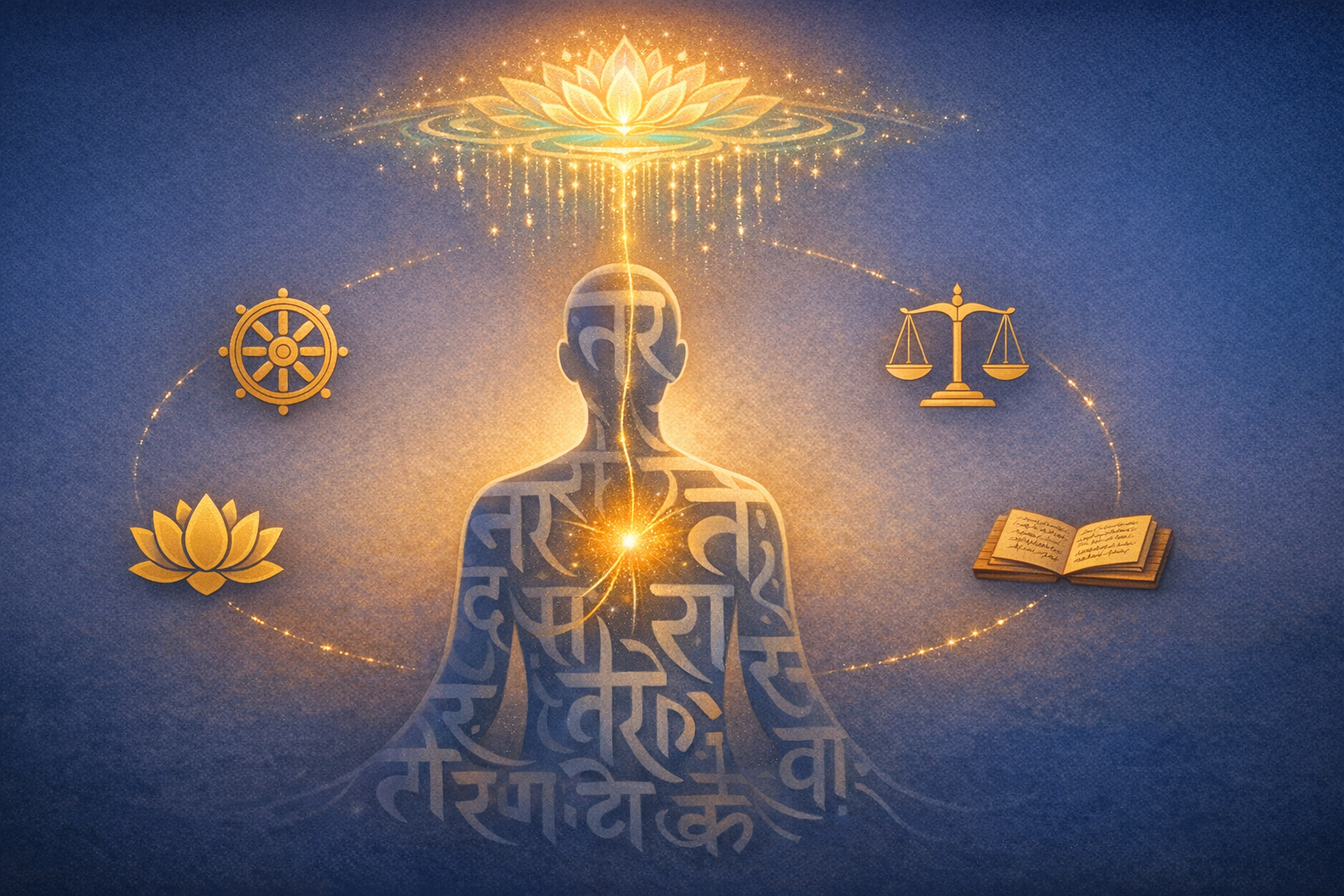
The Sanskrit term “nara” does more than denote a human being; it encodes a civilizational understanding of agency, ethics, and liberation. Its deep Indo-European etymology, rich scriptural presence, and philosophical nuance explain why Hinduism treats human life as uniquely suited to dharma and karma. Classical distinctionssañcita, prārabdha, and kriyamāṇa karmashow how present choices reshape experience.…
-
Bali’s Mercy Toward Ravana: A Ramayana Lesson on Dharma, Restraint, and Modern Leadership

The Bali–Ravana encounter in the Ramayana tradition yields a precise ethic for modern life: power must be governed by restraint. Later tellings and purāṇic echoes preserve the episode of Bali subduing yet sparing Ravana, illustrating kṣātra-dharma, proportionality, and the protection owed to a suppliant. The narrative anticipates principles of international humanitarian law while aligning with…
-
Satyakama Jabala: A Timeless Upanishadic Tale of Truth, Inclusion, and Vedic Learning
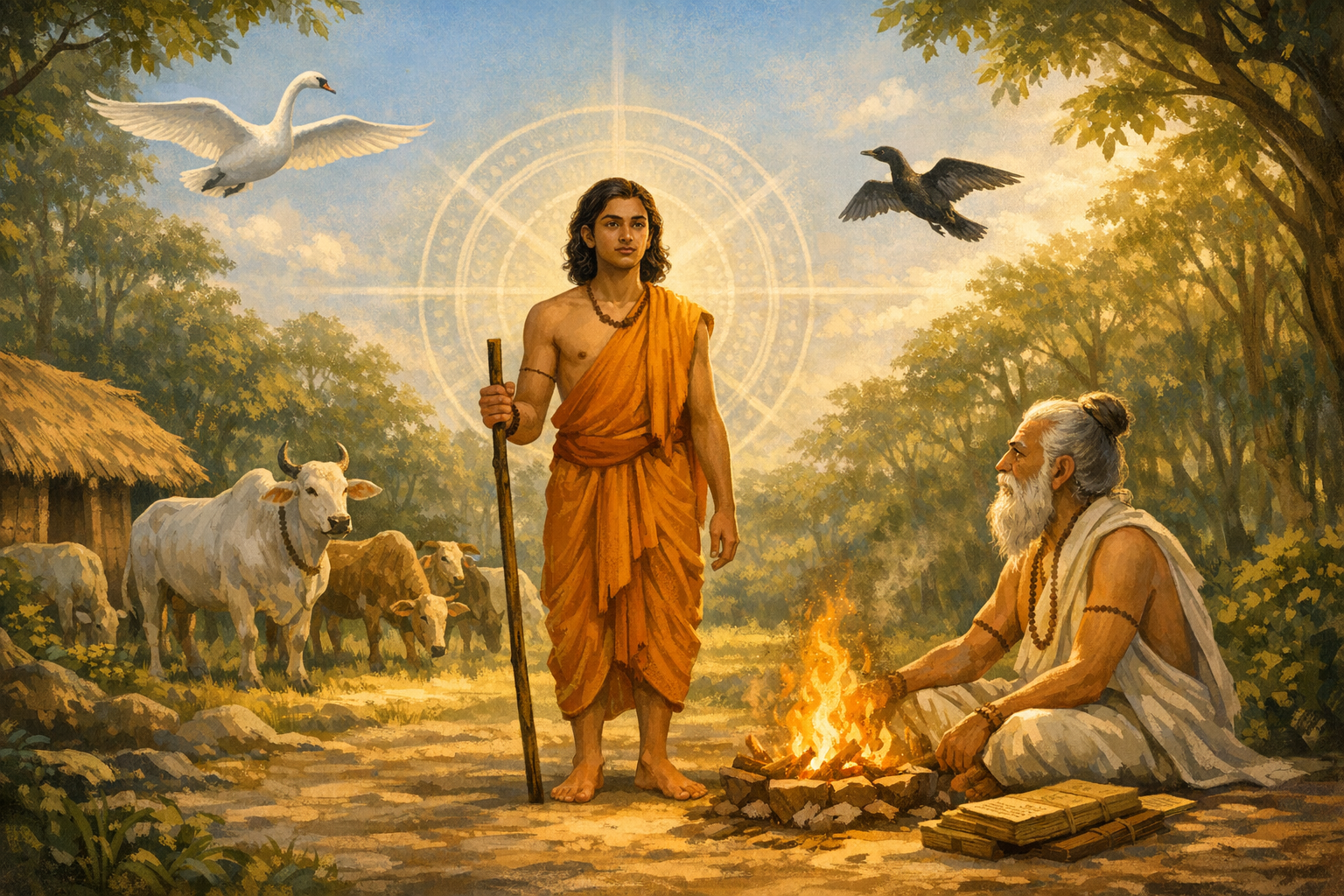
Satyakama Jabala, celebrated in the Chandogya Upanishad, embodies the Upanishadic conviction that truthfulness, not lineage, determines eligibility for the highest learning. His candid admission of uncertain ancestry and his acceptance by the sage Haridrumata Gautama have long been read as a scriptural affirmation of inclusion grounded in dharma. Through years of disciplined service in the…
-
Break the Grip of Envy: Dharmic Wisdom on Desire, Aparigraha, and True Wealth

A timeless dharmic principle“Do not covet what is not yours”is examined through Hindu, Buddhist, Jain, and Sikh frameworks to show how freedom from envy safeguards inner clarity and social trust. The analysis grounds the ethic in the Isha Upanishad, the Bhagavad Gita’s psychology of desire, and Patanjali’s yamas of Asteya and Aparigraha. It then aligns…
-
Anirvacanīya-khyāti in Advaita Vedanta: Decoding Illusion, Truth, and Liberation

Anirvacanīya-khyāti, often popularized as “Anirvachaniya Akhyati,” is Advaita Vedānta’s nuanced account of illusion: what appears in error is neither absolutely real nor absolutely unreal, but indeterminable until corrected. This theory situates everyday misrecognitionlike mistaking nacre for silver or a rope for a snakewithin Advaita’s three levels of reality and its method of sublation (bādha). It…
-
Beyond Crisis Prayers: Kabir’s Smaraṇa and the Dharmic Science of Constant Remembrance

Kabir’s doha captures a universal tendency: many remember the Divine only in hardship. This article presents smaraṇa as a rigorous, unbroken discipline that stabilizes attention and ethics across both adversity and prosperity. Drawing from Hindu bhakti, Buddhist mindfulness, Jain samayik and pratikraman, and Sikh simran, it outlines a shared dharmic science of remembrance. It explains…
-
Wrath to Wisdom: Parashurama and Rama’s Timeless Ethics for Power, Justice, and Dharma

This long-form analysis interprets Parashurama and Rama as complementary modalities of Dharma: emergency correction and constitutional restraint. Drawing on the Ramayana, Puranas, and classical ideas of Dharma-Yuddha, it shows how the “axe” symbolizes decisive action against entrenched injustice while the “arrow” symbolizes calibrated governance under maryada. Readers gain a practical framework for leadershipwhen to act…
-
Beyond Self-Help: Ashtavakra Gita’s Radical Path to Effortless Freedom and Peace

In a culture obsessed with optimization, the Ashtavakra Gita advances a precise Advaita Vedanta insight: liberation is recognition, not improvement. The text dismantles the self-help treadmill by distinguishing instrumental refinement of the mind from Self-realization, which rests on witness-consciousness and non-doership. Practical contemplationsneti neti, seer-seen discernment, resting as awarenessintegrate easily into daily life without breeding…
-
Unshakable Calm in Life’s Storms: Vedantic Truth and Dharmic Resilience Across Traditions

This essay examines the adage, “Storms will be ever present in life, and the best anchor is knowledge of Supreme Truth,” through Hindu philosophy and related dharmic traditions. It clarifies how Advaita Vedanta, the Upanishads, the Bhagavad Gita, Buddhism, Jainism, and Sikhism converge on a practical, verifiable path from instability to resilience. Readers gain a…
-
The World as a Roadside Inn: A Dharmic Guide to Impermanence, Detachment, and Freedom

This essay explores the classic dharmic metaphor of the world as a roadside inn to clarify impermanence, detachment, and ethical action. A teaching story of a mendicant and a king introduces the theme, which is then examined through the Bhagavad Gita, Upanishads, Patanjali’s Yoga Sutra, and Jain, Buddhist, and Sikh perspectives. Readers learn how anitya…