-
Srila Gaura-Kisora Dasa Babaji: Austerity, Bhakti, and a Timeless Blueprint for Inner Freedom

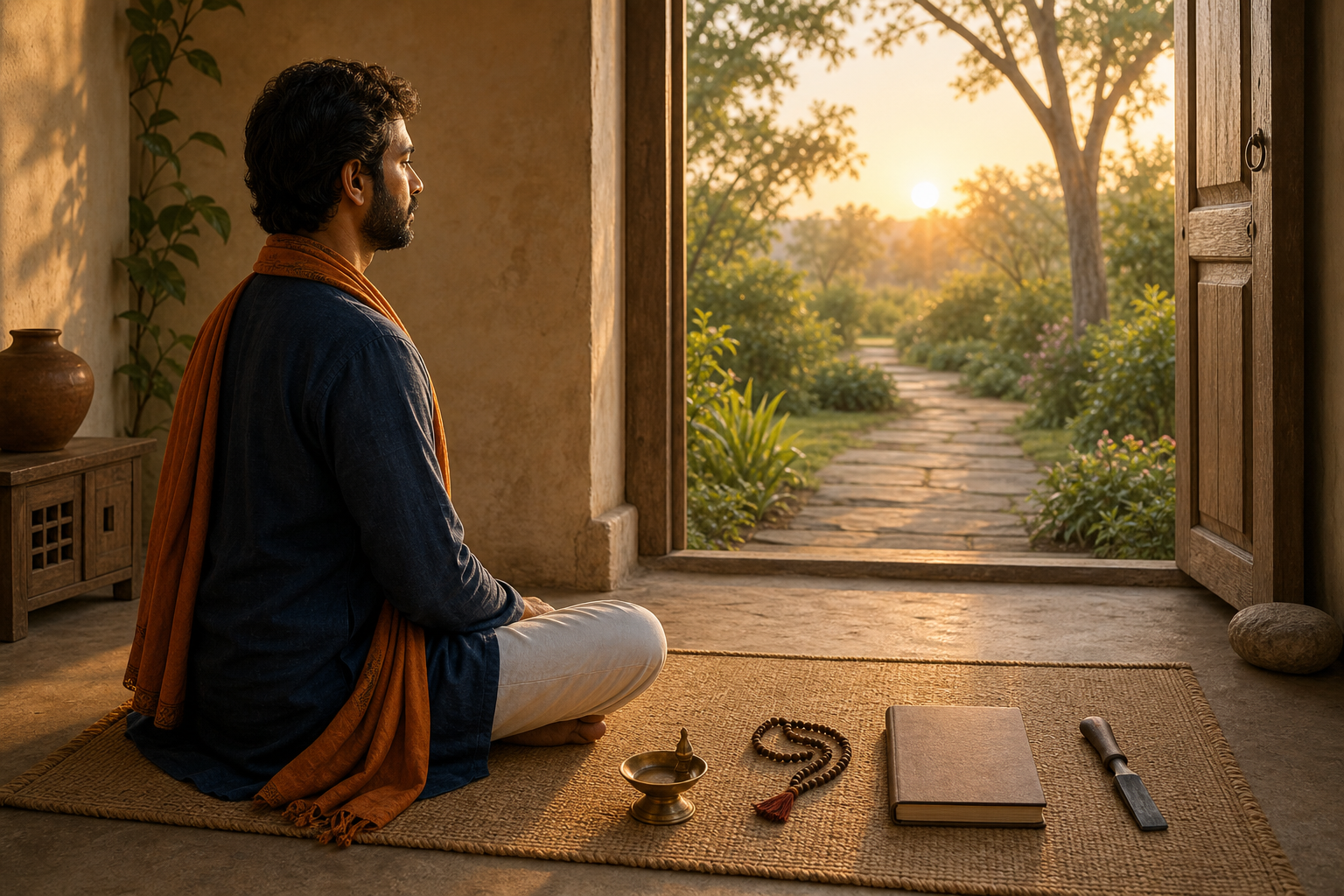
Srila Gaura-Kisora dasa Babaji exemplified uncompromising renunciation within the Bhakti Tradition, keeping only Tulasi-mala and a few core texts while declining all personal service. Set in late colonial Bengal, his life centered on nama-japa and the deep internalization of Narottama Dasa Thakura’s Prarthana and Prema Bhakti Chandrika. His method foregrounded aparigraha and guarded attention, modeling…
-
Vaisnava Sarvabhauma Srila Jagannatha Dasa Babaji: Disappearance Day and Sacred Yoga Pitha Legacy

The Holy Disappearance Day of Srila Jagannatha Dasa Babaji is observed as a celebration of enduring guidance rather than an ending, highlighting his role as Vaisnava Sarvabhauma and his profound influence on Gaudiya Vaishnava practice. Traditional accounts preserved in Sri Navadwipa Dhama Mahatmya recount his decisive affirmation of Sri Caitanya Mahaprabhu’s birthplace at Mayapur’s Yoga…
-
Unveiling Rahu Navagraha: Why the Serpent Head Without a Body Embodies Desire and Eclipses

Rahu Navagraha’s depiction as a serpent’s head without a body encodes a dual truth: the human experience of insatiable desire and the astronomical mechanics of eclipses. This article clarifies the Puranic origin of Rahu and Ketu, unpacks the symbolism of a head that can consume but never digest, and links the image to the lunar…
-
Guarding Lakshmi at the Door: Why Hindu Dharma Discourages Charity on the Threshold

Why do many Hindu households discourage giving charity at the doorway? This article unpacks the threshold as a sacred, liminal space in Hinduism and explains how Vastu Shastra, the Grihya Sutras, and Dharmaśāstra converge on a single ethic: dāna should occur in a clean, clearly defined place with dignifying courtesies. It shows how “deśa–kāla–pātra–śraddhā” guide…
-
Unmasking Myths: How Truly Enlightened Beings Live, Eat, and Speak Among Us

This essay dismantles the popular myth that enlightened beings must look or act extraordinary, showing instead how Dharmic traditions depict realization as profound normalcy. Drawing on Hindu philosophy, Buddhism, Jainism, and Sikhism, it clarifies how liberation expresses itself in everyday eating, speaking, working, and serving. It synthesizes concepts such as mokṣa, nirvāṇa, kaivalya, kevala-jñāna, and…
-
Beyond Name and Fame: A Dharmic Blueprint to Transcend Materialism and Find Lasting Fulfillment

Modern culture often mistakes accumulation, name, and fame for life’s highest achievement, yet this chase rarely resolves the inner void it aims to fill. A Hindu lens—aligned with Buddhist, Jain, and Sikh insights—frames the compulsion as avidya, a misidentification of self with roles and possessions. Anchored in the purusharthas, the analysis shows how artha and…
-
February 25, 2026 Panchang Guide: Shukla Paksha Navami, Auspicious Timings, Nakshatra & Rashi

On Wednesday, February 25, 2026, the Daily Hindu Calendar (Panchang) records Shukla Paksha Ashtami until 4:47 AM IST, followed by Shukla Paksha Navami for the rest of the civil day in most regions. The transition reflects the tithi’s astronomical definition based on the Moon–Sun elongation in 12-degree steps. Auspicious timing can be centered on Abhijit…
-
Complete Panchang for 18 February 2026 (IST): Tithi, Nakshatra, Choghadiya & Shubh Muhurat

The Panchang for Wednesday, 18 February 2026 (IST) brings together Tithi, Nakshatra, Yoga, Karana, Sunrise/Sunset, Moonrise/Moonset, Rahu Kalam, Yamaganda, Gulika Kalam, Abhijit Muhurat, Durmuhurtham, Choghadiya, Tarabalam, Chandrabalam, Lagna timings, and Amrit Kalam/Varjyam to guide auspicious planning. Presented in an academic, practical style, it explains how to compute location-specific windows under IST while preserving accuracy. Readers…
-
Panchang 21 Feb 2026 (IST): Auspicious Timings, Tithi, Nakshatra, Yoga & Practical Guide

This comprehensive guide to the Panchang for Saturday, 21 February 2026 (IST) explains how to apply Tithi, Nakshatra, Yoga, and Karana—together with Lagna, Choghadiya, Abhijit Muhurta, Rahu Kalam, Durmuhurtham, Amrit Kalam, Tarabalam, and Chandrabalam—to plan the day intentionally. It details the core formulas and interpretive logic, clarifies what must be city-specific, and offers a practical…
-
When Life Shatters the Script: Reframing Expectations, Grief, and Resilience with Dharmic Wisdom

Life scripts often feel reliable until an unpredictable event shatters the plan. This analysis follows a young widow’s experience to show how grief includes both the loss of a loved one and the collapse of anticipated futures. It explains why rigid expectations amplify suffering, drawing on cognitive science, bereavement research, and shared dharmic wisdom across…
-
Ravana’s Abduction of Sita Revisited: Dharma, Curses, and a Deliberate Path to Moksha

Did Ravana kidnap Sita to be slain by Sri Rama and attain moksha? A careful, text-sensitive study shows that while Valmiki’s Ramayana emphasizes Ravana’s pride and desire, later Puranic and bhakti traditions interpret his fall within a cosmic design of grace. The Jaya–Vijaya doctrine, vaira-bhakti (absorption through enmity), karmic curses, and the Maya Sita motif…
-
Overcoming Inner Battles in Meditation: Hindu-Yogic, Buddhist, Jain, Sikh Tools for Calm

Meditation across the dharmic traditions often collides with restlessness, distracting thoughts, emotional agitation, doubt, and subtle resistance. Drawing on the Yoga Sutras of Patanjali and the Bhagavad Gita—alongside Buddhist, Jain, and Sikh parallels—this piece delivers a technical, evidence-informed roadmap to stabilize dhyana. Readers learn how to diagnose obstacles (antaraya), regulate arousal with breath awareness and…
-
A Little-Known 1977 Moment with Srila Prabhupada: Consolation, Realism, and Generous Service

A quietly powerful 1977 exchange with Srila Prabhupada captures three enduring pillars of ISKCON’s ethos: compassionate consolation grounded in the Bhagavad-gita’s teaching of the soul’s immortality, pastoral realism that dignifies the grihastha path, and purposeful philanthropy directed to printing Srimad-Bhagavatam. In a few sentences—“Oh Srila Prabhupada, whatever Krishna desires.” and “Every girl wants to get…
-
From Ritual to Revelation: End ‘Courtesy Japa’ with Focused, Science-Backed Mantra Practice

Courtesy japa—mechanical, minimally attentive mantra repetition—yields little transformative benefit because it lacks clear sound, focused attention, and heartfelt intent. Drawing on Srila Prabhupada’s memorable illustration, this analysis explains why ritual without presence does not mature into love of Krsna, while still acknowledging the protective value of vow-keeping. Integrating insights from Hinduism, Buddhism, Jainism, and Sikhism,…
-
Unveiling Keshanta (Godana): The Sacred Rite of First Shaving in Hindu Samskaras

Keshanta (often called godana) is a Hindu samskara that marks the first formal shaving and the transition from adolescence to disciplined study. Rooted in the Grihya Sutras and Dharmashastras, it is performed variously as the first shaving of beard and moustache, and in some traditions includes head and limited body hair. The rite affirms values…
-
Conquering the Restless Mind: Markandeya’s Counsel to Lakshmana in Skanda Purana

This article examines a Skanda Purana dialogue in the Nagara Kanda where Sage Markandeya counsels Lakshmana on the restless mind, the genesis of sin, and the restoration of dharma. It outlines a classical Hindu psychological framework—antahkarana and the guṇas—and explains why intention (saṅkalpa) is ethically decisive. Readers receive a practical sādhanā protocol that includes breath…
-
Stop Chasing Happiness: Dharmic Science to Light the Inner Cave of Joy and Resilience

The dharmic saying “Seeking happiness outside is like waiting for sunshine inside a deep cave” captures a precise psychology of well-being common to Hinduism, Buddhism, Jainism, and Sikhism. Rather than promising joy through acquisition, these traditions direct attention to the hṛdaya-guha—the cave of the heart—where clarity and resilience abide. Vedanta, the Yoga Sutra, Buddhist insight,…
-
February 24, 2026 Panchang: Shukla Saptami to Ashtami – Auspicious Times, Meanings, and Ritual Guide

February 24, 2026 spans two tithis in the Hindu Panchang: Shukla Paksha Saptami until 7:09 AM (IST), followed by Shukla Paksha Ashtami for the remainder of the day. The guide explains how tithis are astronomically defined and why the timing of the transition matters for worship, fasting, and planning. It highlights Saptami’s association with Surya-centered…
-
Mahashivratri 2026 Puja Mantras: Timings, Vidhi, Abhishekam & Stotras (Bilvashtakam, Lingashtakam)

Mahashivratri 2026 falls on 15 February and is observed through a structured, night-long vigil of puja, stotra chanting, abhishekam, and japa. This comprehensive guide explains exact puja components—Panchopachara vs. Shodashopachara, samagri, bilva patra significance, and safe, traditional abhishekam sequences. It details the role of key mantras—ॐ नमः शिवाय and the Mahamrityunjaya mantra—and outlines when to…
-
Maha Shivaratri Jagaran and Lingodbhava: Ritual Science, Sacred Myth, and Inner Awakening

Shivaratri Jāgaraṇa is the disciplined practice of wakefulness at the heart of Maha Shivaratri Vrat, guiding awareness from tamas to sattva through mantra, dhyāna, and Shivalinga Puja. Scriptural sources in the Shiva Puranam and Linga Puranam describe Lingodhbhavam, the emergence of Śiva as an endless column of light, establishing the linga as the aniconic sign…