-
Shiva–Parvati Kalyanam on Maha Shivaratri: Ritual Steps, Timings, and Sacred Symbolism

Shiva Parvati Kalyanam—ritually enacted around Maha Shivaratri—celebrates the sacred marriage of Shiva and Shakti as a living synthesis of ascetic insight and householder dharma. Readers gain clarity on timing (Shivaratri’s midnight worship followed by a next-day Kalyanotsavam in many traditions), detailed ritual steps (from Kanya Daanam and Panigrahana to Saptapadi), and the theological sources in…
-
Mahashivaratri Night Vigil Explained: Scriptural Roots, Profound Benefits, Practical Guide

Why remain awake on Mahashivaratri? The night-long jagaran is a carefully structured sadhana—rooted in Purana and Agama—combining four prahar abhishekas, mantra japa, meditation, and upavasa to cultivate clarity and devotion. Scriptural narratives, including the Lubdhaka episode, affirm that vigilant remembrance invites Shiva’s anugraha. Practically, aligning with nishita kala and prahar timings preserves continuity with temple…
-
Maha Shivratri 2026 Muhurat: Precise Nishita Kala, Lingodbhava Meaning & Complete Puja Guide

Maha Shivratri 2026 will be observed on the night of 15 February across South and North India, with the principal Shivalinga Puja anchored to the deep-night Nishita Kala Muhurat. This guide explains how tithi and the Ratri-first rule determine the correct date, why Nishita is the gold-standard Muhurat, and how to approximate it locally from…
-
Maha Shivaratri 2026 Lingodbhava Kalam: Midnight Muhurat, Ritual Guide, Calendar Science

Maha Shivaratri 2026 will be observed on the night of Sunday, 15 February, with Lingodbhava Kalam—the most auspicious Maha Shivaratri Muhurat—occurring around local midnight and extending into the early hours of Monday, 16 February, by the Gregorian calendar. Rooted in the Krishna Paksha Chaturdashi tithi and anchored in Nishita Kaal, this midnight window aligns ritual…
-
Boundaries That Heal: End People‑Pleasing, Reclaim Energy, and Protect Your Peace

This research‑grounded narrative shows how a single, consistently enforced boundary can reverse burnout, resentment, and people‑pleasing. It distinguishes non‑negotiable needs from others’ non‑emergent wants and explains why early pushback (the “extinction burst”) is normal. Readers receive technical tools—implementation intentions, triage matrices, respectful scripts, and capacity checks—to operationalize boundaries. Practical aftercare (breathwork, mindfulness, brief walks) is…
-
Comprehensive Guide to Hindu Festivals in April 2026: Dates, Vrats, and Rituals (IST)

This IST-aligned guide assembles all key Hindu observances in April 2026—Renuka Chaturdashi, Panguni Uthiram, Purnima Vrat, Hanuman Jayanti, and the onset of Vaishakh—within a single, reliable reference. It explains how tithi, nakshatra, and month conventions (Purnimanta, Amanta, and Tamil solar months) shape dates, so planning is accurate and stress-free. Clear fasting and puja frameworks emphasize…
-
Why Ganesha Rides a Mouse: Mastering the Restless Mind Through Ancient Sacred Symbolism

The celebrated image of Śrī Gaṇeśa seated on a mouse encodes a complete psychology of spiritual practice: wisdom seated above impulse, directing and calming the restless mind. Philological analysis of mūṣika (“the thief”) aligns with traditional models of manas, buddhi, and ahaṃkāra, while Purāṇic sources frame the vāhana as a pedagogical tool. Read alongside Yoga,…
-
Srimad Bhagavatam 7.12.16: Bhakti Discipline and Inner Transformation at ISKCON GEV

This in-depth summary of the Srimad Bhagavatam 7.12.16 class by H.G. Mahamaya Mataji at ISKCON GEV presents a clear, academically grounded pathway to devotional growth. It situates the verse within Canto Seven’s broader ethical and spiritual framework and explains how guru–shishya parampara safeguards scriptural integrity. Readers gain a practical map of sadhana—from śraddhā to prema—supported…
-
Unlocking Kayavyūhajñāna: Patañjali’s Nabhi Chakra Insight into Yogic Inner Anatomy

Kayavyūhajñāna in the Yoga Sūtras points to a precise, embodied insight: by samyama on the nābhi-cakra, practitioners gain reliable knowledge of the body’s inner organization. This long-form guide situates the sūtra within Patañjali’s Vibhūti Pāda, unpacks the commentarial tradition, and outlines a practical, ethical method grounded in yama–niyama, breath awareness, and non-reactive attention. Drawing bridges…
-
Supari’s Sacred Power in Ganesha Puja: Betel Nut as Living Symbol of Riddhi–Siddhi and Vows

The betel nut (supari), referenced as Poogiphal in Sanskrit, serves as a durable, auspicious symbol in Ganesha Puja. Placed in pairs beside Ganapati, it represents Riddhi and Siddhi—ethical prosperity and perfected capability—giving form to a complete spiritual aspiration. The nut’s wholeness supports sankalpa (vow) and steadiness, while its longevity makes it ideal for ongoing domestic…
-
Cultivating Contentment: Dharmic Pathways to Enduring Happiness and Inner Peace

This essay examines why contentment generates enduring happiness through a unified lens from Hinduism, Buddhism, Jainism, and Sikhism. It distinguishes short-lived pleasure (sukha) from abiding wellbeing (ananda) and situates santosha within Yoga philosophy and the Bhagavad Gita’s portrait of steady wisdom. It integrates Vedanta’s Pancha Kosha model, Buddhist mindfulness and equanimity, Jain ahimsa and aparigraha…
-
Beyond Possession: Timeless Dharmic Wisdom on Desire, Consumerism, and Inner Freedom

Consumer culture promises joy through acquisition, yet the thrill fades quickly. Dharmic traditions anticipated this pattern and offer rigorous, practical tools to transform desire into discernment. Drawing from the Bhagavad Gita, the Upanishads, the Yoga Sutra, Buddhist insight on craving, Jain vows of aparigraha, and Sikh practices of remembrance and sharing, this article explains why…
-
February 23, 2026 Panchang – Shukla Paksha Sashti to Saptami, Nakshatra and Rashi Guide

On Monday, February 23, 2026, the Hindu calendar (Panchang) shows Shukla Paksha Sashti tithi until 09:26 AM IST, followed by Shukla Paksha Saptami. The post explains what a tithi is, why it changes mid-morning, and how to schedule rituals around the transition. It outlines Panchanga shuddhi—weekday, tithi, nakshatra, yoga, and karana—and how to choose a…
-
2,300 Miles of Mindfulness: The Transformative 108-Day Walk for Peace Across America

Nineteen Vietnamese Buddhist monks from Fort Worth completed a 108-day, 2,300-mile Walk for Peace to Washington, D.C., modeling compassion, nonviolence, and mindful presence across nine states. The journey’s 108-day design drew on a shared dharmic symbol of completeness, uniting Buddhist metta with Hindu ahimsa, Jain vows of non-harm, and Sikh seva. Public response centered on…
-
Unveiling Meenakshi’s Fish-Eyed Gaze: Compassion, Protection, and Madurai’s Living Temple

This in-depth exploration decodes why Goddess Meenakshi is praised as the fish-eyed queen of Madurai, revealing how her unblinking gaze symbolizes ever-watchful compassion, civic guardianship, and spiritual assurance. It traces the epithet’s etymology, links it to Pandya dynastic emblems and South India’s riverine culture, and explains how darśana transforms devotees through a felt experience of…
-
Maha Shivaratri 2026: Awe-Inspiring Nightlong Vigil Unites India and Nepal in Devotion

Maha Shivaratri 2026 was observed on 15 February across India and Nepal, drawing lakhs of devotees into an all-night vigil centered on Nishita Kaal worship and Shivalinga Puja. The night’s rituals—Rudrabhisheka, Panchamrita offerings, and the recitation of “Om Namah Sivay,” Sri Rudram, and the Maha Mrityunjaya Mantra—were performed with calendaric precision across major temples such…
-
Transforming Community through Vaiṣṇava Etiquette: HG Urmila Mataji, Naperville 2026

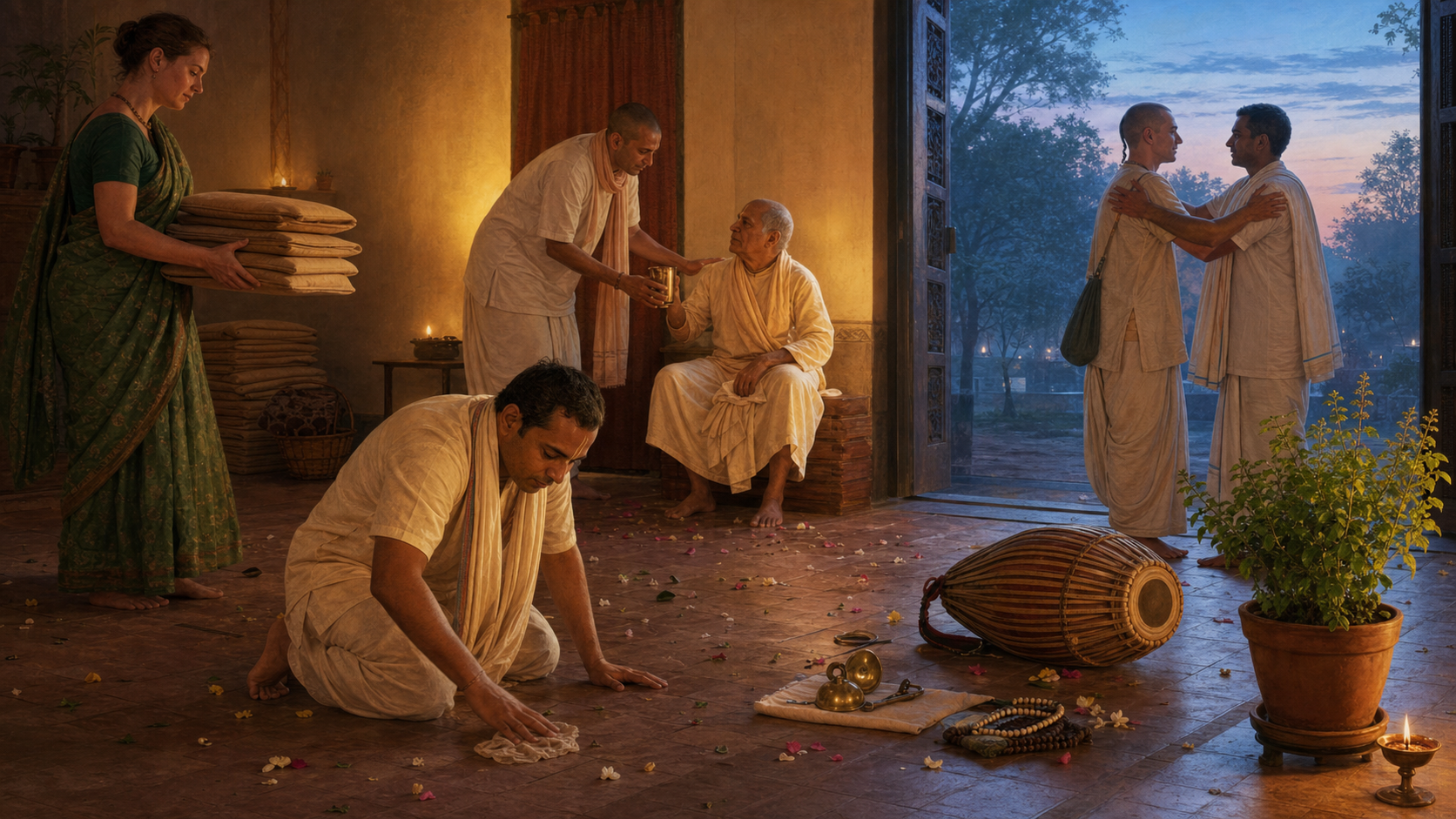
Held on 14 February 2026 in Naperville, HG Urmila Mataji’s seminar unpacked Vaiṣṇava etiquette as a practical, textually grounded path to stronger community life. Centering on respect, forbearance, and patience, the session translated timeless virtues into clear behaviors for meetings, digital spaces, and daily service. Participants learned conflict-resolution steps that honor truth without sacrificing kindness,…
-
In Memoriam: Ekanatha Das’s Profound Humility and the Timeless Guru–Shishya Ethos

This in memoriam reflection on Ekanatha Das examines a formative devotional episode in Bombay to unpack the difference between authentic humility and performative self-negation. Drawing on the Bhagavad-gita’s “amanitvam adambhitvam” and the Gaudiya Vaishnava instruction “trinad api sunicena…,” it clarifies how humility matures as steady presence, gratitude, and service. The analysis situates the episode within…
-
Brahmā’s Joy, Kapila’s Descent: A Powerful, Unifying Study of Srimad-Bhāgavatam 3.24.11

Srimad-Bhāgavatam 3.24.11 marks the moment Brahmā, purified by worship, speaks to Kardama and Devahūti as the Supreme Lord prepares to descend as Kapila. The verse frames avatāra as purposeful revelation and grounds understanding in devotion, anticipating Kapila’s theistic Sāṅkhya. Connected to Bhagavad-gītā Chapter 4—especially 4.9 (“janma karma ca me divyam”)—it teaches that properly understood divine…