-
Beyond Chanting Alone: How Pancaratrika-vidhi Powers Bhagavad-vidhi in Kali-yuga

Many devotees wonder whether chanting alone suffices in Kali-yuga or whether the formal Pancharatra tradition remains essential. This analysis clarifies the complementary roles of Pancaratrika-vidhi (regulated Deity worship) and Bhagavad-vidhi (the Bhagavata’s path of hearing and chanting) as taught in ISKCON and Gaudiya Vaishnavism. It explains how Pancharatra codes purify and qualify the practitioner so…
-
Why Sri Krishna Is Called Murari: Puranic Sources, Ekadashi Origins, and Inner Triumph

Murari—literally “foe of Mura”—is a precise Sanskrit epithet of Sri Krishna grounded in the Puranas. The Bhagavata Purana narrates Krishna’s defeat of the asura’s general Mura at Pragjyotisha, while allied strands in the Vishnu Purana and Harivamsha confirm the theme. The Padma Purana adds a complementary arc by linking Mura’s fall to the origin of…
-
Shiva as Shava Beneath Kali’s Feet: Decoding the Cosmic Union of Consciousness and Shakti

This essay decodes the renowned icon of Mother Kali standing upon Lord Shiva as a precise visual theology of consciousness and energy. It integrates insights from Shaktism, Shaivism, Tantra, Advaita Vedanta, and Kashmir Shaivism to clarify why the image symbolizes complementarity, not domination. Readers gain a technical understanding of the śava–śiva pun, the role of…
-
Kaudi Mata of Varanasi: The Sacred Sister South Indians Visit to Complete the Kashi Yatra

Kaudi Mata of Varanasi is venerated in living tradition as a compassionate “divine sister” whose modest shrine teaches universal equality in Kashi. Many South Indian pilgrims include her darshan to feel their Kashi Yatra is truly complete, complementing visits to Kashi Vishvanath, Annapurna, Vishalakshi, and Kalabhairava. The shrine’s simplicity — a brief archana with kumkum,…
-
Beyond Crisis Prayers: Kabir’s Smaraṇa and the Dharmic Science of Constant Remembrance

Kabir’s doha captures a universal tendency: many remember the Divine only in hardship. This article presents smaraṇa as a rigorous, unbroken discipline that stabilizes attention and ethics across both adversity and prosperity. Drawing from Hindu bhakti, Buddhist mindfulness, Jain samayik and pratikraman, and Sikh simran, it outlines a shared dharmic science of remembrance. It explains…
-
Beyond Self-Help: Ashtavakra Gita’s Radical Path to Effortless Freedom and Peace

In a culture obsessed with optimization, the Ashtavakra Gita advances a precise Advaita Vedanta insight: liberation is recognition, not improvement. The text dismantles the self-help treadmill by distinguishing instrumental refinement of the mind from Self-realization, which rests on witness-consciousness and non-doership. Practical contemplations—neti neti, seer-seen discernment, resting as awareness—integrate easily into daily life without breeding…
-
Yogic Vision of Narayana: A Transformative Guide to Dhyana, Unity, and Srimad Bhagvatam 3.15.45

The exposition on Srimad Bhagvatam 3.15.45 at ISKCON Indore presents the divine form of Narayana as a real and transformative focus for meditation. It frames true yoga as disciplined mental absorption—dharana and dhyana—upon the Supreme dwelling in the heart. The narrative of Vaikuntha and Narayana’s four-armed iconography provides a precise meditative support, aligning with classical…
-
Unshakable Equanimity in Srimad Bhagavatam 11.2.49: Suffering, Divine Memory, and Practice

Śrīmad-Bhāgavatam 11.2.49 offers a precise map of suffering across body, prāṇa, mind, intelligence, and senses, and pairs it with a single remedy: steady remembrance of the Divine. This analysis explains how that remembrance stabilizes attention, recalibrates desire, and transforms reactivity into equanimity. Practical guidance shows how to translate the verse into daily anchors—japa, prāṇāyāma, curated…
-
Unveiling Dharma Sastha: Profound Yogic Symbolism in Ayyappa’s Idol for Deep Meditation

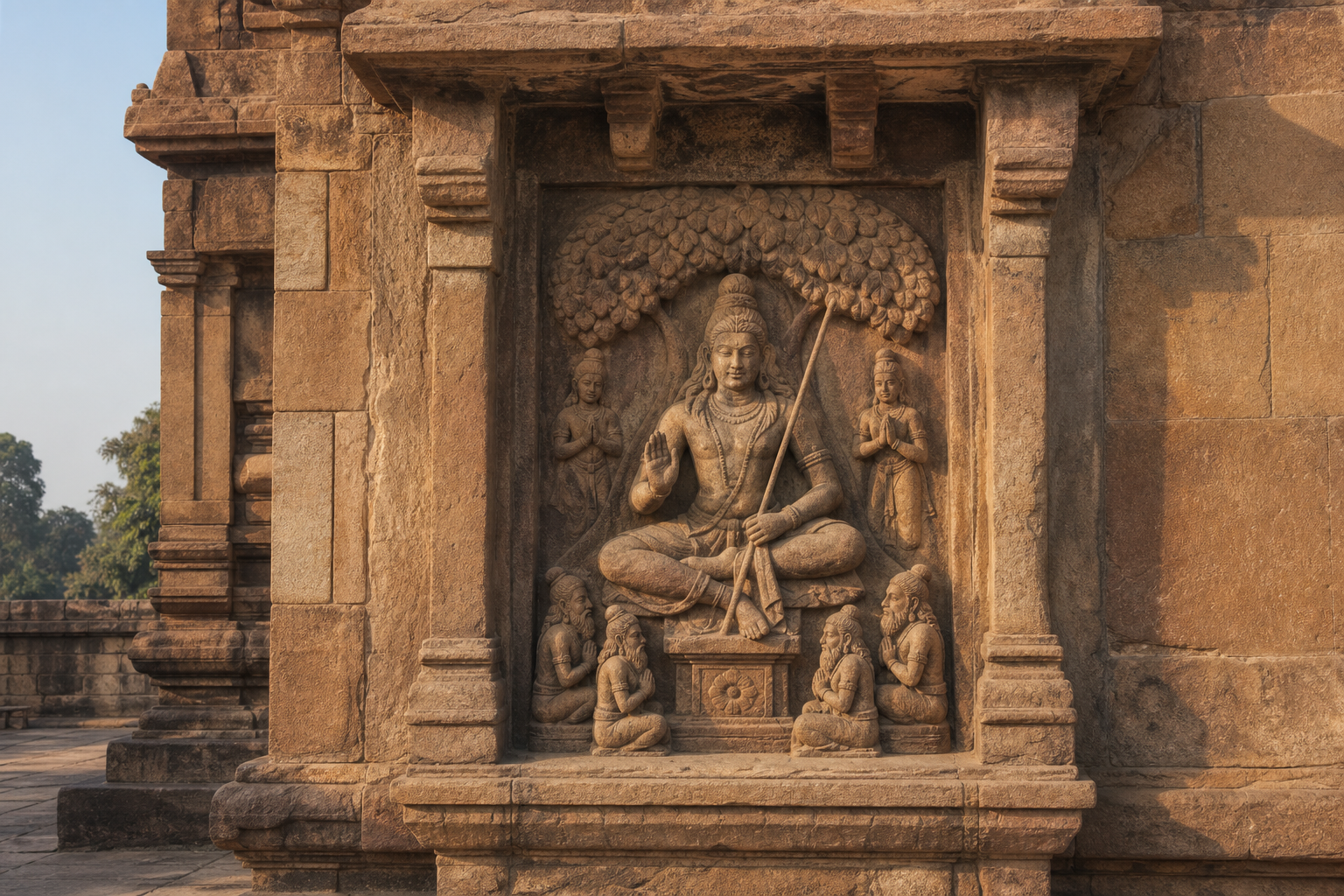
Dharma Sastha, the yogic manifestation of Ayyappa, functions as a complete visual pedagogy of dharma and meditation. The yogapatta—binding the knees in yogapattasana—symbolizes ethical restraint and embodied stability, enabling pratyahara, dharana, and dhyana. Mudras such as jnana-mudra and varada-mudra communicate the union of self with the Absolute and the compassionate bestowal of knowledge. Read through…
-
Ashtanga vs Panchanga Namaskara: Decode the Sacred Bows for Devotion, Alignment, and Safety

This in-depth guide distinguishes Ashtanga Namaskara (eight-limbed) from Panchanga Namaskara (five-limbed) with precise technique, symbolism, and practical guidance for temple and home worship. Readers learn safe alignment grounded in yogic anatomy, step-by-step instructions, and breath cues that integrate devotion with mindful movement. The article clarifies regional variations and etiquette, including when temples prefer Panchanga for…
-
Unshakable Calm in Life’s Storms: Vedantic Truth and Dharmic Resilience Across Traditions

This essay examines the adage, “Storms will be ever present in life, and the best anchor is knowledge of Supreme Truth,” through Hindu philosophy and related dharmic traditions. It clarifies how Advaita Vedanta, the Upanishads, the Bhagavad Gita, Buddhism, Jainism, and Sikhism converge on a practical, verifiable path from instability to resilience. Readers gain a…
-
February 28, 2026 Panchang: Shukla Dwadashi to Trayodashi, Auspicious Times, Nakshatra, Rashi Guide

Saturday, February 28, 2026 carries Shukla Paksha Dwadashi until 8:04 PM, then transitions to Shukla Paksha Trayodashi. This Panchang guidance explains what that means for vratas, temple routines, and daily worship across regions. It outlines technical tithi foundations (12° lunar elongation per tithi) and shows how to compute location-specific auspicious windows using Brahma Muhurta, Abhijit…
-
Decoding the Charchika Mudra: Chamunda’s Fearless Iconography and the Science of Inner Purification

The Charchika Mudra—Chamunda cleaning her teeth with the left little finger—condenses a complete Shakta theology of protection and purification into one subtle gesture. Read against the Devi Mahatmyam and Shakta iconography, it signifies post-conflict cleansing, non-attachment to the taste of violence, and disciplined speech and appetite. Jackals, cremation ground, and skull garlands frame a fearless…
-
Child Kali on Maa Sarada’s Lap: Decoding Ramakrishna’s Vision of Fierce Grace and Love

This essay decodes a powerful Hindu symbol: Child Goddess Kali seated on the lap of Maa Sharda as Sri Ramakrishna brings food. It situates the scene within Sanatana Dharma, Shakta Tantra, and Bengal’s devotional culture, showing how fierceness softens into maternal grace through seva. Drawing on Ramakrishna’s life—especially the Shodashi Puja to Sarada Devi—it interprets…
-
Beyond Blind Chance: A Dharmic Inquiry into Evolution, Consciousness, and Life’s Purpose

This article examines two assumptions often attached to evolution: that life’s diversity is driven entirely by chance and law, and that consciousness is reducible to chemistry. It distinguishes well-supported evolutionary mechanisms from the still-open questions of abiogenesis, emphasizing that conflating them obscures both scientific strengths and genuine uncertainties. It then surveys leading origin-of-life hypotheses and…
-
When Sacred Sound Met the Beatles: Srila Prabhupada’s 1969 Kirtan at Tittenhurst Park

In September 1969 at Tittenhurst Park, Srila Prabhupada brought rigorous bhakti practice into dialogue with leading artists of the age. This article reconstructs that setting and examines chanting — kirtan and japa — as a precise method for liberation within Gaudiya Vaishnavism. It explains how sacred sound functions theologically and technically, from breath mechanics and…
-
Why Devotional Focus Suddenly Turns Sensual—and Science-Backed Ways to Steady the Mind

Devotional focus can collapse into sensual distraction with surprising speed because material desire functions like a gravitational pull on attention. Classical frameworks from Hinduism, Buddhism, Jainism, and Sikhism explain this shift through gunas, kleshas, hindrances, and the five thieves, while neuroscience highlights cue-driven reward predictions and attentional capture. A practical, evidence-aligned toolkit helps steady the…
-
Protecting Energy Without Guilt: Science-Backed Boundaries for Dharmic Compassion

Protecting energy is not selfish; it is a compassionate response to finite human capacity. Drawing on burnout science, allostatic load, and polyvagal-informed insights, this article explains why social withdrawal often reflects physiological triage rather than indifference. It reframes boundaries as conditions for sustainable compassion, aligning evidence with dharmic principles such as prana, ahimsa, metta, aparigraha,…
-
Navagvas and Dāśagvas in Hinduism: Angiras Lineage, Vedic Timekeeping, Ritual Mastery

This study explains why Navagvas and Dāśagvas matter in Hinduism by situating them within the Angiras lineage and the Rigvedic ritual world. It clarifies how these names encode nine‑ and ten‑month attainments in year‑long sattras (Sattrayāga), while noting alternative scholarly views that treat them as Angirasa group designations. Readers gain a clear overview of Vedic…
-
Manikarnika: Sacred Symbolism of Parvati’s Meditative Devotion and the Shiva–Shakti Union

Manikarnika presents Goddess Parvati in her meditative, devotional form, revealing how Bhakti, Dhyana, and Tapas interweave in Shaiva–Shakta symbolism. Rooted in Kashi’s sacred landscape and reflected in the Skanda Purana’s Kashi Khanda, this vision situates the Goddess as both Shakti and the supreme devotee of Shiva. The article explores etymology, sacred geography, and iconography, then…