

Bhakti becomes transcendent not when religious emotion becomes more dramatic, but when the relationship with the Divine is no longer governed by exchange. Read together, the two source essays locate this transformation in a reciprocal movement: the Divine crosses the distance created by majesty and protocol, while the devotee crosses the boundaries imposed by desire, self-reliance, and ego.
This synthesis clarifies how Vaishnava narrative and Upanishadic contemplation illuminate one another. The stories of Gajendra and Pundalik show what divine accessibility looks like; the Gopāla-pūrva-tāpanī Upanishad, as presented by the second source, explains the inward discipline through which devotion ceases to be transactional and becomes liberating.
Key takeaways
- Transcendent bhakti relinquishes claims upon both worldly success and heavenly reward.
- Renunciation and concentrated absorption belong together: one releases competing desires, while the other gathers attention around the Divine.
- The Gajendra and Pundalik traditions portray divine freedom in contrasting ways: Vishnu rushes to the helpless devotee but willingly waits for the devotee faithfully performing service.
- Ritual, sacred images, mantras, and inherited forms remain valuable, but their purpose is to cultivate surrender, attention, humility, and ethical action rather than spiritual entitlement.
Transcendence begins where spiritual bargaining ends
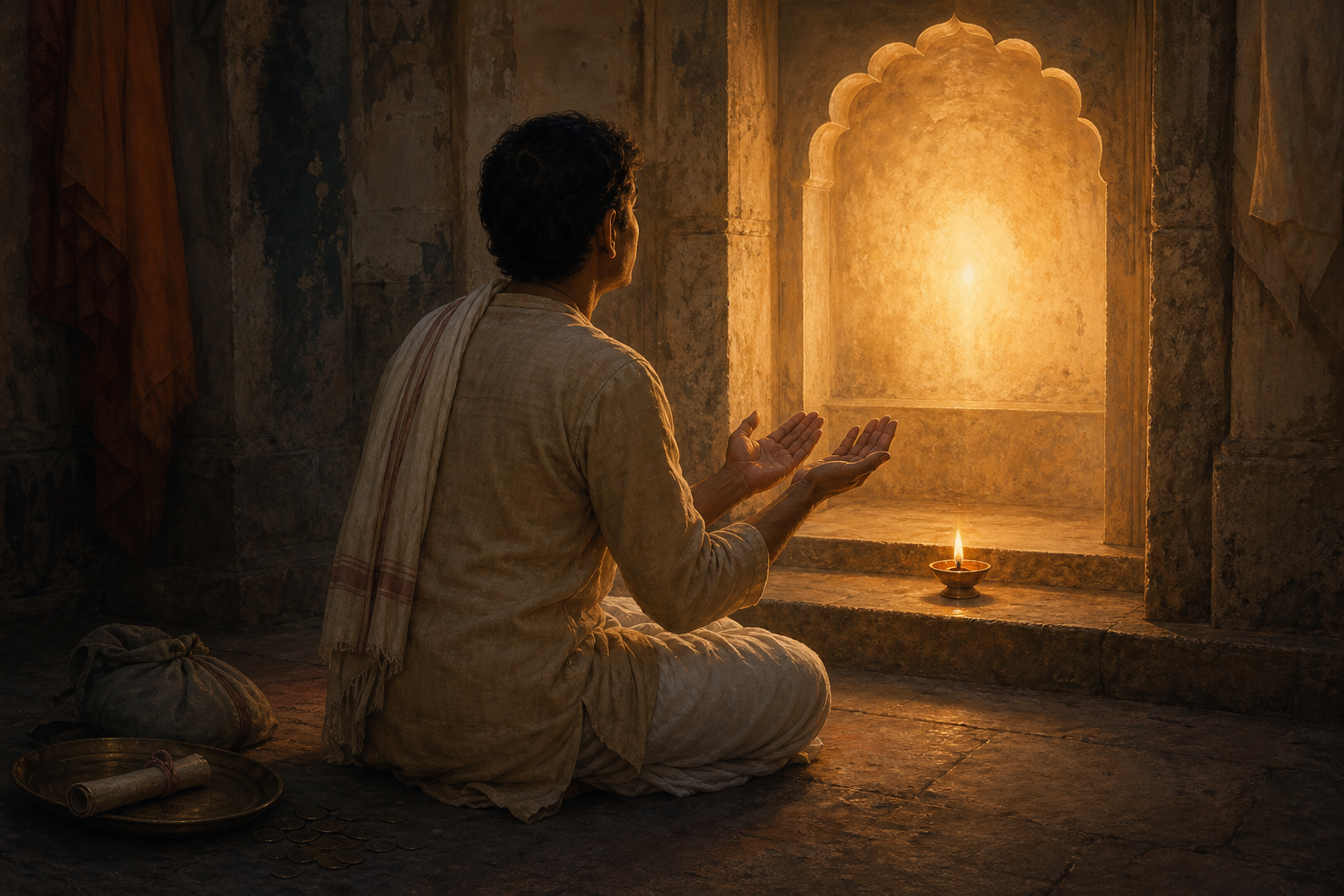
The Upanishad-focused source defines mature bhakti through two inseparable commitments: renunciation of rewards available in this world, or iha, and renunciation of rewards imagined in another world, or amutra. The distinction matters because religious desire can survive the abandonment of ordinary ambition. A person may cease seeking wealth or status yet continue treating devotion as a way to accumulate merit, secure heaven, or guarantee a preferred spiritual result.
Renouncing both categories does not mean refusing life, duty, or hope. In the source’s account, it means ending the attempt to make the Divine an instrument of acquisition. Bhakti consequently moves from transaction to participation. The same article relates the word to the Sanskrit root bhaj, meaning to share or participate, and presents devotion as a reorientation of the person’s center of gravity from the demands of the ego toward the plenitude of the Supreme.
The legend-focused source approaches the same transformation from the other direction. Its narratives emphasize that grace is not held back until the devotee possesses the proper status, strength, or ceremonial apparatus. Taken together, the sources dismantle both sides of a spiritual bargain: the devotee cannot purchase divine presence through desired fruits, and divine compassion is not restricted to those who appear religiously self-sufficient. Transcendent devotion is therefore neither a payment nor a prize. It is a relationship liberated from calculation.
Divine freedom appears as both urgency and patience
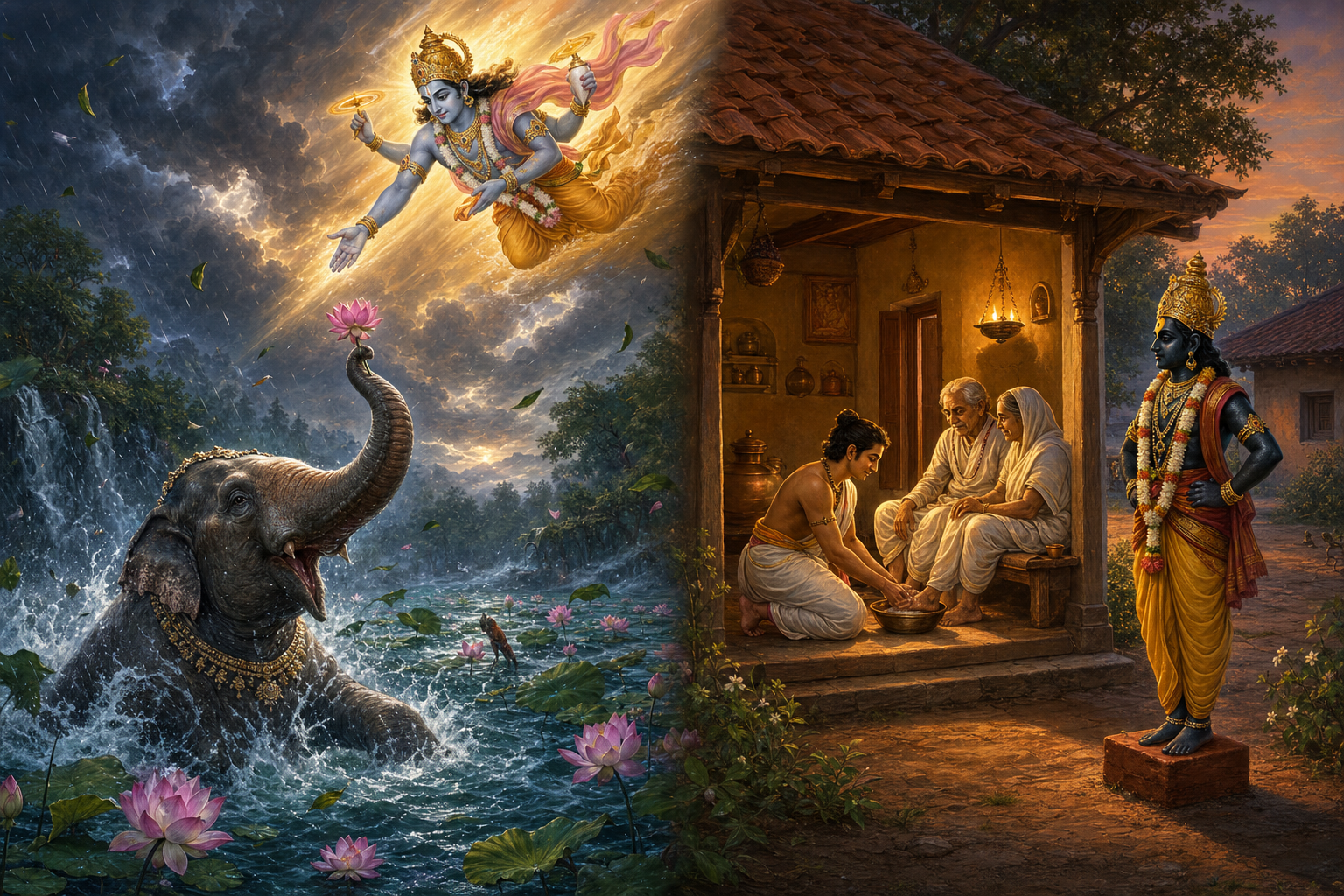
The Gajendra and Pundalik traditions give this freedom two seemingly opposite forms. In the account discussed by the first source, Gajendra, the elephant king, is caught by a crocodile in a lake at Trikuta. After his own strength has failed, he addresses the Supreme, and Vishnu comes to his aid. The article carefully distinguishes textual narration from devotional amplification: it reports that common recensions of the Bhagavata Purana have Vishnu mount Garuda, while oral exposition and temple storytelling may emphasize that the Lord did not wait for vehicle, ornaments, or attendants.
The expression that Vishnu left Garuda behind should therefore be read as bhakti poetry rather than as a correction of the scriptural account. Its concern is the velocity of compassion. Garuda signifies extraordinary speed, sacred knowledge, and disciplined service, yet even these exalted qualities cannot set the timetable of grace when helpless surrender calls forth an immediate response.
The Pundalik tradition reverses the tempo. As reported by the same source, Vishnu-Krishna arrives while Pundalik is serving his parents. Pundalik asks the Lord to wait and offers a brick on which to stand; the form of Vithoba at Pandharpur, standing upon a brick with hands on hips, preserves the theological meaning of that encounter. Here the Divine does not hurry the devotee away from human duty. The Lord accepts a place within the devotee’s time because sincere service is itself an expression of devotion.
Urgency and patience are not contradictory in these stories. Both reveal a sovereignty unconstrained by ceremonial hierarchy. Vishnu rushes when vulnerability requires rescue and waits when fidelity requires steady service. The decisive element is not speed but responsiveness to the devotee’s actual condition. Bhakti transcends protocol without devaluing dharma.
Devotion trains attention as well as affection
The narrative tradition explains divine responsiveness, but it does not by itself provide a complete account of the devotee’s interior formation. The Gopāla-pūrva-tāpanī discussion supplies that dimension through ekāgratā, the gathering of attention into a single focus upon the Supreme Self, identified in the text as Gopāla Krishna. Renunciation clears the field of rival claims; absorption gives the released mind a stable orientation.
This makes bhakti more exacting than intermittent emotion. According to the source, its contemplative environment includes śravaṇa, listening to revealed wisdom; manana, sustained inquiry; and nididhyāsana, deep meditation. Mantra, japa, upāsanā, and dhyāna support concentration by repeatedly returning the mind to its chosen center. Their significance lies not merely in repetition but in the quality of attention they cultivate.
From this perspective, renunciation without absorption could become emptiness or suppression, while absorption without renunciation could leave spiritual practice serving unexamined ambitions. Their union produces ananya-bhakti: devotion in which no competing object of ultimate dependence remains. This is how affection becomes a path of self-transcendence rather than another possession of the self.
The source also resists treating bhakti, knowledge, and yoga as mutually exclusive paths. Discernment exposes the instability of desired fruits, contemplative discipline steadies the mind, and devotion directs both toward the Supreme. In its reading, personal devotion to Krishna and the Upanishadic search for ultimate reality can consequently meet in one practice. Love does not displace knowledge; it gives knowledge an existential center. Concentration does not cool devotion; it protects devotion from dispersion.
Forms matter, but transformation remains the test
Neither source requires a choice between inward devotion and religious form. The first emphasizes Garuda’s continuing dignity as Vishnu’s vahana and exemplary servant. It also points to Garuda Seva at Srirangam and Tirumala as a ritual expression of divine protection, scriptural wisdom, and majestic presence. The second treats mantra and contemplative practice as real supports for steadiness. Sacred forms are therefore not discarded when bhakti transcends ritualism; they are released from the burden of functioning as spiritual currency.
The motif called the sorrow of Garuda makes this distinction especially clear. As the first source interprets it, Garuda’s response is not jealous resentment because another devotee has received the Lord’s attention. It is humility before a compassion swifter than even his wings. The vahana is elevated, rather than diminished, when service becomes free of possessiveness. Garuda can delight in grace that does not center him.
The Upanishadic account supplies an ethical measure for the same freedom. It associates devotion purified of reward-seeking with compassion, truthfulness, non-violence, and service. These qualities are not decorative additions to mystical experience. They indicate whether absorption has actually weakened egoic demand. Pundalik’s filial service reinforces the point narratively: attention to God need not compete with responsible care when duty itself has ceased to be an instrument of self-display.
A practical reading of the sources therefore asks what religious practice is producing. Ritual that intensifies entitlement, meditation organized around achievement, or service leveraged for identity remains tied to exchange. Practice matures as motives become less possessive, attention less scattered, and conduct more responsive to others. This criterion also guards against confusing emotional intensity with spiritual depth.
Bhakti’s continuing relevance will depend on preserving this union of form and freedom. Temples, stories, study, mantra, and disciplined remembrance can carry devotion across generations, while renunciation keeps those inheritances from becoming instruments of status. Where attention deepens into service and surrender loosens the demand for reward, transcendent devotion can remain both contemplatively rigorous and fully present within ordinary life.

References
- DharmaRenaissance Blog — When Vishnu Left Garuda Behind: Two Bhakti Legends Where Love Outran the Vahana
- DharmaRenaissance Blog — Bhakti Beyond Ritual: Renunciation and Absorption in the Gopalapurvatapani Upanishad