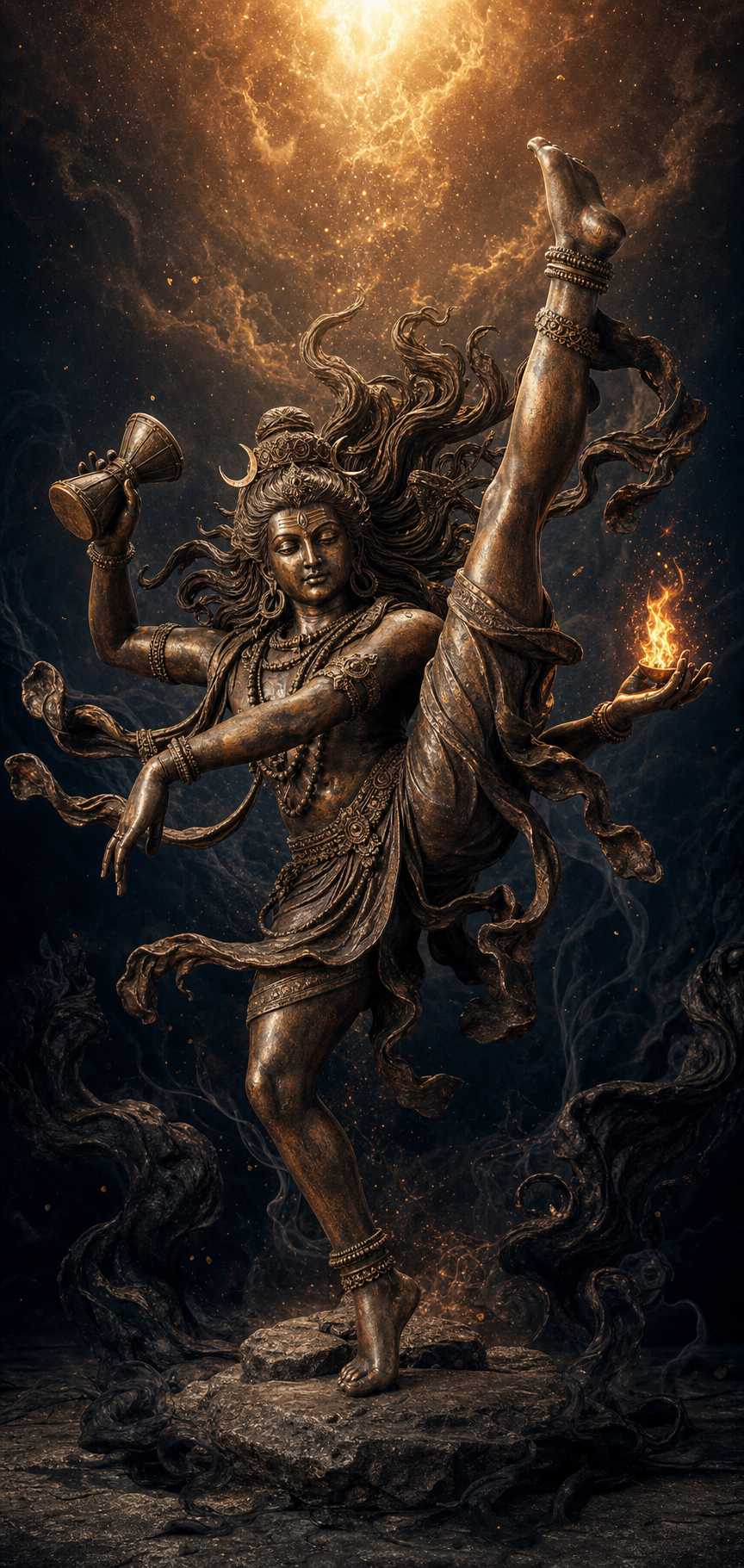
Urdhva Tandava asks the eye to hold two movements together: Shiva is firmly grounded, yet decisively rising. The posture is therefore more than a feat of balance. It presents spiritual ascent as a transformation of embodied life rather than a flight from it.
The DharmaRenaissance account brings iconography, Shaiva cosmology, South Indian sacred narrative, performance, ritual, and yogic interpretation into one frame. Read together, these layers show how the dance turns a vertical gesture into a theology of grace, disciplined awareness, and freedom from forgetfulness.
A vertical composition grounded in awareness
As the source explains, urdhva means upward or raised, while tandava denotes Shiva’s dynamic and forceful dance. The name identifies the image’s most conspicuous feature, but the significance of the raised leg becomes clear only in relation to the rest of the composition.
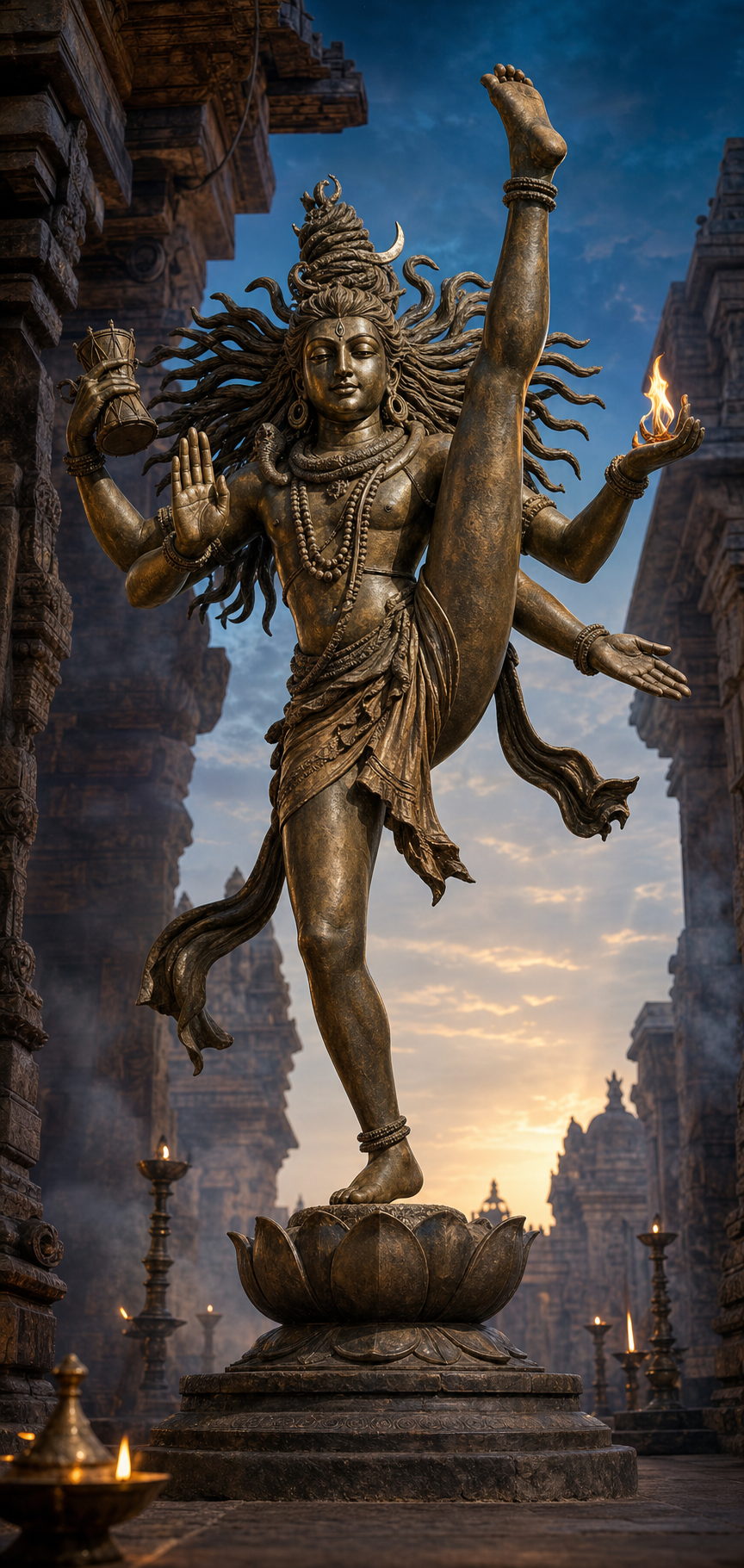
The source describes a recurring visual grammar: one foot rests upon Apasmara, the dwarf associated with ignorance or forgetfulness, while the other rises in a high vertical arc. Shiva’s torso may form a graceful tribhanga curve, the matted locks fly outward, and the face remains composed despite the intensity of the movement. Apasmara, also identified in the article as Muyalaka in Tamil sources, is subdued rather than treated as a symbol of life being destroyed.
This arrangement makes balance part of the teaching. The grounded foot represents the stabilization of awareness where spiritual amnesia once prevailed; the elevated foot opens a direction beyond that limitation. The serene expression prevents ascent from being mistaken for agitation or ambition. Stillness and movement are not competing states here: composure makes the upward movement possible.
The image can consequently be read from the ground upward. Forgetfulness is first recognized and restrained, awareness becomes steady, and only then does the composition direct attention toward liberation. The lifted foot never detaches the figure from the world below, so transcendence remains joined to presence.
Creation, dissolution, and grace share one rhythm
Within the source’s Shaiva Siddhanta and related Agamic framing, Nataraja’s dance embodies the five cosmic acts: srishti, or emanation; sthiti, sustenance; samhara, withdrawal; tirobhava, veiling; and anugraha, grace. The article associates Urdhva Tandava especially with grace because the movement reorients the individual being, or jiva, toward freedom.
That emphasis changes the meaning of ascent. It is not simply a self-powered conquest in which the practitioner climbs through will alone. The upward movement arises where divine initiative, disciplined attention, and the removal of ignorance meet. Grace does not bypass the grounded foot; it works through the newly stabilized awareness that the foot signifies.
The accompanying emblems extend this logic. In the source’s interpretation, the damaru expresses the primal vibration that initiates and measures time, while agni signifies transformative dissolution. The abhaya gesture offers fearlessness, and a pointing or sweeping hand may guide the devotee’s gaze toward the elevated foot. The surrounding circle of flame, when present, represents the cyclic world clarified and transmuted through insight.
The source also notes regional variation. Additional hands may carry a trident, a deer associated with the restless mind, or other Shaiva attributes. The crescent moon, Ganga, and serpents placed among the locks are interpreted in relation to time, purification, and awakened energy. These features are best approached as an interacting symbolic vocabulary rather than a rigid checklist: their force lies in the relationship between creation and dissolution, fearlessness and instability, grounding and release.
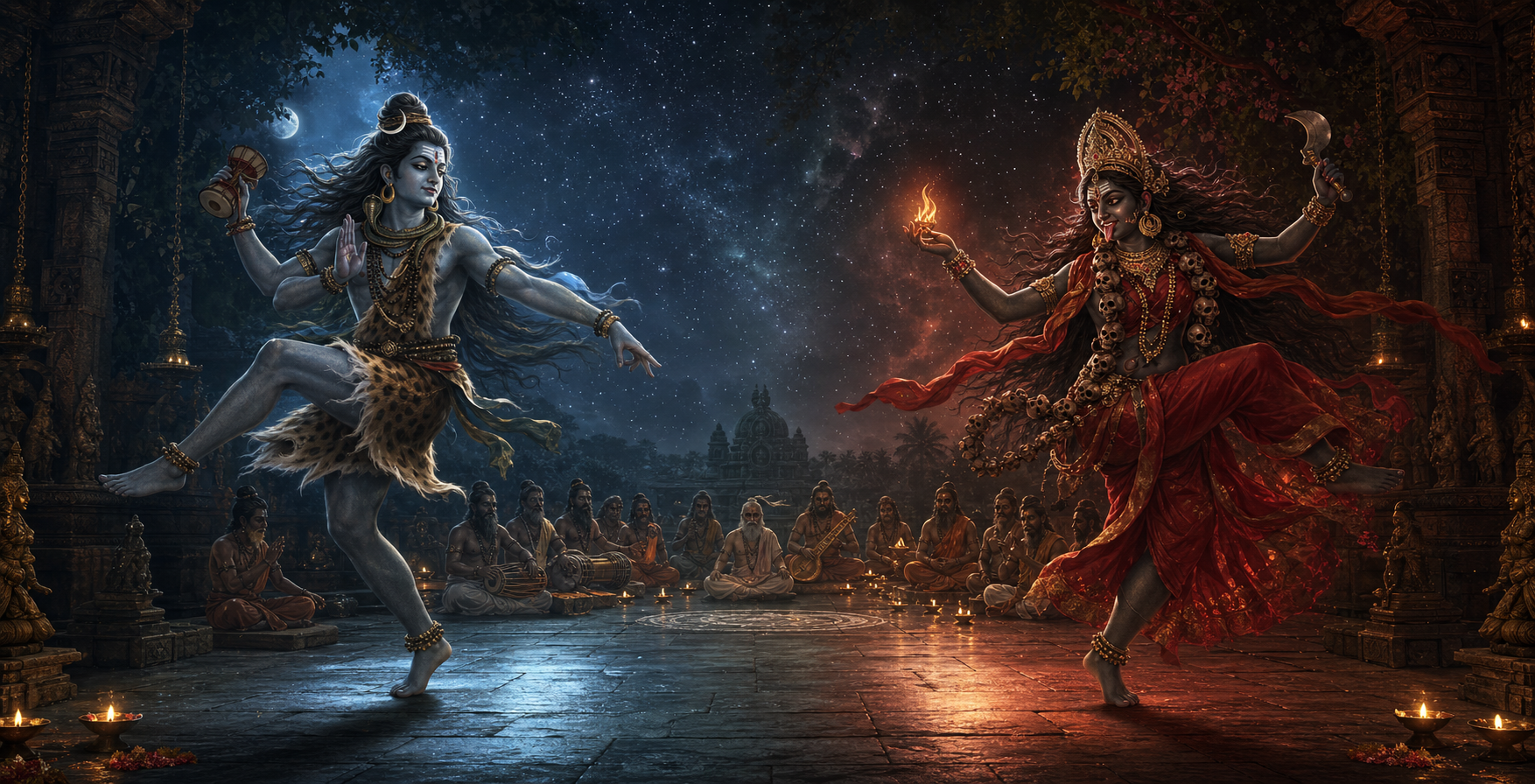
The Shiva-Kali encounter is richer than a contest
The source situates the sacred lore of the upward leg within the landscape of Chidambaram and refers to South Indian narrative traditions involving a dance encounter between Shiva and Kali. It argues against reducing this episode to Shiva’s victory over Shakti. Such a winner-and-loser interpretation would make the raised leg an emblem of superiority and obscure the wider metaphysical relationship being dramatized.
In the article’s preferred reading, Shiva and Kali represent complementary principles: consciousness and energy. Their encounter reveals the tension of apparent duality, while the upward gesture points beyond egoic competition toward a more integrated condition. The movement is thus not only higher in a spatial sense; it raises the meaning of the episode beyond rivalry.
This reading also clarifies why the source discusses Urdhva Tandava alongside Ananda Tandava, Shiva’s blissful dance. Ascent and bliss need not be separate destinations. When energy is no longer organized around contest and contraction, its upward movement can become an expression of freedom rather than striving.
A distinction nevertheless matters: the source provides an interpretive framework, not a comparative survey of every regional version of the narrative. Its non-dual reading is therefore most useful as a way of understanding the theological possibilities of the scene, rather than as proof that all communities or artistic traditions explain it identically.
From temple image to embodied discipline
The source proposes a yogic reading in which the upward gesture corresponds to kundalini rising through the sushumna nadi. It connects the image with the refinement of prana, sometimes expressed as urdhva-retas, and with the movement of attention from muladhara toward sahasrara. Concentration and meditation, identified as dharana and dhyana, supply the interior discipline behind this ascent.
This is best understood as a contemplative analogy, not as a claim that a sculpture is a literal anatomical chart. The posture gives visible form to an inward process: scattered energy is collected, attention is aligned, and habitual reaction is transformed into deliberate response. The external image becomes useful precisely because it makes an otherwise invisible reorientation imaginable.
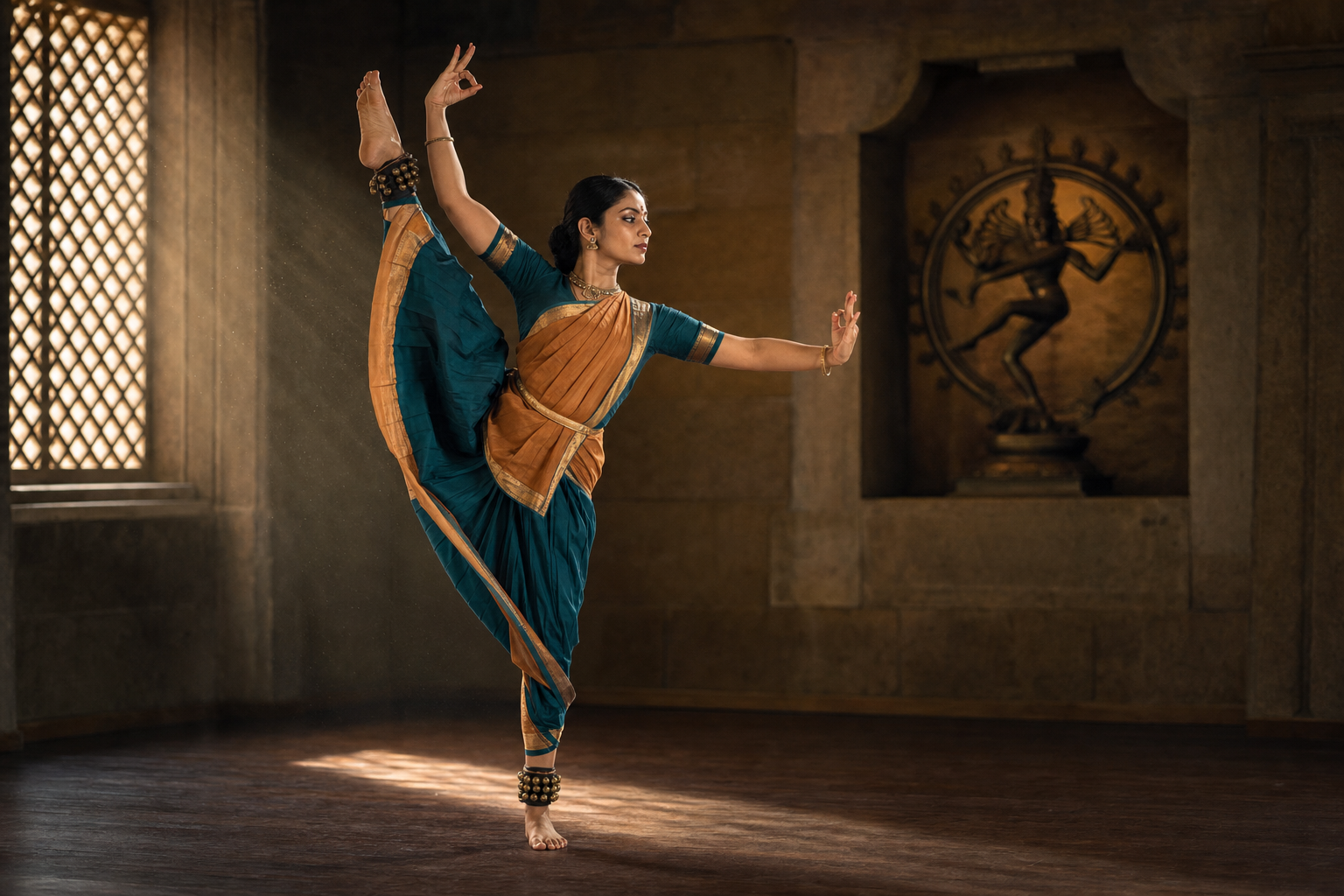
Performance provides another bridge between image and experience. The article invokes the Natyashastra‘s 108 karanas as part of the movement grammar underlying Shiva’s dance iconography and highlights Bharatanatyam as a setting in which an upward leg, controlled breath, balance, and drishti can give bodily expression to the idea of ascent. The dancer does not merely illustrate a doctrine; disciplined movement tests whether energy and composure can coexist.
The material and ritual settings add further dimensions. The source points to Chola bronzes of Tamilakam and to images associated with Chidambaram, Thanjavur, Kumbakonam, and other centres, noting variations in attributes, hand positions, and the angle of the raised leg. It also connects the dance with Arudra Darshan, or Tiruvathirai, when adornment, recitation, lamps, percussion, and abhishekam intensify the encounter with Shiva’s cosmic movement.
For personal contemplation, the source suggests visualizing the lifted foot as an invitation to move beyond habitual patterns, coordinating the breath with an imagined damaru rhythm, and using the transforming fire of agni as an image for refining intention. It also mentions Om Namah Shivaya, a steady posture, and relaxed attention near the heart or anahata region. These practices concern the direction of attention; they do not require physically imitating the icon’s extreme leg position.
The article finally proposes resonances with other Dharmic critiques of constricted identity, comparing Apasmara’s ignorance with Buddhist attention to clinging, Jain commitments to restraint and right knowledge, and the Sikh challenge to haumai. Such comparisons are most illuminating when treated as ethical parallels rather than assertions that distinct traditions teach identical doctrines.
Key takeaways
- Read the grounded and lifted feet together: stabilized awareness is the basis of ascent.
- Interpret the emblems relationally: the damaru and agni join emergence and dissolution within one rhythm.
- Recognize grace as central: the upward movement is not merely an achievement of individual will.
- Approach the Shiva-Kali encounter as a drama of complementary consciousness and energy, while allowing for other regional interpretations.
- Keep historical, performative, ritual, and yogic readings distinct enough to preserve their integrity, yet connected enough to reveal the image’s full range.
Future study can deepen this interpretation by comparing regional images, narrative variants, ritual settings, and performance lineages while continuing to distinguish documented artistic features from later contemplative applications.