
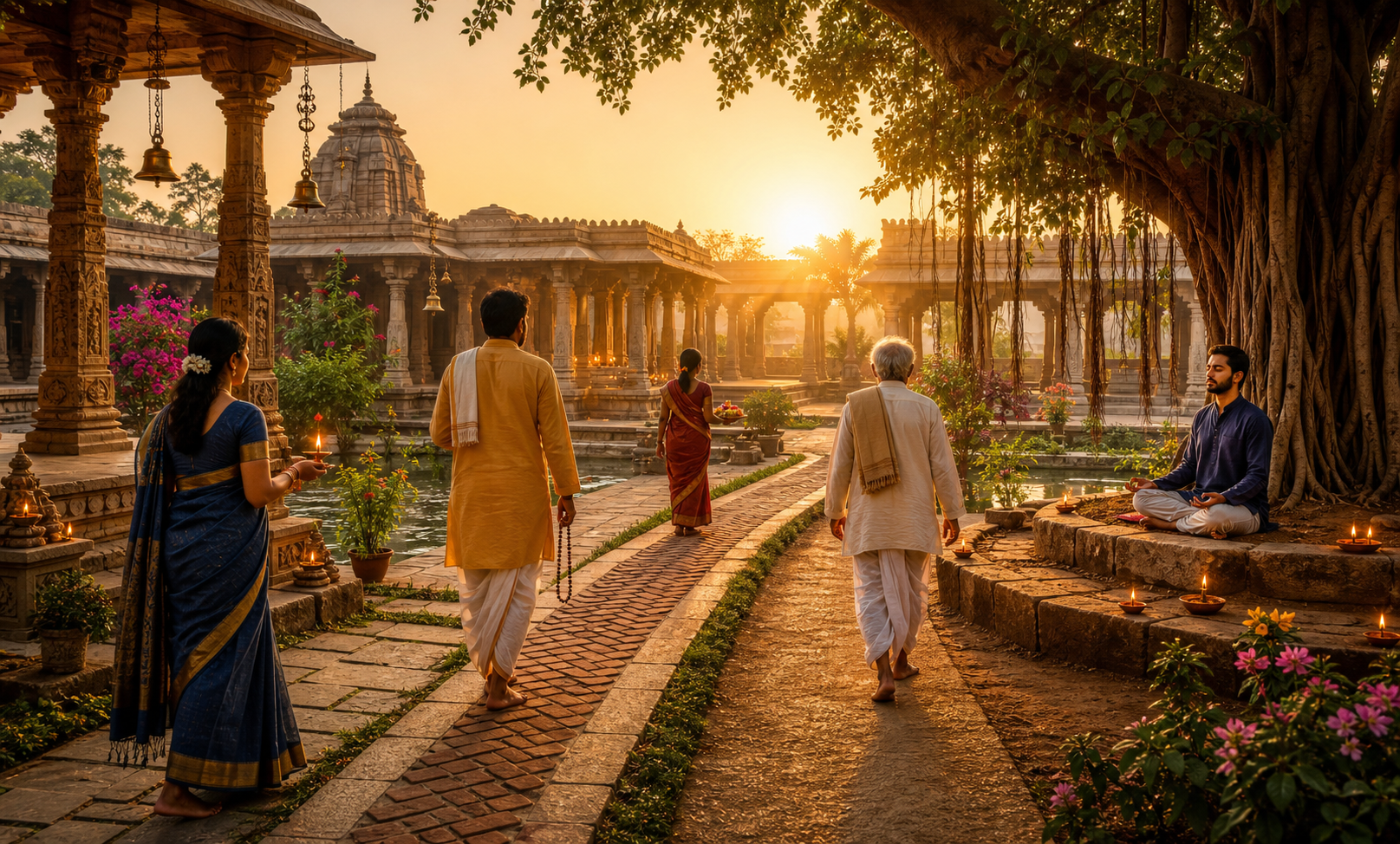
Sanatana Dharma’s pluralism is most clearly understood not as an abstract tolerance of competing beliefs, but as a framework for practicing commitment without demanding uniformity. A seeker can form a deep relationship with a chosen manifestation of the sacred while recognizing that other temperaments may require other forms, disciplines, and philosophical languages.
The two source articles approach this framework from different directions. One surveys Sanatana Dharma as a broad ecosystem of philosophy, scripture, ritual, ethics, and community life. The other examines gauni bhakti, especially the ordinary or mixed devotion through which spiritual life often begins. Read together, they show how civilizational pluralism becomes credible through daily remembrance, disciplined affection, and service.
Pluralism is an architecture of paths, not an absence of conviction
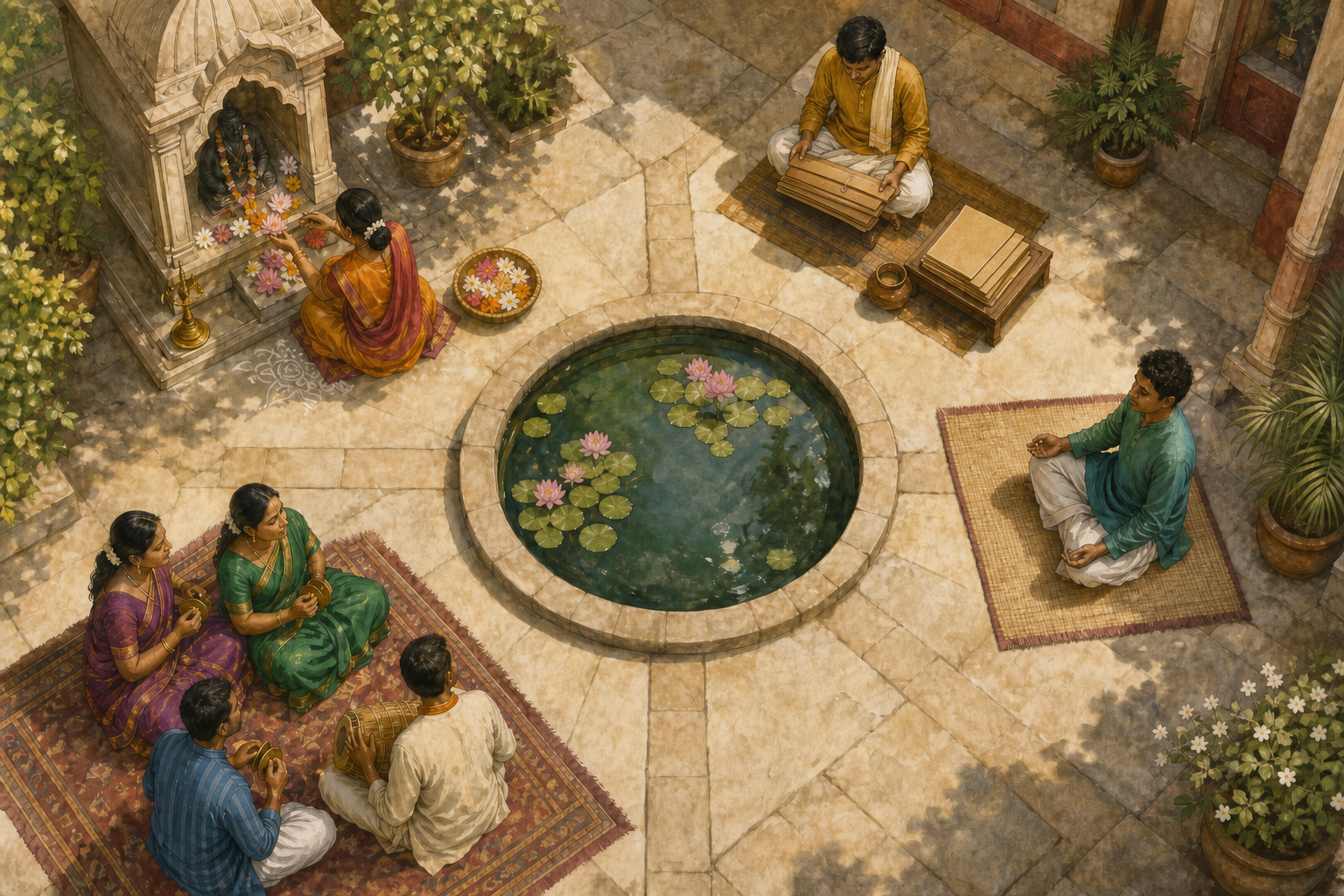
The article Sanatana Dharma as Living Wisdom presents Sanatana Dharma as a layered tradition rather than a single creed. It reports that Shruti, Smriti, the Agamas, and the Tantras serve different but interacting functions, from metaphysical inquiry to narrative, ritual, temple practice, and yogic discipline. It likewise describes the six classical darshanas as distinct lenses concerned with such subjects as logic, categories of existence, consciousness and matter, disciplined practice, ritual interpretation, and liberation.
This plurality does not imply that every proposition means the same thing. It establishes a culture in which disagreement can occur inside a larger search for truth and transformation. The source’s discussion of multiple pramanas, or means of knowledge, reinforces that point: perception, inference, reliable testimony, analogy, postulation, and non-cognition are presented as different resources for discernment. Reason, inherited teaching, and experience therefore need not be reduced to a single method.
Both source articles identify Ishta, the chosen focus of devotion, as the practical center of this pluralism. The wider survey says that a person may orient spiritual life toward Krishna, Shiva, Devi, formless Brahman, or Om. The gauni bhakti article adds an affective explanation: devotion becomes sustainable when its focus is congenial to the seeker’s temperament. A chosen form creates intimacy, but it need not become a boundary against other forms.
This distinction clarifies a frequently misunderstood feature of Hindu practice. Many divine names and forms need not indicate spiritual fragmentation. According to the first source, they can function as numerous approaches to an ultimate reality that exceeds any single representation. Pluralism, on this account, permits full participation in a particular lineage while discouraging contempt for another seeker’s path.
Everyday devotion is a beginning that can mature
The gauni bhakti article introduces an important terminological caution. It reports that gauna can mean secondary, derived, or indirect in Sanskrit hermeneutics and that some bhakti theologies use it for devotion mixed with karma, jnana, or personal aims. The same article also describes an experiential usage: the quiet devotional impulse embedded in ordinary life, such as remembrance, gratitude, reverence, and spontaneous care. These meanings should not be collapsed, but they can illuminate different stages of practice.
The theological meaning prevents romanticizing every religious emotion as complete realization. The experiential meaning prevents dismissing imperfect beginnings as worthless. As reported in the second source, the Bhagavad Gita’s four kinds of devotees include the distressed, the seeker of prosperity, the inquisitive, and the wise. The article interprets the first three as examples of devotion that may initially be entangled with need or curiosity. It contrasts such beginnings with the motiveless and unimpeded devotion praised in the Bhagavata Purana, while treating development between them as possible.
This makes gauni bhakti especially relevant to household life. A person may first pray because of fear, family custom, gratitude, or a practical hope. The decisive question is not whether the initial motive is already pure, but what repeated practice does to it. The second source argues that remembrance, worship, and service can gradually loosen self-regarding motives and cultivate steadier love.
The first source reaches a compatible conclusion from a broader perspective. It describes small household acts, including lighting a lamp, sharing prasad, reciting a verse, practicing japa, and performing seva, as ways of joining spiritual aspiration to the rhythm of daily responsibilities. Together, the articles present lived devotion as developmental: ordinary acts form attention, attention reshapes intention, and intention becomes visible in conduct.
Form, feeling, and discipline support one another
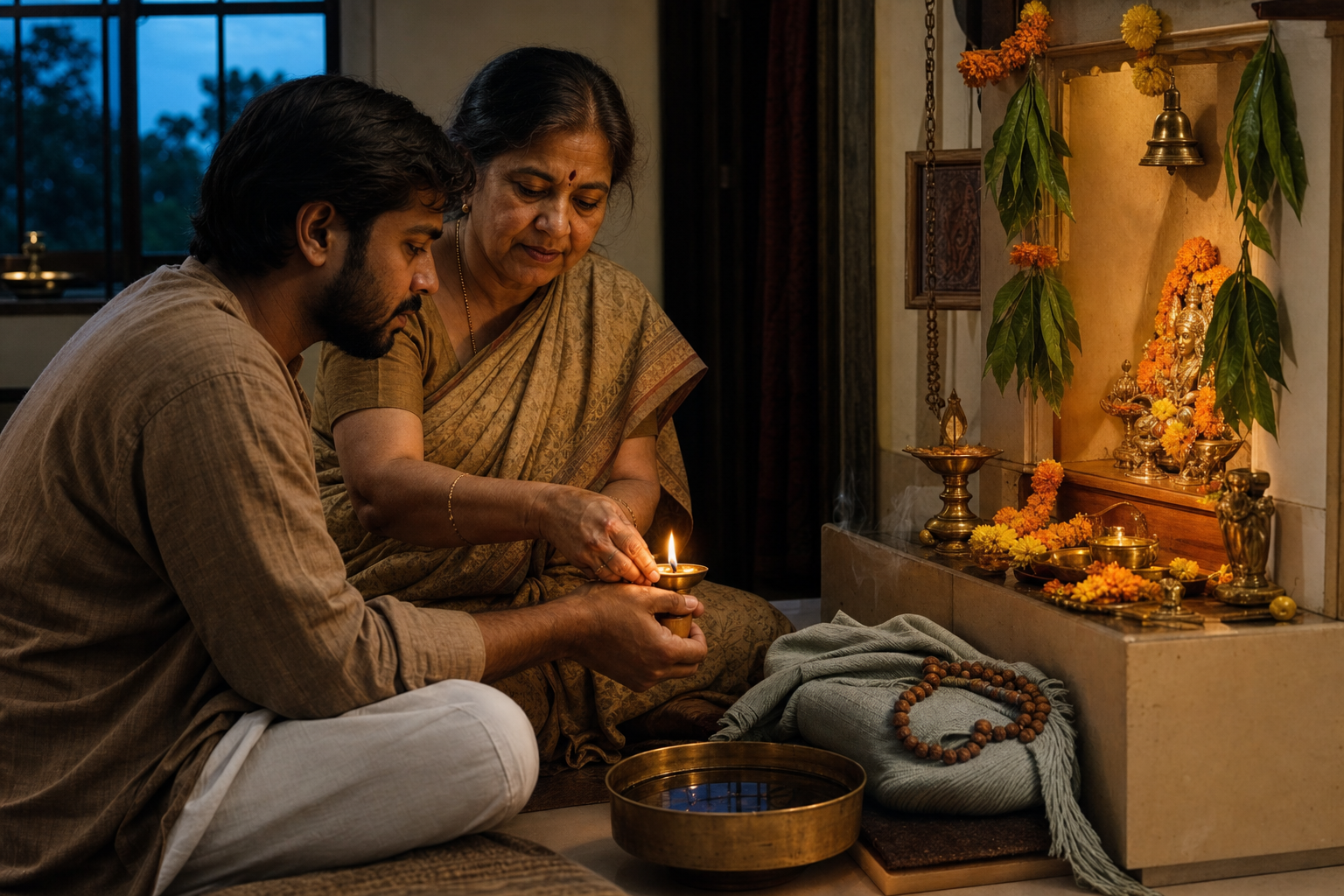
Plural practice is not necessarily casual practice. The first article relates bhakti to karma yoga, jnana yoga, and Raja or Ashtanga Yoga, arguing that practitioners commonly combine action, devotion, inquiry, and contemplative discipline according to capacity and context. The second source makes a parallel distinction between vaidhi-bhakti, sustained by guidance and regularity, and raganuga-bhakti, led more spontaneously by devotional attraction.
These accounts suggest that structure and spontaneity are complementary. A rule can protect practice during periods when emotion is weak; affection can keep a rule from becoming mechanical. The gauni bhakti article portrays disciplined practice as a possible foundation for growing taste and intimacy, not as a rival to heartfelt devotion.
The second source also uses the devotional rasas to explain how human feeling can be refined rather than suppressed. It associates peacefulness, service, friendship, parental tenderness, and intimate love with different relational orientations toward the Divine. Its examples place these orientations within ordinary settings: remembrance during a commute, loving care for a child, or volunteering in a temple kitchen. The point is not that every emotion is automatically sacred, but that emotion can be educated through repetition, ethical direction, and a worthy object of attention.
Ritual form has a related function. The first source describes murti worship as engagement with a consecrated locus of presence rather than the adoration of a mere object. It presents puja, festivals, pilgrimage, and life-cycle samskaras as bridges between inward meaning and embodied participation. The second article brings the same principle into smaller practices through listening, chanting, remembrance, worship, praise, friendship, service, and self-offering. In both accounts, material and vocal forms give devotion something repeatable to inhabit.
Pluralism is tested by the ethics it produces
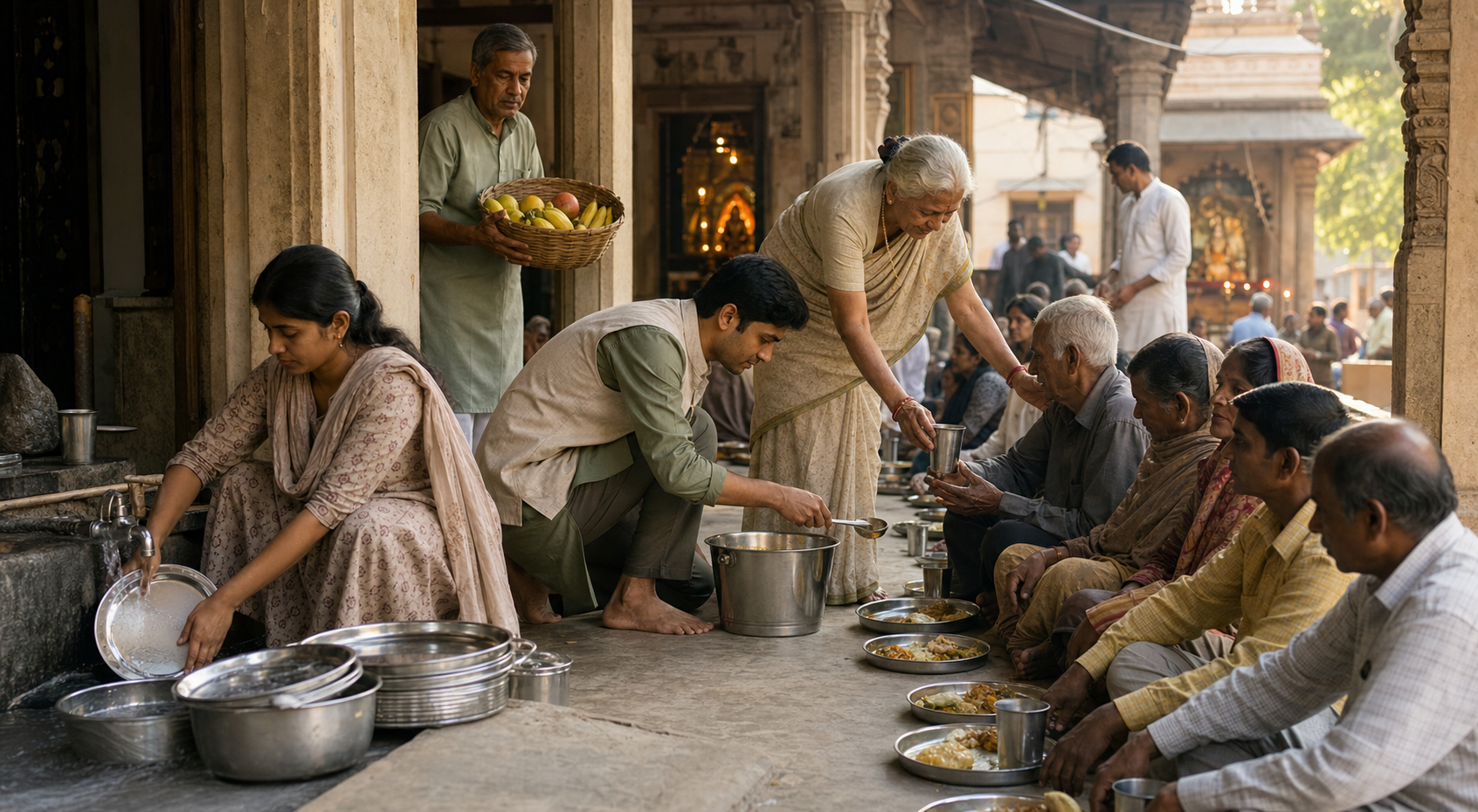
The strongest synthesis of the sources appears where devotion becomes ethical action. Both connect spiritual practice with seva, restraint, gratitude, and responsibility. The broad overview places ahimsa, truthfulness, non-stealing, responsible use of energy, and non-hoarding within Dharma’s moral orientation. The gauni bhakti article argues that reverence should become patient care for elders, mentorship without expectation, and community welfare without self-display.
This ethical test guards against two opposite failures. Devotion without discernment can become sentimental or sectarian, while philosophical pluralism without practice can become a posture with little effect on relationships. The sources instead connect bhakti with karma and jnana: love supplies motive, action gives love social form, and discernment examines whether action is actually conducive to spiritual growth.
Both articles also place Hindu pluralism beside related Dharmic approaches. They point to Jain Anekantavada and practices of reverence, Buddhist confidence and loving-kindness, and Sikh remembrance of the Divine Name, kirtan, and seva. These are not presented as interchangeable doctrines. They are treated as distinct traditions whose practices can support humility, compassion, and unity without erasing difference.
The result is a demanding account of pluralism. Respect for another path does not require a person to weaken commitment to an Ishta, lineage, or discipline. It requires that commitment to produce greater steadiness, generosity, and freedom from contempt. Lived devotion becomes the place where claims about unity in diversity are either verified or contradicted.
Key takeaways
- Sanatana Dharma’s pluralism accommodates different scriptures, philosophies, practices, and chosen forms without making them identical.
- Ishta turns plurality into a personal discipline: one focus can be loved deeply while other valid orientations are respected.
- Gauni bhakti can refer technically to secondary or mixed devotion and, in experiential discourse, to the accessible devotional current of ordinary life.
- Regular worship, remembrance, inquiry, and service can refine initial motives rather than demanding spiritual purity at the outset.
- Pluralism proves its value when devotion produces ahimsa, humility, responsibility, and care beyond one’s own group.
As Sanatana Dharma is interpreted in changing household, community, and diaspora settings, its vitality will depend on preserving this relationship between freedom and formation. Chosen paths can remain distinct, but their future credibility will rest on whether disciplined devotion enlarges the seeker’s capacity to recognize dignity across those differences.
References
- DharmaRenaissance Blog – Sanatana Dharma as Living Wisdom: Pluralism, Practice, and Purpose in a Complex World
- DharmaRenaissance Blog – Unveiling Gauni Bhakti: Harness the Heart’s Innate Devotion in Hinduism for Dharmic Unity