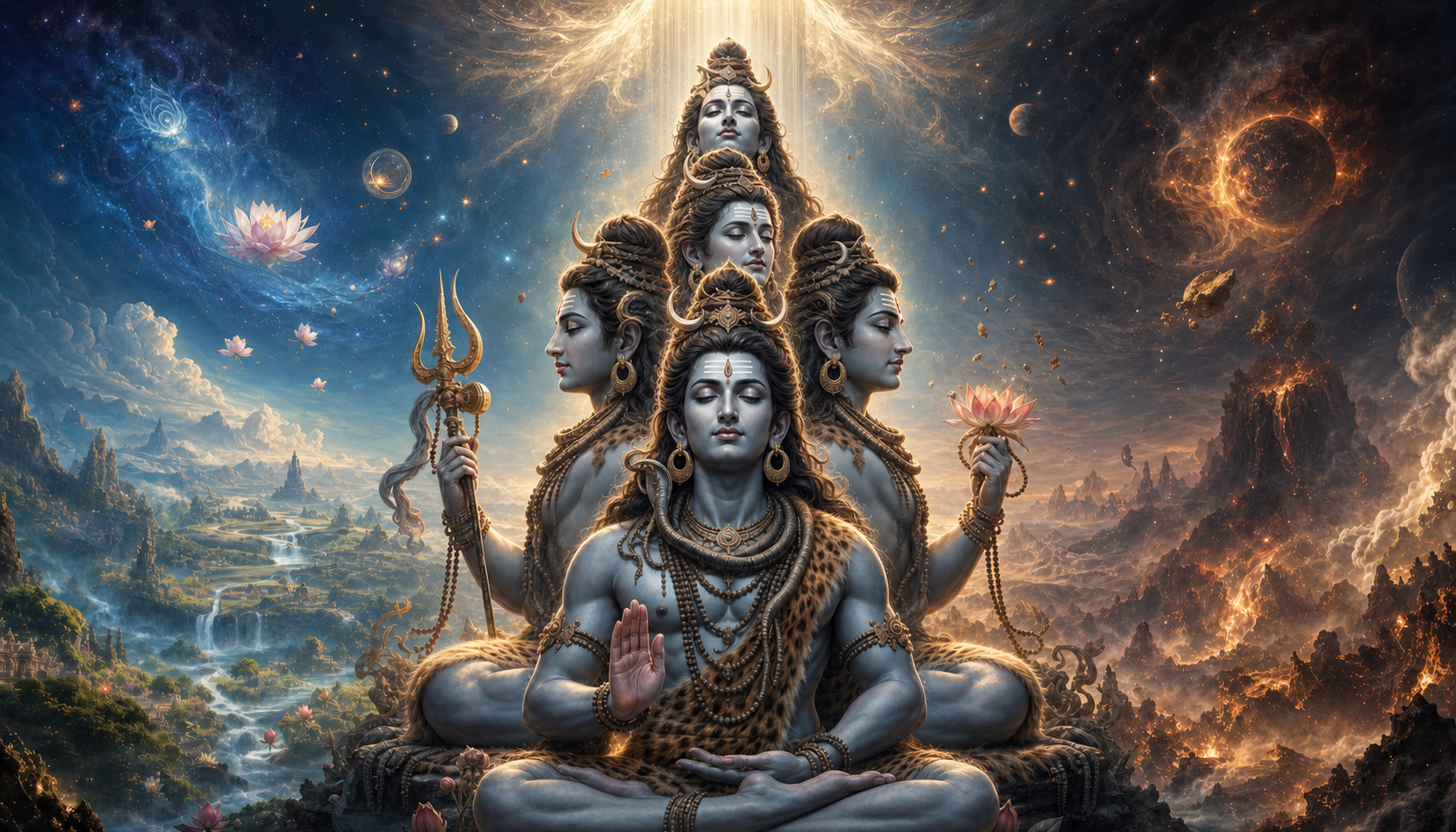
At first glance, a five-faced image of Shiva may appear to divide the divine into separate personalities. Shaiva thought uses the image in the opposite way: the faces distinguish five operations while affirming one undivided reality. Read together with Shiva’s five cosmic acts, they provide a grammar for change, continuity, loss, limitation and awakening.
The available research packet contains one DharmaRenaissance Blog article rather than several independently published accounts. This article therefore synthesises the philosophical, iconographic, ritual and practical strands reported in that source; it does not present its mappings as independently corroborated across publications.
The five acts describe a living process, not a timeline
The source article presents Panchakritya as five continuous activities: srishti, the emanation or creation of forms; sthiti, their sustenance; samhara, their dissolution or reabsorption; tirobhava or tirodhana, the concealment of full awareness; and anugraha, the grace through which freedom is recognised. These are not merely successive chapters in a remote cosmic history. They operate together within the world and within experience.
This simultaneity is essential. Something can be beginning while something else is being maintained, relinquished or temporarily obscured. Grace likewise need not wait until every other process has ended. The fivefold model is therefore better understood as a set of interacting movements than as a rigid sequence.
The source also reports a pedagogical relationship with the Trimurti: creation may be associated with Brahma, preservation with Vishnu and dissolution with Rudra. The Shaiva framework goes further by explicitly including concealment and grace. Those final two acts address questions that a three-part account of cosmic change leaves open: why awareness experiences limitation, and how liberation becomes possible.
How the five faces coordinate act, direction and element
Panchabrahma names five faces or modalities of Shiva: Sadyojata, Vamadeva, Aghora, Tatpurusha and Ishana. The DharmaRenaissance source gives the following common correspondence while cautioning that details can vary among schools. The table should therefore be read as a traditional interpretive map, not as a universally fixed classification.
| Face | Cosmic act | Direction | Element | Primary meaning |
|---|---|---|---|---|
| Sadyojata | Srishti | West | Earth | Forms come into manifestation |
| Vamadeva | Sthiti | North | Water | Manifest life is supported and continued |
| Aghora | Samhara | South | Fire | Forms are dissolved or reabsorbed |
| Tatpurusha | Tirobhava or tirodhana | East | Air | Full awareness is veiled |
| Ishana | Anugraha | Zenith | Ether | Grace reveals freedom |
The directional scheme gives visible form to unity-in-diversity. Four faces extend across the horizontal field, while Ishana occupies the upward direction. The five elements similarly connect cosmic functions with the experienced world. Yet the faces are not five competing gods or independent agents. Their theological purpose is to show how a single reality can perform distinguishable acts without ceasing to be one.
Nataraja turns the fivefold doctrine into movement
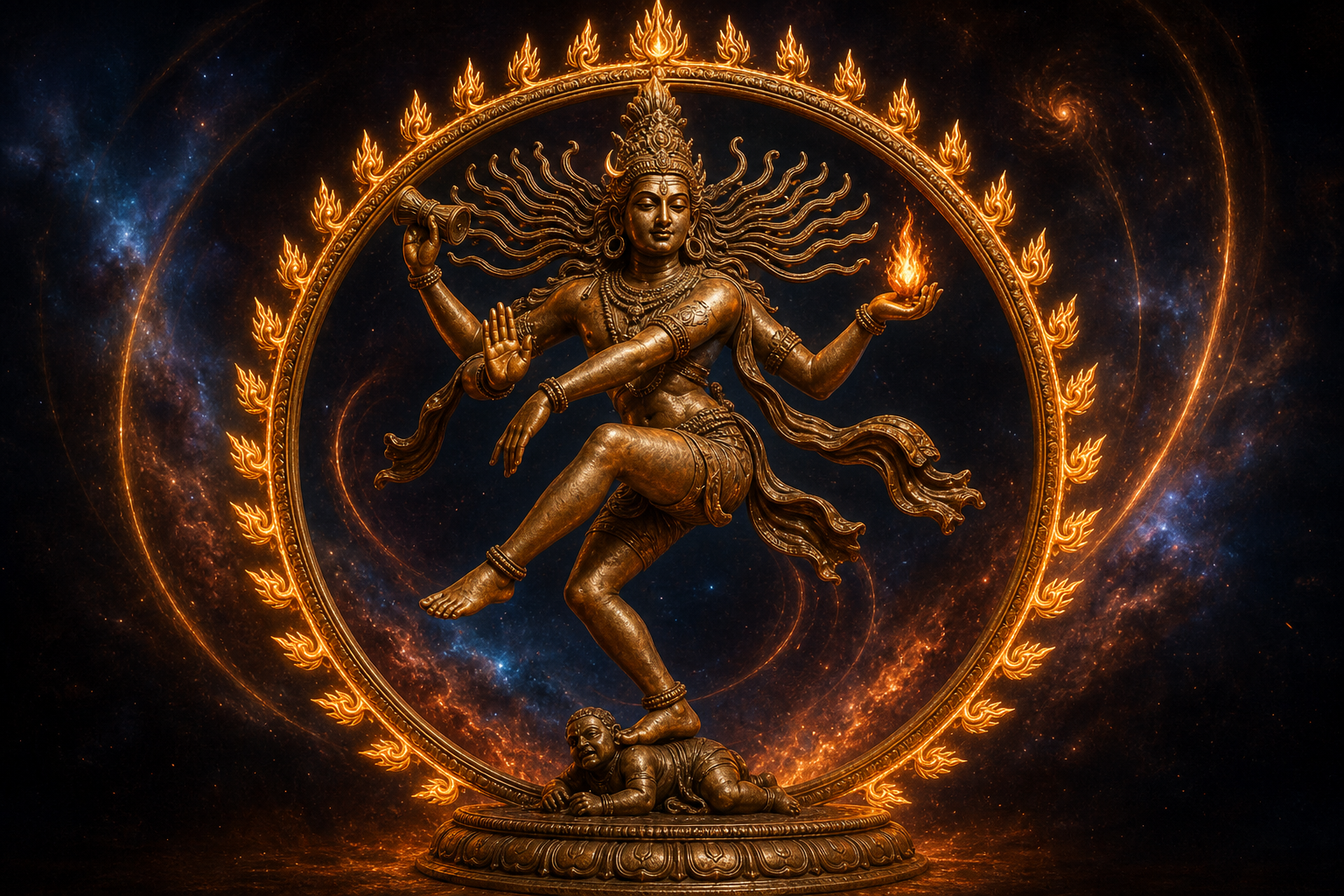
The source reads Shiva Nataraja as a concentrated visual account of Panchakritya. The drum in the upper right hand marks the pulse of manifestation. The lower right hand’s abhaya gesture offers reassurance and expresses preservation. Fire in the upper left hand signifies dissolution. Apasmara beneath the right foot represents forgetfulness and the concealment of knowledge, while the uplifted left foot and accompanying gesture communicate grace and release.
The surrounding ring of flame places all these signs within one unbroken dance. This is the image’s most important contribution to the philosophy: creation, stability, dissolution, concealment and liberation are not isolated departments. They belong to a single rhythm. Nataraja consequently prevents the doctrine from becoming a static chart of divine responsibilities.
The article reports that the same structure extends into worship and sacred space. Invocations connected with the five faces appear in daily puja, bodily placement practices such as nyasa and temple consecration. Panchamukha lingas and five-faced sculptures translate the doctrine into visible form, while temple directionality and the upward architectural axis can evoke the faces’ spatial relationships.
As a reported textual background, the source links the doctrine with Vedic, Agamic and Puranic layers. It names the Satarudriya or Sri Rudram, Panchabrahma-related recitations, Shaiva Agamas such as the Kamikagama, and the Shiva, Linga and Skanda Puranas. Because the supplied material does not provide passage-level analysis from those works, these references establish the source article’s claimed traditional setting rather than independent textual verification.
Concealment and grace complete the spiritual picture
Tirobhava is the conceptual hinge of the fivefold system. If it were treated simply as evil, Shiva would appear divided against Shiva’s own creation. The source instead presents concealment as the condition under which limited identity, learning and relationship become possible. A person can act from a partial viewpoint without that partial viewpoint being the final truth of awareness.
Anugraha answers concealment through disclosure rather than through the manufacture of an entirely new self. In the interpretation reported by the source, grace reveals what was already fundamental: Shiva as the ground of awareness. Liberation is thus connected with recognition, even though discipline, worship and ethical action remain meaningful within the concealed condition.
This pairing also changes how dissolution should be understood. Samhara is not identical with failure, just as tirobhava is not identical with permanent ignorance. Endings release forms whose work is complete, while concealment makes a journey of discovery possible. The framework does not romanticise every loss or blind spot; it places them within a larger account in which no single phase exhausts reality.
The source applies the five acts to ordinary inner life: ideas arise, disciplined attention sustains them, habits fall away, blind spots limit understanding and insight restores clarity. Used contemplatively, the model can help distinguish a necessary beginning from a task of maintenance, a timely ending from avoidance, and honest uncertainty from settled truth.
Key takeaways
- Shiva’s five faces represent coordinated functions of one reality, not five separate deities.
- Panchakritya includes creation, sustenance, dissolution, concealment and grace as concurrent cosmic and experiential movements.
- The reported face-act mapping is traditional but may vary across Shaiva schools.
- Nataraja gathers all five acts into one dancing form, showing their interdependence rather than a simple chronological order.
- In practical reflection, the framework asks what should begin, what deserves care, what should end, what remains obscured and where greater clarity is emerging.
The continuing value of this doctrine lies in its refusal to reduce sacred reality to beginnings and favourable outcomes. Maintenance, ending, uncertainty and release also belong to the field of spiritual attention. Future study can deepen the framework through direct comparison of Shaiva texts and lineages; daily contemplation can begin more simply, by recognising which of the five movements a present situation requires.