-
Bhagavad Gita on Inescapable Action: Krishna on Nature’s Gunas and Dharmic Responsibility

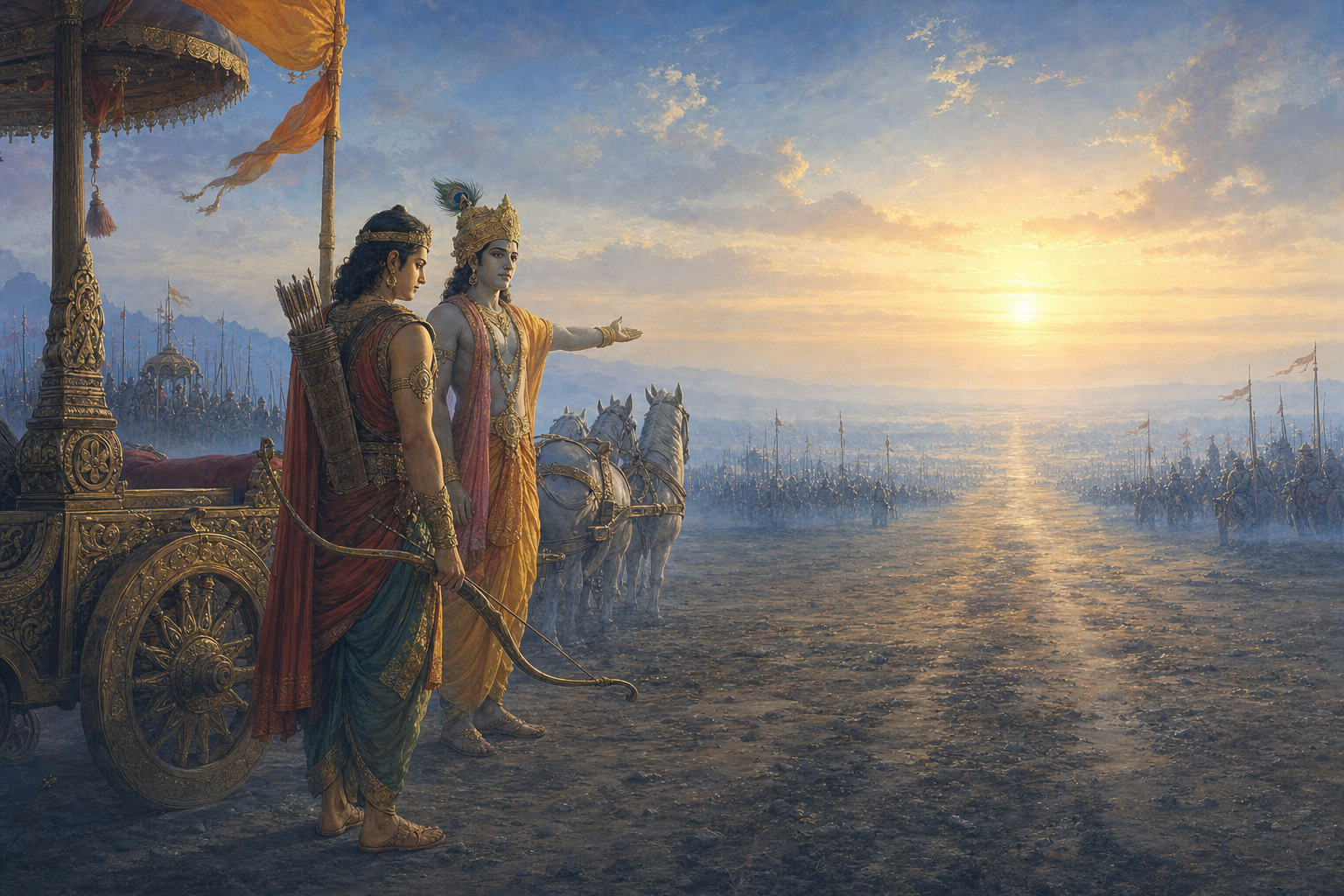
The Bhagavad Gita teaches that action is inescapable because Nature (Prakriti) operates through the gunas, compelling continuous activity. Krishna reframes the human challenge from “whether to act” to “how to act” through Karma Yoga—duty aligned with dharma and freedom from anxious attachment to results. Key verses (3.5, 3.27, 18.60, 2.47–48) establish a compatibilist vision in…
-
Haunting Wisdom of Guhya Kali: Decoding the Corpse Earrings in Tantric Iconography

Guhya Kali’s corpse earrings are a deliberate Tantric teaching, not a sensational detail. They place mortality at the gate of listening, turning fear into insight through śravaṇa and mantra. Read as memento mori in a Dharmic register, the earrings signify impermanence, the conquest of fear, and the transmutation of impurity into wisdom. Their paired symmetry…
-
Beyond Chanting Alone: How Pancaratrika-vidhi Powers Bhagavad-vidhi in Kali-yuga

Many devotees wonder whether chanting alone suffices in Kali-yuga or whether the formal Pancharatra tradition remains essential. This analysis clarifies the complementary roles of Pancaratrika-vidhi (regulated Deity worship) and Bhagavad-vidhi (the Bhagavata’s path of hearing and chanting) as taught in ISKCON and Gaudiya Vaishnavism. It explains how Pancharatra codes purify and qualify the practitioner so…
-
Why Sri Krishna Is Called Murari: Puranic Sources, Ekadashi Origins, and Inner Triumph

Murari—literally “foe of Mura”—is a precise Sanskrit epithet of Sri Krishna grounded in the Puranas. The Bhagavata Purana narrates Krishna’s defeat of the asura’s general Mura at Pragjyotisha, while allied strands in the Vishnu Purana and Harivamsha confirm the theme. The Padma Purana adds a complementary arc by linking Mura’s fall to the origin of…
-
Shattering the Myth: Why Valmiki’s Ramayana Has No Maya Sita—Evidence and Dharma

The Maya Sita motif—an illusory duplicate of Sita—does not appear in Valmiki’s Ramayana. Textual criticism across northern and southern manuscript families confirms its absence, especially in the Yuddha Kanda where Sita’s Agni-praveśa serves as public vindication. Later Puranic and bhakti-era tellings, such as the Adhyātma Rāmāyaṇa, introduce Maya Sita to offer a theologically protective reading…
-
Wrath to Wisdom: Parashurama and Rama’s Timeless Ethics for Power, Justice, and Dharma

This long-form analysis interprets Parashurama and Rama as complementary modalities of Dharma: emergency correction and constitutional restraint. Drawing on the Ramayana, Puranas, and classical ideas of Dharma-Yuddha, it shows how the “axe” symbolizes decisive action against entrenched injustice while the “arrow” symbolizes calibrated governance under maryada. Readers gain a practical framework for leadership—when to act…
-
Unshakable Equanimity in Srimad Bhagavatam 11.2.49: Suffering, Divine Memory, and Practice

Śrīmad-Bhāgavatam 11.2.49 offers a precise map of suffering across body, prāṇa, mind, intelligence, and senses, and pairs it with a single remedy: steady remembrance of the Divine. This analysis explains how that remembrance stabilizes attention, recalibrates desire, and transforms reactivity into equanimity. Practical guidance shows how to translate the verse into daily anchors—japa, prāṇāyāma, curated…
-
Karma and Karmaphala in the Ramayana and Mahabharata: Dharma, Consequence, and Liberation

This essay reads the Ramayana and Mahabharata as precise ethical maps of karma (action) and karmaphala (consequence), showing how intention, duty, and context shape outcomes. It explains sañchita, prārabdha, and āgāmi karma, and situates them within dharma and the puruṣārthas. Through case studies—Daśaratha’s unintended harm, Rāvaṇa’s hubris, the dice hall’s complicity, Karna’s complexity, and Bhīṣma’s…
-
Decoding Khila in Vedic Sutras: Hidden Supplements That Shaped Ancient Hindu Wisdom

Khila, the Vedic category for recognized supplements, reveals how ancient Indian literature balanced canonical integrity with lived adaptability. This in-depth exploration maps khila across the Rigveda Khilāni and sūtra traditions, showing how supplementary hymns and pariśiṣṭas extend ritual capacity without unsettling core śruti. Readers learn why texts like the Śrīsūkta, though technically ancillary in many…
-
Navagvas and Dāśagvas in Hinduism: Angiras Lineage, Vedic Timekeeping, Ritual Mastery

This study explains why Navagvas and Dāśagvas matter in Hinduism by situating them within the Angiras lineage and the Rigvedic ritual world. It clarifies how these names encode nine‑ and ten‑month attainments in year‑long sattras (Sattrayāga), while noting alternative scholarly views that treat them as Angirasa group designations. Readers gain a clear overview of Vedic…
-
Mahabharata Masterguide: Clear, Powerful Summary of Dharma, War, and Wisdom (18 Parvas)

This academically grounded summary presents the Mahabharata in short while preserving the epic’s depth and coherence. It outlines authorship traditions (Veda Vyasa as composer, Lord Vinayaka as scribe), textual history, and the 18-parva structure. Readers gain a clear, chronological narrative—from the Kuru lineage and the dice game to the Bhagavad Gita and the 18-day Kurukshetra…
-
Ravana’s Fatal Breach of Rajadharma: Desire Over Duty and the Ruin of Lanka’s Statecraft

This long-form analysis examines Ravana’s breach of rajadharma in the Ramayana as a rigorous lesson in Dharmic statecraft. It situates kingship within Hindu, Buddhist, Jain, and Sikh ethical frameworks, showing how a ruler’s personal desire must remain subordinate to public duty. It explains how Ravana’s abduction of Sita, dismissal of counsel, and politicization of private…
-
Mahabharata Made Clear: A Comprehensive, Soul-Stirring Summary of Dharma, War, and Wisdom

This academically grounded summary presents the Mahabharata’s eighteen parvas with clarity, linking narrative, statecraft, and spirituality into a single, coherent guide. Readers gain a concise understanding of the Kuru lineage, the Kurukshetra War, and the Bhagavad Gita’s integrated path of action, knowledge, and devotion. The overview highlights Vidura-niti and Bhishma’s lectures on just governance, ethical…
-
Hotṛ, Rigvedic Master of Sacred Sound: Role, Ritual Science, and Legacy in Yajña

The Hotṛ is the Rigvedic specialist who gives Vedic yajña its articulate voice through precise śāstra recitations. Anchored in exact meter (chandas) and tonal accent (svara), the Hotṛ’s work integrates with the Adhvaryu’s actions, the Udgātṛ’s chants, and the Brahman’s oversight to ensure ritual integrity. Training includes advanced pāṭha methods and phonetic sciences, preserving textual…
-
Kumbha and Nikumbha in the Ramayana: Lanka’s Fiercest Duel, Dharma-Yuddha, and Justice

Kumbha and Nikumbha’s entry into the Lanka war crystallizes the Ramayana’s central themes of courage, anger, and divine justice. Situated in the Yuddha Kanda, their duels with Sugriva and Hanuman reveal how Dharma-Yuddha prizes restraint, clarity, and righteous alignment over sheer force. While valor is acknowledged on all sides, the epic distinguishes between bravery harnessed…
-
Enigmatic Two-Headed Golden Deer: What Regional Ramayanas Reveal about Sita’s Abduction

The Ramayana’s Sita abduction episode is not a fixed script but a living tradition across India. In select Kerala and Tamil Nadu repertoires, the golden deer becomes a two-headed marvel, amplifying the epic’s meditation on maya, desire, and deception. Anchored in Valmiki’s Aranya Kanda yet enriched by Kamba Ramayanam, Adhyatma Ramayanam Kilippattu, and folk performance,…
-
Srimad Bhagvatam 4.14.34–37: Sacred Sound, Just Rule, and the Fall of King Vena

Srimad Bhagvatam 4.14.34–37 narrates how sages countered a tyrant’s denial of dharma using sanctified speech rather than weapons, offering a profound study in political theology, sacred sound, and ethical governance. The background of King Anga’s departure and King Vena’s misrule clarifies why authority without transcendence self-destructs. The episode is read not as praise of violence…
-
Beyond Temple Worship: Kapila on Seeing the Supersoul in All (Bhagavatam 3.29.21–27)

Srimad-Bhagavatam 3.29.21–27 defines authentic devotion as seeing the Lord (Paramātman) in every being, not only in the temple Deity. The discussion clarifies why ritual worship, though essential, remains incomplete without ahiṃsā and dayā. Drawing on the Bhagavad-Gita and the Upanishads, it shows how arcā-vigraha trains perception to recognize the indwelling Lord everywhere. Practical guidance translates…
-
Sacred Robes Betrayed: Ravana’s Sanyasi Deceit, Sita’s Abduction, and Shiva’s Silent Wrath

This long-form analysis examines Ravana’s abduction of Sita through the guise of a Sanyasi, highlighting why the episode is treated across Ramayana traditions as a grave betrayal of civilizational trust. It clarifies the Valmiki baseline, explains later vernacular expansions, and separates popular motifs like the Lakshmana Rekha from the Sanskrit core while preserving their ethical…
-
Ravana’s Abduction of Sita Revisited: Dharma, Curses, and a Deliberate Path to Moksha

Did Ravana kidnap Sita to be slain by Sri Rama and attain moksha? A careful, text-sensitive study shows that while Valmiki’s Ramayana emphasizes Ravana’s pride and desire, later Puranic and bhakti traditions interpret his fall within a cosmic design of grace. The Jaya–Vijaya doctrine, vaira-bhakti (absorption through enmity), karmic curses, and the Maya Sita motif…