Category: Scriptures

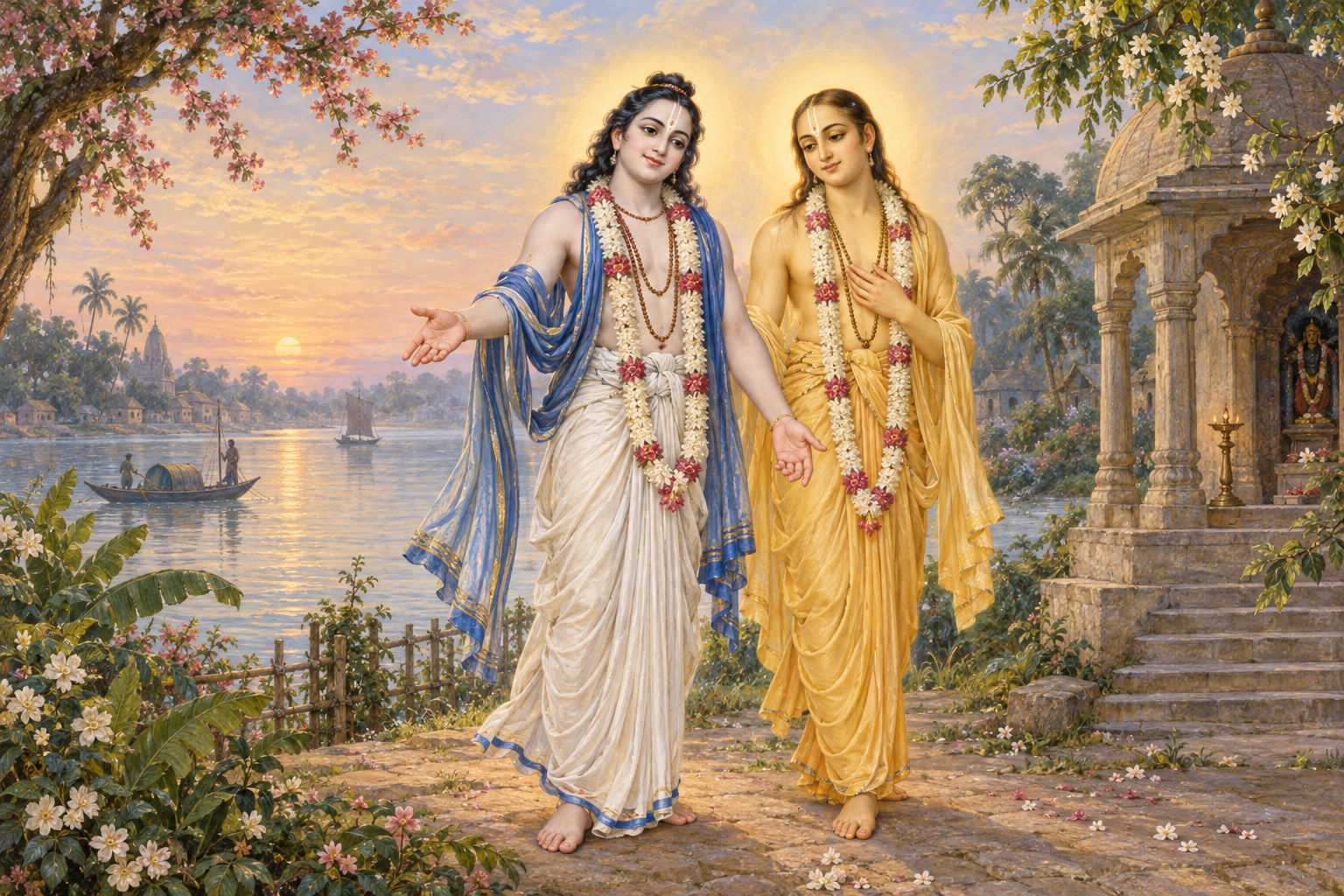
  • Why Balarama Wears Blue: Profound Symbolism of Strength, Serenity, and Seva Revealed

    Why Balarama Wears Blue: Profound Symbolism of Strength, Serenity, and Seva Revealed

    Balarama’s fair form and blue garment, described in the Bhagavata tradition, operate as a visual theology encoding strength, serenity, and selfless service. The Sanskrit color terms nīla, śyāma, and pīta clarify the chromatic contrast with Krishna and convey deeper cosmological moods. Vaishnava exegesis links Balarama’s blue attire to his identities as ādi-guru, Ananta Śeṣa, and…

  • Hanuman’s Tail-Dome and the Underworld Duel: Mahiravana’s Deception and a Dharmic Rescue

    Hanuman’s Tail-Dome and the Underworld Duel: Mahiravana’s Deception and a Dharmic Rescue

    This analytical retelling explores the Mahiravana (Ahiravana) episode from later Ramayana traditions, where Hanuman’s innovative “tail-dome” defense is outwitted by a master of illusion and redeemed by a precise, dharmic rescue in Patala. It situates the story within regional Ramayana literatures, clarifies iconography around Panchamukhi Hanuman, and explains the technical constraint of extinguishing five life-lamps…

  • Makaradhwaja and Hanuman’s Karmaphala: Unveiling Dharma, Lineage, and the Fire of Lanka

    Makaradhwaja and Hanuman’s Karmaphala: Unveiling Dharma, Lineage, and the Fire of Lanka

    This essay offers a scholarly, engaging reading of Makaradhwaja—the wondrous “son of Hanuman” said to arise from sweat after the Lanka Dahana—as a profound meditation on karmaphala in the Ramayana tradition. It clarifies that the tale is absent from the Valmiki Ramayana and instead flourishes in later and regional sources such as the Krittivasi Ramayan,…

  • Smriti Chandrika: The Definitive 12th‑Century Dharmashastra Digest That Shaped Hindu Law

    Smriti Chandrika: The Definitive 12th‑Century Dharmashastra Digest That Shaped Hindu Law

    Smriti Chandrika (Smṛticandrikā), attributed to the 12th‑century South Indian scholar Devannabhatta, is a landmark Dharmashastra digest (nibandha) that shaped Hindu law in the Drāviḍa school. Distinguished by meticulous citations and minimal authorial intrusion, it consolidates earlier authorities on conduct (Achāra), life‑cycle rites (Saṃskāra), expiations (Prāyaścitta), ancestor rites and charity, and especially on legal procedure (Vyavahāra),…

  • Abhinavabharati Unveiled: Abhinavagupta’s Masterwork on Bharata’s Natyashastra and Rasa Theory

    Abhinavabharati Unveiled: Abhinavagupta’s Masterwork on Bharata’s Natyashastra and Rasa Theory

    Abhinavabharati, Abhinavagupta’s celebrated commentary on Bharata Muni’s Natyashastra, clarifies how drama, dance, and music yield rasa through vibhavas, anubhavas, and vyabhicari-bhavas in the receptive sahridaya. It accepts śānta rasa as the apex, harmonizing aesthetic passion with contemplative calm in line with dharmic ideals shared across Hinduism, Buddhism, Jainism, and Sikhism. By integrating dhvani (suggestion) from…

  • Decoding Ashta Bhairava’s Eight Directions: Names, Fierce Symbolism, and Sacred Geometry

    Decoding Ashta Bhairava’s Eight Directions: Names, Fierce Symbolism, and Sacred Geometry

    Ashta Bhairava, the eight directional manifestations of Bhairava, unify Tantric metaphysics with temple architecture, ritual time, and ethical practice. This guide clarifies widely attested mappings of names to directions and explains how each form functions as a guardian of thresholds, conduct, and clarity. It situates the Ashta Bhairava within Agamic design, sacred geometry, and living…

  • Rakshasas Reconsidered: Three Orders, Genealogies, and Dharma Across Hindu Scriptures

    Rakshasas Reconsidered: Three Orders, Genealogies, and Dharma Across Hindu Scriptures

    Rakshasas in Hindu scriptures are not a single moral type but a spectrum of beings whose actions and destinies illuminate dharma. A threefold interpretive model—sattva-, rajas-, and tamas-aligned Rakshasas—maps consistent patterns across the Ramayana, Mahabharata, and Puranic genealogies. Vibhishana, Ravana, and figures such as Khara and Kirmira exemplify distinct ethical orientations that readers can recognize…

  • Dasa Bhairava Unveiled: A Powerful Shaiva-Tantric Journey through Fear, Time, and Grace

    Dasa Bhairava Unveiled: A Powerful Shaiva-Tantric Journey through Fear, Time, and Grace

    This long-form, research-based exploration presents Dasa Bhairava (the Tenfold Fierce One) as a living Shaiva-Tantric framework that transforms fear into clarity and ethical action. It clarifies how tenfold schemas vary by lineage, situating them alongside Ashta Bhairava and sixty-four Bhairava traditions without imposing a single orthodoxy. Readers gain a technical yet accessible view of iconography,…

  • When Shiva Bled: Vamana Purana’s Origin of the Eight Bhairavas and Andhaka’s Fall

    When Shiva Bled: Vamana Purana’s Origin of the Eight Bhairavas and Andhaka’s Fall

    The Vamana Purana narrates a riveting moment—”when Shiva bled”—to explain how the Eight Bhairavas arose to stop the multiplication of the asura Andhaka and restore cosmic order. Read alongside the Shiva Purana and Skanda Purana, the episode highlights a shared Shakta–Shaiva method: intercept proliferating harm and convert it into insight. The Ashta Bhairavas appear as…

  • From Axe to Bow: Parashurama and Rama’s Weapons across India’s Civilizational Evolution

    From Axe to Bow: Parashurama and Rama’s Weapons across India’s Civilizational Evolution

    Parashurama’s axe and Rama’s bow are more than weapons; they are precise metaphors for India’s civilizational evolution from corrective severity to codified restraint. Read together, they chart the passage from foundational pruning to lawful kingship, illuminating Kshatra Dharma and maryada in the Ramayana. The parashu symbolizes necessary removal of entrenched harm, while the Kodanda embodies…

  • Decoding Srimad Bhagavatam 3.26.9: Sankhya, Consciousness, and a Roadmap to Dharmic Unity

    Decoding Srimad Bhagavatam 3.26.9: Sankhya, Consciousness, and a Roadmap to Dharmic Unity

    This in-depth exploration of Srimad Bhagavatam 3.26.9, inspired by H.H Subhag Swami Maharaj’s discourse at ISKCON Mayapur, unpacks Kapila’s Sankhya as a precise map of consciousness, causality, and liberation. It clarifies how purusha, prakriti, time, and the three gunas co-operate to shape experience, and why that structure makes ethical effort and devotion both meaningful and…

  • Dhruva’s Turning Point: Manu’s Counsel on Anger, Humility, and Surrender (SB 4.11.15–35)

    Dhruva’s Turning Point: Manu’s Counsel on Anger, Humility, and Surrender (SB 4.11.15–35)

    Bhagavatam Class 4.11 15–35 explores Svayambhuva Manu’s intervention as Dhruva Maharaja shifts from reactive anger to disciplined humility. The class clarifies a core Vaishnava principle: the Supreme Lord is the ultimate cause behind all causes, guiding practitioners toward surrender rather than escalation. Verse 27 functions as a cognitive pivot, redirecting the mind from krodha to…

  • Inside the Impregnable: Golden Walls, Iron Gates, and Hanuman’s Reconnaissance of Lanka

    Inside the Impregnable: Golden Walls, Iron Gates, and Hanuman’s Reconnaissance of Lanka

    This long-form analysis situates Hanuman’s reconnaissance in the Yuddha Kāṇḍa of the Valmiki Ramayana as a precise military assessment of Lanka’s defenses. It explains Lanka as a classic jala-durga (water fort), where golden walls and iron gates combine spectacle with deterrence. Readers gain a technical view of fortification-in-depth, early-warning systems, ordnance such as śataghnī, and…

  • The Peril of Vaishnava Aparādha: SB 11.1.13–15 and the Yadu Dynasty’s Devastating Fall

    The Peril of Vaishnava Aparādha: SB 11.1.13–15 and the Yadu Dynasty’s Devastating Fall

    Srimad Bhagavatam 11.1.13–15 warns that mocking saintly persons—illustrated by the Yadu youths disguising Samba as a pregnant woman—carries devastating karmic and social consequences. Drawing on HH Guru Prasad Swami Maharaj’s insights, this analysis clarifies the doctrine of Vaishnava aparādha and shows how even technical fixes cannot undo moral causes. Readers gain precise context for the…

  • Conquering the Disease of Envy: SB 3.29’s Remedy for Respect, Ahimsa, and Dharmic Unity

    Conquering the Disease of Envy: SB 3.29’s Remedy for Respect, Ahimsa, and Dharmic Unity

    This deep-dive, inspired by a Brambleton, VA discourse on May 21, 2026, examines why envy (īrṣyā, asūyā, mātsarya) is the principal obstacle to authentic respect and spiritual growth. Drawing on Srimad Bhagavatam 3.29, it maps how envy aligns with rajas and tamas and why non-envious devotion in sattva is essential. The analysis integrates parallel remedies…

  • Unveiling Bhaujya: Aindra Mahabhisheka, Aitareya Brahmana, and the Power of Vedic Statecraft

    Unveiling Bhaujya: Aindra Mahabhisheka, Aitareya Brahmana, and the Power of Vedic Statecraft

    Bhaujya in the Aitareya Brahmana names both a system of governance and the oath-taking moment of the Aindra Mahabhisheka, where sovereignty is publicly bound to dharma. The celebrated sequence “samrajyam”, “bhaujyam”, “svarajyam”, “vairajya”, and “paramestya” maps layered forms of power—from self-rule to apex sovereignty—while insisting on ethical constraint. Read with Arthasastra and Dharmasastra, bhaujya emerges…

  • Rama on Hanuman, Lakshman on Angada: Decoding Yuddha Kanda Strategy and Sacred Symbolism

    Rama on Hanuman, Lakshman on Angada: Decoding Yuddha Kanda Strategy and Sacred Symbolism

    This study examines Rama’s march to Lanka through the dual lenses of strategy and symbolism in the Yuddha Kanda. It traces how intelligence from Sundara Kanda matured into a disciplined campaign: ritual diplomacy with the ocean, Nala’s engineering of Rama Setu, and Sugriva’s team-of-teams command across a high-mobility Vanara army. It clarifies that Valmiki does…

  • Mahabharata Wisdom on the True Gift: Markandeya’s Guide to Nishkama Dāna and Seva

    Mahabharata Wisdom on the True Gift: Markandeya’s Guide to Nishkama Dāna and Seva

    This long-form exploration distills Sage Markandeya’s Mahabharata teaching on the nature of the true gift (dāna) and explains why intention, not magnitude, confers ethical value. It maps dāna to the Bhagavad-Gita’s guṇa framework, clarifying the difference between sāttvika, rājasa, and tāmasa giving. Through the exemplar of King Śibi, it highlights abhayadāna (the gift of fearlessness)…

  • Srimad-Bhagavatam: Timeless Wisdom That Transcends Dharma, Artha, Kama, and Moksha

    Srimad-Bhagavatam: Timeless Wisdom That Transcends Dharma, Artha, Kama, and Moksha

    Srimad-Bhagavatam, the Bhagavata Purana, honors the classic Hindu puruṣārthas—dharma, artha, kāma, and mokṣa—while demonstrating how each is perfected and transcended through bhakti. Presented through a refined narrative and commentarial tradition, it integrates theology, cosmology, ethics, and contemplative practice. Readers encounter vivid exemplars such as Dhruva, Prahlāda, Ajamila, Gajendra, and Ambarīṣa, alongside philosophical teachings that unite…

  • What Happens After Death? Garuda Purana’s Vivid Journey of the Soul, Karma, and Liberation

    What Happens After Death? Garuda Purana’s Vivid Journey of the Soul, Karma, and Liberation

    The Garuda Purana’s teachings on what happens after death combine vivid narrative with careful ethics and ritual guidance. Rather than inducing fear, these descriptions function as moral instruction, emphasizing accountability (karma), communal care (śrāddha and piṇḍa-dāna), and the ultimate aim of liberation (moksha). Read alongside Upaniṣadic psychology, death can be seen as akin to deep…