Category: Scriptures

  • From Jamun to Jambudvipa: Sacred Dark Hues, Divine Cosmology, and Bharata’s Enduring Soul

    From Jamun to Jambudvipa: Sacred Dark Hues, Divine Cosmology, and Bharata’s Enduring Soul

    Jamun’s deep purple hue, Jambudvipa’s sacred geography, and the dark complexions of Divine iconography converge to reveal a unifying civilizational vision of Bharata. Drawing on Hindu Puranas, Buddhist Pali sources, and Jain cosmography, the analysis shows how Jambudvipa frames Bharata-varsha as a moral and spiritual habitat rather than a mere map. The essay connects sacred…

  • Nandagopa, Krishna’s Foster-Father: A Powerful Study in Dharma, Adoption, and Love Beyond Blood

    Nandagopa, Krishna’s Foster-Father: A Powerful Study in Dharma, Adoption, and Love Beyond Blood

    Nandagopa—Nanda Maharaja of Vraja—embodies a dharmic model of fatherhood defined by nurture rather than blood. Drawing on the Bhagavata Purana and allied traditions, this analysis situates him as Krishna’s foster-father who performs samskaras, protects the child, and leads the Gopa community with ethical clarity. The study explores adoption and kinship in Dharmashastra, shows how bhakti…

  • Parvati and the Sacred Bilva in Skanda Purana: Symbolism, Ritual Science, and Ecology

    Parvati and the Sacred Bilva in Skanda Purana: Symbolism, Ritual Science, and Ecology

    The Skanda Purana portrays the Bilva as emerging from Parvati’s sacred perspiration on Mount Mandara, placing the tree at the heart of Shaiva devotion and uniting Shiva and Shakti in a single living symbol. The trifoliate Bilva leaf mirrors core Shaiva triads, from Shiva’s three eyes to the three shaktis, transforming daily worship into contemplative…

  • Pradhanikarahasya on Mahalakshmi’s Supremacy: Unveiling the Primordial Shakti of Creation

    Pradhanikarahasya on Mahalakshmi’s Supremacy: Unveiling the Primordial Shakti of Creation

    Pradhanikarahasya, an annex to the Devimahatmya (Durgasaptashati), presents a rigorous Shakta theology in which Mahalakshmi is the primordial source of creation. It integrates Vedic and Upanishadic insights to show how Shakti is both nirguna and saguna, aligning non-dual metaphysics with living devotion. The text decodes the Devimahatmya’s three episodes through the three gunas, offering a…

  • SB 4.9.37–53 Decoded: Dhruva’s Unshakable Devotion, Cosmic Boons, and Inner Renewal

    SB 4.9.37–53 Decoded: Dhruva’s Unshakable Devotion, Cosmic Boons, and Inner Renewal

    Srimad-Bhagavatam Canto 4, Chapter 9, verses 37–53 narrate how Dhruva Maharaja’s devotion matures from personal austerity to public responsibility. The passage culminates in Dhruvaloka—symbolizing unwavering devotion—and a restored social order that validates rajadharma as service. Drawing on themes often highlighted by Kalakantha Prabhu, the analysis explains how bhakti integrates knowledge and action while transmuting anger…

  • Kishkindha Kanda Unveiled: Hampi’s Sacred Landscape, Dharma Debates, and Hanuman’s Rise

    Kishkindha Kanda Unveiled: Hampi’s Sacred Landscape, Dharma Debates, and Hanuman’s Rise

    Kishkindha Kanda (Book IV of the Valmiki Ramayana) forges the Rama–vanara alliance, situates the narrative in the sacred Hampi–Anegundi landscape, and prepares the ground for Hanuman’s mission. Readers gain a clear map of key episodes—the pact with Sugriva, Vali-vadha’s dharma debate, Sugriva’s coronation, the monsoon interlude, and the strategic dispatch of search parties. The analysis…

  • Kishkindha Kanda Unveiled: Rama–Hanuman Alliance, Vali’s Fall, and Hampi’s Sacred Landscapes

    Kishkindha Kanda Unveiled: Rama–Hanuman Alliance, Vali’s Fall, and Hampi’s Sacred Landscapes

    Kishkindha Kanda, the fourth book of the Valmiki Ramayana, turns grief into disciplined action as Rama allies with Sugriva, brings down Vali, and launches a continent-spanning search for Sita. Set against the sacred landscapes around Hampi–Anegundi in Karnataka, it blends political acumen, ethical debate, and ecological poetics. The kanda highlights exemplary speech and statesmanship through…

  • The Donkey’s Silence at Krishna’s Birth: Textual Evidence, Folk Memory, and Sacred Symbolism

    The Donkey’s Silence at Krishna’s Birth: Textual Evidence, Folk Memory, and Sacred Symbolism

    A widely told folk variant claims a donkey brayed during Devaki’s earlier births yet fell silent at Krishna’s birth—sometimes after Vasudeva’s quiet prayer that no sound betray the child. Canonical sources such as the Bhagavata Purana and Harivamsa do not mention a donkey, focusing instead on a divinely wrought hush: chains loosened, doors opened, and…

  • Srimad Bhagavatam 10.66.21–24: Paundraka’s Fall, Kāśī’s Fire, and Dharmic Governance

    Srimad Bhagavatam 10.66.21–24: Paundraka’s Fall, Kāśī’s Fire, and Dharmic Governance

    This in-depth reading of Srimad Bhagavatam 10.66.21–24, contextualized by a Villa Vrindavana ISKCON discourse (15/5/2026), explains how Paundraka’s imposture and Kāśī’s retaliatory abhicāra illustrate the karmic recoil of weaponized ritual and the necessity of right-seeing (Sudarśana). Readers gain a precise grasp of the chapter’s ethical architecture—ego inflation, misuse of sacred means, and restoration of order…

  • Tripura’s Death-Reviving Nectar and Shiva’s Cosmic Arrow: Power, Ethics, and Dharmic Unity

    Tripura’s Death-Reviving Nectar and Shiva’s Cosmic Arrow: Power, Ethics, and Dharmic Unity

    This long-form, research-informed retelling examines the Purāṇic episode of Tripura, three mobile fortresses granted by Brahma to the asura brothers and sustained by a sacred reservoir of death‑reviving nectar. It outlines how Shiva’s single cosmic arrow—released at a rare celestial alignment—resolved a conflict made otherwise insoluble by continual revivification. Drawing on Shiva Purana, Linga Purana,…

  • Purusha, the All-Pervading Cosmic Being: Vedic origins, Yogic meaning, living significance

    Purusha, the All-Pervading Cosmic Being: Vedic origins, Yogic meaning, living significance

    Purusha, the all-pervading Cosmic Being, bridges Vedic cosmology, Upanishadic self-knowledge, Yoga philosophy, and everyday spiritual practice. The article clarifies etymology and the ‘city of the body’ metaphor, then unpacks the Purusha Sukta as a symbolic vision of interdependence rather than rigid social prescription. It examines Advaita, Vishishtadvaita, and Dvaita perspectives, and presents Samkhya-Yoga’s precise account…

  • Decoding the Dashagvas: Swift Angirasa Sages of the Rigveda and Their Living Legacy

    Decoding the Dashagvas: Swift Angirasa Sages of the Rigveda and Their Living Legacy

    The Dashagvas, remembered in the Rigveda as Angirasa-aligned priests, exemplify the Vedic fusion of disciplined speech, precise timing, and communal practice. Tradition pairs them with the Navagvas and links their names to nine- and ten-month sacrificial cycles that culminate in the release of light symbolized as cows and dawns. Rather than celebrating haste, their famed…

  • Srimad Bhagavatam Distribution Guide: Ethical, Scalable, Data-Driven Outreach to 100,008 Homes

    Srimad Bhagavatam Distribution Guide: Ethical, Scalable, Data-Driven Outreach to 100,008 Homes

    This guide presents an ethical, inclusive, and data-driven framework for distributing Srimad Bhagavatam at scale, aligning cultural heritage stewardship with modern outreach practices. It situates the Bhagavata Purana within the wider corpus of Hindu scriptures and emphasizes unity among Hinduism, Buddhism, Jainism, and Sikhism through non-coercive, consent-based engagement. The roadmap covers volunteer training, legal compliance,…

  • Adhika Masa (Purushottama) 2026: A Deep Guide to Calendar Science, Bhakti Sadhana, and Unity

    Adhika Masa (Purushottama) 2026: A Deep Guide to Calendar Science, Bhakti Sadhana, and Unity

    This long-form guide situates Adhika Masa (Purushottama Masa) within precise Hindu calendar science while presenting a practical, compassionate framework for intensified bhakti in 2026. It explains how the intercalary month is determined by the absence of a solar saṅkrānti within a lunar month and why many panchangs identify the 2026 occurrence as Adhik Jyeṣṭha. Drawing…

  • Anityam Asukham Lokam (Gita 9.33): A Powerful Guide to Inner Freedom in Change

    Anityam Asukham Lokam (Gita 9.33): A Powerful Guide to Inner Freedom in Change

    Bhagavad Gita 9.33 encapsulates a clear diagnosis of worldly life—impermanent and unreliable—and couples it with a precise remedy: orient devotion, action, and insight toward the Ultimate. The phrase “Anityam Asukham Idam,” read with its fuller context, explains why outcomes alone cannot secure lasting peace. Rather than pessimism, the verse offers a liberating realism that frees…

  • Kapi Dhvaja Unveiled: How Hanuman on Arjuna’s Banner Powered Dharma at Kurukshetra

    Kapi Dhvaja Unveiled: How Hanuman on Arjuna’s Banner Powered Dharma at Kurukshetra

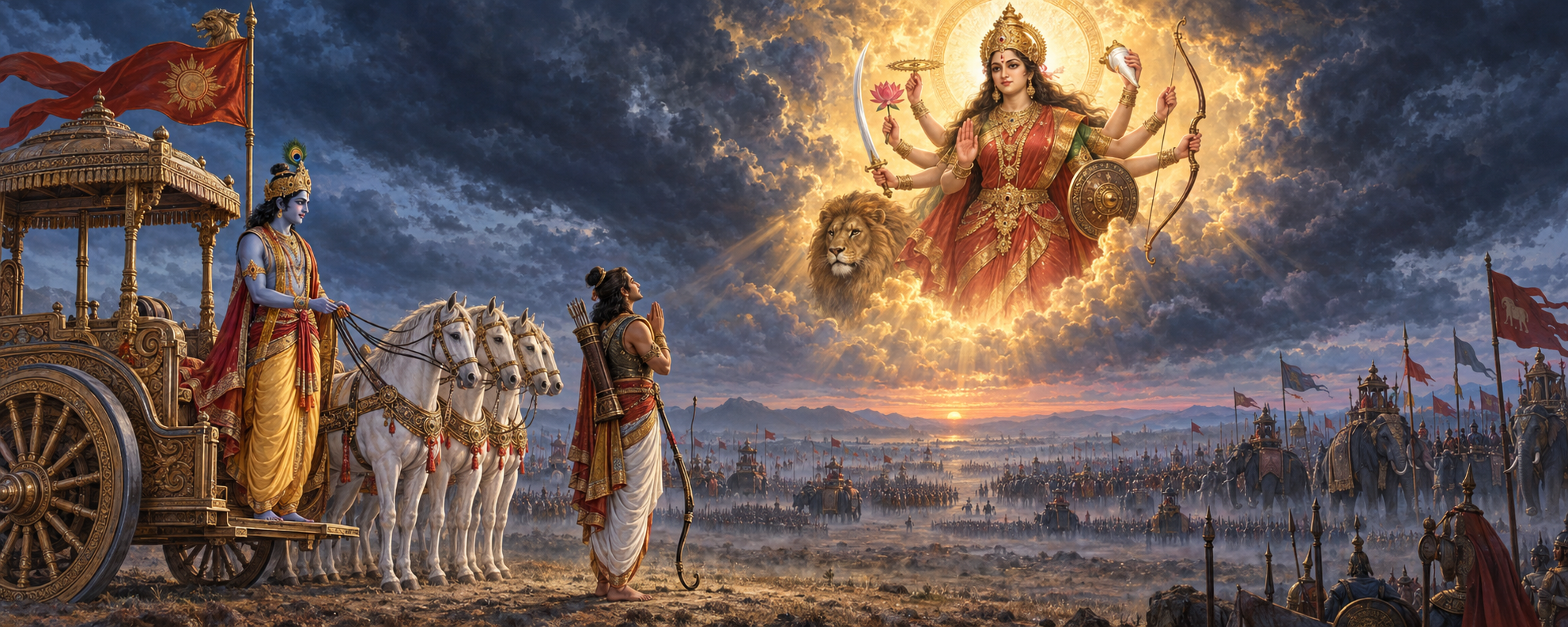
    Arjuna’s Kapi Dhvaja—the “ape-banner” of Hanuman—anchors the Bhagavad Gita’s battlefield in a powerful blend of scripture, strategy, and spirituality. The term kapidhvajaḥ in Gita 1.20 is not decorative; it signals divine sanction, morale-building semiotics, and an ethic of service above strength. Traditional lore explains Hanuman’s presence as a boon following Arjuna’s humility before Krishna, binding…

  • Narayaneeyam: A Soul-Stirring, Scholarly Guide to the Bhagavata Purana in 100 Dasakas

    Narayaneeyam: A Soul-Stirring, Scholarly Guide to the Bhagavata Purana in 100 Dasakas

    Nārāyaṇīyam (Narayaneeyam) condenses the Srimad Bhagavatham into 100 daśakas and just over a thousand ślokas, uniting poetry, philosophy, and devotion. Composed in 16th‑century Kerala by Melpathur Nārāyaṇa Bhaṭṭathiri at Guruvayur, it offers a structured path from cosmology and avatāras to Krishna’s intimate līlās and a culminating meditative vision. This guide clarifies its history, architecture, meters,…

  • Hanumath Kalyanam Explained: Why Hanuman Weds Suvarchala—Texts, Symbolism, Ritual Life

    Hanumath Kalyanam Explained: Why Hanuman Weds Suvarchala—Texts, Symbolism, Ritual Life

    Hanumath Kalyanam asks a striking question: why would a nitya-brahmachari like Hanuman marry? This exploration traces the South Indian legend in which Suvarchala—born of Surya Bhagavan’s Varchas—weds Hanuman, while his vow of brahmacharya remains intact. It clarifies that the Valmiki Ramayana is silent on this motif, which emerges richly in regional sthala-puranas and temple kathas.…

  • Rakshasa Linga Explained: How Fierce Tapas Wins Shiva’s Non‑Discriminating Grace

    Rakshasa Linga Explained: How Fierce Tapas Wins Shiva’s Non‑Discriminating Grace

    This in-depth exploration clarifies what a Rakshasa Linga is and why it matters: a Shivalinga worshipped or installed by a Rakshasa in Purana and sthala-mahatmya traditions. It explains how Skanda Purana and Shiva Purana preserve narratives—such as Gokarna’s Atma Linga and Baidyanath Jyotirlinga—that highlight Ravana’s fierce tapas and Shiva’s impartial grace. It situates these accounts…

  • Mayasura: Legendary Demon Architect of Maya Sabha, Mandodari’s Lineage, and Vastu Shastra

    Mayasura: Legendary Demon Architect of Maya Sabha, Mandodari’s Lineage, and Vastu Shastra

    Mayasura (Maya Dānava) stands at the confluence of epic imagination and technical science—an unrivaled asura architect who builds palaces, aerial cities, and enduring canons of design. The Mahabharata’s Maya Sabha showcases optical and spatial ingenuity while warning against hubris. The Ramayana’s lineage threads—through Mandodari, Mayavi, and Dundubhi—demonstrate how moral counsel and unchecked pride shape political…