Month: December 2025

  • Pavitraropana Vrata: A Powerful Temple Ritual of Purification, Renewal, and Unity

    Pavitraropana Vrata: A Powerful Temple Ritual of Purification, Renewal, and Unity

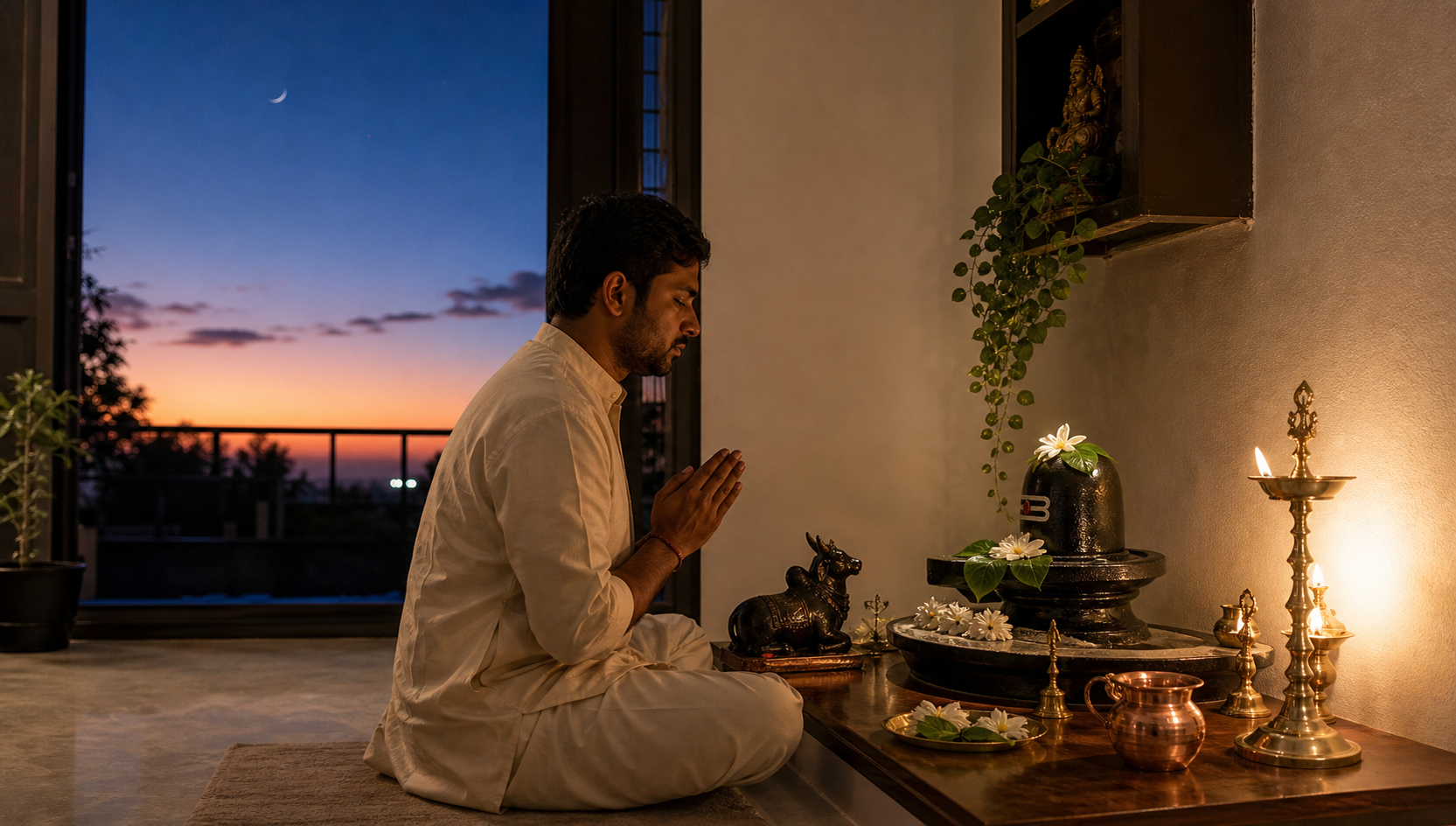
    Pavitraropana Vrata is a sacred Hindu ritual in which a sanctified pavitra (thread) is invested on the deity to purify, rectify, and renew temple worship. Grounded in Agamic practice and Purana references such as the Skanda Purana and Padma Purana, it serves as a formal prayaścitta for inadvertent ritual lapses. The ceremony typically includes mantra,…

  • Antaraya in Hinduism: Overcoming Yoga’s Inner Obstacles with Steady, Devoted Practice

    Antaraya in Hinduism: Overcoming Yoga’s Inner Obstacles with Steady, Devoted Practice

    Antaraya in Hinduism explains why even sincere Yoga practice sometimes loses momentum and clarity. Classical guidance identifies nine common obstacles and shows how they undermine abhyasa, pratyahara, and dhyana. Recognizing these patterns helps practitioners diagnose distractions early rather than mistaking them for failure. Practical remedies—steady abhyasa with vairagya, ethical discipline, breath awareness, and nairantarya abhyase—restore…

  • Conquering Death through Devotion: SB 10.87.27, Vedic Wisdom, and Dharmic Unity

    Conquering Death through Devotion: SB 10.87.27, Vedic Wisdom, and Dharmic Unity

    SB 10.87.27 teaches that devotion to the Supreme, the shelter of all beings, confers fearlessness and purifies the heart, while scholarship without humility can bind the mind. The passage underscores a Vedic philosophy emphasis on realized wisdom over mere textual mastery. Its insight aligns with the Bhakti Tradition and resonates with Upanishadic teachings and the…

  • Simplicity Over Crookedness: Humility, Bhakti, and Lasting Grace in Jiva Goswami’s Teachings

    Simplicity Over Crookedness: Humility, Bhakti, and Lasting Grace in Jiva Goswami’s Teachings

    This lecture at ISKCON Hudson NJ examines why simplicity, grounded in humility and sincerity, advances spiritual growth while crookedness hinders it. Referencing Jiva Goswami’s Bhakti Sandarbha, it explains how bhakti-abhasa—“a shadow of devotion”—still draws meaningful grace. The discussion highlights how transparent intention often matters more than complex ritualism. It shows that straightforward conduct nurtures inner…

  • Make Krishna-katha a Daily Joy: Practical Insights from Srimad Bhagavatam 10.1.8–13

    Make Krishna-katha a Daily Joy: Practical Insights from Srimad Bhagavatam 10.1.8–13

    This presentation on Srimad Bhagavatam 10.1.8–13 by H.H. Hanumat Presaka Swami demonstrates how Krishna-katha can become a daily joy even within busy, modern schedules. Grounded in the Bhagavad-gita, it shows how ordinary experiences—tasting water, seeing sunlight, or noticing strength and beauty—can serve as contemplative cues for remembrance. Emphasizing “tailor-made” practice, it endorses diverse, temperament-sensitive methods…

  • High-stakes Supreme Court Hearing on PM Modi’s Ajmer Sharif Visit: Law, Faith, and Unity

    High-stakes Supreme Court Hearing on PM Modi’s Ajmer Sharif Visit: Law, Faith, and Unity

    The Supreme Court of India is slated to hear a plea on December 26 seeking to restrain PM Narendra Modi’s visit to Ajmer Sharif dargah and the customary chadar offering on behalf of the government. The petition invokes questions of secularism, public expenditure, and executive discretion, while alleging a prior claim to the site as…

  • When Plans Backfire: A Dharmic Lesson on Karma, Intent, and Humility Across Traditions

    When Plans Backfire: A Dharmic Lesson on Karma, Intent, and Humility Across Traditions

    This reflection explores the Hindu proverb, “The hunter set the snare, but it caught the wrong prey,” as a timeless lesson on karma, intention, and the unpredictability of outcomes. It explains how the Bhagavad Gita’s focus on right action over guaranteed results guides ethical decision-making under uncertainty. The discussion connects Hindu insights with Buddhism’s dependent…

  • Why Sanatana Dharma Endures: The Self-Correcting Wisdom Unifying Dharmic Traditions

    Why Sanatana Dharma Endures: The Self-Correcting Wisdom Unifying Dharmic Traditions

    Sanatana Dharma endures because it carries a built-in, self-corrective system that updates practice without losing core principles. Hinduism’s framework of shruti, smriti, ācāra, and yukti enables context-aware refinement guided by reason and community debate. Buddhism, Jainism, and Sikhism share this ethos through councils, Anekantavada, and collective deliberation, demonstrating a broader dharmic commitment to internal reform.…

  • Paush Purnima Explained: Profound Vishnu Worship, Sacred Rituals, and Life-Enriching Benefits

    Paush Purnima Explained: Profound Vishnu Worship, Sacred Rituals, and Life-Enriching Benefits

    Paush Purnima, the full moon of the Paush month, is an auspicious day for Vishnu worship, snan, and dana, marking the onset of Magha Snan in many regions. Rituals such as Vishnu Sahasranama recitation, Satyanarayana Puja, and tulsi offerings are complemented by community charity, especially annadanam and sesame donations. Many practitioners report emotional lightness, clarity,…

  • Online Gurbani Kirtan Mastery: A Step-by-Step Learning Manual for Ragas, Taal, and Simran

    Online Gurbani Kirtan Mastery: A Step-by-Step Learning Manual for Ragas, Taal, and Simran

    This step-by-step online manual equips learners with a clear path to Gurbani Kirtan, combining sur sadhana, raag–taal foundations, and careful Gurmukhi diction with devotional focus. It outlines a four-phase pedagogy—from simran and technique to shabad learning, rhythmic integration, and digital presentation—suited to beginners and intermediates. Practical guidance covers harmonium basics, tabla or app-based theka, metronome…

  • Raising Fearless Children: Powerful Parenting Lessons from Dharmic Wisdom and Practice

    Raising Fearless Children: Powerful Parenting Lessons from Dharmic Wisdom and Practice

    Fearlessness in childhood is best understood as calm confidence rooted in dharmic values—ahimsa, satya, seva, and mindful presence. Evidence-informed parenting lessons show that secure attachment, steady routines, and growth-oriented language build resilience. Mindfulness and breathing exercises (pranayama, anapanasati, simran) help children regulate emotions during exams, performances, and social pressures. Storytelling from Ramayana, Jataka, Jain traditions,…

  • December 31, 2025 Panchang: Exact Tithi, Shubh Muhurat, Nakshatra & Rashi for Auspicious Planning

    December 31, 2025 Panchang: Exact Tithi, Shubh Muhurat, Nakshatra & Rashi for Auspicious Planning

    On Wednesday, December 31, 2025, the Panchang marks Shukla Paksha Ekadashi until 1:13 AM, followed by Shukla Paksha Dwadashi for the rest of the day. This precise transition helps devotees schedule puja, vrata observances, and parana with confidence. As Shubh Muhurat depends on Nakshatra, Chandra Rashi, weekday, and local sunrise, consulting a city-specific Panchang ensures…

  • 10 Defining Moments of the Ramayana: Timeless Lessons from Rama’s Epic Journey

    10 Defining Moments of the Ramayana: Timeless Lessons from Rama’s Epic Journey

    This concise guide highlights ten defining moments of the Ramayana—from Rama’s birth in Ayodhya and Sita’s swayamvara to the vanvas, Hanuman’s Sundara Kanda mission, and the return to Ayodhya. Each episode is presented with clear context and ethical significance to illuminate Dharma in action. Readers gain practical insights into righteous leadership, loyalty, compassion, and the…

  • 6 Legendary Shiva Tales That Illuminate Dharma, Courage, and Compassion for Modern Life

    6 Legendary Shiva Tales That Illuminate Dharma, Courage, and Compassion for Modern Life

    Six legendary Shiva stories—Neelkanth, Gangādhara, Ardhanārīśvara, Tripurāntaka, Daksha Yajña, and Kirātārjunīya—offer timeless insights for modern life. Each tale highlights a core dharmic value: compassion that contains harm, wisdom that channels power, balance of complementary energies, disciplined focus, humility with reconciliation, and perseverance aligned with dharma. Read together, they illuminate Sanatana Dharma’s emphasis on character and…

  • Dyutakrida in the Mahabharata: The Fateful Game of Dice That Shaped a Civilization

    Dyutakrida in the Mahabharata: The Fateful Game of Dice That Shaped a Civilization

    Dyutakrida—the Game of Dice in the Mahabharata—marks the epic’s moral and political turning point, revealing how desire and deception can erode dharma and destabilize institutions. This clear, academic retelling traces the invitation by Duryodhana, Shakuni’s manipulation, the catastrophic wagers by Yudhishthira, and Draupadi’s courageous challenge to an unjust order. Readers gain a concise sequence of…

  • Yudhishthira’s Half-Truth: Decoding a Heart-Rending Dharma Dilemma of the Mahabharata

    Yudhishthira’s Half-Truth: Decoding a Heart-Rending Dharma Dilemma of the Mahabharata

    Yudhishthira’s half-truth in the Mahabharata presents a timeless ethical dilemma: when personal virtue conflicts with public duty in the midst of war, how should leaders act? The episode, centered on Drona’s disarmament after the ambiguous proclamation “Aśvatthāmā hataḥ,” highlights dharma-sankata and the costs of hard choices. Rather than offering easy answers, it encourages a method…

  • Dasharatha and Shani in the Padma Purana: A Timeless Legend of Karma, Courage, and Grace

    Dasharatha and Shani in the Padma Purana: A Timeless Legend of Karma, Courage, and Grace

    Padma Purana’s Uttara Khanda presents Narada’s inquiry to Mahadeva on Shani’s feared reputation and reveals Shani as a stern upholder of karmic justice rather than a capricious force. The legend of King Dasharatha complements this insight, illustrating leadership grounded in devotion, responsibility, and service. Readers gain a clear, balanced understanding of Shani’s symbolism within Hindu…

  • Kolkata Protests After Dipu Das Killing: Lathi-Charge, Human Rights Calls, Dharmic Unity

    Kolkata Protests After Dipu Das Killing: Lathi-Charge, Human Rights Calls, Dharmic Unity

    Protests intensified outside the Bangladesh Deputy High Commission in Kolkata on December 23, 2025, after reports of the killing of Hindu youth Dipu Chandra Das in Bangladesh. Demonstrators called for a credible, transparent investigation and long-term safeguards for minority communities. Police conducted a lathi-charge when crowds pressed against barricades, briefly disrupting the area before order…

  • Break Generational Patterns: Heal Anxiety, Perfectionism, and Conflict with Mindful Choice

    Break Generational Patterns: Heal Anxiety, Perfectionism, and Conflict with Mindful Choice

    Generational patterns—such as anxiety, perfectionism, and conflict avoidance—are learned adaptations, not character flaws. This piece traces how a stutter emerged from inherited anxiety, how awareness and breathwork disrupted the loop, and how compassion replaced blame. It outlines a clear, research-informed process: identify inherited behaviors, recognize the inner critic as learned, pause mid-pattern, and choose a…

  • Kalpataru’s Wish-Fulfilling Wisdom: Amalananda on Bhamati and Advaita Vedanta

    Kalpataru’s Wish-Fulfilling Wisdom: Amalananda on Bhamati and Advaita Vedanta

    Kalpataru, the 13th-century Advaita Vedanta commentary by Amalananda, illuminates Bhamati’s nuanced exposition of Śaṅkara’s Brahma-sutra-bhashya with remarkable clarity. It models meticulous Sanskrit scholarship—dialectic, hermeneutics, and precise definitions—while guiding readers from scriptural sentences to non-dual insight. Set within a living chain of commentaries that includes Vacaspati Mishra and Appaya Dikshita, Kalpataru shows how Indian philosophy evolves…