
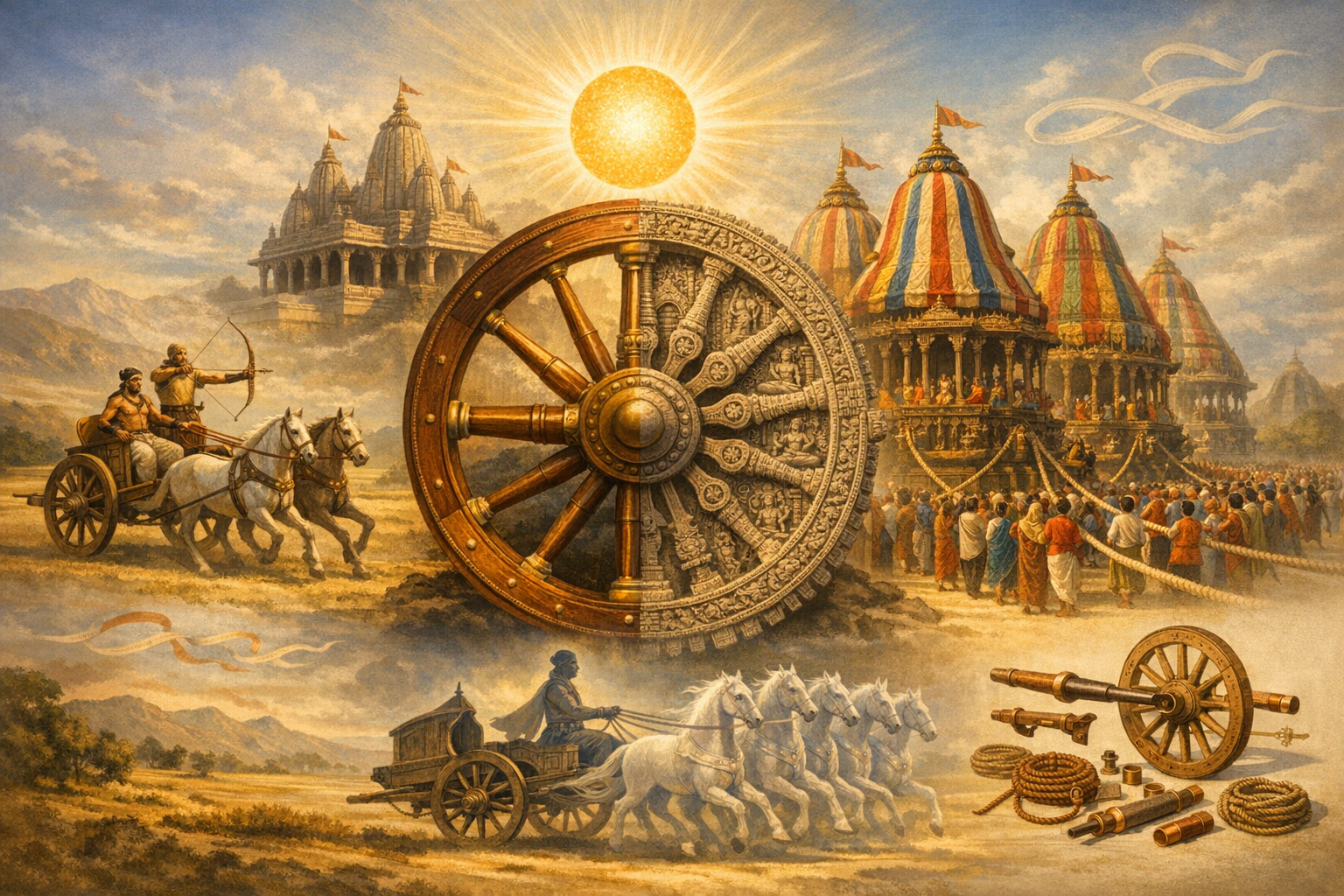
Few technologies have inscribed themselves as deeply into South Asian memory as the ratha, the two-wheeled chariot of ancient India. Long before iron forges and stone temples transformed the subcontinent’s skyline, the quickening rhythm of chariot wheels reverberated through Vedic hymns, epic narratives, and ritual landscapes. In ancient Hinduism, the ratha stood at the confluence of statecraft, sacred procession, and moral philosophyequally at home on the battlefield, in the festival street, and in the pages of scripture.
Earliest attestations of the ratha emerge in the Rigveda, where deities such as Indra and Surya are praised for their chariots, and dawn itselfUṣasmoves with regal motion. These hymns do more than celebrate velocity and power; they offer glimpses of engineering insight and social prestige, placing ratha use among elites and ritual specialists. Across the Vedas and later Sanskrit literature, the chariot’s vocabulary and metaphors proliferate, locating it at the very heart of early Indo-Aryan mobility and imagination.
Archaeology complements yet also complicates this textual record. Iron Age horizons associated with Painted Grey Ware (c. 1200–600 BCE) coincide with a cultural milieu in which horse-drawn vehicles likely served military and ceremonial roles. More recently, discoveries at Sinauli in the Upper Ganga Plain revealed wagon-like vehicles with solid disc wheels and ornate copper fittings. Scholars debate whether these were true horse-drawn, spoked-wheel chariots or ox-drawn ceremonial carts, a reminder that chronology and typology must be handled cautiously. Nevertheless, India’s chariot story, attested in texts and enriched by finds, clearly belongs to a wider Bronze and Iron Age world that prized spoked-wheel mobility.
Technically, the Vedic ratha is best understood as a light, two-wheeled vehicle engineered for speed and agility. Spoked wheels, a wooden chassis, and a yoke harnessing a pair of horses formed the core ensemble. Joinery, leather lashings, and fiber ropes provided resilience; bronze or copper fittings strengthened high-stress joints. Ancient harness systems limited traction per horse, but on firm, level ground the ratha offered extraordinary maneuverability, enabling rapid feints, withdrawals, and archer-based shock.
Chariotry in early India was an institution as much as an instrument. Literature distinguishes roles: the sārathi (charioteer) exercised fine control, the dhanurdhara (archer) projected force, and an attendant might bear shields or spare weapons. The epics and military treatises classify warriorsrathi, mahārathi, and atirathiby skill, endurance, and command. Beyond mere prestige, these titles indexed tactical expectations on the field, reflecting a sophisticated martial ethos within which the ratha was both vehicle and vocation.
Battlefield practice reveals a vivid tactical grammar. Chariots operated in concert with cavalry and elephants, creating combined-arms effects suited to the open plains that favored wheel-borne speed. Formation warfare (vyūha) exploited lanes and flanks, while duels between matched charioteers established both honor and narrative drama. Even so, the ratha’s performance was terrain-sensitive; marsh, forest, and broken ground favored elephants and later, increasingly, cavalry. This reality helps explain why chariots waned as decisive instruments even as their ceremonial and symbolic lives expanded.
The Mahābhārata’s Kurukṣetra War immortalizes the ratha’s tactical and ethical worlds. Duels unfold with rigorous conventions, projectiles arc from standing archers, and the sārathi’s judgment often proves as fateful as the warrior’s bow. The chariot thus becomes a mobile stage upon which dharma-yuddhawar governed by normsplays out, while also serving as the intimate space where courage, grief, and decision converge.
Within that charged space, the Bhagavad Gītā unfolds. Kṛṣṇa, as PārthasārathiArjuna’s charioteertransforms the ratha into a moving sabhā, a council chamber for ethical and metaphysical instruction. The chariot ceases to be a mere instrument of war and becomes a vantage point on action, duty, and liberation. In this sense, the ratha mediates between temporal strategy and timeless counsel, binding martial realism to spiritual clarity.
Upanishadic thought codifies the chariot’s philosophical force. The Kaṭha Upaniṣad’s celebrated allegory makes the body the chariot, the ātman the lord of the chariot, buddhi (intelligence) the charioteer, manas (mind) the reins, the indriyāḥ (senses) the horses, and the sense-objects the roadways. Mastery emerges from disciplined coordination of faculties, not from brute force. This model of ethical psychology resonated across Indian schools, informing pedagogy and practice well beyond its original setting.
Dharmic traditions repeatedly returned to the chariot to frame complex ideas. In Buddhism, the Milindapañha’s “chariot simile” clarifies the doctrine of non-self: just as a chariot is a convention for a collection of parts, so too is the person a conventional designation for aggregates. In Jain communities, ratha-yātrās carry images of tīrthaṅkaras through city streets in acts of devotion and service. While the theological conclusions differ, the shared reliance on the chariot metaphor for moral and metaphysical teaching underscores a deep civilizational vocabulary that unites Hinduism, Buddhism, and Jainism without erasing their distinctions.
Processional culture in Sikh communities likewise preserves the ideal of sacred mobility, notably in Nagar Kīrtans where the Guru Granth Sahib is borne with devotion on elaborately decorated floats. Though not termed ratha, these processions share with ratha-yātrā the conviction that scripture, song, and community belong in public life, weaving a unifying fabric among dharmic traditions through movement, music, and shared streets.
Ritual chariotry reached archetypal expression in the Jagannath Ratha Yatra at Puri, where three monumental wooden chariotsNandighosha (Jagannath), Taladhwaja (Balabhadra), and Darpadalana (Subhadrā)proceed from the main temple to the Gundicha temple. Each chariot, distinguished by its canopy colors and wheel counts, is rebuilt annually by hereditary artisans, encoding craft knowledge into living tradition. The festival’s participatory ethosdevotees drawing the ropes togetherexpresses a public theology of presence: the divine does not recede behind sanctum walls but travels with the people.
Across the subcontinent, the same spirit animates countless ratha-sevās: the great ther processions of Tamil Nadu, rathotsavas in Karnataka, and the Brahmotsavam at Tirumala where the Lord’s utsava-mūrti rides the streets. Solar symbolism adds a cosmic dimension in Ratha Saptamī, the pan-Indian celebration of Sūrya’s seven-horsed chariot and the renewal of light and health with the turning of the agricultural year.
Architecturally, ratha terminology migrated from mobile vehicles to immobile temples. In North Indian (Nāgara) architecture, ratha denotes external vertical projections on a shrine’s planyielding triratha, pañcaratha, or saptaratha layouts depending on the number of offsets. This “ratha-logic” organized light, shadow, and sculptural rhythms on the temple exterior, turning walls into processional surfaces for both deities and devotees.
Iconic monuments rendered the chariot in stone at a grand scale. Konark’s Sun Temple, conceived as Sūrya’s colossal stone ratha with twenty-four intricately carved wheels, fuses astronomy, kingship, and devotion in a single image of cosmic motion. The “stone chariot” at Hampi’s Vijaya Vitthala temple and the monolithic “Pancha Rathas” of Mamallapuram (popularly named for the Pāṇḍavas though not literal vehicles) further illustrate how the chariot became a master motif for temple-makers, translating motion into mass and pilgrimage into permanence.
Economic and social histories also register the ratha’s significance. Rigvedic dānastuti hymns praise lavish gifts that include chariots, horses, and cattle, revealing how vehicles functioned as currency of prestige and reciprocity. In later courts, ceremonial chariots signaled sovereignty during royal entries and public festivals, extending the ratha’s aura from battlefield capital to civic theater.
Equine science and harnessing traditions sustained the institution. Veterinary compendia attributed to Śālihotra, along with Dhanurveda sections embedded in texts such as the Agni Purāṇa, attend to horse care, training, and battlefield conditioning. The sārathi’s competencebalancing reins, terrain, and warrior timingwas as much a moral art as a mechanical one, demanding calm judgment under pressure.
Statecraft codified chariots within the catur-aṅga-bala, the fourfold army of infantry, cavalry, chariots, and elephants. The Arthaśāstra recognizes chariotry as a pillar of royal power while also implying logistical burdens that later favored cavalry in many regions. By the early centuries of the Common Era, chariots in most theaters had ceded tactical primacy, yet their ritual and philosophical functions only deepened, ensuring that the ratha never disappeared from India’s living repertoire.
A comparative lens situates India’s ratha amid Egyptian and Hittite chariot traditions, yet the South Asian trajectory is distinctive in the way a military technology was moralized and sacralized. Texts refashioned the ratha into a vehicle of ethical pedagogy; cities entrusted it with the public face of devotion; and artisans gave it stone memory. Even modern urban processionsHindu ratha-yātrās, Jain festivals, and Sikh Nagar Kīrtansecho a common conviction: what is most revered must circulate, be seen, and gather communities into shared purpose.
Thus the ratha in ancient Hinduism is more than a wheel-borne platform. It is a grammar of movement linking force to responsibility, craft to kingship, and ritual to philosophy. From the thunder of war to the slow roll of festival streets, from the Kaṭha Upaniṣad’s inner chariot to the Jagannath carts of Puri, the ratha continues to carry a civilizational promise: that power, wisdom, and presence can travel togetherand that the road of dharma is best walked, and sometimes rolled, in unity across the dharmic traditions of Hinduism, Buddhism, Jainism, and Sikhism.
Inspired by this post on Hindu Blog.
