-
Powerful Vikata Sankashti Chaturthi, 5 April 2026: Moonrise 9:50 PM, Puja and Vrat Guide

Sankashti Chaturthi in April 2026 occurs on Sunday, 5 April 2026, as Krishna Chaturthi in Chaitra and is observed as Vikata Sankashti Chaturthi. Moonrise for concluding the fast is noted at 9:50 PM IST, with local variations to be confirmed via a reliable Panchang. The vrata emphasizes disciplined worship of Shri Ganesha—offerings of durva, modak,…
-
Swaha’s Fiery Warning to Ravana: A Ramayana Lesson on Dharma, Consent, and Sacred Power

This essay examines the lesser-known Ramayana strand in which Swaha, consort of Agni, curses Ravana, framing Lanka’s burning as karmic consequence for transgressing consent and ritual sanctity. It clarifies Swaha’s role in Vedic ritual as the mantric seal that legitimizes offerings, showing why an affront to the sacred feminine implies ethical and ritual collapse. Cross-references…
-
Sita’s Sacred Resolve: Why Only Rama Could Rescue Her—and What It Teaches About Dharma

Why did Sita insist that only Rama rescue her, even when Hanuman could have carried her to safety? This long-form analysis of Sundara Kanda shows how her decision unites maryada, kshatra-dharma, reputation, and tactical prudence into a single, coherent ethic. Drawing on Valmiki Ramayana and key regional traditions, it explains why justice in the Ramayana…
-
Knower of the Field: Cutting-Edge Insights into Consciousness, Experience, and Dharmic Unity

This essay examines consciousness through the Bhagavad-Gita’s kshetra–kshetrajna lens and connects it with current neuroscience and philosophy of mind. It clarifies arousal versus awareness, reviews global neuronal workspace and integrated information theory, and explains how predictive and recurrent processing shape experience. Drawing on cell biology, it traces how neuronal excitability, glial modulation, and plasticity ground…
-
Person or Energy? Find Clarity in a Dharmic Synthesis across Vedanta, Buddhism, Jainism, Sikhism

This essay clarifies whether the Divine is best understood as Person or Energy by synthesizing perspectives from Vedanta, Buddhism, Jainism, and Sikhism. It defines key terms (Brahman, purusha, shakti, prana) and shows how saguna–nirguna, nirgun–sargun, and anekantavada converge in a coherent framework. Readers gain a precise yet accessible model that honors both devotional intimacy and…
-
Arjuna’s Dilemma and the Power of Svadharma: Choosing Authentic Duty Over Escapism

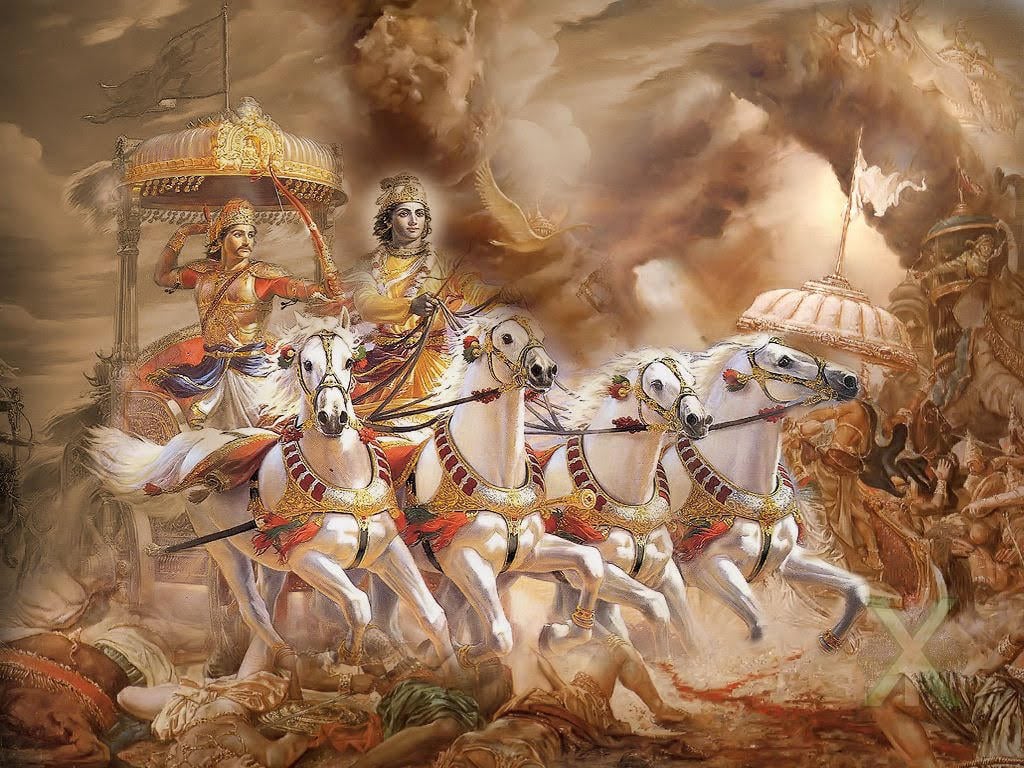
The Mahabharata’s portrayal of Arjuna reveals why authentic duty (svadharma) outperforms artificial renunciation over the long term. By aligning action with intrinsic disposition (svabhava) and practicing karma yoga, individuals gain inner steadiness, ethical clarity, and resilience. This insight, far from endorsing aggression, exemplifies Dharma-Yuddha—protective duty guided by compassion, proportionality, and the common good. Parallel teachings…
-
Pure Mind Beyond Desire: A Rigorous Path to Moksha in the Gita, Upanishads, and Yoga

This article offers a rigorous, text-anchored exploration of the Hindu ideal of a pure mind free from desire, linking it to moksha in the Bhagavad Gita, the Upanishads, and Patanjali’s Yogasutra. It clarifies the difference between eliminating compulsive craving and nurturing dharma-aligned intention, avoiding the common pitfall of suppression or nihilism. Readers gain a practical…
-
Show the Path, Not Carry the Burden: Empowering Dharmic Wisdom for Inner Freedom

Across Hinduism, Buddhism, Jainism, and Sikhism, a unifying principle prevails: sages can show the path, but seekers must walk it. The essay grounds this ethic in the Bhagavad Gita, Upanishads, Dhammapada, Jain Tattvartha-sutra, and Sikh teachings, explaining how grace, community, and guidance support but never replace personal agency. Technical concepts such as svadharma, adhikara-bheda, abhyasa–vairagya,…
-
Shiva at the Margins: Why Mahadeva Reigns Over Ghosts, Outcasts, and Sacred Transgression

Shiva’s dwelling in cremation grounds and sovereignty over bhuta-ganas present a theology of fearless inclusion that dignifies what societies often cast aside. By tracing the arc from Vedic Rudra to Puranic Shiva, the discussion shows how ashes, serpents, and the smashana encode teachings on impermanence and compassion. Bhairava’s guardianship of thresholds clarifies why time, change,…
-
Vishukkani Darshan: Timeless Ritual Science, Solar New Year, and Kerala’s Sacred Abundance

Vishukkani Darshan—Kerala’s sacred first sight on the Solar New Year—unites ritual, ecology, and ethics in a luminous dawn tableau. The arrangement features konna pua, a bronze Uruli with rice, seasonal fruits and vegetables, a nilavilakku, a mirror, gold or coins, and a revered text. Celebrated at Mesha Sankramana (mid-April), it aligns eyes and mind with…
-
Master Your Breath, Still Your Mind: Kapila’s Precise Yogic Protocol in SB 3.28.8

SB 3.28.8 presents Kapila’s concise blueprint for meditation: a sanctified, secluded space; an easy, erect posture (svasti samāsīnaḥ); and regulated breath control. The verse aligns environment, asana, and pranayama to quiet the senses and stabilize attention for dhyana. Practical guidance includes seat preparation, spinal alignment, and gentle ratios such as 4–4 progressing to 4–6 exhalations.…
-
Once Tasted, Never Lost: The Transformative Power of Rasa-Graha in Bhakti-Yoga

This article examines the Gaudiya Vaishnava principle of rasa-graha—once the joy of devotion to Krishna is genuinely tasted, one cannot fully return to a purely material life. Grounded in the Śrīmad-Bhāgavatam (SB 1.5.17–19), it explains why a devotee who appears to fall does not become “ordinary” again: powerful bhakti-saṁskāras repeatedly draw the heart back to…
-
From Atheism to Bhakti: How Srila Prabhupada Guided Visakha Devi Dasi Toward Lasting Fulfillment

This long-form analysis traces Visakha Devi Dasi’s movement from atheism to Bhakti Yoga through Srila Prabhupada’s guidance, situating her experience within Vedic philosophy and contemporary inquiry. It explains how structured practices—chanting, study, seva, and community—offer a replicable methodology for lasting fulfillment. The discussion clarifies the ninefold processes of bhakti, the epistemic role of the Guru-Shishya…
-
Shakini of the Vishuddhi Chakra: Bone-Breaking Power in Kubjika and Kularnava Tantras

Shakini, the yogini of the Vishuddhi Chakra, is celebrated in the Kubjika Mata Tantra and the Kularnava Tantra as the luminous power that purifies speech, refines breath, and clarifies understanding. Her epithet “bone-breaking” signals not violence but compassionate reshaping of inner rigidity, enabling truthful and compassionate voice. Rooted in matrika doctrine, she governs the vowels…
-
Resisting the Dream‑Big Mandate: The Liberating Dharma, Joy, and Science of Wanting Less

This essay interrogates the cultural pressure to “dream big” and shows, with research and Dharmic insight, why wanting less can enhance well-being. It traces how social comparison and positional goods narrow youthful aspirations into a single script centered on status and income. Drawing on hedonic adaptation and self-determination theory, it explains why material gains often…
-
Nilasukta Unveiled: Nila Devi’s Compassionate Radiance in a Vedic Hymn of the Taittiriya Samhita

Nilasukta (Nila Sukta) is a Krishna Yajurveda hymn linked to the Taittiriya Samhita that venerates Nila Devi, the compassion-aspect of Vishnu’s shakti. Drawing on the cosmic symbolism of Surya, Chandra, and Agni, it frames compassion as ethical clarity, serene poise, and transformative warmth. The article clarifies its textual transmission, triadic theology (Sri–Bhu–Nila), and ritual use…
-
Rama Katha: Scholarly, Soul-Stirring Life History of Sri Rama, the Maryada Purushottama

This comprehensive Rama Katha presents a scholarly yet accessible life history of Sri Rama, the Maryada Purushottama, rooted in Valmiki Ramayana and allied traditions. Readers gain a clear overview of the seven kandas, from Ayodhya and vanvas to the Setubandha, Yuddha Kanda, and Sri Rama Pattabhishekam. Ethical complexities—such as Vali-vadha and the Agni Pariksha—are examined…
-
Non-attachment, Not Apathy: A Dharma-Based Guide to Compassionate Action in Hinduism

Non-attachment in Hinduism is often mistaken for apathy, yet classical sources show it is the basis for lucid, compassionate action. The Bhagavad Gita’s niṣkāma karma, Patañjali’s abhyāsa–vairāgya, and the Īśā Upaniṣad’s ethos of enjoyment through renunciation all unite clarity with care. Distinguishing vairāgya and anāsakti from indifference reveals a sattvic, not tamasic, quality—a stance that…
-
April 10, 2026 Panchang: Krishna Paksha Ashtami→Navami, Auspicious Muhurats, Nakshatra & Rashi

On Friday, April 10, 2026, the Hindu Panchang shows Krishna Paksha Ashtami until 7:34 PM IST, followed by Krishna Paksha Navami. The article explains tithi scientifically as 12-degree lunar elongations, clarifies why timings vary by location, and outlines how drik calculations with Lahiri ayanamsa are used. It details practical muhurta selection—Abhijit Muhurat, Choghadiya (with Friday’s…