-
Sitayana: A Powerful Ramayana Retelling Celebrating Sita’s Courage, Grace, and Dharma

Sitayana presents the Ramayana through Ma Sita Devi’s perspective, highlighting courage, grace, and dharma with academic clarity and devotional warmth. It complements classical tellings by foregrounding Sita’s agency, compassion, and steadfastness during exile and separation. Readers gain ethical insights grounded in shared dharmic values that resonate across Hinduism, Buddhism, Jainism, and Sikhism. The text enriches…
-
Thirumana Kandam Explained: The Sita Kalyanam Chapter Shaping Living Ramayana Devotion

Thirumana Kandam is a devotional, standalone presentation of Sita Kalyanam that does not exist as a separate kanda in the Sri Valmiki Ramayana but highlights the wedding narrative found in Bala Kanda. Traditional accounts place its composition with a Sanskrit scholar about a century ago as a gesture of gratitude to Prabhu Sri Rama. The…
-
Mahidhara of Kashi: The 16th‑Century Vedic Exegete Who Illuminated the Shukla Yajur Veda

Mahidhara, a seminal 16th-century scholar from Kashi (Varanasi), shaped the study of the Shukla Yajur Veda through his Vedadipa, a lucid commentary on the Madhyandina Samhita. The work blends textual precision with ritual context, making complex mantras intelligible to students, practitioners, and researchers. Readers benefit from a model of Vedic exegesis that transmits tradition without…
-
Kashyapa Samhita & Smriti: Unraveling Dharma’s Timeless Blueprint for Ethical Life

Ancient Indian literature remembers the Kashyapa Samhita and Kashyapa Smriti through later citations, signaling their importance in the Dharmasastra tradition. Though not fully extant, these works likely addressed ritual, ethics, jurisprudence, and social duty, shaping the Hindu legal system and cultural heritage. Readers gain clarity on how dharma was transmitted intertextually—through compendia and commentaries that…
-
Agni’s Gift to Durga: The Sacred Spear of Shakti and the Transformative Fire of Wisdom

Agni’s gift of the spear (Borsha) to Goddess Durga, as narrated in the Devi Mahatmya, signifies the union of righteous strength with purifying wisdom. The spear’s straight shaft symbolizes disciplined focus, and its tip stands for discriminative insight that pierces ignorance. Ritual experiences—from āratī to Navaratri celebrations—invite practitioners to internalize this clarity in ethical action.…
-
Mahāvīra Earthen Pot in Pravargya: Sacred Fire, Sun Symbolism, and Vedic Precision

The Mahāvīra earthen pot is the central vessel of the Pravargya rite, an ancillary but potent phase of the Soma sacrifice in the Vedic tradition. Heated to an intense glow, it boils fresh milk that becomes the gharmá offering, energizing the entire yajña. Prepared by the adhvaryu according to the Śrauta Sūtras, the vessel’s design,…
-
Transcending Duality in Srimad Bhagavatam 7.13: Saintly Python and Perfect Krishna Consciousness

Srimad Bhagavatam 7.13.41–42 presents a disciplined ideal of conduct through the emblem of a saintly python, emphasizing acceptance, equanimity, and focused remembrance of Sri Krishna. The teaching reframes obsession with good-versus-bad as a distraction born of duality, urging a return to love and steady devotion. This focus on inner poise aligns with Advaita’s discernment beyond…
-
Four Yugas, Four Marvelous Cities: Vishwakarma’s Vision and the Elusive Quest for Peace

Hinduism’s narratives of Vishwakarma’s four cities across the Four Yugas reveal a striking truth: celestial architecture cannot guarantee inner peace. Set within the cyclical moral texture of Satya, Treta, Dvapara, and Kali, these cities reflect the era’s ethics more than their own splendor. The Puranas and related ancient texts show that sacred geometry and urban…
-
Vajra in Durga’s Hands: Indestructible Power, Sacred Courage, and Dharmic Unity

The Vajra in Goddess Durga’s hands symbolizes indestructible power guided by wisdom, as narrated in the Devi Mahatmyam of the Markandeya Purana. Indra’s gift of the thunderbolt links Durga’s protective mission with earlier Vedic and puranic themes of sacrifice, courage, and cosmic balance. Readers gain a clear understanding of how the Vajra denotes sudden illumination,…
-
Why Shiva Gave His Golden Palace to Ravana—Timeless Lessons on Detachment and Karma

This exploration of Shiva gifting a golden palace to Ravana distills a powerful lesson in detachment, karma, and dharma. Drawing on Puranic variations, it shows how Shiva’s non-attachment contrasts with Ravana’s intensifying desire, turning a boon into a test of character. The analysis connects seamlessly with Buddhist insights on clinging, Jain aparigraha, and Sikh cautions…
-
When Ravana Became Rama: A Brief Awakening to Dharma and the Transformative Power of Virtue

This exploration of a lesser-known Ramayana motif—Ravana assuming Rama’s form—examines how virtue resists imitation and demands inner transformation. By situating the episode in the ethical drama of Sita’s steadfastness in the Ashoka grove, it shows how adharma collapses under the weight of authentic dharma. The analysis highlights literary, psychological, and philosophical dimensions, clarifying the difference…
-
Agni Within: Unlocking SB 3.26.40 on Fire, Digestion, Ayurveda, and Spiritual Vitality

Srimad-Bhagavatam 3.26.40 portrays fire as a transformative force that illuminates, warms, cooks, and digests, while awakening hunger and thirst as drivers of growth. Drawing on insights shared by HG Narayani Dasi, the reflection links Agni with Ayurveda’s Jatharagni and Yoga’s Tapas and Prana to show how balanced digestive fire sustains vitality and clarity. The analysis…
-
Lotus of Wisdom in Durga’s Hand: Padma, Shakti, and the Defeat of Mahishasura

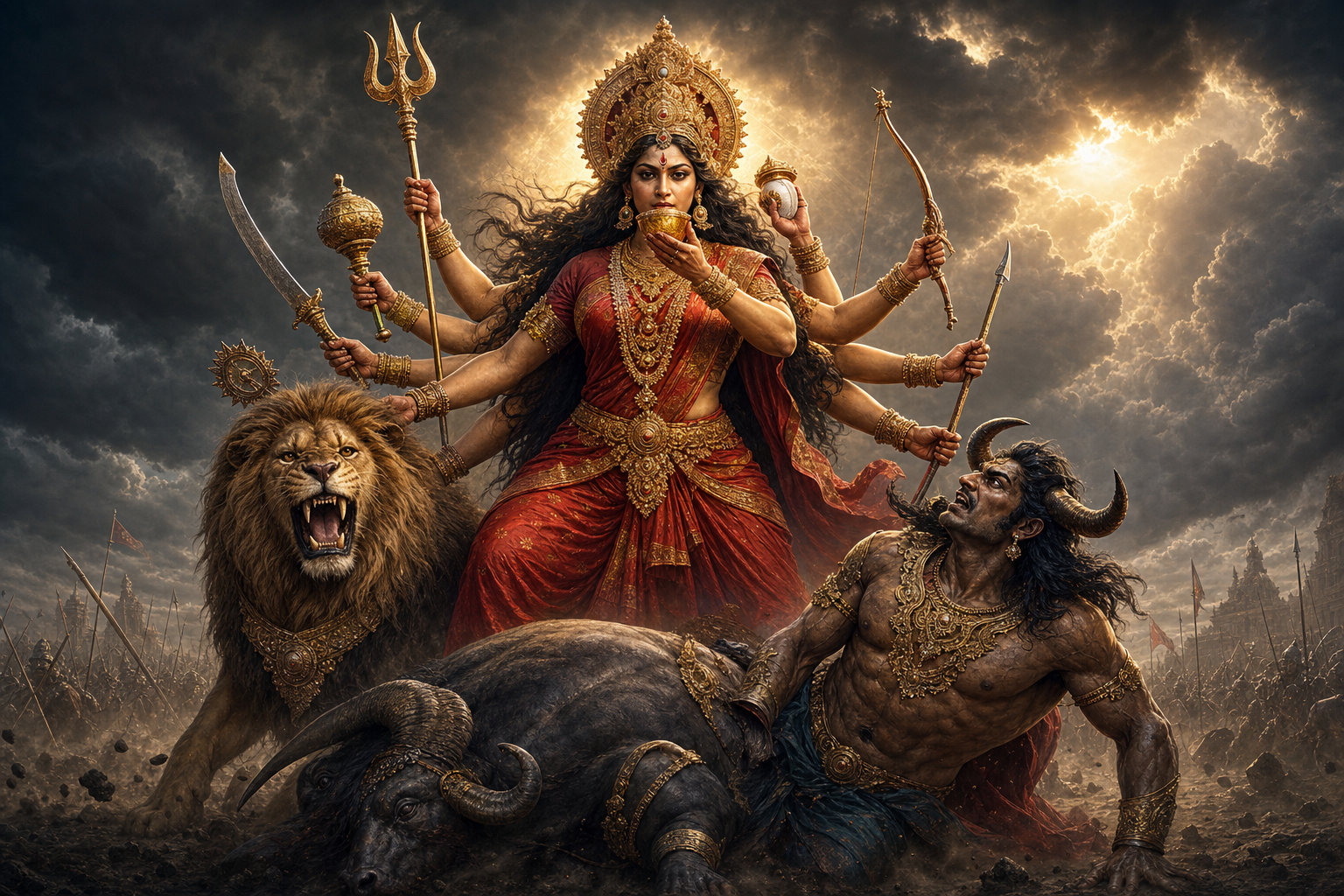
Goddess Durga’s Padma (lotus) in the Devi Mahatmya is more than ornament—it is a compass of consciousness guiding Shakti’s righteous action against Mahishasura. The lotus’s rise from mud to light illustrates clarity amidst chaos and courage tempered by wisdom. Across Hinduism, Buddhism, Jainism, and Sikhism, the shared lotus motif promotes unity, detachment, and compassionate awareness.…
-
Shvetadvipa Beyond Meru: Unveiling the White Island’s Sacred Symbolism and Unity

Shvetadvipa, the “White Island” beyond Mount Meru in the Mahabharata’s Shanti Parva, is presented as a luminous symbol of sattva, bhakti, and inner transcendence. Narada’s journey to this realm reveals a community grounded in remembrance of Narayana and compassionate discipline. Read as sacred cartography of consciousness, the narrative guides seekers beyond rajas and tamas toward…
-
Mahamaya’s Triumphant Illusion: How Adi Shakti Humbled Madhu-Kaitabha and Ego
The Devi Mahatmyam’s account of Mahamaya and the defeat of Madhu–Kaitabha illuminates how Adi Shakti restores balance when arrogance threatens creation. The narrative shows Maya as both veil and revealer, empowering discernment (viveka) and humility over ego. Readers gain a clear retelling of the episode, a careful unpacking of Hindu symbolism, and practical ways to…
-
Unveiling Molten Gold Radiance: The Symbolic Power of Goddess Durga’s Golden Skin

Hindu scriptures portray Goddess Durga with a golden, molten radiance that signifies purity, tejas, and protective power. This essay decodes that symbolism, showing how gold connotes incorruptibility and transformative wisdom aligned with dharma. It connects scriptural insight to living traditions—especially Navaratri and Durga Puja—where light, alankara, and community devotion make theology tangible. The discussion integrates…