Category: Philosophy

  • Hamsa Ksheera Nyaya Explained: Cultivating Wise Discernment Across Dharmic Traditions

    Hamsa Ksheera Nyaya Explained: Cultivating Wise Discernment Across Dharmic Traditions

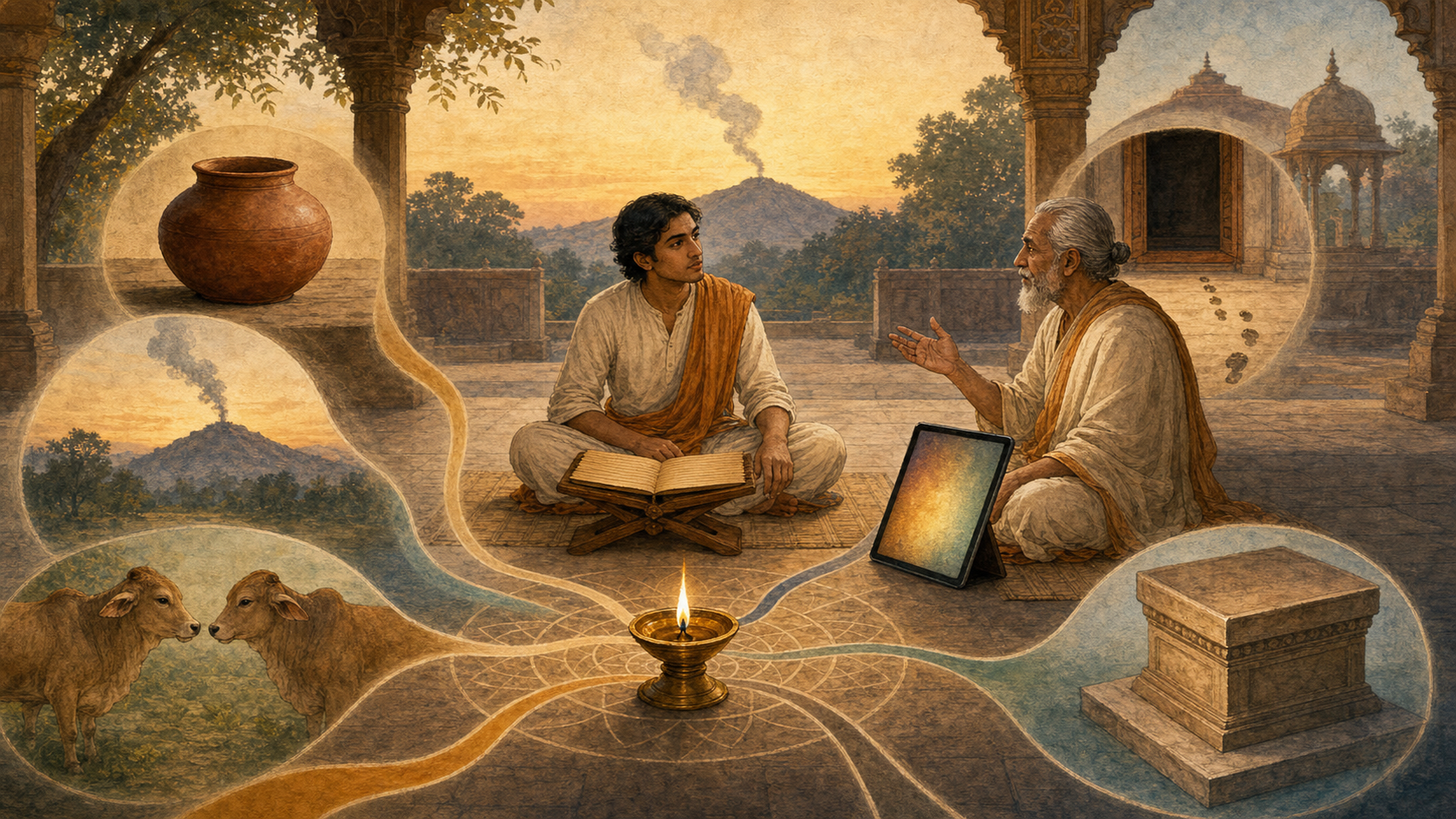
    Hamsa Ksheera Nyaya—the swan’s ability to separate milk from water—offers a powerful model of discernment in Hindu philosophy and allied Dharmic traditions. It refines judgment (viveka), aligning truth-seeking with ethical clarity and practical wisdom. Drawing on the Upanishads, Vedanta, and Nyaya, this maxim translates into daily skills for navigating information overload, relationships, and moral complexity.…

  • Soham Hamsah Explained: The Transformative Mantra of Oneness, Breath, and Inner Peace

    Soham Hamsah Explained: The Transformative Mantra of Oneness, Breath, and Inner Peace

    “Soham Hamsah” embodies an Advaita Vedanta insight: the unity of jivatma and paramatma realized through breath-aware mantra meditation. By aligning the natural rhythm of inhalation and exhalation with an inner mantra, practitioners cultivate calm, clarity, and discernment. The practice remains gentle and accessible while deepening mindfulness and ethical responsiveness. Cross-dharmic resonances—with Buddhist ānāpānasati, Jain samayik,…

  • Silent Victory: Redefining Success Through Dharma, Inner Peace, and Pluralistic Unity

    Silent Victory: Redefining Success Through Dharma, Inner Peace, and Pluralistic Unity

    This reflection redefines victory beyond visibility and dominance, grounding it in Dharma, inner peace, and responsible action. It emphasizes context-sensitive discernment, resonant with Srila Prabhupada’s guidance and shared across dharmic traditions. Readers discover how equanimity, compassion, and ethical conduct constitute a lasting success that does not polarize. The discussion connects teachings from the Bhagavad Gita…

  • Is Consciousness Within? Sri Sri Ravishankar’s Transformative Insight for Daily Awareness

    Is Consciousness Within? Sri Sri Ravishankar’s Transformative Insight for Daily Awareness

    A disciple once asked Sri Sri Ravishankar, “Is there consciousness within me?” The reply pointed to immediate experience: awareness is what allows one to ask, hear, and see. This simple recognition invites a rigorous, experiential understanding central to Hindu philosophy and in harmony with Buddhism, Jainism, and Sikhism. The insight is practical: by noticing breath…

  • Let Curiosity Guide the Heart: Timeless Hindu Wisdom for a Unified Dharmic Journey

    Let Curiosity Guide the Heart: Timeless Hindu Wisdom for a Unified Dharmic Journey

    Curiosity in ancient Hindu wisdom is not idle questioning but sacred inquiry that guides ethical living and Self-Realization. Across the dharmic traditions of Hinduism, Buddhism, Jainism, and Sikhism, disciplined curiosity unites intellectual rigor with compassion. Drawing on the Upanishads, the Bhagavad Gita, Yoga, anekantavada, and reflective practices, this piece shows how curiosity can deepen devotion,…

  • Unveiling the Unmanifest (Avyakta): A Clear Guide to the Eternal Self in Hindu Thought

    Unveiling the Unmanifest (Avyakta): A Clear Guide to the Eternal Self in Hindu Thought

    This article clarifies the Hindu concept of the unmanifest—”avyakta”—as reality beyond sensory perception and change. It explains how classical sources like the Upanishads and the Bhagavad Gita describe a timeless ground of being that illumines experience without becoming an object of experience. Readers learn how practices such as pratyahara and meditation reveal a lucid, steady…

  • Six Profound Transformations of Life: A Dharmic Guide to the Eternal Self Beyond Change

    Six Profound Transformations of Life: A Dharmic Guide to the Eternal Self Beyond Change

    Hindu scriptures teach that embodied life unfolds through six universal transformations—existence, birth, growth, decay, disease, and death—while pointing to the atman beyond change. Seeing these phases clearly reduces fear, strengthens resilience, and fosters compassionate conduct guided by dharma. Parallel insights in Buddhism, Jainism, and Sikhism reinforce impermanence, many-sided truth, and alignment with divine order, cultivating…

  • Vīra Swarga Explained: The Uplifting Hindu Ideal of Dharma, Courage, and Sacred Sacrifice

    Vīra Swarga Explained: The Uplifting Hindu Ideal of Dharma, Courage, and Sacred Sacrifice

    Vīra Swarga, the “Heaven of Heroes,” illuminates a central Hindu philosophical ideal: selfless courage in service of dharma. It affirms valor only within strict ethical bounds—protection of innocents, restraint, and last resort—echoing the Bhagavad Gita and Kshatra Dharma. Distinguished from moksha, it represents a meritorious heavenly state that honors noble sacrifice while encouraging continued spiritual…

  • Varṇa–Āśrama as Cooperative Dharma: Harmonizing Wisdom and Power for Spiritual Ascent

    Varṇa–Āśrama as Cooperative Dharma: Harmonizing Wisdom and Power for Spiritual Ascent

    Srimad Bhagavatam (3.22.4) presents varṇa–āśrama as a cooperative system that harmonizes wisdom and power for social harmony and spiritual ascent. Brāhmaṇas offer ethical counsel while kṣatriyas provide protection, creating principled governance and knowledge that benefits society. This reciprocity nurtures lokasaṅgraha and encourages inclusive upliftment. The model resonates across Buddhism, Jainism, and Sikhism, where wisdom and…

  • Life’s Long Journey: Harness Daily Opportunities for Transformative Change through Dharmic Wisdom

    Life’s Long Journey: Harness Daily Opportunities for Transformative Change through Dharmic Wisdom

    This essay frames a classic Hindu teaching—each day offers a chance to change—within a dharmic, academically grounded perspective. It explains how small, consistent actions reshape samskara, aligning daily life with Dharma and karma-yoga. Drawing on the Bhagavad Gita and the Upanishads, it shows how Mindfulness, Meditation, and Yoga convert insight into routine resilience. Parallels with…

  • Parashurama, Balarama, Sri Rama: Mapping Humanity’s Ascent from Force to Righteousness

    Parashurama, Balarama, Sri Rama: Mapping Humanity’s Ascent from Force to Righteousness

    Hindu scriptures present an integrated model of moral evolution through Parashurama, Balarama, and Sri Rama. Together, these avatars map a movement from raw force to cultivated strength and ultimately to principled righteousness. Parashurama encodes the courageous correction of entrenched adharma. Balarama anchors strength in restraint, agriculture, and social balance. Sri Rama perfects the arc through…

  • Gunatita Explained: Rise Beyond Sattva, Rajas, and Tamas for Unshakable Inner Freedom

    Gunatita Explained: Rise Beyond Sattva, Rajas, and Tamas for Unshakable Inner Freedom

    Gunatita, a core concept in Hindu philosophy, describes freedom from the three gunas—Sattva, Rajas, and Tamas—that bind the jiva to samsara. The Bhagavad Gita portrays the gunatita individual as steady in equanimity, acting from dharma without compulsion. Practical disciplines—meditation, mantra japa, mindful action, and reflective study—strengthen Sattva and tame reactivity. This state enhances emotional resilience,…

  • Anger Distracts from Solutions: Dharmic Wisdom for Clear Thinking and Inner Peace

    Anger Distracts from Solutions: Dharmic Wisdom for Clear Thinking and Inner Peace

    Hindu philosophy—and related dharmic traditions—teach that anger clouds intellect, drains attention, and diverts energy from the real problem. The Bhagavad Gita maps this precisely: anger breeds confusion, weakens memory, and undermines judgment. Across Buddhism, Jainism, and Sikhism, practices of mindfulness, forgiveness, and living without enmity offer practical antidotes. In everyday contexts—at work, at home, and…

  • From Superhuman to Frankenstein? Reclaiming Dharma in a Material Age

    From Superhuman to Frankenstein? Reclaiming Dharma in a Material Age

    Humanity faces a defining choice between fragmented augmentation and integrated inner growth. Drawing on Hinduism, Buddhism, Jainism, and Sikhism, this piece outlines a dharmic roadmap for aligning technology and power with wisdom, restraint, and compassion. It explains how practices like meditation, pranayama, and seva cultivate clarity and purpose while advancing social wellbeing. The analysis reframes…

  • Sankhya Philosophy Explained: A Timeless, Rational Roadmap to Absolute Reality

    Sankhya Philosophy Explained: A Timeless, Rational Roadmap to Absolute Reality

    Sankhya offers a clear, rational pathway for understanding absolute reality within Hindu philosophy. By distinguishing Purusha (consciousness) from Prakriti (nature), it explains both experience and liberation. Its ordered model of tattvas and emphasis on valid knowledge make it a rigorous system rather than speculation. The philosophy directly supports Yoga’s practical methods for inner transformation and…

  • Awaken Inner Awareness: Sri Sri Ravi Shankar on the Proof of Consciousness Within

    Awaken Inner Awareness: Sri Sri Ravi Shankar on the Proof of Consciousness Within

    A disciple asked Sri Sri Ravishankar, “Is there consciousness within me?” The response revealed a precise truth: the ability to ask, hear, and understand already confirms awareness. This insight aligns with Hindu philosophy and echoes across Buddhism, Jainism, and Sikhism, highlighting unity in spiritual diversity. Practical methods—conscious breathing, sensory noticing, and brief pauses—make this recognition…

  • No Soul Is Ever Lost: Hinduism’s Compassionate Path to Liberation Beyond Fear

    No Soul Is Ever Lost: Hinduism’s Compassionate Path to Liberation Beyond Fear

    Hinduism affirms that no soul is eternally doomed; every jiva progresses through samsara toward moksha through karma, dharma, and disciplined practice. This non-eternalist vision frames suffering as corrective and finite, not permanent punishment. Upanishadic and Bhagavad Gita teachings support moral agency over fatalism, inviting steady self-cultivation. Parallel perspectives in Buddhism, Jainism, and Sikhism further strengthen…

  • Vasudhaiva Kutumbakam: Embracing One Global Family through Dharmic Unity and Compassion

    Vasudhaiva Kutumbakam: Embracing One Global Family through Dharmic Unity and Compassion

    Vasudhaiva Kutumbakam—“the whole world is one family”—offers a timeless, practical ethic for unity in diversity. Drawing on Hindu, Buddhist, Jain, and Sikh insights, it fosters interfaith harmony, mutual respect, and community cohesion. Audiences often recognize that its spirit already animates family rituals, seva, and inclusive festivals. The principle aligns with ahimsa, anekāntavāda, metta, and sarbat…

  • If Something Changes Your Life, Let It: Dharmic Wisdom to Cultivate Resilience and Grace

    If Something Changes Your Life, Let It: Dharmic Wisdom to Cultivate Resilience and Grace

    The reflection “If something changes your life, let it” expresses a core dharmic insight shared by Hinduism, Buddhism, Jainism, and Sikhism: change, met with discernment and non-attachment, catalyzes spiritual growth. Drawing from the Bhagavad Gita, Patanjali’s Yoga Sutra, anicca, Anekantavada, Hukam, and Chardi Kala, the post outlines a practical path—pause, breathe, discern, act ethically, reflect—to…

  • Enlightenment Meets Dharma: Uniting Dharmic Paths with Krishna-Conscious Compassion

    Enlightenment Meets Dharma: Uniting Dharmic Paths with Krishna-Conscious Compassion

    This reflection presents Krishna consciousness as a bridge to universal values that resonate across Hinduism, Buddhism, Jainism, and Sikhism. It explains how Vedic principles harmonize with compassion, dignity, protection of life, and the cultivation of wisdom. The discussion highlights ahimsa, karuna, maitri, and seva as practical, everyday commitments that build social cohesion. It emphasizes ethical…