Category: Philosophy

  • Understanding ‘Sin’ in Hinduism: Karma, Dharma, and the Compassionate Nature of the Divine

    This article reframes “sin” through a Hindu lens grounded in the Bhagavad Gita, clarifying that moral error arises from misalignment with dharma rather than divine anger. It explains pāpa and puṇya, the role of karma, and the compassionate nature of the Divine. Readers gain a structured, hopeful path to self-correction via prāyaścitta, ahimsa, and the…

  • Life as Transmigration: Profound Hindu Wisdom on Samsara, Desire, and Inner Freedom

    Life as Transmigration: Profound Hindu Wisdom on Samsara, Desire, and Inner Freedom

    This reflection examines life as a transmigratory process through the shared dharmic lens of Hinduism, Buddhism, Jainism, and Sikhism. It explains samsara, karma, and desire as drivers of restlessness while clarifying how dharma orients artha and kama toward moksha. Readers gain practical insights into unifying disciplines such as dhyana, anapanasati, samayik, and simran that cultivate…

  • Sanatana Dharma Unveiled: Living the Eternal Philosophy of Unity, Duty, and Harmony

    Sanatana Dharma is presented as an eternal, living philosophy that prioritizes ethical action over mere belief. It unites Hinduism, Buddhism, Jainism, and Sikhism around shared values such as compassion, self-discipline, and respect for diverse paths. The philosophy emphasizes daily practices—truthfulness, non-violence, generosity, and service—that strengthen personal integrity and social cohesion. Concepts like Ishta and loka-saṅgraha…

  • Six Grave Offenders in Vasistha Smriti: Timeless Dharma Principles to Protect Life and Justice

    Six Grave Offenders in Vasistha Smriti: Timeless Dharma Principles to Protect Life and Justice

    The Vasistha Smriti identifies six grave offenders—ṣaḍ-ātātāyinaḥ—whose actions pose immediate threats to life, dignity, and community stability. Framed within the Dharmashastra tradition, these categories (poisoner, arsonist, lethal assailant, plunderer, land-grabber, and abductor/violator) articulate a calibrated ethic of protection rather than retribution. The underlying principles—preservation of life, deterrence of extreme harm, and responsibility of governance—parallel modern…

  • Why a Disciplined Mind Outshines Any Army: Timeless Dharmic Wisdom for Inner Power

    Why a Disciplined Mind Outshines Any Army: Timeless Dharmic Wisdom for Inner Power

    The saying, “A well-trained and controlled mind is better than a powerful army,” captures a core dharmic insight: inner discipline surpasses external force. Rooted in the Bhagavad Gita and Raja Yoga, this principle is echoed across Buddhism, Jainism, and Sikhism through practices like mindfulness, Ahimsa, Simran, and Seva. Practical applications—calm communication, measured leadership, and ethical…

  • Why the Divine Answers to Every Name: Hindu Wisdom on Ishta and Radical Inclusivity

    Why the Divine Answers to Every Name: Hindu Wisdom on Ishta and Radical Inclusivity

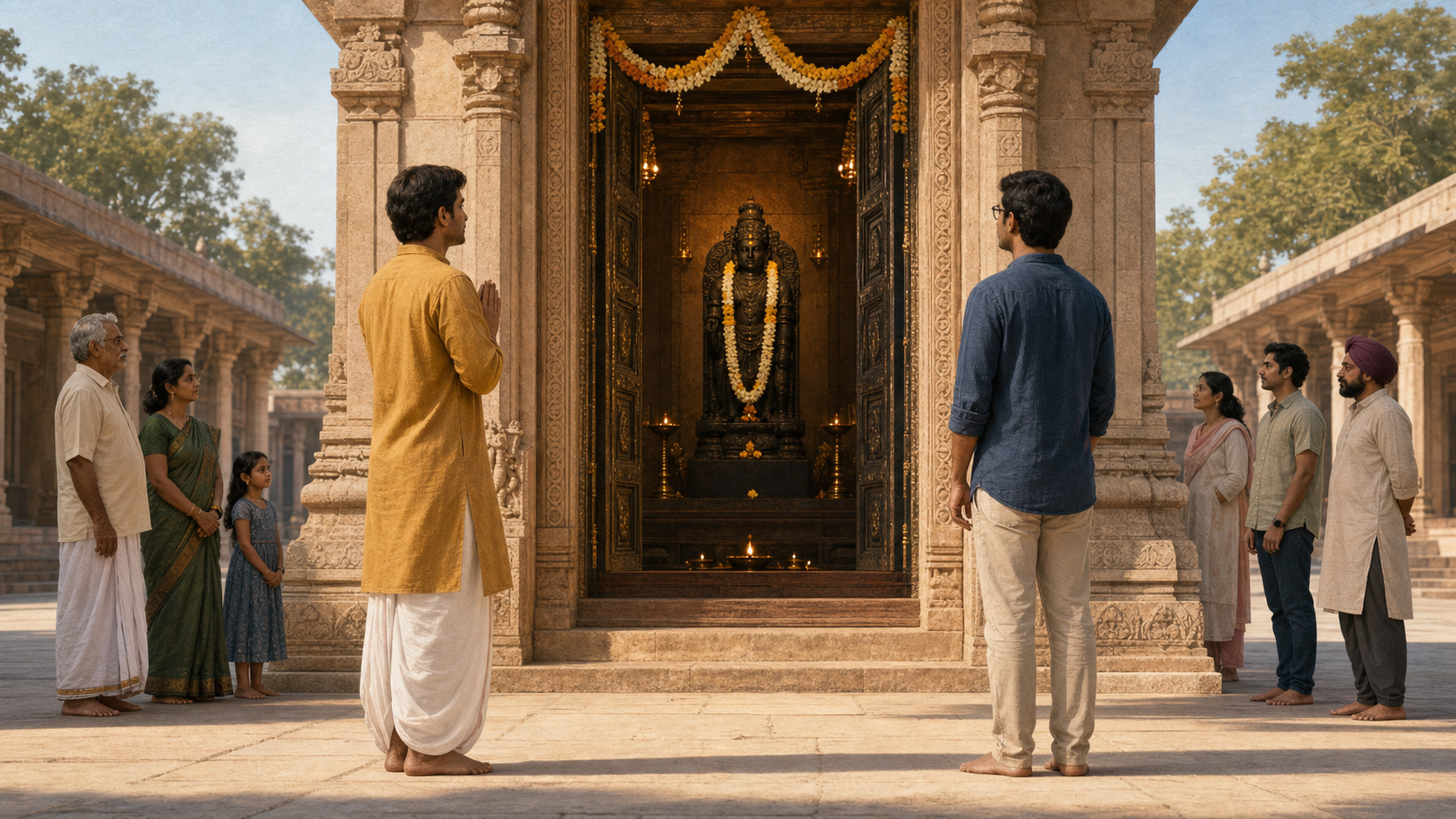
    This article explains a core Hindu teaching: the Divine responds to sincere devotion regardless of the name, language, or pronunciation used. Drawing on the doctrine of Ishta and resonances from the Bhagavad-Gita, it shows why intention and inner feeling outweigh verbal precision. It situates this insight within the broader dharmic family—Hinduism, Buddhism, Jainism, and Sikhism—highlighting…

  • Gitartha Sangraha: Yamunacharya’s 32-Verse Masterpiece for Gita Clarity and Self-Realization

    Gitartha Sangraha distills the Bhagavad Gita into 32 precise Sanskrit verses, offering a clear, memorable pathway through karma-yoga, jñāna-yoga, and bhakti-yoga. Composed by Yamunacharya (Alavandar), it anticipates the Vishishtadvaita contours later systematized by Ramanujacharya. The text bridges rigorous study and practical sādhanā, aiding memorization, reflection, and ethical decision-making. Its succinct form supports learners, scholars, and…

  • Poetry as an Arrow: Devotion That Pierces the Heart and Spins the Mind in Bhakti

    Poetry as an Arrow: Devotion That Pierces the Heart and Spins the Mind in Bhakti

    A timeless aphorism frames a dharmic insight: true poetry and devotion should stir both heart and mind. This piece explores how bhajans, shabads, gathas, and stavans act like a bowman’s arrow—precise, transformative, and unifying across Hinduism, Buddhism, Jainism, and Sikhism. Readers gain an academic yet accessible understanding of why emotional resonance must be joined with…

  • Deeds Over Birth: Transformative Dharmic Wisdom on Karma, Dharma, and Social Equality

    Deeds Over Birth: Transformative Dharmic Wisdom on Karma, Dharma, and Social Equality

    This post examines the dharmic teaching that dignity arises from deeds—not birth—and explains its roots in karma and dharma. It shows how Hinduism, Buddhism, Jainism, and Sikhism converge on this ethic, reinforcing unity in spiritual diversity. The narrative explores symbolism such as the wheel of karma and the scale of dharma to illustrate inner transformation.…

  • The Potter’s Gift and the Wasted Vessel: Hinduism’s Powerful Life Symbol and a Call to Purpose

    The Potter’s Gift and the Wasted Vessel: Hinduism’s Powerful Life Symbol and a Call to Purpose

    The parable of the potter and the pot in Hinduism teaches that human life is a carefully crafted vessel meant to hold wisdom, compassion, and purposeful action. Read in the light of the Bhagavad Gita and the Upanishads, the vessel represents the body-mind where dharma is lived and moksha is pursued. The image resonates across…

  • Why the 16 Samskaras Exclude Divorce: Sacred Purpose, Dharma, and the Role of Sannyasa

    Why the 16 Samskaras Exclude Divorce: Sacred Purpose, Dharma, and the Role of Sannyasa

    The 16 samskaras sanctify entry into life’s key stages, which is why a ritual for divorce does not appear among them. Vivāha is a consecration toward shared dharma, whereas dissolutions are handled through ethical and legal guidance, not sacramental rites. Sanyaasa illustrates how “letting go” is itself an initiation, not a deletion. Dharmashastras address separation…

  • Timeless Wisdom: Why the 16 Samskaras Exclude Divorce and What It Reveals about Dharma

    Timeless Wisdom: Why the 16 Samskaras Exclude Divorce and What It Reveals about Dharma

    This analysis explains why the 16 Samskaras in Hinduism exclude a ritual for divorce, highlighting that samskaras are purificatory rites designed to consecrate constructive life transitions and responsibilities. Vivaha inaugurates the grihastha āśrama, while sannyasa initiates a purposeful renunciate path—neither functions as a ritualized negation. Classical Dharmashastra addresses marital breakdown through ethics, community mediation, and…

  • Bhagavad Gita’s Timeless Intelligence: A Transformative Framework Beyond Modern Science

    Bhagavad Gita’s Timeless Intelligence: A Transformative Framework Beyond Modern Science

    The Bhagavad Gita offers a rigorous framework that complements modern science by addressing meaning, ethics, and practice. Rather than a scientific treatise, it functions as a practical philosophy that stabilizes attention and clarifies action. Its insights into equanimity and non-attachment parallel contemporary psychological tools for resilience. Models such as the gunas and Panchakosha anticipate holistic…

  • Dharma and Spiritual Elevation: Timeless Ethics for Unity and Inner Transformation

    Dharma and Spiritual Elevation: Timeless Ethics for Unity and Inner Transformation

    Dharma offers more than an approximate blend of righteousness, virtue, or moral law; it is a living framework that integrates ethical conduct with inner transformation. Grounded in Hinduism yet resonant across Buddhism, Jainism, and Sikhism, Dharma fosters unity in spiritual diversity. Practitioners report greater clarity, emotional balance, and purpose when actions align with truth, compassion,…

  • Why Choosing Spirituality Reflects True Wisdom: A Dharmic Path to Clarity, Peace, and Unity

    Why Choosing Spirituality Reflects True Wisdom: A Dharmic Path to Clarity, Peace, and Unity

    Spirituality, within Hindu philosophy and related Dharmic traditions, is a deliberate, wise choice rooted in discernment and Dharma. It emphasizes distinguishing the temporary from the eternal, echoing the Bhagavad Gita and the Upanishads. Practically, it matures through ethics, Meditation, and Yoga philosophy, cultivating clarity, compassion, and resilience. Across Hinduism, Buddhism, Jainism, and Sikhism, diverse practices…

  • Beyond Sight: Profound Hindu Wisdom to Experience the Divine and Nurture Dharmic Unity

    Beyond Sight: Profound Hindu Wisdom to Experience the Divine and Nurture Dharmic Unity

    Hindu philosophy teaches that while the Divine transcends the senses, it is directly knowable through disciplined inner experience. Using the classic lamp-and-electricity metaphor, the discussion clarifies how pramāṇa and the Upanishadic method of “neti neti” lead to self-authenticating awareness. It maps multiple Hindu paths—bhakti, jñāna, karma-yoga, and rāja-yoga—and parallels in Buddhism, Jainism, and Sikhism (vipassanā,…

  • Dharma as Living Ethics: A Compassionate Path to Spiritual Elevation and Unity

    Dharma as Living Ethics: A Compassionate Path to Spiritual Elevation and Unity

    Dharma is a Sanskrit concept that defies exact translation, often approximated as righteousness, virtue, or moral law. It is best understood as living ethics: principles applied in daily life that elevate both the individual and society. This applied wisdom aligns personal responsibility with the common good, balancing svadharma and Lokasangraha. Across Hinduism, Buddhism, Jainism, and…

  • Decode Horoscope House Strength: Kendra, Tricona, Upachaya, and Dhushta Sthana for Life Clarity

    Decode Horoscope House Strength: Kendra, Tricona, Upachaya, and Dhushta Sthana for Life Clarity

    This guide explains how the strength of horoscope houses is assessed through the four classical groups—Kendra Houses, Tricona Houses, Dhushta Sthana, and Upachaya Houses. It clarifies the role of planetary dignity, aspects, lordship, Shadbala, and Digbala in determining real-world impact. Readers learn why Kendra and Tricona synergy is prized, how Dhushta Sthana can catalyze growth…

  • Vishishtadvaita on Prakriti: A Clear Guide to Nature, Matter, and Spiritual Purpose

    Vishishtadvaita on Prakriti: A Clear Guide to Nature, Matter, and Spiritual Purpose

    Vishishtadvaita Vedanta understands Prakriti as the real, insentient material world governed by Ishvara. It includes both gross (sthula) forms like the body and subtle (sukshma) instruments such as mind and intellect. As the dynamic field shaped by the three gunas—sattva, rajas, and tamas—Prakriti supports the jiva’s actions across samsara. Ethical living, devotion (bhakti and prapatti),…

  • Why Calling One Faith Eternal Is Misguided: Dharmic Wisdom on Plurality and Peace

    Why Calling One Faith Eternal Is Misguided: Dharmic Wisdom on Plurality and Peace

    This essay explains why claiming one religion as exclusively eternal contradicts the dharmic commitment to humility, openness, and pluralism. It shows how Hinduism’s Ishta, Jainism’s Anekantavada, Buddhism’s upaya, and Sikhism’s Ik Onkar converge on a shared ethic of acceptance. Readers gain a clear understanding of Sanatana Dharma as timeless principles rather than a singular creed.…