Category: Philosophy

  • Ramanujacharya’s Bold Vision: How a “Changing” Brahman Enriches Bhakti and Reality

    Ramanujacharya’s Bold Vision: How a “Changing” Brahman Enriches Bhakti and Reality

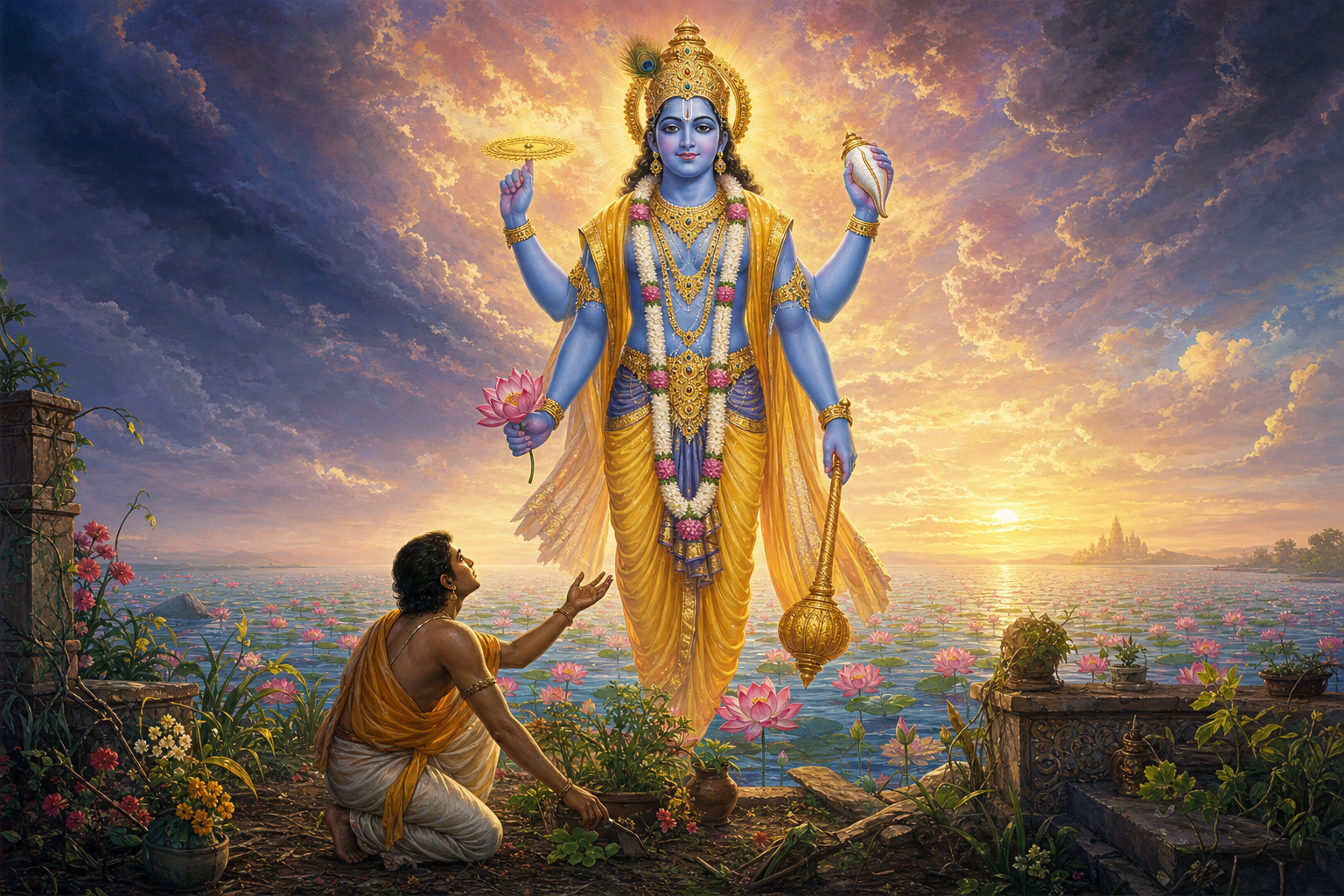
    Can the Supreme truly relate and respond without losing perfection? Advaita emphasizes the changeless Absolute, while Viśiṣṭādvaita affirms a relational oneness in which Brahman’s essence remains immutable but the inseparable modes (cit and acit) undergo real change. This nuance, central to Ramanujacharya’s Śrī-bhāṣya, reconciles creation passages in the Upaniṣads, safeguards the reality of ethics and…

  • Ethical Conduct that Inspires Trust: A Dharmic Guide to Confidence and Social Harmony

    Ethical Conduct that Inspires Trust: A Dharmic Guide to Confidence and Social Harmony

    Ethical conduct, grounded in dharma, fosters trust, confidence, and social harmony across Hinduism, Buddhism, Jainism, and Sikhism. Practicing virtues like satya, ahimsa, compassion, and seva makes ethics practical and visible in everyday life. Consistent ethical action builds credibility, strengthens relationships, and enhances institutional legitimacy. Classical teachings—from the Bhagavad Gita and Upanishads to the yamas and…

  • Why God Means Many Things: Hinduism’s Profound Inclusivity and Dharmic Unity, Explained

    Hinduism presents a spacious, many-sided understanding of the Divine, where God may be personal and impersonal, with form and beyond form. Anchored in the Upanishads and the Bhagavad Gita, it honors multiple authentic paths through the concept of Ishta in Hinduism. Philosophical streams—Advaita, Viśiṣṭādvaita, and Dvaita—map different facets of one spiritual landscape without contradiction. This…

  • Deathbed Visions or Hallucinations? A Compassionate Dharmic Guide to the Final Journey

    Deathbed Visions or Hallucinations? A Compassionate Dharmic Guide to the Final Journey

    This article clarifies the difference between deathbed visitations and hallucinations through a Hindu and broader Dharmic lens, combining scriptural insights with contemporary hospice observations. It outlines clear phenomenological markers—such as serenity, coherence, and value alignment—that can help families distinguish spiritually meaningful visions from delirium. The discussion highlights convergences across Hinduism, Buddhism, Jainism, and Sikhism, fostering…

  • Satyaloka Unveiled: The Awe-Inspiring Symbolism of Brahma’s Highest Realm of Truth

    Satyaloka Unveiled: The Awe-Inspiring Symbolism of Brahma’s Highest Realm of Truth

    Satyaloka—also known as Brahmaloka—stands at the summit of Hindu cosmology as the realm where truth shines unobscured by illusion. This article explains why it is called the “abode of truth,” linking its symbolism to sattva, Vedic wisdom, and the integrative path of knowledge, devotion, and duty. It clarifies how Brahmaloka functions as a gateway to…

  • Parinama Explained: Three Profound Transformations Shaping Hindu Wisdom and Daily Life

    Parinama Explained: Three Profound Transformations Shaping Hindu Wisdom and Daily Life

    Parinama—sacred change—clarifies how reality unfolds in Hindu philosophy through three core transformations: change of form (svarūpa), change of state (avasthā), and change marked by time (lakṣaṇa). Grounded in sources such as the Yoga Sutras, this framework aligns philosophical depth with everyday observation. It also connects meaningfully with dharmic perspectives in Buddhism, Jainism, and Sikhism, fostering…

  • One Divine Reality Beyond Many Names: A Powerful, Unifying Insight into Krishna and God

    This reflection explains how one Divine Reality is known by many names across cultures and languages, emphasizing unity rather than division. It clarifies that attributes like Almighty or Omniscient name the same Supreme Being, not separate deities. The Sanskrit name Krishna, meaning “all-attractive,” highlights a universal, inclusive vision of the Divine. The discussion encourages religious…

  • Stop Overthinking, Start Living: Hindu Wisdom for a Life of Presence and Joy

    Stop Overthinking, Start Living: Hindu Wisdom for a Life of Presence and Joy

    Hindu wisdom highlights a simple paradox: the more life is overanalyzed, the less it is truly lived. Drawing from the Hindu way of life and allied dharmic traditions, the path emphasizes presence, ethical action (dharma), and mindful awareness over relentless explanation. Karma yoga reframes daily duties as opportunities for clarity by releasing attachment to outcomes.…

  • Threads of Oneness: How Hinduism Inspires Unity in Diversity Across Dharmic Traditions

    Threads of Oneness: How Hinduism Inspires Unity in Diversity Across Dharmic Traditions

    Hinduism’s core insight is that life is fundamentally interconnected, and this truth is expressed through diverse forms of worship, philosophy, and community ritual. By honoring Ishta and multiple yogic paths, it sustains unity in diversity without demanding uniformity. Ethical commitments such as ahimsa and seva translate this vision into daily conduct and social responsibility. Related…

  • Mastering Purushaartha: A Transformative Guide to Dharma, Artha, Kaama & Moksha

    Mastering Purushaartha: A Transformative Guide to Dharma, Artha, Kaama & Moksha

    Purushaartha offers a complete framework—Dharma, Artha, Kaama, and Moksha—for a life that is ethical, prosperous, joyful, and inwardly free. Rather than rejecting wealth or desire, it refines them through Dharma so they support higher clarity. Practical steps include right livelihood, generosity, mindful restraint, and steady yoga-meditation practice. The Bhagavad Gita and the Upanishads inform a…

  • Detached Engagement in Dharma: Harness Emotions Without Attachment for Inner Freedom

    Detached Engagement in Dharma: Harness Emotions Without Attachment for Inner Freedom

    Detached engagement offers a dharmic way to live fully while remaining inwardly free. The approach honors emotions and even strong impulses, yet channels them through discernment and ethical restraint. Rooted in the Bhagavad Gita’s nishkama karma and supported by Upanishadic witness-awareness, it unites action with non-attachment. Parallel insights from Buddhism, Jainism, and Sikhism—upekkhā, Aparigraha, sehaj,…

  • Release Judgment, Embrace Compassion: A Dharmic Path to Inner Freedom and Shared Harmony

    Release Judgment, Embrace Compassion: A Dharmic Path to Inner Freedom and Shared Harmony

    Non-judgment in Hindu Dharma is a disciplined form of discernment that calms the mind, clarifies perception, and supports ethical action. Drawing from the Upanishads, the Bhagavad Gita, and Yoga, it replaces reactive labeling with compassionate understanding. Dharmic traditions converge on this insight—Hinduism, Buddhism, Jainism, and Sikhism each cultivate humility, Ahimsa, and service. Practical methods such…

  • Dakshina, Vama, Uttara: Three Transformative Paths for the Hindu Seeker’s Inner Journey

    Dakshina, Vama, Uttara: Three Transformative Paths for the Hindu Seeker’s Inner Journey

    Hindu spirituality honors three complementary pathways—Dakshina Marga, Vama Marga, and Uttara Marga—so seekers can approach moksha according to temperament, capacity, and guidance. Dakshina Marga emphasizes dharma, bhakti, and temple worship, grounding householders in ethical and devotional rhythms. Vama Marga, properly transmitted and supervised within sampradāya, uses mantra, mudra, and disciplined ritual to transmute energy and…

  • ਚੁੱਪ ਦਾ ਸੰਦੇਸ਼: A Poetic Meditation on Truth, Courage, and Dharmic Unity in Silence

    ਚੁੱਪ ਦਾ ਸੰਦੇਸ਼: A Poetic Meditation on Truth, Courage, and Dharmic Unity in Silence

    This reflection explores how silence, practiced with mindfulness, strengthens truth and courage across Hinduism, Buddhism, Jainism, and Sikhism. It presents mauna, Noble Silence, and simran as convergent disciplines that align speech with dharma and Ahimsa. Readers gain an academic yet accessible understanding of how Anekantavada invites many-sided truth while reducing harm. Practical micro-practices—brief mauna, three-breath…

  • Sacred Stillness, Lasting Clarity: A Dharmic Guide to Mindful Observation over Endless Seeking

    Sacred Stillness, Lasting Clarity: A Dharmic Guide to Mindful Observation over Endless Seeking

    Modern life rewards endless seeking, yet dharmic wisdom demonstrates that mindful observation offers deeper clarity and freedom. Drawing from Hindu philosophy—sakshi-bhava, pratyahara, dhyana, and aparigraha—this piece shows how observation refines attention and aligns action with dharma. Convergences with Buddhism’s vipassana, Jainism’s samayik, and Sikhism’s simran and sehaj reveal a shared contemplative core that nurtures unity…

  • Ever-Watchful Deities in Veda Shastras: Karma, Vayu Bhagavan, and Dharmic Conduct

    Ever-Watchful Deities in Veda Shastras: Karma, Vayu Bhagavan, and Dharmic Conduct

    Vedic wisdom teaches that devas and devis attentively witness human actions, reinforcing the law of karma and encouraging alignment with dharma. This perspective frames accountability as compassionate guidance rather than fear-based surveillance. Lord Vayu Bhagavan, present in every breath, becomes a practical reminder to live with mindfulness, gratitude, and restraint. The theme resonates across Buddhism,…

  • Ishtasiddhi by Vimuktatman: A Timeless Advaita Masterwork Illuminating Non-Dual Wisdom

    Ishtasiddhi by Vimuktatman: A Timeless Advaita Masterwork Illuminating Non-Dual Wisdom

    Ishtasiddhi by Vimuktatman (9th–10th century CE) is a landmark Sanskrit treatise in Advaita Vedanta that unites rigorous reasoning with Upanishadic insight. It clarifies core non-dual themes—Brahman, Atman, māyā, and the role of knowledge in liberation—through a fair-minded purvapaksha–siddhanta method. Readers gain a dependable map of Advaita epistemology while experiencing a gradual movement from conceptual complexity…

  • Beyond Stone-Like Detachment: Embracing Compassionate Awareness Across Dharmic Paths

    Beyond Stone-Like Detachment: Embracing Compassionate Awareness Across Dharmic Paths

    A thought experiment imagines a conscious stone to question whether freedom from feeling is truly freedom from suffering. The analysis rejects emotional numbness as a spiritual ideal and clarifies that Dharmic philosophies do not endorse stone-like detachment. Instead, Hinduism, Buddhism, Jainism, and Sikhism converge on compassionate awareness, mindful presence, and ethical action. The Bhagavad Gita’s…

  • Like a Phoenix: How Hinduism’s Resilient Spirit Reimagines Challenges into Renewal

    Like a Phoenix: How Hinduism’s Resilient Spirit Reimagines Challenges into Renewal

    Hinduism is often likened to a phoenix because it repeatedly transforms adversity into renewal. This piece explains how Sanatana Dharma’s pluralism and philosophical flexibility sustain resilience across centuries. It highlights how households, temples, and learning traditions preserve living culture even under pressure. The narrative situates Hinduism within the broader dharmic family—Buddhism, Jainism, and Sikhism—emphasizing shared…

  • The Sacred Ecology of Life: Hindu Wisdom to Ease Suffering through Interdependence

    The Sacred Ecology of Life: Hindu Wisdom to Ease Suffering through Interdependence

    Hindu philosophy presents a transformative insight: everything is food for something else, revealing an intimate web of interdependence. Rooted in the Upanishads and the Bhagavad Gita, this sacred ecology reframes suffering and softens attachment by aligning life with reciprocity and flow. The principle encourages ahimsa, aparigraha, and gratitude, turning consumption into a practice of reverence.…