-
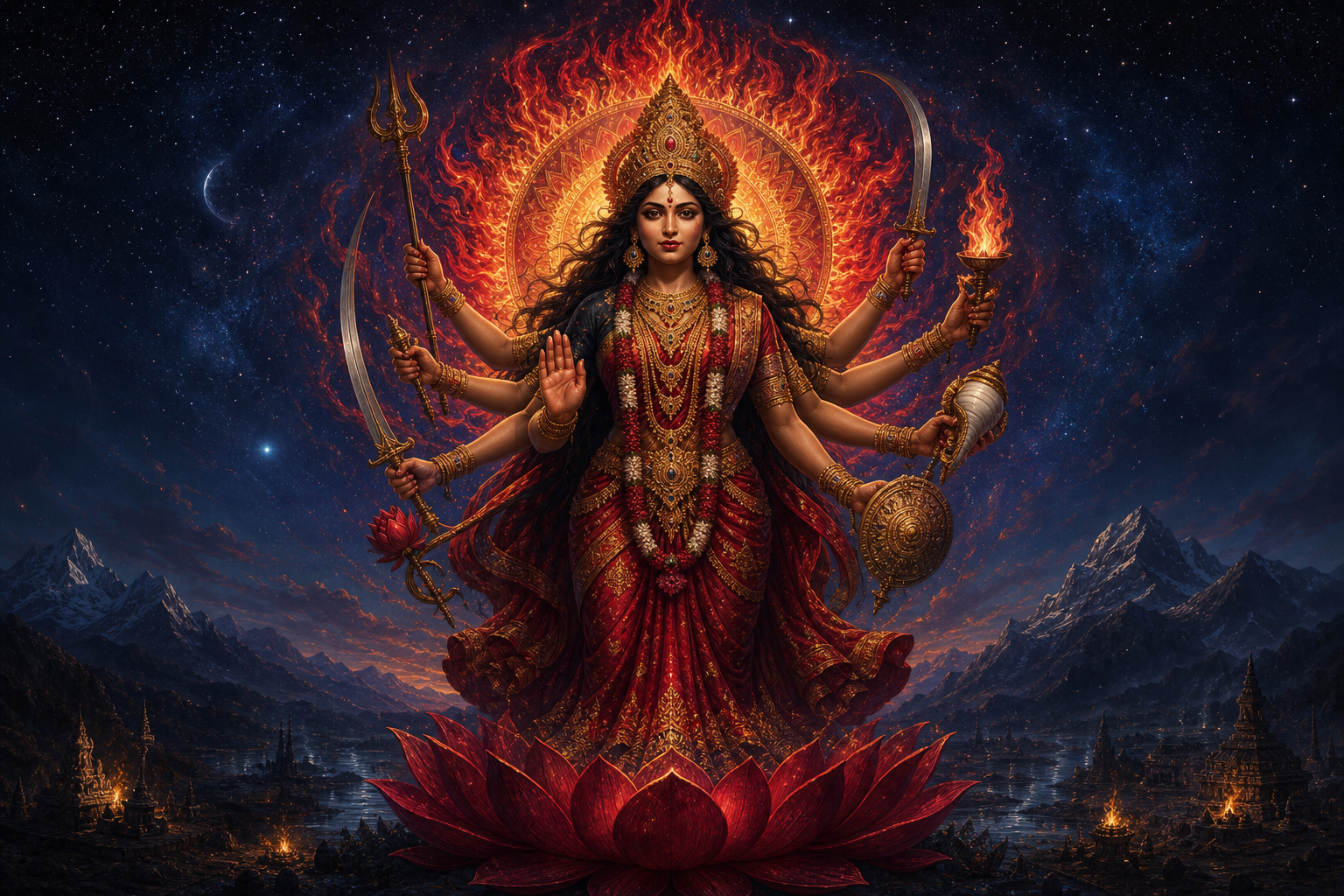
Nagapasha in Durga’s Hand: Unleashing Conscious Power and the Serpent’s Victory Over Evil

The serpent—Sarpa—in Goddess Durga’s hand is not mere ornament but Nagapasha, the symbol of conscious power and ethical control. It signifies the binding of ego and disorder through lucid awareness rather than brute force. A yogic reading links the serpent to Kundalini rising from the muladhara through the sushumna nadi, illustrating disciplined Shakti in service…
-
Mahakala as Kali’s Vehicle in Tantra: Unveiling Time, Power, and Non-Dual Wisdom

This exploration clarifies why, in Tantric symbolism, Mahakala is described as Kali’s vahana not as a literal mount but as the timeless ground supporting Shakti’s transformative dance. It unpacks the etymology of kala, linking time and the fathomless dark to non-dual metaphysics. The discussion reframes iconography—Kali standing upon Mahakala—as a pedagogy for transcending fear and…
-
Manmatha’s Five Arrows and the Five Bhakti Rasas: Symbolism, Practice, and Dharmic Unity

This article explores Manmatha (Kamadeva) as the celestial archer whose five flower-arrows symbolize the refinement of love from emotion to devotion. It connects these arrows to the five bhakti rasas—śānta, dāsya, sakhya, vātsalya, and mādhurya—clarifying how each rasa expresses a distinct relationship with the Divine. Readers gain practical ways to integrate these rasas into daily…
-
Why Contentment Differs for Everyone: Dharmic Wisdom to Transform Suffering into Peace

Contentment, in Hindu philosophy and allied dharmic traditions, is an inner equilibrium that naturally varies across individuals. This piece explains why that variability often generates suffering, and how dharmic wisdom reframes it as a pathway to growth. Drawing on concepts such as santosha, aparigraha, Anekantavada, and santokh, it shows how plural measures of fulfilment can…
-
Revealing Trinajalayuka Nyaya: The Caterpillar Maxim Illuminating the Soul’s Rebirth

Trinajalayuka Nyaya, the maxim of the caterpillar, clarifies how the jiva transitions between lives with continuity shaped by karma and samskara. Rather than abrupt change, it presents a measured movement that preserves moral causation across embodiments. This insight aligns with Vedanta and finds resonances in Buddhism, Jainism, and Sikhism, reinforcing unity across dharmic traditions. The…
-
Everlasting Happiness through Spirituality: A Dharmic Guide to Inner Peace and Purpose

Can spirituality truly deliver everlasting happiness? From a dharmic perspective, enduring joy is not fleeting pleasure but a stable ananda rooted in clarity, compassion, and ethical living. Hinduism, Buddhism, Jainism, and Sikhism converge on shared practices—meditation, selfless service, mindful conduct—that cultivate inner peace beyond changing moods. This article clarifies the difference between momentary pleasure and…
-
Kashaya Unveiled: Vedanta, Yoga, and Jain Insights to Purify Mind and Elevate Spirit

Kashaya—mental impurities such as attachment, anger, and delusion—sits at the heart of Hindu philosophy’s exploration of the mind. Seen across Vedanta, Yoga, and Jain philosophy, and resonating with Buddhist kleshas and Sikh teachings on haumai, it represents both obstacle and opportunity. By cultivating mindfulness, ethical clarity, and contemplative depth, seekers learn to recognize and transform…
-
Krishna’s Bold Reframing of Dharma: An Enlightened Householder Blueprint for Kali Yuga

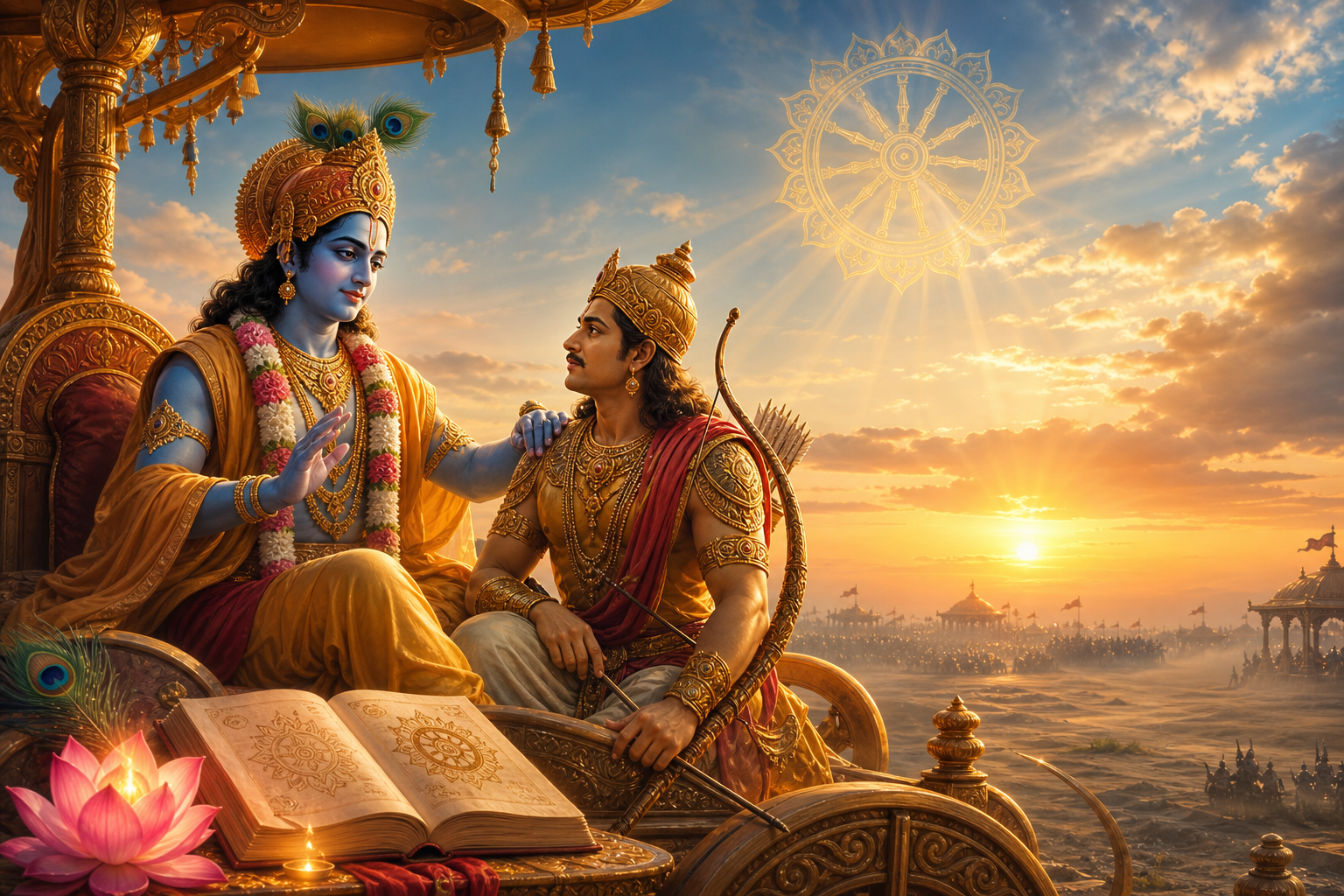
This article clarifies the long-standing tension between renunciation (sannyasa) and worldly engagement (grihastha) and explains Krishna’s synthesis in the Bhagavad Gita. It shows how Karma Yoga transforms daily duties into spiritual practice, especially suited to the demands of Kali Yuga. Readers gain practical steps—nishkama karma, mindful remembrance, ethical livelihood, generosity, and seva—to integrate dharma into…
-
Karya Karana Bhava: Unveiling Causality’s Power Across Dharmic Wisdom Traditions

Karya Karana Bhava—the principle of cause and effect—offers a clear lens for understanding reality, ethics, and spiritual growth in Hinduism. Grounded in the Vedas and Upanishads and refined by Samkhya, Nyaya, and Vedanta, it clarifies how choices shape outcomes through karma and disciplined practice. Everyday examples show how patience, consistency, and seva produce meaningful effects,…
-
Nadi Samudra Nyaya: A Powerful River–Ocean Metaphor of Jiva, Brahman, and Liberation

Nadi Samudra Nyaya, the “Maxim of the River and the Ocean,” clarifies how Advaita Vedanta explains the relation between the individual self (jiva) and the ultimate reality (Brahman). The metaphor shows how apparent separateness dissolves at the point of realization, aligning with Upanishadic insights such as “Tat Tvam Asi.” Readers gain a clear, experience-near understanding…
-
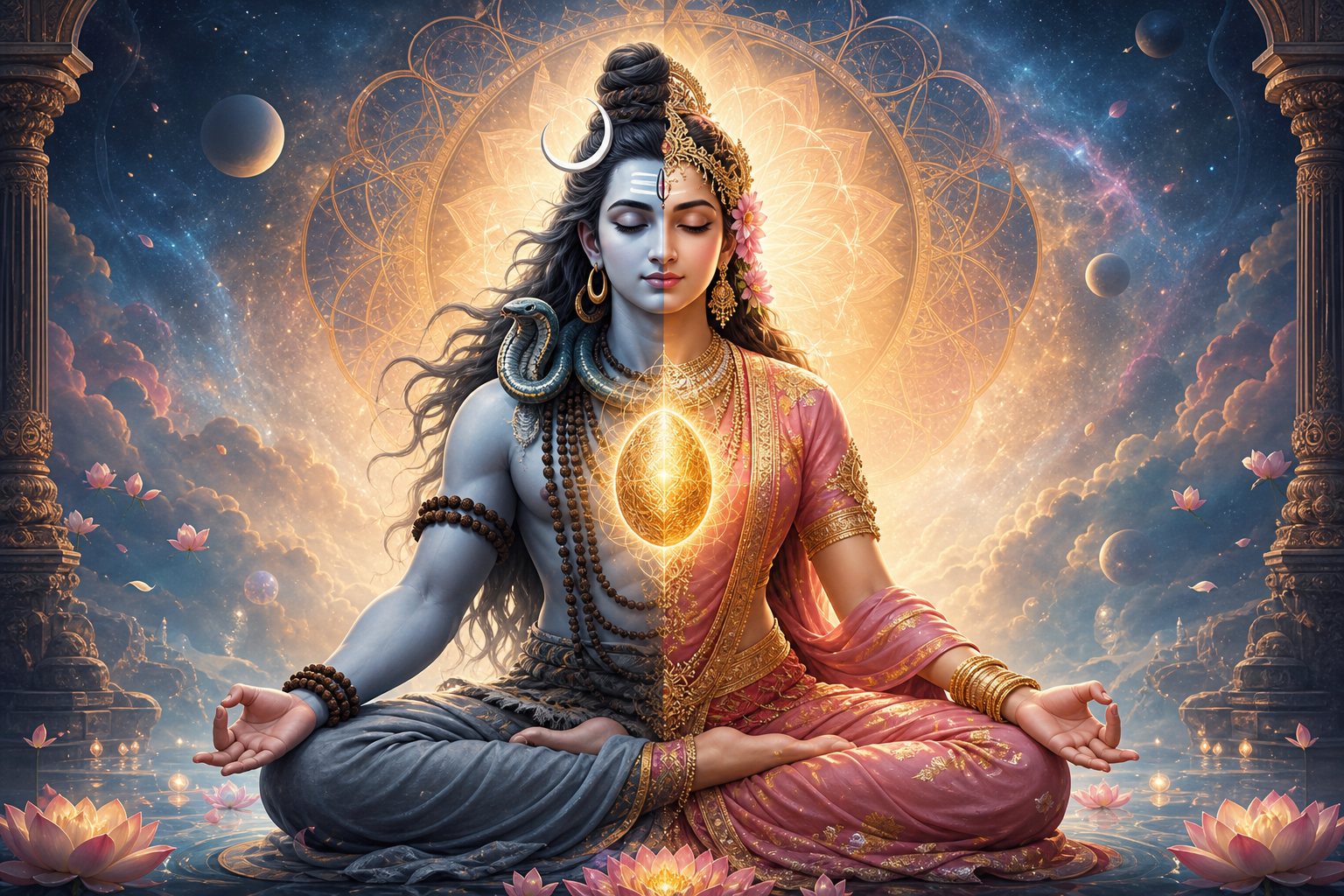
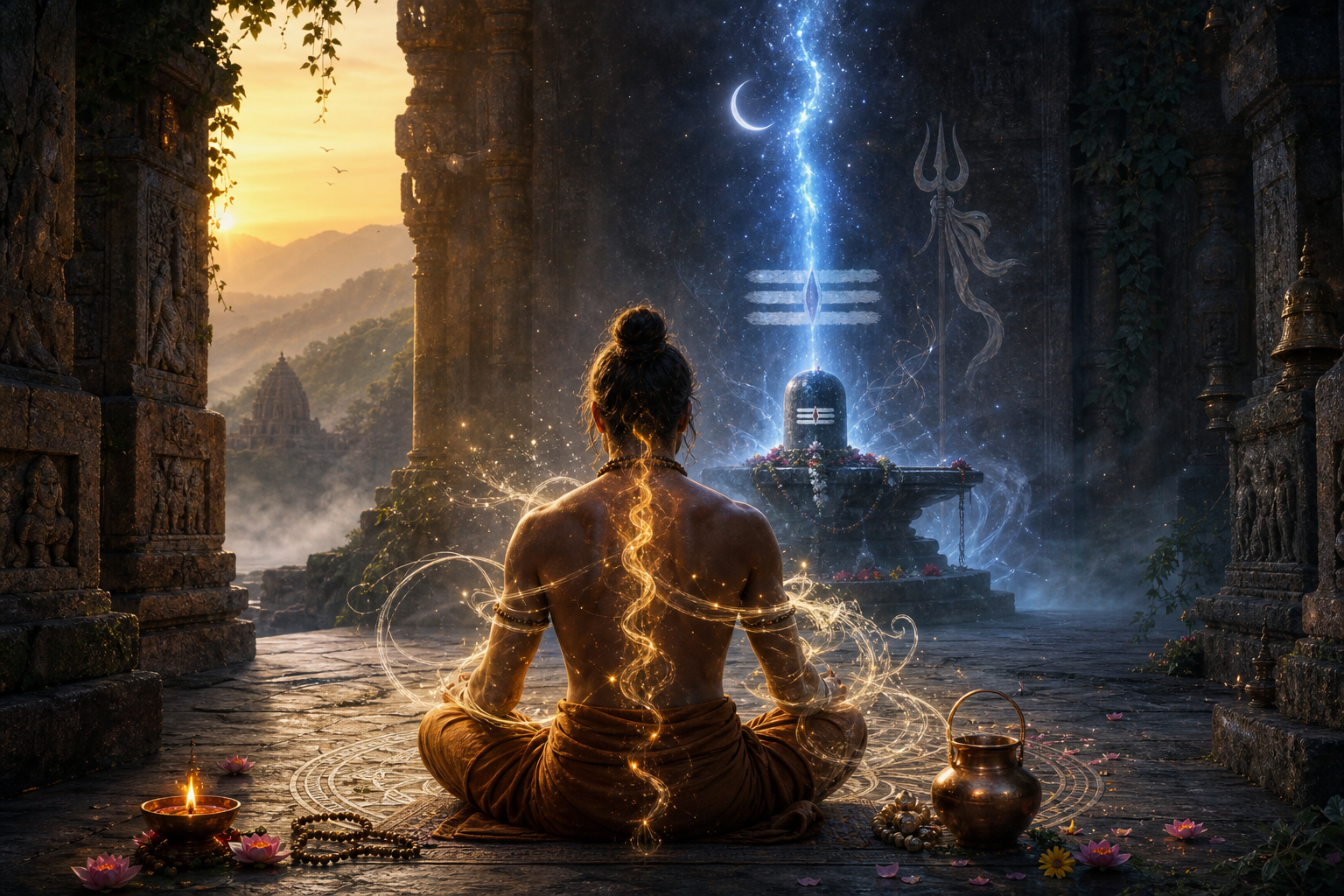
Shiva Tattva Explained: Profound Meaning and Practical Paths to Dissolve into Oneness
Shiva Tattva points to the universal principle of pure, all-pervading consciousness—beyond form and sect—where experience arises and subsides. Drawing on Advaita, yoga, and related dharmic insights, this overview clarifies what Shiva Tattva means and why all are already immersed in it. It outlines practical methods—self-inquiry, meditation, prāṇāyāma, mantra-japa, devotion, and selfless service—grounded in ethical disciplines.…
-
Choice, Control, and the Senses: An Eye-Opening Guide to Real Freedom in Daily Life

Freedom in daily life is shaped by many inner voices—senses, mind, intelligence, ego, and habit—working at once. Drawing on the Bhagavad-gita and allied dharmic traditions, this piece explains how recognizing these layers clarifies real agency. A simple pause, mindful breathing, and recalling dharma-centered priorities can turn impulse into intention. Rather than self-blame, compassionate self-knowledge builds…
-
From Doubt to Clarity in Krishna Consciousness: Navigating Vedic Proofs with Confidence

Seeking certainty in matters of truth is natural, especially within Krishna Consciousness. Vedic philosophy organizes valid knowing into three pramanas—pratyaksa, anumana, and sabda—so doubt can mature into clarity. The Brahma-Madhva-Gaudiya Sampradaya emphasizes sabda, operationalized through guru, sastra, sadhu, while still valuing perception and reason. This balanced approach aligns with broader dharmic traditions: Buddhism’s experiential insight,…
-
Hindu Wisdom on Human Nature: Why Grand Reforms Fail Without Inner Transformation

Hindu thought explains why many global reforms falter: they overlook the depth of human conditioning shaped by avidya, samskara, and the three gunas. Sustainable change emerges when inner transformation precedes institutional redesign, aligning personal ethics with public policy. A dharmic, three-layer approach—self, community, and systems—integrates nishkama karma, seva, and accountability to support lokasangraha. This perspective…
-
Embracing Human Limits for Inner Peace: A Dharmic Guide to Ambition and Acceptance

Modern culture often imagines success as limitless, yet Dharmic wisdom clarifies that human achievements are bounded by body, time, and causality. Acceptance of these limits is not resignation but a disciplined orientation that supports inner peace and spiritual growth. Drawing on Hindu philosophy—especially the Bhagavad Gita and Karma Yoga—alongside Buddhist insights on impermanence, Jain anekantavada,…
-
Karya in Hindu Thought: How Actions Shape Destiny, Ethics, and Liberation

Karya, derived from the Sanskrit root “kr” (to act), encapsulates “that which is done” and unites Hindu philosophy, ethics, and daily practice. It connects intention with outcome across traditions—from Sāṅkhya’s satkāryavāda and Nyāya’s causal clarity to Mīmāṁsā’s duty and Vedanta’s purifying karma yoga. The Bhagavad Gita’s “kāryam karma” frames action as an obligation performed without…
-
Spiritual Oneness in Hinduism: Vedic Wisdom to Heal Division, Injustice, and Ecological Harm

Spiritual oneness in Hinduism, rooted in the Vedas and Upanishads, offers a practical ethic for resolving modern crises. By recognizing a shared ground of being, communities can move beyond polarization toward empathy, dialogue, and responsible action. Dharmic traditions converge on this vision: Buddhism highlights interdependence, Jainism advances anekantavada and ahimsa, and Sikhism affirms Ik Onkar…
-
Sri Vaishnavism Unveiled: Devotion, Vedanta, and the Heart of Vishnu Worship

Sri Vaishnavism (Srivaishnavism) is a major Hindu tradition that unites Vedanta philosophy with heartfelt bhakti to Vishnu, especially through devotion to Sri Rama and Sri Krishna. Anchored in Tamil Nadu and Karnataka, it draws on the Tamil Alvars’ hymns and Acharya scholarship—especially Ramanuja’s Vishishtadvaita—to harmonize poetry and philosophy. Readers gain clear insight into its sacred…
-
Impermanence and Human Bonds: Hindu Wisdom on Loving, Letting Go, and Lasting Peace

Hinduism teaches—most explicitly in the Yoga Vasishta—that all human associations are impermanent, a truth that clarifies how to love without clinging. Recognizing anitya (impermanence) reframes loss, softens attachment, and supports ethical, compassionate action in relationships. This perspective aligns with the dharmic insights of Buddhism (anicca), Jainism (anitya), and Sikh wisdom on hukam and seva, highlighting…
-
Dhyana and Vichara: Harmonizing Meditation and Enquiry for Self-Realization in Hinduism

This article presents an academic yet accessible synthesis of Dhyana (meditation) and Vichara (enquiry) as complementary paths in Hindu philosophy. It explains how moksha is the unveiling of the ever-present Self (Atman) as Brahman, grounded in the Upanishads, Vedanta, and the Bhagavad Gita. Readers gain practical clarity on how meditation stabilizes attention while enquiry dissolves…