Category: Philosophy

  • Beyond Gender: How the Guru’s Universal Guidance Elevates Every Seeker in Krishna Consciousness

    Beyond Gender: How the Guru’s Universal Guidance Elevates Every Seeker in Krishna Consciousness

    This reflection affirms that the guru’s role in Krishna consciousness transcends gender and other external identities. Anchored in Srila Prabhupada’s guidance, it emphasizes spiritual qualification—realization, character, and capacity to guide—as the true criterion for leadership. Framed within the Guru-Shishya Tradition of the Bhakti Tradition, the discussion invites communities to evaluate teachers by siddhanta, sadhana, humility,…

  • Ravana Gita: Timeless Leadership Wisdom from the Ravana–Lakshmana Dialogue in Ramayana

    Ravana Gita: Timeless Leadership Wisdom from the Ravana–Lakshmana Dialogue in Ramayana

    Ravana Gita, the widely known title for Ravana’s final counsel to Lakshmana in the Ramayana, offers clear, actionable lessons on leadership and governance. The dialogue emphasizes timing—acting swiftly on beneficial duties while exercising caution in risky matters—and the ethics of counsel, confidentiality, and honest dissent. It also warns against underestimating adversaries, urging vigilance and strategic…

  • Sri Shankara Gita: Timeless Advaita Wisdom on Shiva’s Grace to Elevate Daily Practice

    Sri Shankara Gita: Timeless Advaita Wisdom on Shiva’s Grace to Elevate Daily Practice

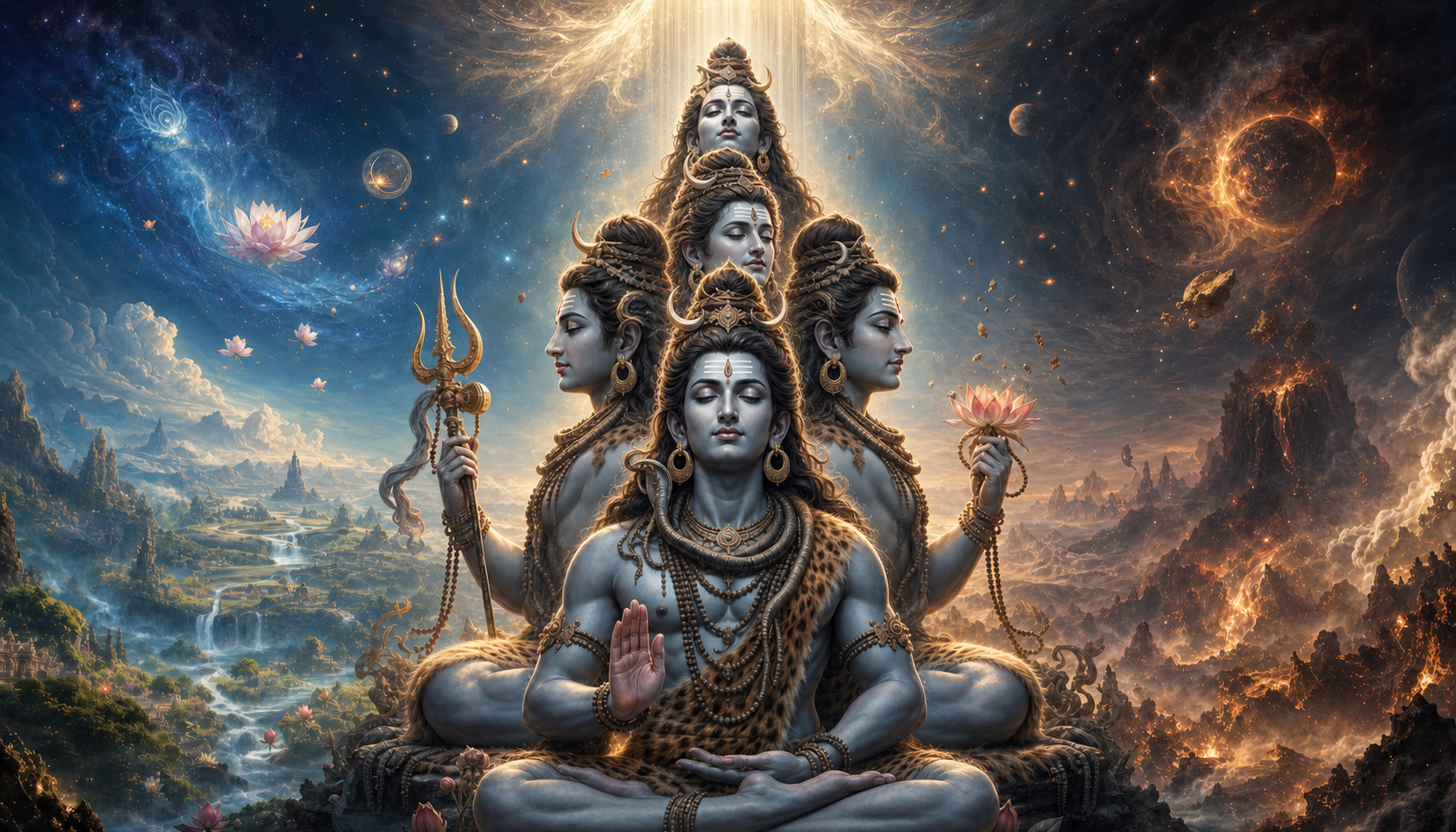
    Sri Shankara Gita, traditionally associated with Adi Shankaracharya, distills Advaita Vedanta through the devotional lens of Lord Shiva’s grace. The text presents Shiva as the symbol of the Supreme Reality, guiding seekers from multiplicity to oneness. Its balanced integration of jnana, bhakti, and dharma makes the teachings both elevating and practical for daily practice. Readers…

  • Before the Particle Accelerator: Soviet Science, atma, and a Profound Dharmic Convergence

    Before the Particle Accelerator: Soviet Science, atma, and a Profound Dharmic Convergence

    A quiet moment before a Soviet-era particle accelerator crystallizes a core insight: the most decisive forces in life are often unseen. This reflection connects modern physics with dharmic inquiry into atma, showing how both rely on disciplined methods to infer what cannot be directly observed. Hindu philosophy and Vedanta, Buddhism’s process-oriented view, Jainism’s jiva and…

  • Karmendriyas and Tanmatras Explained: How Action Organs Align with the Five Elements

    Karmendriyas and Tanmatras Explained: How Action Organs Align with the Five Elements

    This article clarifies how the five karmendriyas—speech, hands, feet, procreation, and elimination—relate to the tanmatras and the five elements in Hindu philosophy. It outlines the classical evolution from subtle tanmatras to pancha mahabhutas and shows how action organs are energized by rajas and prana. Readers gain a clear, text-sensitive view of commonly taught correspondences—such as…

  • Manas and Buddhi Explained: Harness the Two Minds for Clarity, Calm, and Wise Action

    Manas and Buddhi Explained: Harness the Two Minds for Clarity, Calm, and Wise Action

    Manas and Buddhi describe two complementary functions of the mind in Hinduism: Manas gathers sensory impressions and emotions, while Buddhi provides discriminative clarity and ethical direction. The Bhagavad Gita (3.42) places Buddhi above Manas and both beneath the Self, offering a practical inner hierarchy for wise action. This model resonates across Buddhism, Jainism, and Sikhism,…

  • Mahat Parinama Explained: Unfolding Timeless Cosmic Intelligence in Dharmic Philosophy

    Mahat Parinama Explained: Unfolding Timeless Cosmic Intelligence in Dharmic Philosophy

    Mahat Parinama—understood as the unfolding of cosmic intelligence—connects Sāṅkhya’s evolution of mahat with Vaisheshika’s precise account of categories and causation. This synthesis clarifies how consciousness becomes mind and world, and why disciplined observation and ethical practice stabilize insight. Read alongside Buddhism’s dependent origination, Jainism’s doctrine of modification, and Sikhism’s Hukam, it affirms unity in spiritual…

  • Ramanujacharya’s Auspicious Birth and Enduring Legacy: Inspiring Unity in Dharma

    Ramanujacharya’s Auspicious Birth and Enduring Legacy: Inspiring Unity in Dharma

    This post presents a concise, academically grounded account of Ramanujacharya’s birth, including precise dating (1017 A.D.; ‘sasthi’ in Chaitra), South Indian geography (Sriperumbudur between Kancipuram and Madras), and lineage. Readers gain clarity on traditional descriptions honoring him as a partial incarnation of Lord Ananta Shesha and Laxman, situated within the broader context of medieval India.…

  • Honoring Sri Ramanujacharya: Disappearance Day, Vishishtadvaita, and Living Bhakti

    Honoring Sri Ramanujacharya: Disappearance Day, Vishishtadvaita, and Living Bhakti

    The Disappearance Day of Sri Ramanujacharya honors a towering acharya of the Sri sampradaya whose Vedantic commentary, Sri-bhasya, shaped Vishishtadvaita—“qualified nondualism.” This perspective affirms unity with meaningful distinction, strengthening a personal relationship with the divine and grounding Bhakti in reason, ethics, and service. His wide travels, debates, and institution-building—seventy-four centers and thousands of initiated disciples—nurtured…

  • Jnana as Eternal Light: How Sacred Knowledge Unites Hindu, Buddhist, Jain, Sikh Paths

    Jnana as Eternal Light: How Sacred Knowledge Unites Hindu, Buddhist, Jain, Sikh Paths

    This essay presents jnana as the eternal light central to Hindu wisdom while connecting it with prajna in Buddhism, kevala-jnana in Jainism, and gyaan in Sikhism. It clarifies how knowledge in the Upanishads and Bhagavad Gita is transformative rather than merely intellectual, aligning atman with Brahman. Readers gain practical guidance—svadhyaya, dhyana, seva, satsanga—for integrating insight…

  • Karma Yoga Made Practical: Serve with Compassion, Protect Your Sanity and Resources

    Karma Yoga Made Practical: Serve with Compassion, Protect Your Sanity and Resources

    Karma Yoga offers a practical path to inner purification through selfless service performed with discernment. Acting without attachment to outcomes builds equanimity while ensuring help remains effective and sustainable. Clear boundaries, realistic budgets, and due diligence protect mental calm and financial stability, preventing burnout and enabling long-term impact. Across dharmic traditions, wise compassion is a…

  • From Trickster to Kingmaker: Maricha to Shakuni and the Karmic Echoes Across the Yugas

    From Trickster to Kingmaker: Maricha to Shakuni and the Karmic Echoes Across the Yugas

    This piece examines the thematic linkage between Maricha in the Ramayana and Shakuni in the Mahabharata as a teaching device about karma, samsara, and moral causality across the yugas. It clarifies that core texts do not attest a direct rebirth but shows how the comparison illuminates the evolution of deception from personal illusion to systemic…

  • Transform Material Cravings into God-Centered Bhakti: A Dharmic Guide to Lasting Peace

    Transform Material Cravings into God-Centered Bhakti: A Dharmic Guide to Lasting Peace

    This essay explains the shift from a life centered on the mind and senses to a God-centered life of bhakti in Hindu spirituality. It clarifies how material attachments create instability while devotion to Krishna offers ethical clarity and inner peace. The discussion highlights practical ways to re-center daily choices, including contemplation, japa, meditation, and seva.…

  • Free Will and Maya: Dharmic Wisdom for Choosing Well Amid Life’s Illusions

    Free Will and Maya: Dharmic Wisdom for Choosing Well Amid Life’s Illusions

    The Bhagavad Gita affirms human agency—“Deliberate on this fully and then do what you wish to do” (Gita 18.63)—while dharmic traditions explain how avidya, moha, and maya condition choice. This piece reconciles freedom and conditioning, showing how responsibility and compassion can coexist. Practical guidance highlights viveka, meditation, breathwork, bhakti, seva, and ethical vows as tools…

  • Karmashaya Demystified: Uncovering the Hidden Storehouse of Karma in Patanjali’s Yoga

    Karmashaya Demystified: Uncovering the Hidden Storehouse of Karma in Patanjali’s Yoga

    Karmashaya—Patanjali’s term for the subtle storehouse of karma—explains how actions leave impressions (samskaras) that condition future experience. Grounded in the Yoga Sutras (2.12), it links klesha-driven actions to both present and unforeseen outcomes, clarifying the mechanics of reactive patterns. Read together with the threefold classification of karma (sanchita, prarabdha, agami), karmashaya functions as a dynamic…

  • Why Everything Happens for a Reason: Hinduism’s Profound Lens on Karma, Dharma, and Cosmic Play

    Why Everything Happens for a Reason: Hinduism’s Profound Lens on Karma, Dharma, and Cosmic Play

    This essay explains how Hindu philosophy gives depth to the idea that everything happens for a reason by integrating karma (ethical causality), dharma (righteous duty), and lila (divine play). It shows how these concepts preserve agency without fatalism, balancing responsibility and openness to mystery. Readers gain practical ways to apply this framework—discernment, svadharma, seva, meditation,…

  • Karna and Kumbhakarna: Tragic Titans of Dharma, Loyalty, and Sacrifice Over Power

    Karna and Kumbhakarna: Tragic Titans of Dharma, Loyalty, and Sacrifice Over Power

    Karna and Kumbhakarna exemplify sacrificial dharma in the Mahabharata and the Ramayana, choosing honor and loyalty over the pursuit of power. Their lives illuminate how gratitude, promise-keeping, and moral courage can coexist with tragic outcomes, enriching the ethical complexity of Indian epics. Readers gain a nuanced perspective on kshatra dharma, where strength is tempered by…

  • Unclothed Infinity: Kali as Digbasana and the Fearless Symbolism of Sky-Clad Truth

    Unclothed Infinity: Kali as Digbasana and the Fearless Symbolism of Sky-Clad Truth

    Kali as Digbasana—“clothed by the directions”—presents a sky-clad iconography of truth, not sensuality. The image signals freedom from illusion and social codification, aligning with Advaita insights on reality beyond attributes. Within Shakti iconography, nakedness becomes an ethic of fearlessness, compassion, and authenticity. Cross-dharmic resonances arise with Jain non-possession, Buddhist Śūnyatā, and Sikh reverence for the…

  • Moha and the Veil of Tamas: Understanding Delusion Across Dharmic Traditions

    Moha and the Veil of Tamas: Understanding Delusion Across Dharmic Traditions

    Moha, in Hindu philosophy, is a state of delusion tied to tamas, the guna of inertia and darkness, that obscures discernment and fosters ignorance or false knowledge. It narrows perception, encourages attachment to assumptions, and turns reactivity into a substitute for reflection. Within the framework of the gunas, rajas can intensify confusion, while sattva restores…

  • Karmavipaka Explained: How Karma Ripens Across Dharmic Paths and Shapes Destiny

    Karmavipaka Explained: How Karma Ripens Across Dharmic Paths and Shapes Destiny

    Karmavipaka (कर्मविपाक) explains how actions ripen into lived experience within Hindu philosophy. Grounded in the Sanskrit kri, meaning “to do,” it frames karma as lawful causality rather than external reward or punishment. The threefold classification—sanchita, prarabdha, and kriyamana—clarifies how past, present, and future actions interrelate. Far from fatalism, Karmavipaka emphasizes purushartha (effort), ethical choices, and…