Author: TR Ramesh

  • Shravan Month 2026: Essential Sawan Dates, Vrats and Sacred Traditions Explained

    Shravan Month 2026: Essential Sawan Dates, Vrats and Sacred Traditions Explained

    Shravan Month 2026 begins on July 30 and ends on August 28 in North Indian Purnimanta calendars. Amavasyant calendars followed widely in western and southern India observe Shravana Masam from August 13 to September 11. This comprehensive guide explains why the dates differ without treating either system as incorrect. It provides the 2026 Shravan Somwar…

  • Powerful Lessons from SB 11.3.22 on Guru, Surrender, and Pure Devotion

    Powerful Lessons from SB 11.3.22 on Guru, Surrender, and Pure Devotion

    Śrīmad-Bhāgavatam 11.3.22 offers a profound teaching on the guru-disciple relationship, sincere service, and the inner discipline required for bhakti. This reflection explains the meaning of bhāgavata-dharma, the importance of learning without duplicity, and the theological idea that Hari gives Himself to the sincere devotee. It presents the guru not as an object of personality worship,…

  • Kokila Vrat 2026: Powerful Ashad Purnima Ritual for Devotion and Marriage

    Kokila Vrat 2026: Powerful Ashad Purnima Ritual for Devotion and Marriage

    Kokila Vrat 2026 is a devotional observance dedicated to Kokila Devi and associated with Ashad Purnima and Guru Purnima. The provided tradition lists the 2026 date as July 29, though devotees should confirm the precise tithi with a local panchang. The vrat is traditionally observed for marital harmony, suitable companionship, and the blessings of Adishakti.…

  • In the Loop with Aniruddha Dasa: Powerful Lessons from Folk Culture and Festivals

    In the Loop with Aniruddha Dasa: Powerful Lessons from Folk Culture and Festivals

    This article develops the theme of “In The Loop, Education, Folk News, Festivals – Aniruddha Dasa” into a detailed academic reflection on dharmic cultural education. It explains how festivals, folk traditions, temple practices, oral storytelling, kirtan, seva, and community news function as living classrooms. The discussion highlights the shared civilizational values of Hinduism, Buddhism, Jainism,…

  • Kulashekhara Alvar: The Chera King Whose Bhakti Redefined Power and Surrender

    Kulashekhara Alvar: The Chera King Whose Bhakti Redefined Power and Surrender

    Kulashekhara Alvar is remembered as a Chera king of Kerala who discovered that royal power was incomplete without surrender to the Divine. This article explores his place among the twelve Alvars, his Tamil work Perumal Tirumoli, and his Sanskrit hymn Mukundamala. It explains his deep devotion to Sri Rama, Krishna, Lord Venkateswara, and Lord Ranganatha…

  • Respect as Sacred Discipline: A Powerful Dharmic Framework for Unity and Dialogue

    Respect as Sacred Discipline: A Powerful Dharmic Framework for Unity and Dialogue

    This rewritten article develops the theme of “Respect Seminar, Part 1” into a comprehensive academic reflection on respect as a Dharmic discipline. It explains how Hinduism, Buddhism, Jainism, and Sikhism each offer powerful ethical frameworks for dignity, dialogue, humility, and social harmony. The piece distinguishes respect from mere politeness and shows how it functions cognitively,…

  • Chiplun’s ‘Har Ghar Yoddha’ Camp: Powerful Youth Safety and Dharma Training

    Chiplun’s ‘Har Ghar Yoddha’ Camp: Powerful Youth Safety and Dharma Training

    The Hindu Janajagruti Samiti’s ‘Har Ghar Yoddha’ camp in Chiplun offered youth a practical framework for self-defence, vigilance, spiritual practice, and personal safety. The initiative highlights how martial training can become more meaningful when guided by discipline, restraint, and dharma. It presents youth empowerment not as a slogan, but as a combination of confidence, awareness,…

  • Jahnavi Harrison’s Honorary Doctorate Honors Bhakti, Music and Education

    Jahnavi Harrison’s Honorary Doctorate Honors Bhakti, Music and Education

    Jahnavi Harrison’s honorary doctorate from Middlesex University represents a meaningful recognition of devotional music, Hindu spirituality, and cultural leadership. The honour highlights the importance of kirtan as both sacred practice and public cultural contribution. It also affirms the role of dharmic traditions in modern education, diaspora identity, and global spiritual dialogue. The recognition is significant…

  • Why Bhagavatam 11.3.6 Powerfully Reveals Karma, Freedom, and Inner Awakening

    Why Bhagavatam 11.3.6 Powerfully Reveals Karma, Freedom, and Inner Awakening

    Śrīmad-Bhāgavatam 11.3.6 offers a profound explanation of karma, desire, and embodied life. The verse shows how the living being acts through the senses, accepts the fruits of action, and wanders through alternating happiness and distress. Its message is not fatalistic; it preserves meaningful human agency within the field created by past karma. The teaching encourages…

  • Water, Forest, and the Soul: A Powerful Reading of Srimad Bhagavatam 11.3.25

    Water, Forest, and the Soul: A Powerful Reading of Srimad Bhagavatam 11.3.25

    This article offers a detailed academic reflection on Srimad Bhagavatam 11.3.25 through the themes of water, forest, simplicity, and spiritual perception. It explains the Sanskrit terms sarvatra, ātma, īśvara, kaivalyam, aniketatām, and santoṣa in clear contemporary language. The discussion connects Vaishnava theology with environmental stewardship, showing how sacred ecology begins with disciplined consciousness. It also…

  • Suchindram’s Sacred Hanuman Tail: Why the Butter Offering Still Moves Devotees

    Suchindram’s Sacred Hanuman Tail: Why the Butter Offering Still Moves Devotees

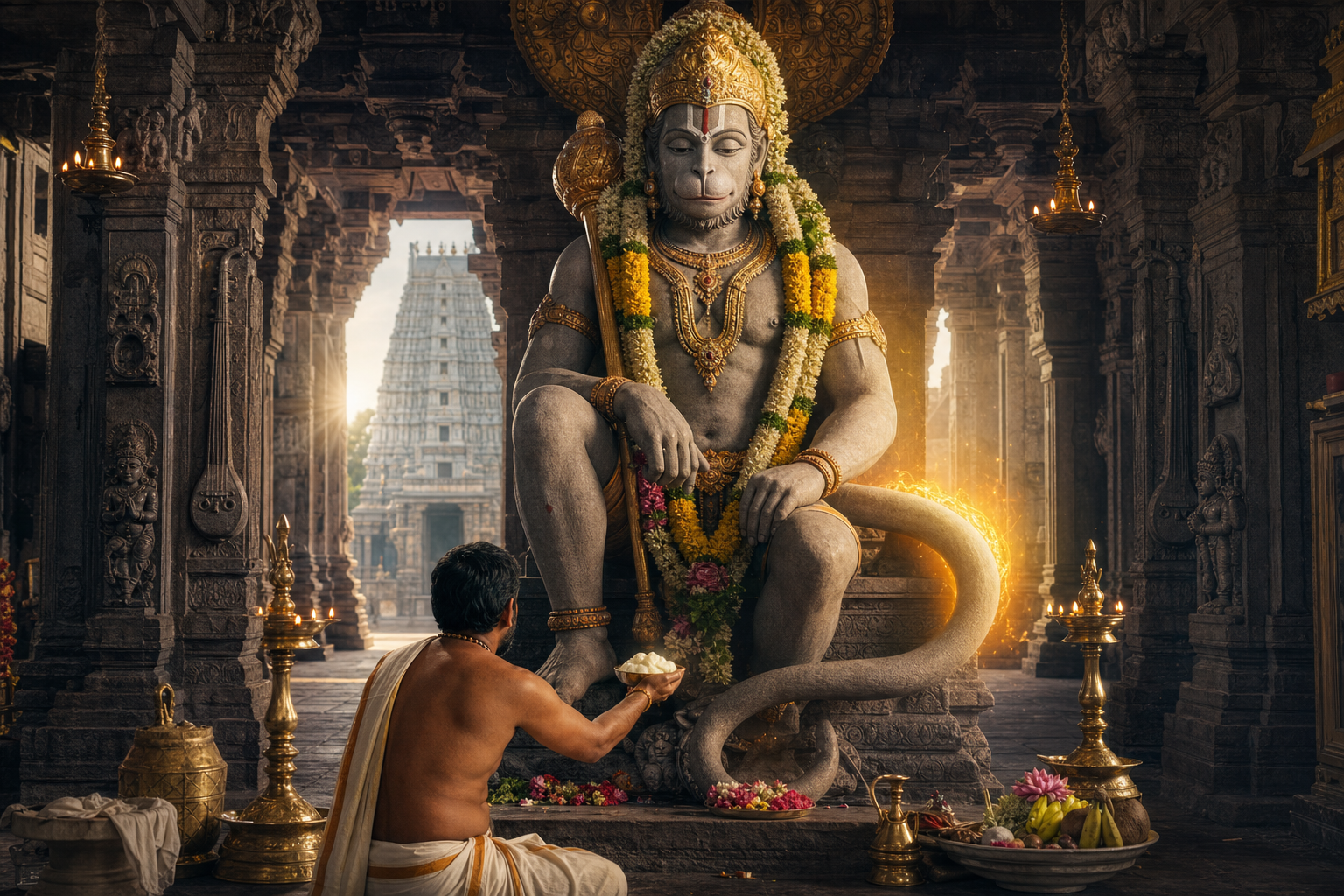
    Suchindram Temple near Kanyakumari is one of Tamil Nadu’s most remarkable sacred spaces, known for the Sthanumalayan form that unites Shiva, Vishnu, and Brahma. Its Hanuman shrine preserves a deeply moving devotional tradition: the offering of butter associated with cooling the sacred memory of Hanuman’s burning tail in the Ramayana. This practice reveals how ritual,…

  • Sanatana Dharma as Living Wisdom: Pluralism, Practice, and Purpose in a Complex World

    Sanatana Dharma as Living Wisdom: Pluralism, Practice, and Purpose in a Complex World

    Sanatana Dharma is presented as a living wisdom traditioncivilizational in scope and practical in methodrather than a narrow, prescriptive religion. The discussion explains how pluralism, exemplified by Ishta and enriched by Jain Anekantavada, Buddhist upaya, and Sikh Ik Onkar, establishes unity in spiritual diversity across Dharmic traditions. It surveys layered scriptures, the six darshanas, and…

  • Decoding ŚB 4.19.13: Prithu’s Sacrifices, Indra’s Envy, and the Power of Dharmic Unity

    Decoding ŚB 4.19.13: Prithu’s Sacrifices, Indra’s Envy, and the Power of Dharmic Unity

    ŚB 4.19.13, discussed in a thoughtful NYC satsanga by HG Hansarupa das, anchors King Prithu’s sacrifices in the Srimad Bhagavatham as a model of ethical leadership and devotion-centered ritual. The verse sits within a chapter that warns against spiritual opportunism and reaffirms that yajña is meaningful only when guided by humility, integrity, and compassion. Framed…

  • June 28, 2026 Panchang Definitive Guide to Tithi, Nakshatra, Rashi and Auspicious Hours

    June 28, 2026 Panchang  Definitive Guide to Tithi, Nakshatra, Rashi and Auspicious Hours

    June 28, 2026 (Sunday) falls on Shukla Paksha Chaturdashi, beginning after Shukla Trayodashi ends at 12:35 AM IST. The day sits in Ashadha and typically brings the Moon through Dhanu Rashi with Purva Ashadha nakshatra, trending toward Uttara Ashadha late night depending on location. Readers can plan around Abhijit Muhurta near local solar noon and…

  • Kudal Resolve: Maharashtra Trustees and Devotees Unite to Safeguard Temple Lands and Autonomy

    Kudal Resolve: Maharashtra Trustees and Devotees Unite to Safeguard Temple Lands and Autonomy

    A gathering of temple trustees and devotees in Kudal, Maharashtra, affirmed a united and constitutionally grounded approach to protecting temple lands, traditions, and religious autonomy. The deliberations emphasized that any changes linked to a proposed Devasthan Inam Abolition Act must align with Article 26 and related jurisprudence safeguarding denominational rights. Participants underscored rigorous compliance under…

  • Reviving Sanskar and Sanskrit: A Transformative Youth Dharma Camp at Narasimhawadi, Maharashtra

    Reviving Sanskar and Sanskrit: A Transformative Youth Dharma Camp at Narasimhawadi, Maharashtra

    A Hindu Dharma Sanskar Shibir at Narasimhawadi (Maharashtra), conducted by Hindu Janajagruti Samiti (HJS), spotlighted three interlinked prioritiesreviving Sanskar, renewing engagement with Sanskrit, and living the Sanatan Hindu culture. Shri. Sadashiv Dhavaleguruji urged youth to cultivate spiritual and cultural strength to meet contemporary challenges with clarity and compassion. The camp’s emphasis maps to a practical…

  • Sant Sopankaka Maharaj Palkhi 2026 (Ashadhi Wari): Route, Schedule, Rituals, and Safety Guide

    Sant Sopankaka Maharaj Palkhi 2026 (Ashadhi Wari): Route, Schedule, Rituals, and Safety Guide

    Sant Sopankaka Maharaj Palkhi 2026 is a disciplined, high-energy stream of the Ashadhi Wari that carries the sacred Padukas of Sant Sopandev in a rath whose charioteer traditionally stands on the right. This definitive guide explains the yatra’s ritual grammar (Paduka puja, dindis, abhang-singing), outlines a schedule outlook synced to Ashadhi Ekadashi, and presents an…

  • Śrī Caurāṣṭakam in English: Bilvamaṅgala Ṭhākura’s ‘Thief of Vraja’ in a Soul‑Stirring Musical

    Śrī Caurāṣṭakam in English: Bilvamaṅgala Ṭhākura’s ‘Thief of Vraja’ in a Soul‑Stirring Musical

    Śrī Caurāṣṭakam is a celebrated Sanskrit aṣṭakam that praises Krishna as the compassionate “Thief of Vraja.” This long‑form analysis situates the hymn within Bilvamaṅgala Ṭhākura’s devotional oeuvre and the Gaudiya Vaishnava tradition, showing how its poetic paradox reframes “theft” as divine grace that frees the heart. A new English musical rendition by Rasamayi Rādhe Dāsīpresented…

  • Defying Death Through Mercy: The Transformative Power of Silent Book Seva in Krsna Bhakti

    Defying Death Through Mercy: The Transformative Power of Silent Book Seva in Krsna Bhakti

    Mercy-centered bhakti offers a rigorous, repeatable pathway to face mortality with clarity rather than fear. Grounded in Bhagavad-Gita and Vaishnava praxis, Krsna Consciousness builds new habits through japa, satsanga, and seva, reconditioning reflexes long before life’s final hour. The understated discipline of silent book distribution functions as both outreach and inner cultivation, tempering ego and…

  • Shankha Nidhi Unveiled: Kubera’s Conch Treasure and Guardian of Auspicious Wealth

    Shankha Nidhi Unveiled: Kubera’s Conch Treasure and Guardian of Auspicious Wealth

    Sankha Nidhi the Conch Treasure of Kuber and an attendant emblem in Hindu temple architecture personifies ethical, auspicious wealth at the very threshold of the sacred. Often paired with Padma Nidhi and placed on door-jambs beneath Gajalakshmi, the figure teaches that resources gain sanctity when devoted to dharmic ends. Śilpaśāstra canons such as Manasara, Mayamata,…