
Suchindram Temple, formally known as Thanumalayan Temple or Sthanumalayan Temple, occupies a distinctive place in the sacred geography of Tamil Nadu. Situated in Suchindram near Kanyakumari and Nagercoil, the temple is widely known for its rare theological synthesis: the presiding deity represents Shiva, Vishnu, and Brahma in a single form. This unity is expressed in the very name Sthanumalayan, where Sthanu signifies Shiva, Mal signifies Vishnu, and Ayan signifies Brahma. In a religious landscape often described through sectarian categories, Suchindram stands as a living reminder that Hindu worship has long contained multiple paths, devotional languages, and philosophical emphases within one sacred space.
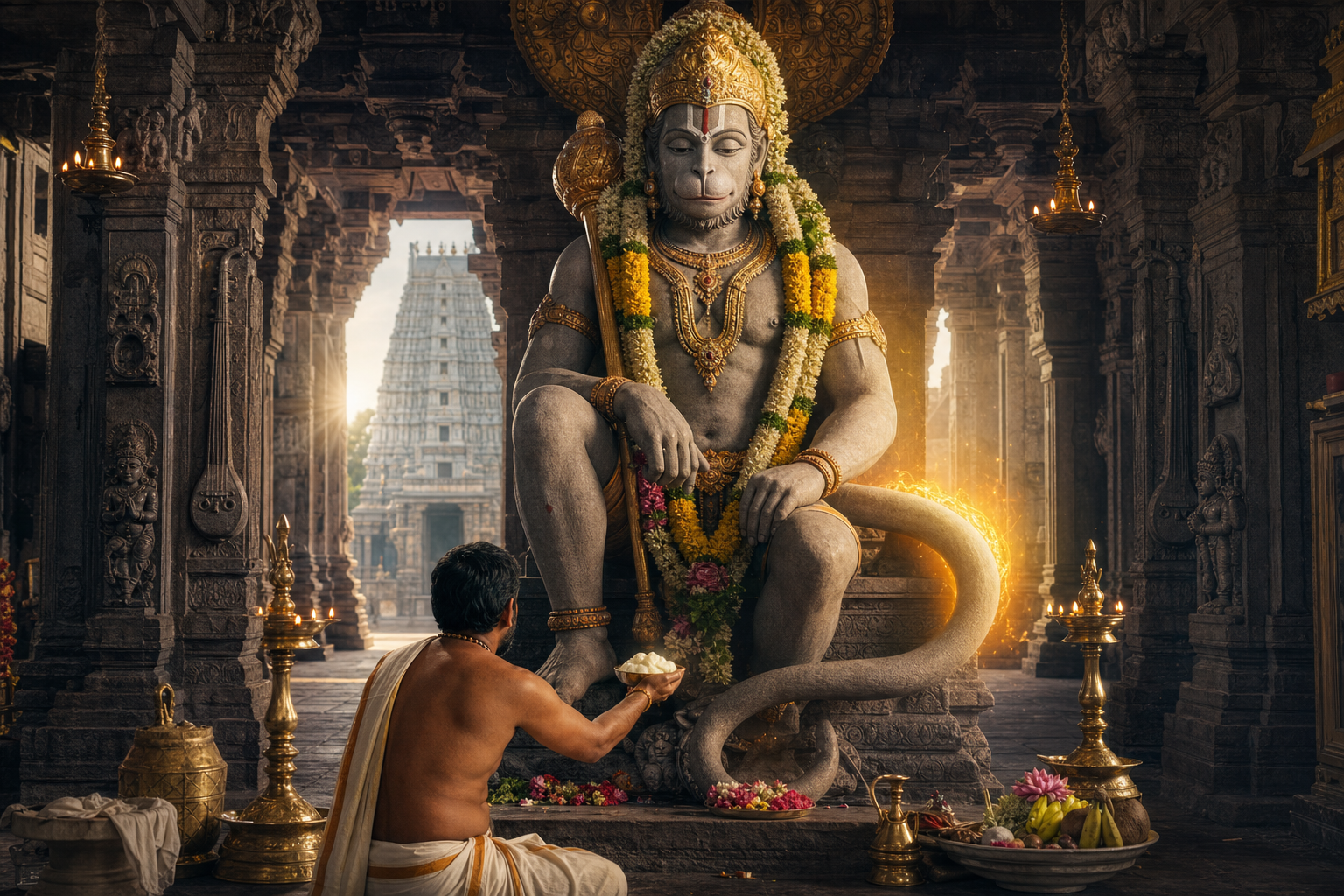
The Hanuman shrine within this temple complex gives Suchindram another layer of devotional depth. The image of Anjaneya, traditionally described as a towering single-stone form, is not merely an architectural feature; it is the center of a tender and emotionally powerful ritual tradition. Devotees offer butter to Hanuman, especially in connection with the memory of his burning tail in the Ramayana episode of Lanka. The act is interpreted as cooling, soothing, and serving the divine servant of Rama. In the devotional imagination, butter is not a casual material offering. It becomes a language of care.
The story behind the offering is rooted in one of the most dramatic episodes of the Ramayana. Hanuman reaches Lanka in search of Sita, reveals the courage and intelligence of Rama’s messenger, and is eventually captured in Ravana’s court. His tail is wrapped and set on fire, but the intended humiliation becomes an instrument of divine purpose. Hanuman uses the burning tail to set Lanka aflame, exposing the arrogance of adharma and announcing that Rama’s cause cannot be dismissed. In many Hanuman traditions across India, this episode is remembered not only as a scene of power but also as a scene of pain willingly endured for dharma.
At Suchindram, the butter offering appears to preserve precisely this emotional memory. The devotee does not approach Hanuman only as a heroic warrior; Hanuman is approached as one who suffered for Rama, Sita, and the restoration of righteousness. Butter, cool and soft by nature, is placed in devotional contrast to flame. The ritual conveys a simple but profound idea: the devotee wishes to cool the sacred wound of one who carried fire for the world. In that symbolic act, worship becomes gratitude, empathy, and participation in the Ramayana’s moral universe.
This is why the phrase devotion heals must be understood carefully. The healing associated with the butter offering is primarily spiritual, emotional, and symbolic. It is not a substitute for medical care, nor should temple ritual be reduced to a mechanical promise of cure. Rather, the offering helps devotees express grief, anxiety, hope, and surrender in a structured sacred act. For many families, especially those who arrive with burdens that cannot be easily spoken, the butter offering becomes a way of placing heat, anger, fear, and exhaustion before Hanuman and asking that they be cooled by devotion.
The temple’s larger setting strengthens this experience. Suchindram is not dedicated to Hanuman alone. It is a complex world of shrines, mandapas, sculptural panels, ritual sounds, and layered legends. The presence of Sthanumalayan at the center establishes a theology of integration. Shiva, Vishnu, and Brahma are not presented as rivals but as dimensions of one sacred reality. The Hanuman shrine then adds the bhakti ideal of service: strength placed at the feet of dharma, speech disciplined by devotion, and power governed by humility.
The temple’s architecture also contributes to its reputation. Suchindram is associated with the Dravidian temple tradition while also reflecting cultural connections with the older Travancore region. Its gopuram, corridors, sculptural workmanship, and celebrated musical pillars point to a long history of artistic and ritual refinement. The musical pillars are especially important in discussions of South Indian temples because they reveal how sacred architecture could integrate acoustics, stone craft, performance, and worship. In such a setting, the Hanuman shrine is not isolated; it belongs to a wider civilizational vision in which art, devotion, and metaphysics meet.
The Hanuman image at Suchindram is often remembered for its imposing size and visual force. Yet its devotional appeal lies not only in height or material. Hanuman’s stature in Hindu tradition comes from his complete alignment with Rama. He is strong but egoless, learned but humble, fierce but compassionate, and active without selfish ambition. These qualities explain why Hanuman worship remains so widespread across regions, languages, and sampradayas. Whether invoked as Anjaneya, Maruti, Bajrangbali, or Hanuman, he becomes the accessible embodiment of disciplined energy and unwavering faith.
The butter offering at Suchindram can therefore be read as a practical theology of bhakti. The devotee does not merely praise Hanuman’s strength; the devotee serves him. The relationship is intimate. Butter is applied or offered not as ornament alone but as a cooling gesture that recalls the fire of Lanka. This kind of ritual memory is central to Hindu practice. Stories are not left in manuscripts or recitations; they enter the body through gesture, substance, scent, touch, sound, and repetition. The Ramayana becomes present through the act of offering.
Such rituals also reveal the sophistication of embodied symbolism in Hindu temples. Fire and butter are not accidental opposites. Fire represents heat, transformation, tapas, danger, and purification. Butter represents nourishment, tenderness, cooling, and care. In Vedic and Puranic worlds, clarified butter has its own sacrificial importance, but at Suchindram the devotional imagination turns toward butter’s cooling and soothing quality. The offering quietly teaches that strength must be balanced by gentleness, and that the heroic must also be cared for.
For devotees, this symbolism often becomes personally meaningful. A person who feels burned by conflict, illness, failure, or sorrow may find in Hanuman’s tail a sacred mirror. The fire of Lanka is cosmic and epic, but the heat of daily life is familiar: worry within a household, the pressure of duty, the pain of separation, or the exhaustion of moral struggle. The offering of butter allows these experiences to be translated into ritual form. Through Hanuman, personal suffering is placed inside a larger story of courage, service, and eventual restoration.
This emotional accessibility is one reason Hanuman devotion has remained strong across centuries. Hanuman is not distant from human struggle. He searches, leaps, negotiates, consoles, fights, carries, and serves. He is present in moments of crisis and action. In the Sundara Kanda, his meeting with Sita is not only a heroic achievement but also an act of reassurance. He gives hope when despair appears rational. The butter offering at Suchindram extends this same devotional mood: where there is heat, Hanuman is remembered as one who can hold it, transform it, and return the mind to courage.
Suchindram Temple’s Trinitarian identity further deepens the ritual’s message. The combined form of Shiva, Vishnu, and Brahma affirms that ultimate reality may be approached through multiple names and forms without losing unity. Hanuman himself bridges several theological worlds. He is the supreme devotee of Rama, an avatara-related figure in Vaishnava devotion, and in many traditions is also connected with Shiva’s energy. This makes the Hanuman shrine at Suchindram especially appropriate within a temple that honors synthesis rather than division.
This integrative spirit aligns with the broader dharmic ideal of respecting diverse modes of worship. Hinduism, Buddhism, Jainism, and Sikhism differ in theology, ritual, and historical development, yet they share a civilizational concern for discipline, compassion, self-mastery, ethical conduct, and liberation from narrow ego. A temple such as Suchindram does not erase difference; it demonstrates how difference can be held within reverence. The butter offering to Hanuman likewise teaches that devotion is not aggression toward another path. It is the refinement of one’s own heart through service.
The history of Suchindram also matters. The temple is associated with older South Indian dynastic and regional traditions, including Chola, Nayak, and Travancore contributions in different phases of its development and patronage. Its location near Kanyakumari places it at a cultural meeting point of Tamil and Kerala influences. Such temples functioned not only as places of worship but also as centers of art, music, social gathering, local memory, and sacred economy. The continuing practice of offering butter to Hanuman is therefore part of a larger heritage ecosystem, not a disconnected custom.
The legend of Suchindram’s name is also tied to purification. Traditional accounts connect the place with Indra’s release from sin or impurity after worship. Whether approached historically, symbolically, or devotionally, this association with purification resonates with the Hanuman ritual. The temple becomes a place where heat is cooled, burden is lightened, and moral disorder is brought before sacred order. The devotee does not simply ask for worldly benefit; the deeper movement is toward inner cleansing and steadiness.
In academic terms, the butter offering may be understood as a form of ritualized empathy. The devotee responds to divine suffering remembered in sacred narrative. This is not unusual in bhakti traditions. Devotees comfort child Krishna, awaken sleeping deities, feed the divine, fan the deity in heat, decorate the deity in festival seasons, and offer cooling substances during specific forms of worship. Such acts may appear simple, but they encode a theology in which the divine is not merely an abstract principle. The divine is relational, approachable, and responsive to love.
At the same time, Suchindram’s Hanuman worship should not be romanticized without attention to discipline. Hanuman is beloved because his devotion is inseparable from self-control. He is a master of speech, strength, movement, and judgment. In Lanka, he knows when to conceal himself, when to speak, when to console Sita, when to warn Ravana, and when to act with force. The butter offering does not sentimentalize him; it honors the cost of such disciplined service. It reminds devotees that courage may burn, and that dharma often requires endurance before victory becomes visible.
The ritual also offers a counterpoint to modern restlessness. Contemporary life often treats pain as either a private burden or a problem to be solved quickly. Temple practice offers another grammar. It permits a person to stand in continuity with generations of devotees, to perform a small act with inherited meaning, and to allow grief or anxiety to become prayer. In this sense, the butter offering is not merely about the past. It remains relevant because human beings still need meaningful ways to cool the fires they carry.
Suchindram Temple also invites reflection on the relationship between grandeur and intimacy. The gopuram, the stone corridors, the musical pillars, and the large Hanuman image create an atmosphere of majesty. Yet the butter offering is intimate and almost domestic in feeling. Butter belongs to the world of nourishment, kitchens, childhood, care, and simplicity. The ritual thus brings together the monumental and the tender. A vast temple tradition becomes approachable through a small offering held in the hands of a devotee.
The continuing appeal of this practice lies in that union. Hanuman’s tail, once weaponized by Ravana’s cruelty, becomes in devotional memory a site of reverence. Fire, meant to shame him, becomes a sign of divine mission. Butter, offered by devotees, becomes a sign that love remembers even the wounds of the strong. This transformation is central to dharmic storytelling: suffering is not denied, but it is placed within a larger movement toward courage, service, and restoration.
From the standpoint of temple studies, Suchindram’s Hanuman tradition also demonstrates how local practice preserves pan-Indian narratives. The Ramayana is known across India and beyond, but each region receives and embodies it differently. In some places Hanuman is worshipped for strength, in others for protection, learning, celibacy, healing, courage, or removal of fear. At Suchindram, the focus on cooling the sacred flame gives the Ramayana episode a distinctly compassionate ritual expression. It shows how local devotion adds texture without breaking the unity of the larger story.
There is also a moral lesson in the ritual’s quietness. Hanuman does not ask to be healed, rewarded, or praised. His service is complete in itself. Yet devotees remember. They bring butter because gratitude seeks expression. This is one of the subtle ethical teachings of bhakti: true devotion notices sacrifice. It does not consume divine help casually. It responds with care, however small the offering may appear.
Suchindram’s sacred landscape therefore speaks to several audiences at once. For the devotee, it is a place of prayer and emotional relief. For the student of religion, it is an example of theological integration, ritual symbolism, and living Ramayana memory. For the heritage observer, it is a South Indian temple of architectural and cultural significance. For anyone interested in dharmic unity, it is a reminder that plurality need not produce fragmentation when held within reverence, discipline, and shared sacred purpose.
The butter offering to Hanuman at Suchindram ultimately endures because it is both simple and profound. It does not require complex explanation to move the heart: Hanuman’s tail burned for Rama’s mission, and devotees bring cooling butter in gratitude. Yet beneath that simplicity lies a complete spiritual vision. Devotion remembers. Devotion serves. Devotion cools the heat of suffering. In the presence of Suchindram’s Hanuman, the Ramayana is not only recited; it is touched, offered, and lived.
Inspired by this post on Hindu Blog.
