
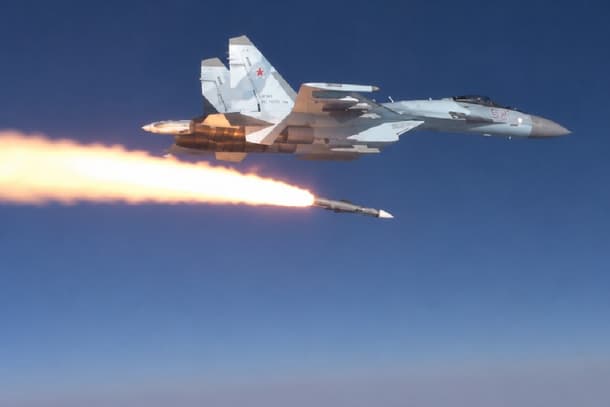
A reported Indian move to acquire around 300 Russian R-37M long-range air-to-air missiles for the Su-30MKI fleet has generated understandable attention in defence circles. The reported value, about $1.2 billion, and the scale of the possible purchase suggest an urgent attempt to answer Pakistan’s induction of the Chinese PL-15 missile with the J-10C fighter. Yet the central lesson is more demanding than a simple missile-for-missile comparison. Bharat’s PL-15 problem is not merely a range problem; it is a kill-chain problem.
The deal has not been confirmed through an official Indian announcement, and that caveat matters. Defence reporting often moves faster than signed contracts, integration schedules, and operational clearances. Still, the logic behind the reported procurement is easy to understand. Operation Sindoor appears to have sharpened the perception that the Indian Air Force needs greater beyond-visual-range reach against Pakistan’s newer Chinese-origin air combat system. In public debate, that perceived gap has quickly been reduced to a single question: does Bharat have a missile that can outrange the PL-15?
That question is too narrow. In modern air warfare, a missile’s advertised range is only the outer edge of a much larger tactical equation. A long-range missile must first be cued by sensors, supported by a secure datalink, launched from a platform that gives it energy, updated during flight, protected against electronic warfare, and guided toward a target that is trying to evade, jam, decoy, and maneuver. The number printed in a brochure is not the number that determines combat outcomes.
The PL-15 is dangerous precisely because it sits inside a broader Chinese-designed system. Open-source assessments describe it as a long-range active radar-homing beyond-visual-range missile with a dual-pulse rocket motor, high terminal energy, and an active electronically scanned array seeker. Its export variant, the PL-15E, is generally assessed to have a lower range than the domestic Chinese version, but it still represents a major improvement over older missiles available to Pakistan. When paired with the J-10C, airborne early warning aircraft, and Chinese tactical datalinks, it becomes a weapon for networked air combat rather than a standalone projectile.
This is the part of the debate that often gets missed. Pakistan’s advantage, if it exists in a particular engagement, may not come only from the missile carried under the wing. It may come from the ability to detect, classify, share, and update target information while keeping the shooter at a safer distance. A J-10C does not need to behave like an isolated aircraft if it can receive targeting support from airborne early warning and control assets. In that model, the aircraft becomes one node in a combat cloud.
The R-37M offers a serious counterweight, but it is not a magic correction. The missile was developed from the Soviet and Russian tradition of very long-range intercept weapons, originally oriented toward high-value targets such as AWACS, tankers, intelligence aircraft, and other large support platforms. It is a heavy missile, often described in open sources as weighing around 500 kilograms in its export RVV-BD form, with a large warhead and very high speed. Its advertised range is impressive, and in Russian service it has gained attention through use in the Ukraine war.
However, range against a large, non-maneuvering aircraft is not the same as lethality against an alert fighter. A support aircraft flying a predictable orbit presents a very different target from a fighter that can turn cold, dive, drag the missile into denser air, use jamming, deploy decoys, and exploit terrain or radar geometry. This difference is central to every honest assessment of the R-37M. It can impose caution on enemy pilots, stretch their decision timelines, and threaten high-value assets, but it cannot by itself guarantee air dominance against a networked fighter force.
The Ukraine experience reinforces this point. Russian long-range missiles have forced Ukrainian pilots to fly defensively and often abandon mission profiles. That is operationally significant even when every missile does not produce a hard kill. A missile can shape the battle by denying airspace, disrupting sorties, and forcing adversaries to operate at lower altitude or with less freedom. For Bharat, the R-37M could serve a similar purpose: it could complicate Pakistan’s use of airborne early warning aircraft and create pressure on standoff formations. But such pressure is not the same as solving the PL-15 challenge.
The launching aircraft matters as much as the missile. The R-37M performs best when launched from a high-altitude, high-speed platform that gives it maximum initial energy. Russia’s MiG-31BM, with its speed, altitude, and interceptor design, is a natural carrier for such a weapon. Bharat’s Su-30MKI is a powerful and flexible fighter, but it is not a MiG-31. It can carry heavy weapons, it has range and payload, and it remains a central pillar of Indian air power, yet the same missile launched from different aircraft under different profiles will not produce identical engagement envelopes.
Integration is another hard reality. A missile is not operational simply because it can be physically mounted. It must be electrically integrated, aerodynamically cleared, tested across flight regimes, connected to fire-control software, linked with identification and targeting systems, and validated through live or instrumented trials. The Su-30MKI fleet is already a complex Indian-Russian-Israeli-French ecosystem with several upgrade pathways. Adding R-37M capability would require more than delivery crates; it would require a robust integration program and training cycle.
The radar question is equally important. The Su-30MKI’s current Bars radar has served India well, but the future of beyond-visual-range combat increasingly belongs to AESA radars, low-probability-of-intercept modes, stronger electronic counter-countermeasures, sensor fusion, and cooperative targeting. If a missile can theoretically fly very far but the aircraft cannot reliably build and maintain a high-quality track at the required distance, the practical value of the missile falls sharply. Long-range air combat begins before launch, and sometimes the decisive contest is won or lost in the sensor layer.
This is why Bharat’s answer to the PL-15 must include airborne early warning and control capacity. AEW&C aircraft extend radar coverage, coordinate fighters, manage battlespace, and provide the mid-course awareness that long-range missiles need. Pakistan’s use of Chinese and Swedish-origin airborne surveillance assets has long been a serious factor in the subcontinent’s air balance. India has capable systems, including indigenous Netra-class AEW&C assets and larger airborne platforms, but the number of aircraft, availability rates, coverage patterns, and survivability of these assets remain crucial.
A modern missile duel is therefore a contest between networks. One network sees first, shares first, shoots first, and supports the missile longer. The other network must detect the threat, deny the shot, break the missile’s tracking chain, and preserve its own freedom to operate. In that contest, electronic warfare becomes as important as propulsion. Jamming pods, towed decoys, radar warning receivers, missile approach warning systems, infrared search and track, and emission-control discipline all shape survivability.
The PL-15’s technical reputation rests partly on its seeker and datalink features. An active radar seeker gives a missile terminal autonomy, while mid-course updates allow it to fly efficiently toward a predicted intercept point before switching on its own radar. A dual-pulse motor helps preserve energy later in flight, making the missile more dangerous at range than older weapons that burn early and coast for a long terminal phase. These features do not make evasion impossible, but they reduce the comfort margin that pilots once enjoyed against earlier-generation missiles.
The R-37M brings a different form of danger. Its speed and size allow it to threaten targets at very long distances, especially if those targets are large, high-flying, or not maneuvering aggressively. Against AWACS, tankers, and support platforms, this is a meaningful deterrent. If Pakistan’s airborne early warning aircraft must operate farther behind the front or with more defensive caution, the effectiveness of its PL-15 shooters could be reduced. In that limited role, the R-37M may be valuable.
But if the R-37M is treated as a direct PL-15 equivalent, the debate becomes misleading. The PL-15 is primarily a fighter-versus-fighter beyond-visual-range weapon. The R-37M is closer to a very-long-range interceptor missile with special value against high-value aerial assets. It may also be used against fighters, and its speed can be intimidating, but its strongest contribution may be to expand India’s threat envelope against the supporting architecture behind Pakistan’s fighters. That is a different mission from simply winning every fighter duel at extreme range.
The Indian Air Force must therefore think in layers. One layer is immediate deterrence: acquiring or integrating a long-range missile that imposes risk on Pakistan’s support aircraft. Another layer is fleet modernization: upgrading Su-30MKI sensors, mission computers, cockpit systems, electronic warfare suites, and datalinks. A third layer is indigenous missile development through the Astra family. A fourth layer is doctrine, training, and networked command and control. Only the combination can produce a durable answer.
The Astra program is especially important because strategic autonomy cannot rest indefinitely on emergency imports. Astra Mk1 has already established the foundation of an indigenous beyond-visual-range missile ecosystem. Astra Mk2 and the longer-range Astra Mk3 or SFDR-derived concepts are expected to move India toward greater reach, improved energy management, and domestic control over seeker, propulsion, software, and production. These programs may not provide an instant fix, but they address the deeper vulnerability: dependence on foreign supply chains in a fast-changing air combat environment.
Domestic development also allows adaptation to Indian doctrine. Imported weapons arrive with their own design assumptions, export limitations, integration constraints, and support dependencies. Indigenous systems can be tailored to Indian aircraft, Indian datalinks, Indian electronic warfare libraries, and Indian threat libraries. For a country facing a two-front military challenge involving Pakistan and China, that adaptability is not a luxury. It is a national security requirement.
The Rafale fleet adds another dimension through the Meteor missile. Meteor’s ramjet propulsion gives it a strong no-escape-zone reputation, particularly in the later stages of flight. Although numbers matter and Rafale squadrons are limited, the platform-missile combination remains one of the most capable elements in India’s current air combat inventory. The lesson from Rafale and Meteor is not that every aircraft must carry the same missile. The lesson is that platform, sensor, datalink, electronic warfare suite, and missile must be designed or integrated as a coherent combat system.
The Su-30MKI upgrade should be viewed through this lens. A modernized Su-30MKI with an AESA radar, stronger electronic warfare suite, improved cockpit, faster processors, secure datalinks, and compatible long-range weapons would be far more valuable than a legacy aircraft carrying a new missile without full system transformation. Bharat possesses a large Su-30MKI fleet, and that fleet’s modernization will influence the regional balance more than any single procurement headline.
There is also a tactical question: how should India use a very-long-range missile? If deployed casually, such missiles may be wasted in low-probability shots. If used thoughtfully, they can force adversary support aircraft to reposition, break coordination, or reduce radar coverage. They can also create dilemmas for enemy fighters that must decide whether to defend, continue guiding their own missiles, or protect high-value assets. The R-37M’s value may lie less in spectacular kills and more in changing the adversary’s geometry.
This distinction is emotionally unsatisfying for a public that wants a clean answer after a perceived capability shock. A missile with a larger range number seems to offer closure. It suggests that humiliation can be reversed through procurement. But air warfare is rarely so simple. The more sober conclusion is that Bharat must rebuild the entire chain from detection to decision to destruction. That is slower, more expensive, and less dramatic, but it is also more real.
Pakistan’s PL-15 capability should therefore be taken seriously without being exaggerated into mythology. No missile is unbeatable. Long-range shots suffer from energy loss, target maneuver, electronic attack, uncertain identification, rules of engagement, and the need for reliable mid-course support. The farther a missile is fired, the more the target’s behavior can change before intercept. Even advanced weapons have a no-escape zone that is much smaller than their maximum aerodynamic range.
At the same time, dismissing the PL-15 would be irresponsible. Its arrival in Pakistan’s inventory changes pilot psychology, tactical spacing, and risk calculations. Indian aircraft operating near contested airspace must assume that Pakistani fighters can engage from longer distances than before, possibly with external sensor support. That assumption affects patrol patterns, strike escort planning, suppression missions, and the positioning of support aircraft. A responsible defence establishment plans against capability, not against comfort.
The deeper Chinese role is also significant. Pakistan’s J-10C and PL-15 combination is not just a bilateral India-Pakistan issue. It is part of the diffusion of Chinese air combat technology into South Asia. China has spent years improving AESA radars, long-range missiles, infrared sensors, datalinks, electronic warfare, and airborne command systems. Pakistan’s access to parts of this ecosystem means India is indirectly facing a Chinese model of air combat even in a western-front scenario.
That reality should push Bharat toward jointness. Air defence cannot be separated from space-based surveillance, ground radar networks, cyber resilience, electronic intelligence, and secure communications. Fighter aircraft are the visible edge of a much larger national system. If that system is fragmented, the best missile becomes underused. If the system is integrated, even older platforms can become more dangerous because they receive better information at the right time.
Secure datalinks deserve special attention. A fighter that turns on its radar at the wrong moment can reveal itself. A fighter receiving target-quality data from another sensor can remain quieter for longer. This is why cooperative engagement matters. It allows one platform to detect, another to launch, and a wider network to support the engagement. The PL-15 challenge is inseparable from this architecture. Bharat’s response must include indigenous, encrypted, jam-resistant networking across fighters, AEW&C aircraft, ground stations, and naval aviation assets.
Electronic warfare libraries are another less glamorous but decisive area. A missile seeker does not operate in a clean laboratory environment. It operates amid noise, deception, clutter, and deliberate attempts to confuse it. The side with better threat libraries, faster updates, and more realistic training will often perform better than the side with a theoretically superior specification sheet. For Bharat, the recovery and analysis of adversary missile debris, radar signatures, and datalink behavior can be as valuable as buying another batch of weapons.
Training must also adapt. Pilots need repeated exposure to long-range missile threat simulations, electronic attack conditions, multi-axis engagements, and degraded communications. They must practice not only firing but surviving: when to crank, when to drag, when to go cold, when to support a missile, when to break lock, and how to coordinate with wingmen and controllers. Modern beyond-visual-range combat is a mental contest under severe time pressure. Technology helps, but training turns technology into combat behavior.
The civilian public often sees air combat as a duel between two aircraft. In reality, it resembles a compressed decision network where seconds matter and uncertainty is constant. A pilot may not know whether an enemy missile has been launched, whether the opposing fighter is illuminating directly, whether an AEW&C aircraft is providing mid-course support, or whether a radar warning is part of a deception pattern. This uncertainty is why doctrine and discipline matter. A force that has rehearsed uncertainty will handle it better than one relying on platform confidence alone.
Bharat also has to consider numbers. A small inventory of exquisite weapons can create deterrence, but sustained operations require stockpiles, maintenance, training rounds, spares, and replacement capacity. If around 300 R-37M missiles are eventually acquired, that would be meaningful, but the number must be understood against squadron strength, sortie rates, training requirements, and wartime expenditure. Missile inventories can be consumed quickly in high-tempo conflict. Industrial depth matters.
This is where the national security debate intersects with industrial policy. Indigenous seekers, propulsion, datalinks, radomes, electronic components, and testing infrastructure are not secondary matters. They are the foundation of wartime independence. A country may import a weapon to close an urgent gap, but it cannot import strategic confidence forever. The R-37M, if acquired, should be treated as an interim operational tool, not as a substitute for domestic capability building.
There is also a risk of overcorrection. If India focuses too heavily on extreme-range air-to-air missiles, it may underinvest in medium-range missiles with larger no-escape zones, close-combat missiles, electronic warfare pods, decoys, and airbase survivability. Wars are rarely won by optimizing one metric. Pakistan and China would adapt to any Indian R-37M deployment by changing flight profiles, support aircraft orbits, emission practices, and decoy tactics. Every weapon creates a countermeasure cycle.
A balanced approach would combine immediate procurement with long-term reform. In the immediate term, India can pursue weapons that complicate Pakistan’s airborne command network. In the medium term, it can accelerate Su-30MKI modernization, Tejas Mk1A and Mk2 integration, Rafale force optimization, and Astra-family deployment. In the long term, it must build a dense, resilient, indigenous air combat network that can fight even under electronic attack and infrastructure stress.
Airbase resilience should not be ignored. Long-range air combat does not occur in isolation from missile strikes, drones, cyber attacks, and runway denial. Aircraft that cannot sortie are irrelevant, regardless of the missiles in storage. Hardened shelters, rapid runway repair, dispersed operations, mobile maintenance, decoys, and layered air defence are part of the same air superiority equation. The side that keeps generating sorties under attack retains initiative.
The political leadership must therefore resist the temptation to present a single purchase as a strategic solution. Procurement is necessary, but procurement is not strategy. Strategy requires a theory of victory: how Bharat intends to detect enemy aircraft, protect its own support platforms, degrade adversary networks, preserve pilot survivability, and sustain operations over days or weeks of conflict. A missile acquisition can serve that theory. It cannot replace it.
For a civilisational state like Bharat, national security also carries a deeper public meaning. Citizens may not follow radar modes or missile kinematics closely, but they understand vulnerability and deterrence. A secure Bharat gives space for its diverse dharmic traditions, communities, institutions, and civil society to flourish without coercion from hostile powers. Defence modernization is therefore not an abstract military obsession. It is part of preserving national confidence and social stability.
That confidence, however, must be disciplined by realism. The PL-15 problem should not produce panic, and the R-37M should not produce complacency. Both reactions distort policy. The correct response is methodical: study the threat, identify the chain behind it, strengthen weak links, import only where necessary, build domestically wherever possible, and train as if the enemy is intelligent. Serious nations do not chase headlines; they build systems.
The reported R-37M acquisition may still prove useful. It could extend the Su-30MKI’s deterrent reach, threaten Pakistan’s high-value aerial assets, and buy time while Indian programs mature. But it will not, by itself, neutralize the PL-15. The true answer lies in sensors, networks, electronic warfare, tactics, indigenous missiles, platform upgrades, and operational doctrine. Bharat’s challenge is not to own the longest spear; it is to ensure that the entire arm can see, move, strike, and survive.
The final lesson is clear. A long-range missile can close a visible gap, but only an integrated air combat system can close the real one. If Bharat treats the PL-15 as a procurement problem, it may buy temporary reassurance. If it treats the PL-15 as a warning about networked warfare, it can build lasting advantage. That second path is harder, but it is the path a serious national security strategy demands.
Inspired by this post on Hindu Post.
