-
Unmasking Myths: How Truly Enlightened Beings Live, Eat, and Speak Among Us

This essay dismantles the popular myth that enlightened beings must look or act extraordinary, showing instead how Dharmic traditions depict realization as profound normalcy. Drawing on Hindu philosophy, Buddhism, Jainism, and Sikhism, it clarifies how liberation expresses itself in everyday eating, speaking, working, and serving. It synthesizes concepts such as mokṣa, nirvāṇa, kaivalya, kevala-jñāna, and…
-
What Macron’s Mumbai Jog Reveals about Leadership Fitness, Soft Power, and India–France Ties

French President Emmanuel Macron’s late-morning jog through Mumbai’s Churchgate district, during a visit associated with the AI Impact Summit, offered a concise case study in soft power and public diplomacy. The moment projected leadership fitness and approachability while showcasing coordination by Indian security and civic agencies. It also served as earned media, linking a policy-focused…
-
Beyond Name and Fame: A Dharmic Blueprint to Transcend Materialism and Find Lasting Fulfillment

Modern culture often mistakes accumulation, name, and fame for life’s highest achievement, yet this chase rarely resolves the inner void it aims to fill. A Hindu lens—aligned with Buddhist, Jain, and Sikh insights—frames the compulsion as avidya, a misidentification of self with roles and possessions. Anchored in the purusharthas, the analysis shows how artha and…
-
February 25, 2026 Panchang Guide: Shukla Paksha Navami, Auspicious Timings, Nakshatra & Rashi

On Wednesday, February 25, 2026, the Daily Hindu Calendar (Panchang) records Shukla Paksha Ashtami until 4:47 AM IST, followed by Shukla Paksha Navami for the rest of the civil day in most regions. The transition reflects the tithi’s astronomical definition based on the Moon–Sun elongation in 12-degree steps. Auspicious timing can be centered on Abhijit…
-
Complete Panchang for 18 February 2026 (IST): Tithi, Nakshatra, Choghadiya & Shubh Muhurat

The Panchang for Wednesday, 18 February 2026 (IST) brings together Tithi, Nakshatra, Yoga, Karana, Sunrise/Sunset, Moonrise/Moonset, Rahu Kalam, Yamaganda, Gulika Kalam, Abhijit Muhurat, Durmuhurtham, Choghadiya, Tarabalam, Chandrabalam, Lagna timings, and Amrit Kalam/Varjyam to guide auspicious planning. Presented in an academic, practical style, it explains how to compute location-specific windows under IST while preserving accuracy. Readers…
-
Unlock 19 February 2026 (IST) Panchang: Sacred Tithi, Nakshatra, Yoga and Auspicious Hours

This comprehensive guide explains how to read the 19 February 2026 (IST) Panchang with precision and care. It clarifies the five limbs—Tithi, Nakshatra, Yoga, Karana, and Vara—and shows how sunrise and moonrise anchor all computations. Readers learn to identify auspicious hours using Choghadiya, avoid inauspicious intervals like Rahu Kalam and Durmuhurtham, and apply personal filters…
-
Panchang 21 Feb 2026 (IST): Auspicious Timings, Tithi, Nakshatra, Yoga & Practical Guide

This comprehensive guide to the Panchang for Saturday, 21 February 2026 (IST) explains how to apply Tithi, Nakshatra, Yoga, and Karana—together with Lagna, Choghadiya, Abhijit Muhurta, Rahu Kalam, Durmuhurtham, Amrit Kalam, Tarabalam, and Chandrabalam—to plan the day intentionally. It details the core formulas and interpretive logic, clarifies what must be city-specific, and offers a practical…
-
Comprehensive Panchang for 22 February 2026 (IST): Tithi, Nakshatra, Choghadiya, Muhurat Guide

This comprehensive Panchang guide for 22 February 2026 (Sunday, IST) explains how to read and apply Tithi, Nakshatra, Yoga, and Karana alongside Choghadiya, Abhijit Muhurat, Amrit Kalam, and Durmuhurtham. It clarifies the computation of Rahu Kalam, Yamaganda, and Gulikai from local sunrise and sunset, and shows how Lagna, Tarabalam, and Chandrabalam personalize timing for individuals.…
-
When Life Shatters the Script: Reframing Expectations, Grief, and Resilience with Dharmic Wisdom

Life scripts often feel reliable until an unpredictable event shatters the plan. This analysis follows a young widow’s experience to show how grief includes both the loss of a loved one and the collapse of anticipated futures. It explains why rigid expectations amplify suffering, drawing on cognitive science, bereavement research, and shared dharmic wisdom across…
-
Historic Milestone: Pran Pratishtha of 12 Jyotirlingas at Shri Goveshwar Devasthan, Old Goa

Shri Goveshwar Devasthan (Mahashiv Temple) in Old Goa has marked a historic milestone with the Pran Pratishtha of twelve Jyotirlinga representations in a single precinct. The ceremony aligns with Agamic and Shilpa Shastra principles, transforming crafted icons into a living locus of presence through mantric and liturgical precision. The twelve-Jyotirlinga configuration offers a compact, pedagogical…
-
Ravana’s Abduction of Sita Revisited: Dharma, Curses, and a Deliberate Path to Moksha

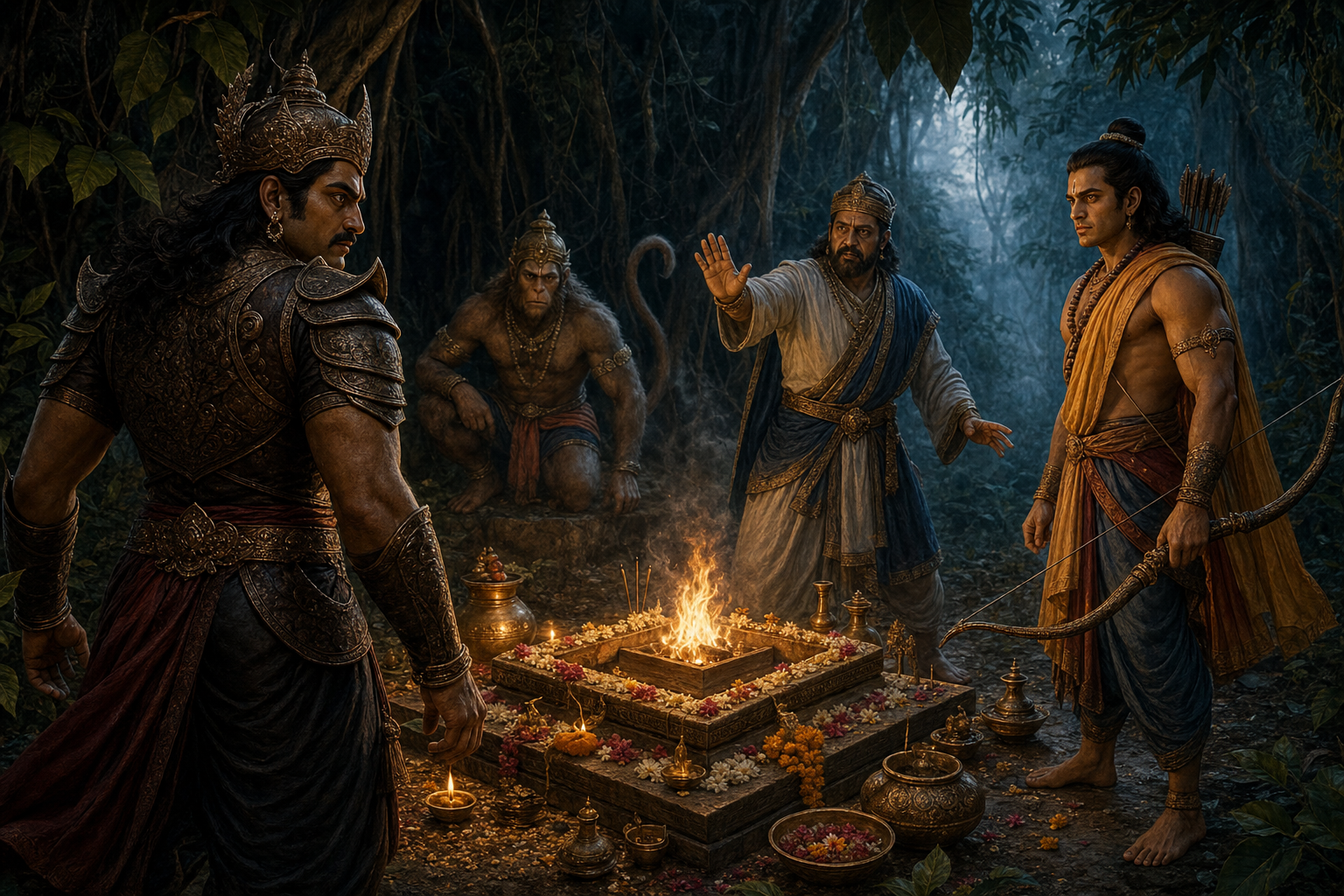
Did Ravana kidnap Sita to be slain by Sri Rama and attain moksha? A careful, text-sensitive study shows that while Valmiki’s Ramayana emphasizes Ravana’s pride and desire, later Puranic and bhakti traditions interpret his fall within a cosmic design of grace. The Jaya–Vijaya doctrine, vaira-bhakti (absorption through enmity), karmic curses, and the Maya Sita motif…
-
125+ Global Hindu Organizations Urge Swift Global Action to Safeguard Hindus in Bangladesh

A coalition of more than 125 global Hindu organizations has called for urgent international action to halt violence against Hindus in Bangladesh, warning that inaction risks a systematic erasure of minorities. This analysis situates the crisis within Bangladesh’s constitutional commitments, recent incident patterns, and the demographic pressures facing Hindu communities. It clarifies the legal meaning…
-
Puttur’s Hindu Rashtra-Jagruti Sabha Proceeds Peacefully, Reaffirming Unity and Rights

On 15 February in Puttur, the Hindu Rashtra-Jagruti Sabha organized by HJS proceeded as scheduled despite SDPI’s objection that the event was unconstitutional and divisive. HJS stated the programme complied with legal requirements and affirmed that similar meetings, including one in Bantwal, will continue. This analysis explains the constitutional framework—Article 19 freedoms and their reasonable…
-
SZA’s Viral Mahashivratri Dance at Isha: A Powerful Bridge Between Pop Culture and Dharma

A viral appearance by Grammy Award-winning artist SZA at Sadhguru’s Mahashivratri in Coimbatore showcased how respectful celebrity participation can amplify Hindu spirituality without diluting its depth. The event highlighted Mahashivratri’s core practices—devotional chant, dance, and meditative vigil—while illustrating soft power at work through cultural appreciation rather than appropriation. For the diaspora, the moment served as…
-
Overcoming Inner Battles in Meditation: Hindu-Yogic, Buddhist, Jain, Sikh Tools for Calm

Meditation across the dharmic traditions often collides with restlessness, distracting thoughts, emotional agitation, doubt, and subtle resistance. Drawing on the Yoga Sutras of Patanjali and the Bhagavad Gita—alongside Buddhist, Jain, and Sikh parallels—this piece delivers a technical, evidence-informed roadmap to stabilize dhyana. Readers learn how to diagnose obstacles (antaraya), regulate arousal with breath awareness and…
-
Safeguarding the Shankaracharya Parampara: Ex-CBI Chief Seeks Unity, Dignity, and Dialogue

A widely discussed letter by former CBI Director M. Nageswara Rao urges the Shankaracharyas of Puri, Sringeri, and Dwarka to help resolve a row over the alleged humiliation of the Jyotirmath Shankaracharya. This analysis explains why the Shankaracharya Parampara is pivotal to Hindu Tradition and Culture and outlines how amnaya peethas and temple administrations can…
-
Hamsa Gita in the Mahabharata: A Timeless Swan-Song of Self-Knowledge and Liberation

The Hamsa Gita in the Mahabharata’s Shanti Parva distills Hindu philosophy into a lucid teaching on witness-consciousness, ethical living, and liberation. It clarifies how ātman stands apart from body and mind, and why steady contemplation and virtue are indispensable for moksha. Read alongside the Bhagavata Purana’s Hamsa avatāra, it reveals a complementary synthesis of jñāna,…
-
Mahabharata’s Karna Reclaimed: Evidence-Based Truths on Dharma, Loyalty, and Fate

This article offers an evidence-based, text-anchored reappraisal of Karna from the Mahabharata, clarifying his birth, training, alliances, battlefield record, and moral complexity. It distinguishes core episodes from later accretions, helping readers separate popular myths from the Critical Edition’s throughlines. By analyzing the Duryodhana–Karna bond through ethical and psychological lenses, it shows how unmet needs for…
-
A Little-Known 1977 Moment with Srila Prabhupada: Consolation, Realism, and Generous Service

A quietly powerful 1977 exchange with Srila Prabhupada captures three enduring pillars of ISKCON’s ethos: compassionate consolation grounded in the Bhagavad-gita’s teaching of the soul’s immortality, pastoral realism that dignifies the grihastha path, and purposeful philanthropy directed to printing Srimad-Bhagavatam. In a few sentences—“Oh Srila Prabhupada, whatever Krishna desires.” and “Every girl wants to get…
-
From Ritual to Revelation: End ‘Courtesy Japa’ with Focused, Science-Backed Mantra Practice

Courtesy japa—mechanical, minimally attentive mantra repetition—yields little transformative benefit because it lacks clear sound, focused attention, and heartfelt intent. Drawing on Srila Prabhupada’s memorable illustration, this analysis explains why ritual without presence does not mature into love of Krsna, while still acknowledging the protective value of vow-keeping. Integrating insights from Hinduism, Buddhism, Jainism, and Sikhism,…