
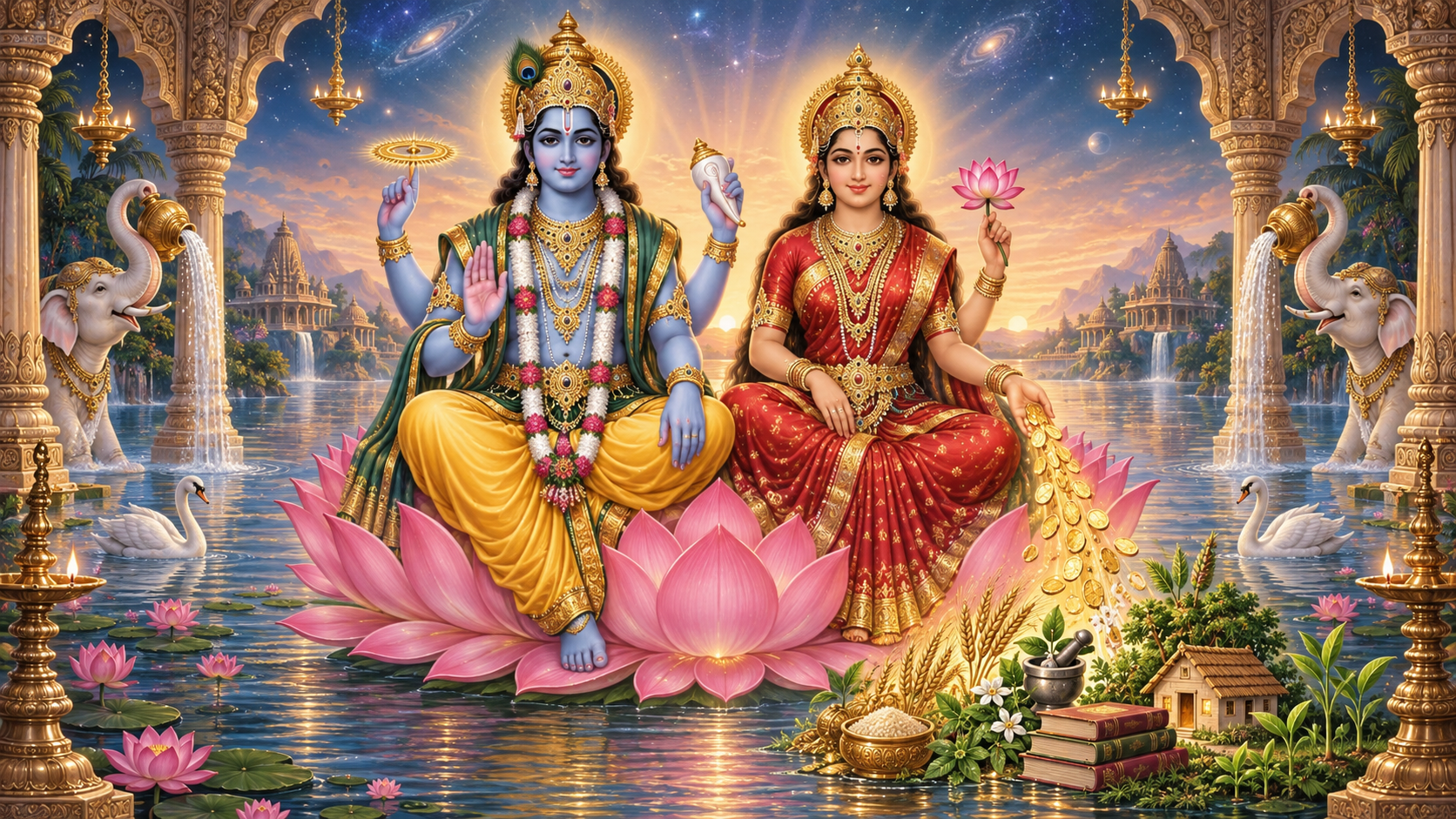
You may want prosperity for your family and still feel uneasy about wanting more. Is the desire for wealth compatible with spiritual life? And when a promotion, purchase, investment, or donation looks beneficial, how do you tell whether it is truly auspicious?
The union of Lakshmi and Vishnu gives you a demanding answer. Wealth is not rejected, but it is not allowed to rule by itself. Prosperity becomes worthy of reverence when it protects duty, dignity, rightful relationships, and the conditions that let life endure.
Why the union changes the meaning of wealth
In this sacred relationship, Lakshmi, the goddess of wealth and prosperity, is united with Vishnu, the preserver of cosmic order. Their union does not reduce either deity to an abstract concept. Devotees worship them as divine. Yet the relationship also teaches a precise moral principle: wealth needs a rightful place within an order larger than itself.
Lakshmi’s choice of Vishnu over the other gods can be read as a statement about the proper dwelling place of prosperity. Wealth remains auspicious where there is steadiness, protection, responsibility, and preservation. Where these disappear, money may remain, but its sacred quality is lost.
This corrects two opposite mistakes. The first is to regard money as inherently impure and deprivation as inherently spiritual. A household needs resources to feed its members, educate children, care for elders, meet obligations, maintain sacred places, and support those in need. Preservation without material means can become an intention with no capacity to act.
The second mistake is to treat financial success as proof of virtue. Wealth can be acquired through deception, pressure, withheld payments, inherited advantage, or the transfer of risk to people who cannot see it. A large balance cannot certify the dharma of the path that produced it.
The relevant question is therefore not simply, “How much wealth do you have?” Ask what your wealth preserves, whom it protects, how it was obtained, and what kind of person its use is making you.
Start with necessities rather than display. Food, shelter, essential care, education, reliable tools, and the fulfillment of promises create a stable base from which generosity and cultural life become possible. Spending for status while a necessary obligation remains unpaid reverses that order.
Then look beyond your own household. Prosperity depends on relationships: workers who perform labor, suppliers who extend trust, customers who rely on truthful claims, relatives who share responsibilities, and communities that sustain institutions. Fair exchange preserves those relationships. Exploitation consumes them.
Finally, consider continuity. A decision can produce immediate pleasure while weakening the future through unmanageable debt, neglected maintenance, exhausted people, or broken trust. Vishnu’s association with preservation directs your attention past the visible gain. What will still be intact after the excitement has passed?
Use this Dharmic test before an important money decision

When a financial choice is morally unclear, do not begin by asking whether you can afford it or how much it might return. Those questions matter, but they come after the ethical boundary. Write a brief answer to each of the following questions before you commit.
- How is the benefit being created? Identify the actual work, product, service, or value behind the income. If the gain depends on a false claim, concealed condition, manipulated fear, or broken promise, greater profitability does not make it Dharmic.
- Who carries the cost or risk? Look for burdens that have been moved out of your sight. A cheap purchase may rest on an unpaid worker. An attractive contract may place nearly all the downside on the less informed party. A personal luxury may quietly become a family debt.
- Which duty is already due? Check wages, bills, taxes, repayments, maintenance, essential household needs, and promises made to others. Public generosity cannot erase a private obligation that you knowingly refused to meet.
- Will this choice strengthen continuity? Ask whether it improves resilience, useful capacity, trust, health of relationships, or the ability to meet future responsibilities. If it only enlarges appearance, its prosperity may be thin.
- What would be enough? Define the legitimate purpose of the gain. Without an idea of sufficiency, every achievement becomes permission for the next appetite, and wealth ceases to serve anything beyond accumulation.
These questions are not a formula for turning every choice into an easy answer. Duties can conflict. Supporting an elder may reduce savings; keeping a business alive may require temporary restraint elsewhere; helping someone can either restore independence or deepen an unhealthy dependence. The test forces you to name the conflict honestly instead of hiding it behind the word “prosperity.”
A clear deception, withheld due payment, or serious undisclosed risk is a reason to stop. Uncertainty calls for verification: read the agreement, ask who is responsible for a loss, calculate the full obligation, and seek relevant expertise. Prayer can clarify intention, but it should not be used to avoid facts.
Notice also that a good use of money does not cleanse an unjust method of obtaining it. Donating part of a dishonest gain may improve a reputation, but it does not repair the original breach. Repair begins with truth, restitution where possible, and a change in conduct.
Turn worship into stewardship at home and at work

A lamp, mantra, offering, or image can orient the mind toward Lakshmi and Vishnu. The test of that orientation appears when money enters or leaves your hands. Ritual is not a bargain in which devotion purchases a favorable outcome. It should make your conduct more attentive.
In the household
Bring the principle into a regular review of income, obligations, reserves, and giving. The aim is not to impose a universal budget ratio. Families have different duties and vulnerabilities. The aim is to give every significant use of money a place within an intelligible order.
- Settle essential duties first. Identify what is already owed for shelter, food, essential care, education, repayments, and commitments made to others.
- Protect against foreseeable disruption. Build a reserve suited to your actual circumstances before treating every surplus as disposable income.
- Maintain what supports life. Repair useful tools, care for the home, preserve family records, and sustain the things people depend on. Replacement for display is not the same as maintenance for continuity.
- Make generosity deliberate. Include giving within your plan, but do not fund visible charity by neglecting an essential obligation to someone who depends on you.
- Let affected people see the truth. A spouse or family member who will carry a debt, sacrifice, or risk should not discover it after the decision has been made.
This turns household finance from a contest between desire and guilt into an exercise in stewardship. You are not required to feel ashamed of comfort. You are required to ask whether comfort rests on fulfilled duties and whether it leaves enough capacity to care for others.
In business and professional life
The same discipline applies when the numbers are larger and responsibility is distributed across an organization. Profit is not automatically opposed to dharma. A sound surplus can preserve employment, improve a product, absorb shocks, reward useful work, and keep promises to customers. The moral question concerns both the creation of that surplus and its use.
- Tell the truth about what you sell. Do not make claims you cannot support or hide a condition that would change a reasonable customer’s decision.
- Treat payment as an obligation, not a favor. Wages, supplier dues, refunds, and agreed compensation should not be delayed merely to make cash flow or public generosity look better.
- Keep a remedy for failure. A business that benefits when things go well should also have a fair process when its product, service, or promise fails.
- Reinvest in preservation. Maintenance, training, accurate records, adequate capacity, and resilience are expressions of stewardship even when they are less visible than expansion.
- Examine incentives. If people can succeed only by pressuring customers, concealing defects, or shifting harm to colleagues, the system is rewarding adharma even if its public language sounds virtuous.
Employees, suppliers, and customers are not obstacles standing between you and Lakshmi. They are relationships through which your treatment of prosperity becomes visible. A religious donation made for applause cannot compensate for avoidable harm imposed on them.
What the Lakshmi-Vishnu union does not promise

This teaching is not a guarantee that right conduct will produce immediate financial success. Outcomes are shaped by many conditions beyond individual intention or control. Ethical work can fail commercially, and dishonest work can appear profitable for a time. Dharma governs what you choose; it does not turn the world into a vending machine.
It also does not permit you to judge another person’s spiritual worth from their bank balance. Poverty can arise from burdens a person did not choose. Wealth can come through inheritance or circumstances that reveal little about character. Prosperity creates responsibility; it does not confer moral superiority.
Nor should hardship be treated as evidence that Lakshmi has abandoned a household. That conclusion adds spiritual blame to material difficulty. The more Dharmic response is to identify the duty at hand: protect the vulnerable, restore stability, correct what can be corrected, and help without humiliating the person who receives help.
Renunciation is not the only spiritual relationship to wealth. For a householder, refusing to manage money can become another form of irresponsibility. Unopened bills, concealed debts, missing records, impulsive giving, and avoidance of difficult conversations do not become holy because they arise from discomfort with finance.
At the same time, no ritual can make greed sacred. If success requires you to numb your conscience, treat people as disposable, or continually move the boundary of “enough,” the appearance of Lakshmi has been separated from the preserving order represented by Vishnu.
For decisions that could endanger housing, essential care, retirement security, tax obligations, or legal rights, do not rely on spiritual intuition alone. Use the Dharmic test to establish what you will not sacrifice, then obtain advice from a qualified financial, accounting, or legal professional who can examine the actual facts. Ethical clarity and technical competence perform different tasks, and serious decisions often require both.
Key takeaways
- Lakshmi’s union with Vishnu presents prosperity as a power that belongs within dharma, preservation, and responsible order.
- Wealth is neither inherently impure nor proof of spiritual merit; its source, effects, and use must be examined.
- Before seeking greater returns, check for deception, hidden costs, unpaid obligations, damaged relationships, and threats to long-term stability.
- Ritual becomes practical when it changes how you earn, disclose, pay, save, maintain, and give.
- Generosity cannot cleanse exploitation, and visible piety cannot replace restitution or truthful conduct.
- Use spiritual principles to set ethical boundaries, but use qualified expertise when a financial decision carries serious or irreversible consequences.
At your next meaningful money decision, pause before asking what you will gain. Ask what the choice will preserve. Then make the most concrete correction available: settle what is due, disclose the hidden condition, reduce needless display, strengthen a reserve, repair a relationship, or give without seeking applause. That is how the sacred union of Lakshmi and Vishnu becomes a discipline for living.
References
