
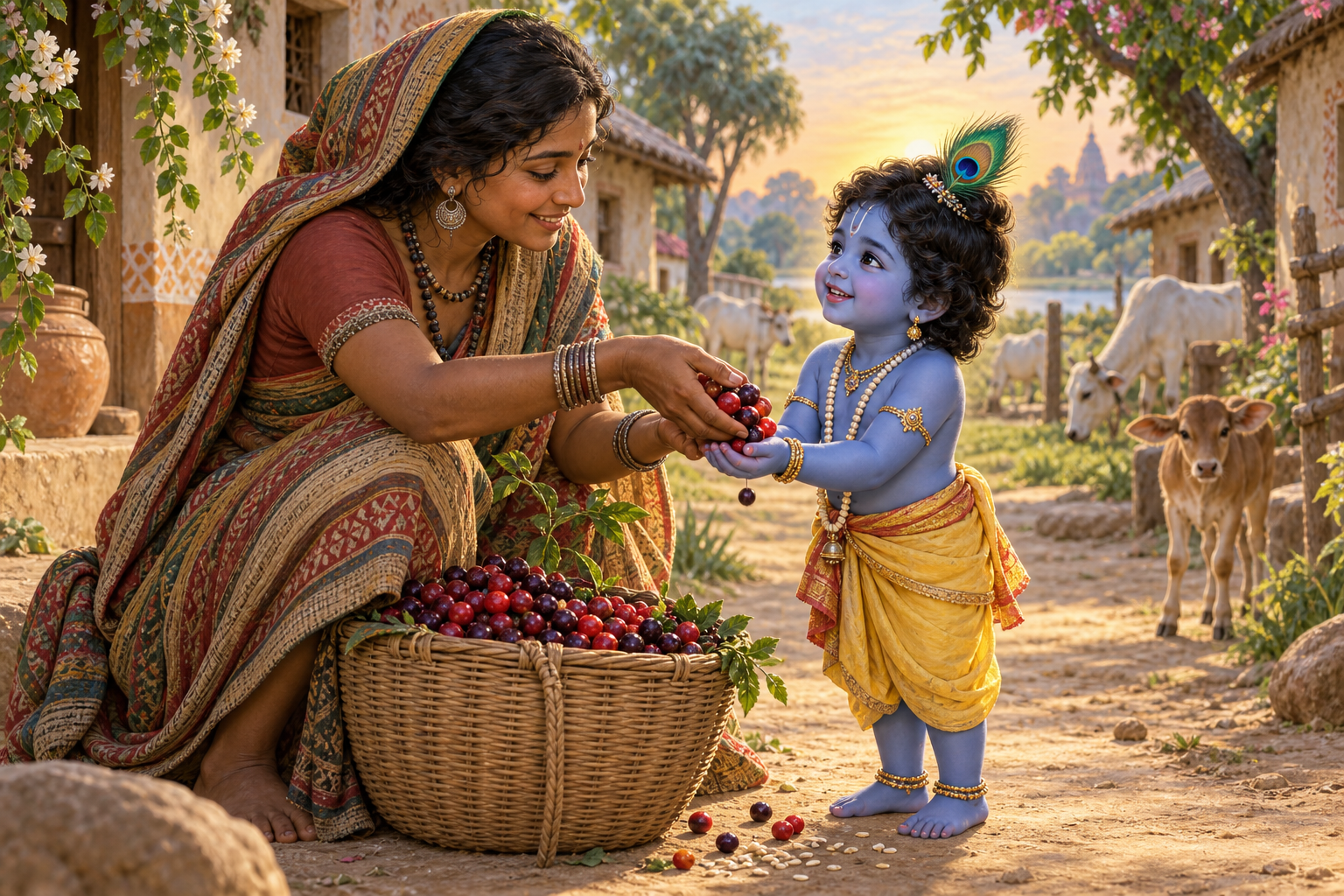
You may know the ending: a berry seller gives freely to child Krishna, and her basket is later filled with gems. But if you were told only that devotion brings rewards, the episode can sound like a promise of prosperity rather than a teaching about bhakti.
The order of events gives you a better way to read it. Krishna brings what he can, much of it slips away, and the woman gives without insisting on an equal return. Grace appears only after ordinary calculation has been released. That distinction matters whenever you wonder whether your own offering is too small, imperfect, or unnoticed.
The exchange turns when the seller stops counting
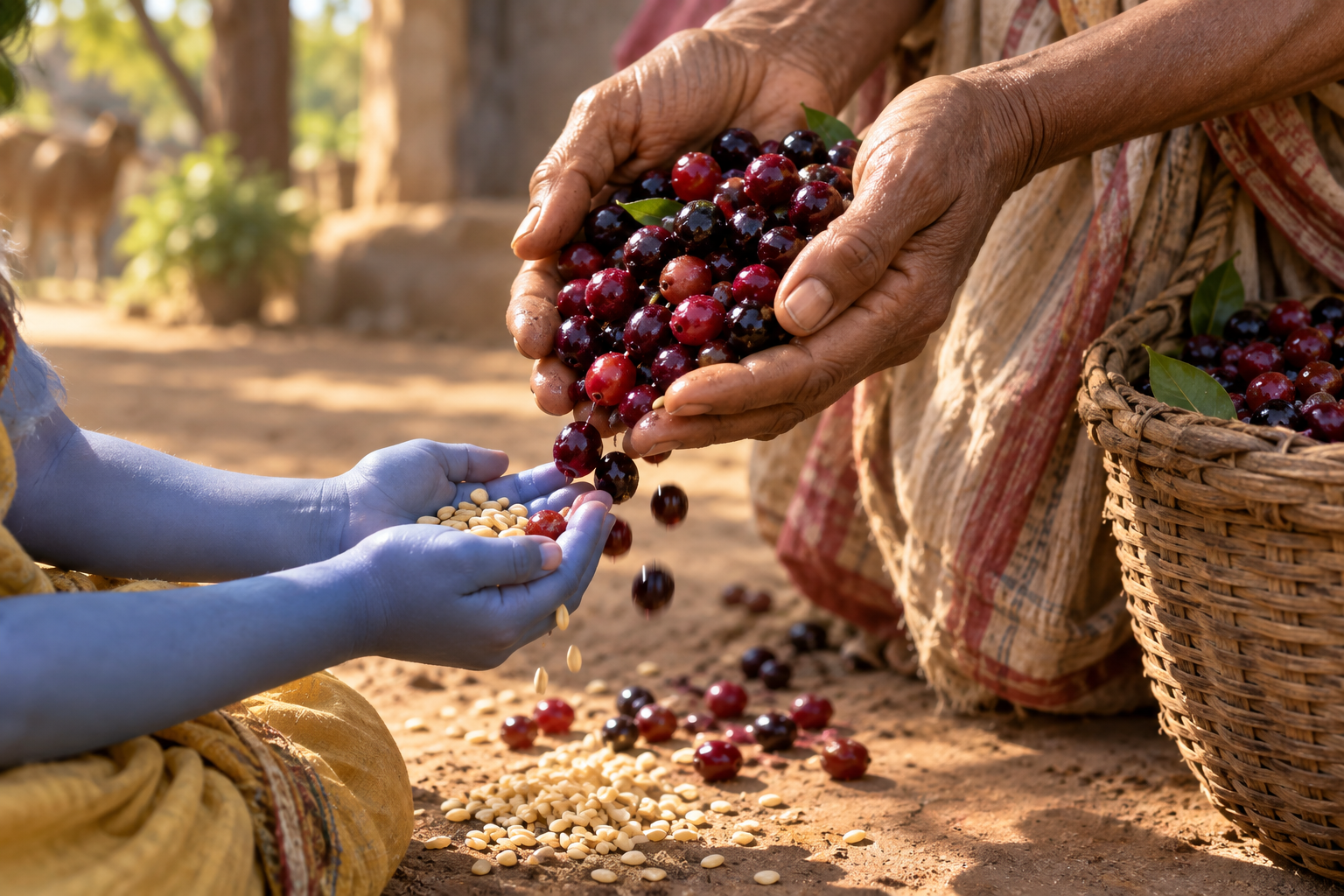
In Gokul, a tribal woman comes to the house of Nanda Maharaja with a basket of wild berries. Her call reaches Krishna, still a playful child. He tries to take part in the proposed barter by carrying grain in his small hands, but much of it falls before he reaches her.
The woman now faces the decisive moment. She has berries to sell, while the child before her no longer holds an adequate exchange. She could measure out only what the remaining grain can purchase. She could refuse him. Instead, she fills his hands with berries. Later, the contents of her basket are transformed into gems.
Notice where the lila changes direction. It is not when the gems appear. It is when the seller sees an inadequate handful and chooses generosity. The visible miracle comes later; the inward miracle is her freedom from exact equivalence.
That makes her more than a passive beneficiary of Krishna’s favour. She assesses the situation and acts. Her generosity has moral weight because it is hers to give. Krishna does not seize the berries, and no one orders her to surrender them.
Krishna is receiving devotion, not pricing berries
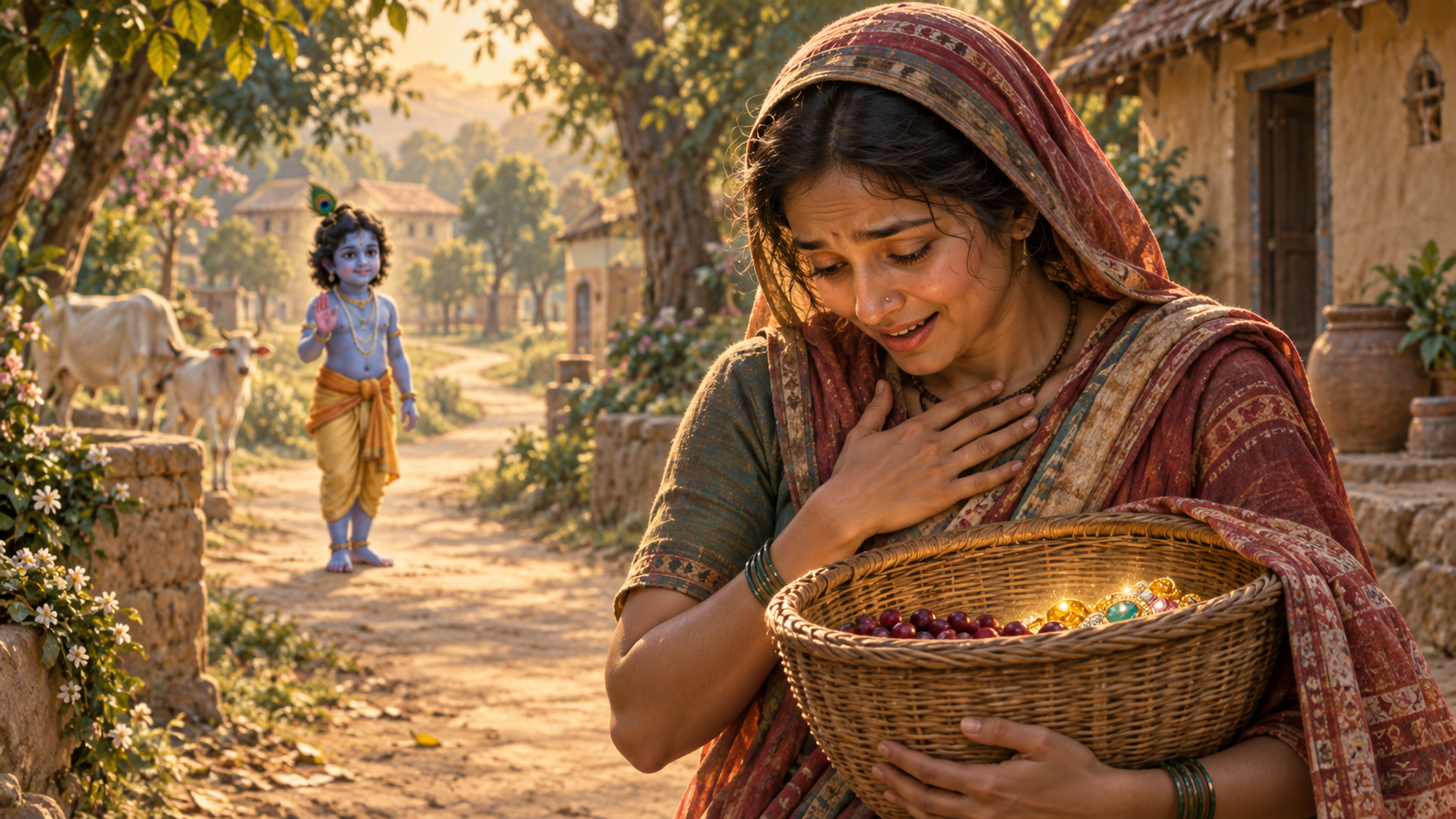
If you read the gems as payment, the exchange becomes a spectacular business deal: the seller gives something modest and receives something vastly more valuable. That reading keeps the arithmetic intact. It merely enlarges the profit.
Bhakti asks you to notice something else. The grain shows Krishna’s intention to reciprocate, but its material insufficiency does not prevent the encounter. The berries show the woman’s willingness to give, but their market price does not determine the measure of her devotion. The gems signify grace that cannot be reduced to a negotiated rate.
This is useful when you feel that you have little to offer. A small act does not become spiritually false merely because it is small. You can bring limited time, an unpolished prayer, a simple meal, a modest contribution, or a few minutes of undivided attention. What matters is that you bring it honestly rather than withholding it because it cannot impress anyone.
Yet Krishna’s small handful is not an excuse for avoidable stinginess. He brings what his little hands can carry. If you possess abundance but deliberately offer the least possible amount, you are not imitating child Krishna’s innocence; you are protecting your surplus. The relevant question is not, “Does this look small?” It is, “Am I sincerely bringing what is mine to bring?”
The same distinction protects another person’s dignity. In a commercial exchange, fair payment remains your responsibility. You cannot invoke devotion to expect a vendor, artisan, priest, worker, or neighbour to provide goods or labour without proper compensation. The berry seller’s generosity is sacred precisely because she chooses it. A gift demanded by the more powerful party is not generosity.
Three misreadings that weaken the lila
Giving as a strategy for getting rich
The transformed basket is not a formula guaranteeing material wealth to anyone who gives something away. If you make an offering while privately calculating the money, recognition, influence, or favour it should produce, the barter has never ended. It has merely moved inside your mind.
Before giving, ask yourself a clean question: “If no visible reward followed, would this still be worth doing?” If the answer is no, you may be making an investment rather than an offering. Investments have their place, but naming one as bhakti does not change its motive.
Romanticising another person’s hardship
The woman’s lack of an elaborate gift does not make deprivation desirable. Her berries are her livelihood as well as her offering. The lila teaches that limited means do not disqualify a devotee; it does not teach that hardship should be preserved because it looks spiritually picturesque.
You can apply that distinction immediately. Pay the person standing before you fairly. Do not bargain aggressively with a small seller and then admire the simplicity of the poor. Do not ask someone to donate professional work while offering them only praise. Let generosity move from your side of the exchange before you celebrate it on theirs.
Turning the tribal woman into scenery
Her identity should not be treated as an exotic detail placed around Krishna’s childhood. She is a working woman with goods to trade, judgement to exercise, and an offering to make. The Divine encounter is not confined to wealth, social prominence, or formal learning.
At the same time, one devotional figure cannot be used to make sweeping claims about every tribal or Adivasi community. Honour her agency without converting a living range of peoples and traditions into a single symbol of innocence. In community storytelling, notice who is permitted to speak and who appears only as a colourful supporting character. Reverence for this lila should sharpen your respect for living people, not replace it.
Carry the lila into your next exchange
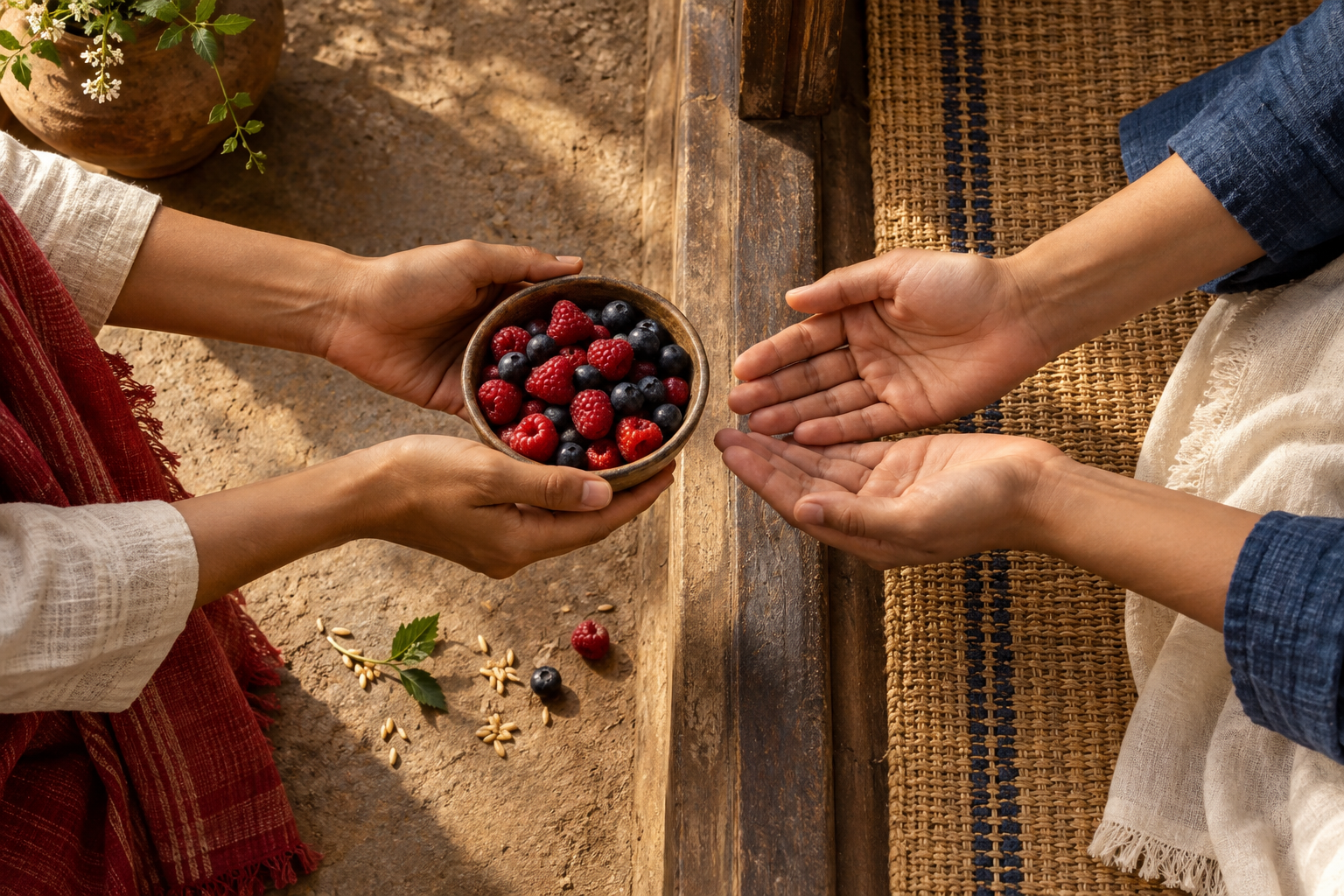
You do not need to wait for a dramatic act of charity. Use the next ordinary exchange in which you are tempted to count recognition, gratitude, or return. Work through it deliberately:
- Decide whether this is a transaction or a gift. If it is a transaction, state the terms and meet them fairly. If it is a gift, do not attach hidden terms after the other person accepts it.
- Name the grain already in your hands. Choose something concrete that you can offer now: food, money, skill, patient listening, practical help, or focused time. Do not postpone every act until you can make a grand gesture.
- Look at the person, not your self-image. Ask what would actually help them. A gift selected to display your generosity may serve you more than its recipient.
- Release the private invoice. After giving, resist keeping count of thanks, praise, invitations, returned favours, or spiritual merit. If repayment was necessary, it should have been named before the exchange.
- Notice transformation without prescribing its form. Grace may appear as greater freedom from possessiveness, a repaired relationship, clearer gratitude, or a stronger capacity to serve. Do not insist that it arrive as money or public success.
If you are teaching this lila to children, place a few grains and berries before them while you retell it. Then ask: Why did the woman give when the exchange was unequal? Would her choice still be beautiful if no gems appeared? What could you give that is small but sincere? These questions keep the child’s attention on motive and agency rather than on magical wealth.
Key takeaways
- Krishna’s spilled grain shows that an imperfect offering can still carry sincere intention.
- The berry seller acts freely; her generosity cannot be demanded or imitated through someone else’s sacrifice.
- The gems represent grace beyond calculation, not a guaranteed return on religious giving.
- Bhakti does not cancel fair dealing. Pay properly when another person’s livelihood is involved.
- Your practical test is simple: give what is honestly yours to give, without attaching a concealed invoice.
At your next opportunity to give, pause before you calculate what will come back. Bring your grain, however modest. See the person before you clearly. Then let a genuine gift be a gift.
References
