
-
When the Lord Becomes a Son: Kardama Muni and the Descent of Real Knowledge (SB 3.24.30)

Srimad Bhagavatam 3.24.30 captures Kardama Muni’s address to the Lord, who descends to fulfill a sacred promise and inaugurate the dissemination of real knowledge in the heart of family life. The episode anticipates Kapila’s theistic Sankhya, where analytical clarity and bhakti-yoga form a coherent path to liberation. By highlighting divine fidelity—“to fulfill Your word”—the verse…
-
Seeing the Banyan in a Seed: Profound Hindu Wisdom on Infinite Potential and Dharmic Unity

Hindu wisdom describes spiritual vision as the ability to perceive wholeness within the smallest fragment of reality, symbolized by seeing a vast banyan in a tiny seed. Drawing on the Chandogya and Mundaka Upanishads, the discussion clarifies how potentiality unfolds lawfully into form and how this insight aligns with Vedanta, Sankhya-Yoga, and systems science. Convergences…
-
Varuna in the Vedas: Majestic Sovereign of rta, Waters, and Nature’s Vital Powers

Varuna, among the oldest deities in the Rigveda, stands as sovereign of rta (cosmic order), guardian of the waters, and witness to truth. The Vedic hymns credit him with distributing nature’s vital powers—strength in horses, milk in cows, vitality in the heart, and even fire concealed within the waters—expressing a grand ecology of interdependence. His…
-
Indra and Varuna’s Celestial Rivalry: Vedic Kingship, Cosmic Law, and the Battle for Order

Indra and Varuna frame a profound Vedic conversation about power, law, and legitimacy. Indra’s thunderous decisiveness (kṣatra) complements Varuna’s guardianship of ṛta, revealing why force must be answerable to truth and why law must be capable of protection. Rigvedic hymns, especially RV 1.32 and RV 7.86–7.89, ground this dialectic, while Brāhmaṇa and Upaniṣadic texts transform…
-
Pancha Tattva Unveiled: Radiant Mercy of Lord Nityananda before Gaura Purnima 2026

This study series introduces Pancha Tattva as a precise, fivefold revelation of the Absolute that powers the Gaudiya Vaishnava sankirtana movement. The opening focus on Lord Nityananda explains His identity with Balaram and His earlier manifestation as Lakshman, situating Him as guru-tattva and the wellspring of compassion. Drawing on Chaitanya Charitamrita and allied scriptures, the…
-
From Brahman to Cosmos: Decoding Hindu Cosmology, Cyclic Time, and Dharmic Unity

Hindu cosmology portrays creation as emergence from an undivided reality, Brahman, rather than a one-time act ex nihilo. Drawing on the Upanishads, Sāṅkhya, Vedānta, and the Puranas, it explains how the subtle becomes gross through ordered stages, from mahat and ahaṅkāra to the five elements. Cyclic time—yugas, manvantaras, and kalpas—replaces linear beginnings with rhythmic manifestation…
-
Clash and Convergence: How Vedic and Western Worldviews Shaped Science, Faith, and History

This long-form essay traces how encounters between Vedic knowledge systems and Western scholarship reshaped global debates on science, faith, and history. It contextualizes John Bentley’s 1825 rebuke of John Playfair within wider conflicts over chronology, authority, and civilizational legitimacy. Readers gain a clear view of India’s mathematical and astronomical achievements, the emergence of Indology, and…
-
The School of Life: Insights from HH Svayam Bhagavan Keshava Maharaja’s Marathon Podcast (Dec 2025)

In December 2025, HH Svayam Bhagavan Keshava Maharaja’s Marathon Podcast, The School of Life, presented a disciplined framework for living as a spiritual education. The approach integrates puruṣārthas with yogic psychology, translating Vedic philosophy and the Upanishads into daily, reproducible practices. Bhakti, karma yoga, jñāna, and dhyāna are balanced with ethics like satya, ahiṁsā, and…
-
Hanuman and the Five Elements in Kamba Ramayanam: Transformative Symbolism and Yogic Science

The Kamba Ramayanam presents Hanuman as an embodied map of the five great elements—Vayu, Jala, Akasha, Agni, and Bhoomi—transforming epic episodes into a precise guide for ethical action and inner balance. Vayu becomes pranic mastery and courage, Jala becomes adaptable resolve, Akasha becomes the clarity of spacious awareness, Agni becomes purifying discernment, and Bhoomi becomes…
-
When Krishna Lifts Govardhan: Tribhanga Beauty, Bhakti-Rasa, and the Ease Found in Surrender

This essay offers a close reading of Krsna’s tribhanga posture amid the Govardhana-dhara-lila, highlighting how visual detail, poetic mood, and theology interlock to transform crisis into joy. It explains how the left foot ‘kissing’ the earth and the effortlessly raised arm express immanence and transcendence in one gesture. Drawing from Srimad-Bhagavatam and Sanskrit aesthetics, it…
-
Profound Prophecy and Transformative Vision: SB 3.14.50 at Bhaktivedanta Manor (20.02.26)
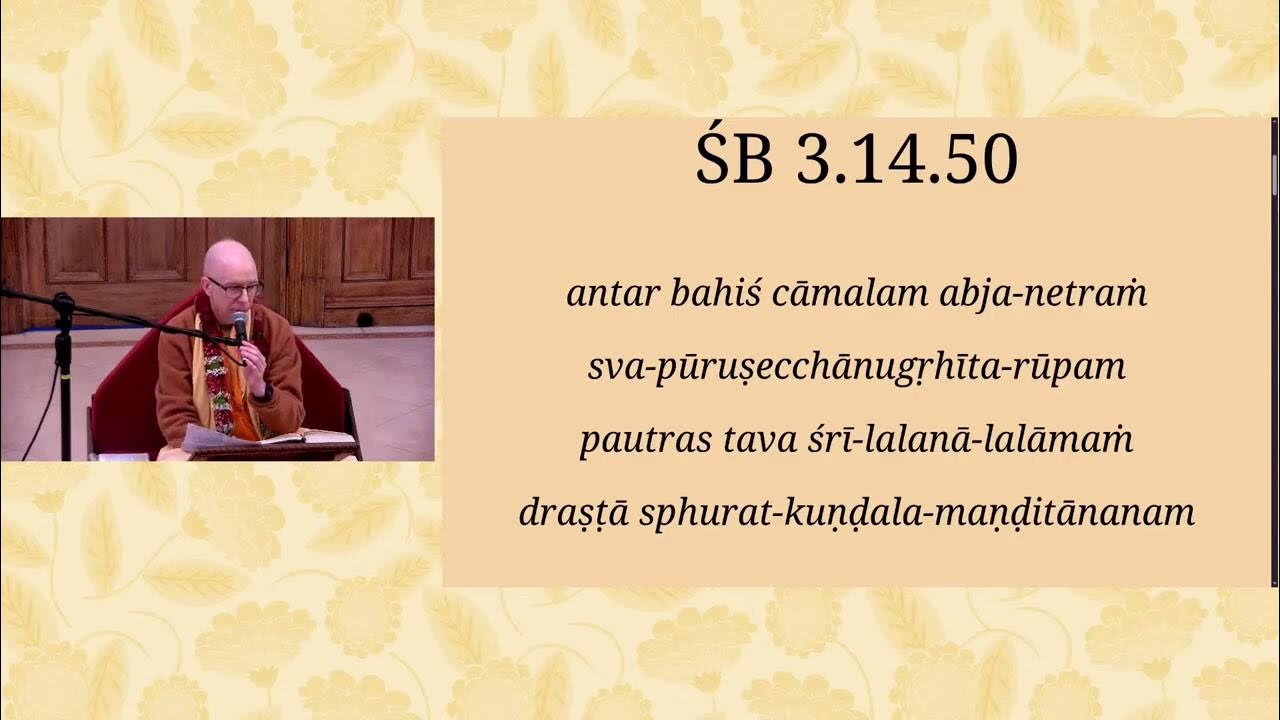
A scripture class at Bhaktivedanta Manor (20.02.26) explored Srimad-Bhagavatam 3.14.50—a prophecy that Prahlāda Mahārāja would perceive the Supreme within and without. The verse integrates ontology and practice, depicting the Lord as simultaneously indwelling (Paramatma) and personally relational (Bhagavan), inseparable from the goddess of fortune. It affirms that the Lord reveals Himself in forms desired by…
-
Why Ganesha Rides a Mouse: Mastering the Restless Mind Through Ancient Sacred Symbolism

The celebrated image of Śrī Gaṇeśa seated on a mouse encodes a complete psychology of spiritual practice: wisdom seated above impulse, directing and calming the restless mind. Philological analysis of mūṣika (“the thief”) aligns with traditional models of manas, buddhi, and ahaṃkāra, while Purāṇic sources frame the vāhana as a pedagogical tool. Read alongside Yoga,…
-
Srimad Bhagavatam 7.12.16: Bhakti Discipline and Inner Transformation at ISKCON GEV
This in-depth summary of the Srimad Bhagavatam 7.12.16 class by H.G. Mahamaya Mataji at ISKCON GEV presents a clear, academically grounded pathway to devotional growth. It situates the verse within Canto Seven’s broader ethical and spiritual framework and explains how guru–shishya parampara safeguards scriptural integrity. Readers gain a practical map of sadhana—from śraddhā to prema—supported…
-
Vṛtrāsura, Indra, and Ṛta: Timeless Dharmic Lessons on Leadership, Anarchy, and Renewal

This rigorous reading of the Vṛtrāsura cycle—spanning the Ṛg Veda, the Mahabharata and Ramayana, and the Purāṇas—unpacks how the myth encodes a timeless governance and ethics playbook. It clarifies Indra’s moral complexity (Brahmahatyā-dōṣa and Tapas), the leadership caution of Nahusha’s ascent and fall, and the systemic anatomy of anarchy when Ṛta is disturbed. Readers gain…
-
Sun–Saturn (Ravi Shani) Conjunction Across 12 Houses: Transformative Vedic Insights

This guide presents a clear, house-by-house exploration of the Sun–Saturn (Ravi Shani) conjunction in Vedic astrology. It preserves the classical note that, when together, these planets are read as aligned in purpose, and that Mercury’s addition can sharpen conflicts wherein the Sun’s effect predominates. Readers gain practical, academically grounded insights for all 12 bhavana (houses),…
-
Jyotishmati in Yoga: Awakening an Illuminated Mind for Clarity, Sattva, and Inner Wisdom

Jyotishmati—rooted in “Jyoti” (light) and “mati” (mind)—signifies an illuminated consciousness within Yoga. It describes a sattva-filled mind where clarity, discernment, and wisdom become reliable guides. The concept unites dharmic traditions by resonating with prajna in Buddhism, kevala-jñāna in Jainism, and the divine jyot in Sikhism. Practical cultivation relies on dhyana, mindfulness, pranayama, ethical discipline, and…
-
Sun–Rahu Conjunction Across the 12 Houses: Clear, Dharmic Insights and Practical Remedies

This balanced guide explores the Sun–Rahu conjunction (Ravi Rahu) across the twelve houses in Vedic astrology, explaining how its eclipse-like symbolism can magnify identity, ambition, and visibility while inviting ethical self-mastery. It outlines house-wise themes at a high level, emphasizes that outcomes depend on the full chart and timing (daśā), and reframes early-life intensity as…
-
Agni Within: Unlocking SB 3.26.40 on Fire, Digestion, Ayurveda, and Spiritual Vitality

Srimad-Bhagavatam 3.26.40 portrays fire as a transformative force that illuminates, warms, cooks, and digests, while awakening hunger and thirst as drivers of growth. Drawing on insights shared by HG Narayani Dasi, the reflection links Agni with Ayurveda’s Jatharagni and Yoga’s Tapas and Prana to show how balanced digestive fire sustains vitality and clarity. The analysis…
-
From Doubt to Clarity in Krishna Consciousness: Navigating Vedic Proofs with Confidence

Seeking certainty in matters of truth is natural, especially within Krishna Consciousness. Vedic philosophy organizes valid knowing into three pramanas—pratyaksa, anumana, and sabda—so doubt can mature into clarity. The Brahma-Madhva-Gaudiya Sampradaya emphasizes sabda, operationalized through guru, sastra, sadhu, while still valuing perception and reason. This balanced approach aligns with broader dharmic traditions: Buddhism’s experiential insight,…
-
Virat Purusha Awakens: Srimad Bhagavatam 3.26 Reveals the Power of the Supersoul
Srimad Bhagavatam 3.26.62–71 presents a clear philosophical insight: the senses, mind, and intelligence remain inert until the Supersoul (Paramatma) enters and animates the Virat Purusha. Mukunda Goswami’s exposition clarifies that all faculties are instruments requiring the integrative power of consciousness to become meaningful. Readers gain a practical framework for aligning speech, thought, and action through…