
-
Why Rama Chose Humanity: Profound Wisdom Behind Ravana’s Boon, Suffering, and Dharma

This article explains why Lord Rama, an avatar of Vishnu, chose to be human in response to Ravana’s boon. It shows how Ravana’s selective invulnerability created a lawful path for dharma to prevail without violating cosmic commitments. By accepting human limitations and suffering, Rama modeled maryadaethical excellence under constraint. The narrative highlights the power of…
-
Srimad Bhagavatam 10.90.18: Mortal Wounds, Spiritual Resilience, and Dharma’s Healing Power
This reflection on Srimad Bhagavatam 10.90.18 clarifies the metaphor of a “mortal wound” and applies it to spiritual ethics and daily practice. It distinguishes minor setbacks from integrity-compromising harms that demand urgent repair. The analysis offers practical toolsatonement, meditation, seva, satsangto prevent moral injury from becoming entrenched. It highlights parallels across Hinduism, Buddhism, Jainism, and…
-
Lions and Tigers in Hindu Scriptures: Powerful Symbols of Dharma, Shakti, and Dharmic Unity

Lions and tigers in Hindu scriptures symbolize disciplined strength aligned with dharma rather than domination. Narasimha, the man-lion avatar of Vishnu, exemplifies protective ferocity that restores moral order, while Pārvatī and Durga seated on a lion or tiger embody Shakti’s compassionate guardianship. The tiger’s association with Durga and Shiva transforms raw energy into ethical force.…
-
Chanting Ramcharitmanas Chaupais: A Time-Tested Path to Peace, Protection, and Resilience

This article examines the traditional view that chanting Ramcharitmanas chaupais supports peace, protection, and resilience during adversity. It outlines why rhythmic, meaningful repetition (japa) steadies attention and breath, helping reduce anxiety and improve focus. Practical guidance highlights intention-setting, steady pacing, and reflective engagement with verses, including those in Sundara Kanda. Devotee accounts frequently describe improved…
-
Timeless Wisdom of Vishnu Purana: Avatars, Devotees, and Dharma for Modern Life

The Vishnu Puranaone of the Eighteen Mahapuranaspresents Lord Vishnu’s sustaining role while illuminating dharma, devotion, and ethical living. Its compelling narratives of Narada, Prahalada, Dhruva, and Thumburu demonstrate how courage, focused practice, compassionate speech, and sacred artistry shape character. Organized into six sections and rooted in the Puranic tradition, the text integrates theology with practical…
-
Gitartha Sangraha: Yamunacharya’s 32-Verse Masterpiece for Gita Clarity and Self-Realization
Gitartha Sangraha distills the Bhagavad Gita into 32 precise Sanskrit verses, offering a clear, memorable pathway through karma-yoga, jñāna-yoga, and bhakti-yoga. Composed by Yamunacharya (Alavandar), it anticipates the Vishishtadvaita contours later systematized by Ramanujacharya. The text bridges rigorous study and practical sādhanā, aiding memorization, reflection, and ethical decision-making. Its succinct form supports learners, scholars, and…
-
The Transformative Power of Divine Names: Vedas, Upanishads, and Epics for Inner Renewal

This reflection examines the power of divine names as preserved in the Vedas, Upanishads, Ramayana, and Mahabharata, highlighting how sacred sound directs the mind toward dharma. It presents chanting, mantra, and japa as disciplined practices that transform remorse into responsible action. The analysis emphasizes unity across Hinduism, Buddhism, Jainism, and Sikhism, where sacred namessuch as…
-
Selfless Love Like the Gopīs: Ādi 4.170 and Bhagavad-gītā’s Call at ISKCON Vrindavan
Drawing on Śrī Caitanya-caritāmṛta Ādi 4.170 and the Bhagavad-gītā, this reflection from ISKCON Vrindavan presents a clear, practical path: shift from sense gratification to devoted, selfless service. It explains how duties and relationships become offerings when aligned with the will of the Supreme Lord, following the gopīs’ exemplar of unwavering love. The analysis shows that…
-
Brahmavada in the Srimad Bhagavata Purana: Unveiling Non-Dual Wisdom that Unites Dharmic Paths
This essay explores Brahmavada in the Srimad Bhagavata Purana as a non-dual (Advaita) teaching that recognizes Brahman as the Absolute while seeing the world as Brahman’s expression. It clarifies how the Purana harmonizes devotion (bhakti) and knowledge (jnāna), showing them as complementary paths to the same Truth. Readers gain an accessible understanding of Advaita Vedanta…
-
Discover Divine Reciprocity in Srimad Bhagavatam 3.21.28: Proven Insights on Grace and Dharma

Srimad Bhagavatam 3.21.28 presents a proven principle of divine reciprocity: the Lord responds to purified intention aligned with dharma. The assurance given to Kardama Muni about Devahūti models how grace guides a marriage that supports sādhana and service. This is not transactional fulfillment but transformative alignment of heart and action through bhakti. Readability improves as…
-
Discover the Proven Benefits of Donating Lakshmi Ashtottara Sata Namavali Books: A Complete Guide

Donating Lakshmi Ashtottara Sata Namavali books unites devotion with service, making sacred literature accessible while deepening the practice of bhakti. The 108 names of Goddess Lakshmi foster clarity, gratitude, and an ethics-centered understanding of prosperity. As a form of dharma and seva, sharing these texts confers punya, supports learning communities, and preserves Hindu scriptures. The…
-
Essential Guide to Śrīmad Bhāgavatam 3.21.25: Discover Manu’s Rule and Sacred Geography

Śrīmad Bhāgavatam 3.21.25 presents Svāyambhuva Manu as an exemplar of righteous leadership grounded in dharma. The verse’s reference to Brahmāvarta and its association with Kurukṣetra illuminate how sacred geography encodes ethical memory in Hindu scriptures. Read in context, the imagery of ruling over the earth “with its seven oceans” signals cosmic completeness and responsible stewardship.…
-
The Complete Story of Takshaka and Parikshit: Essential Insights into Karma and Vengeance
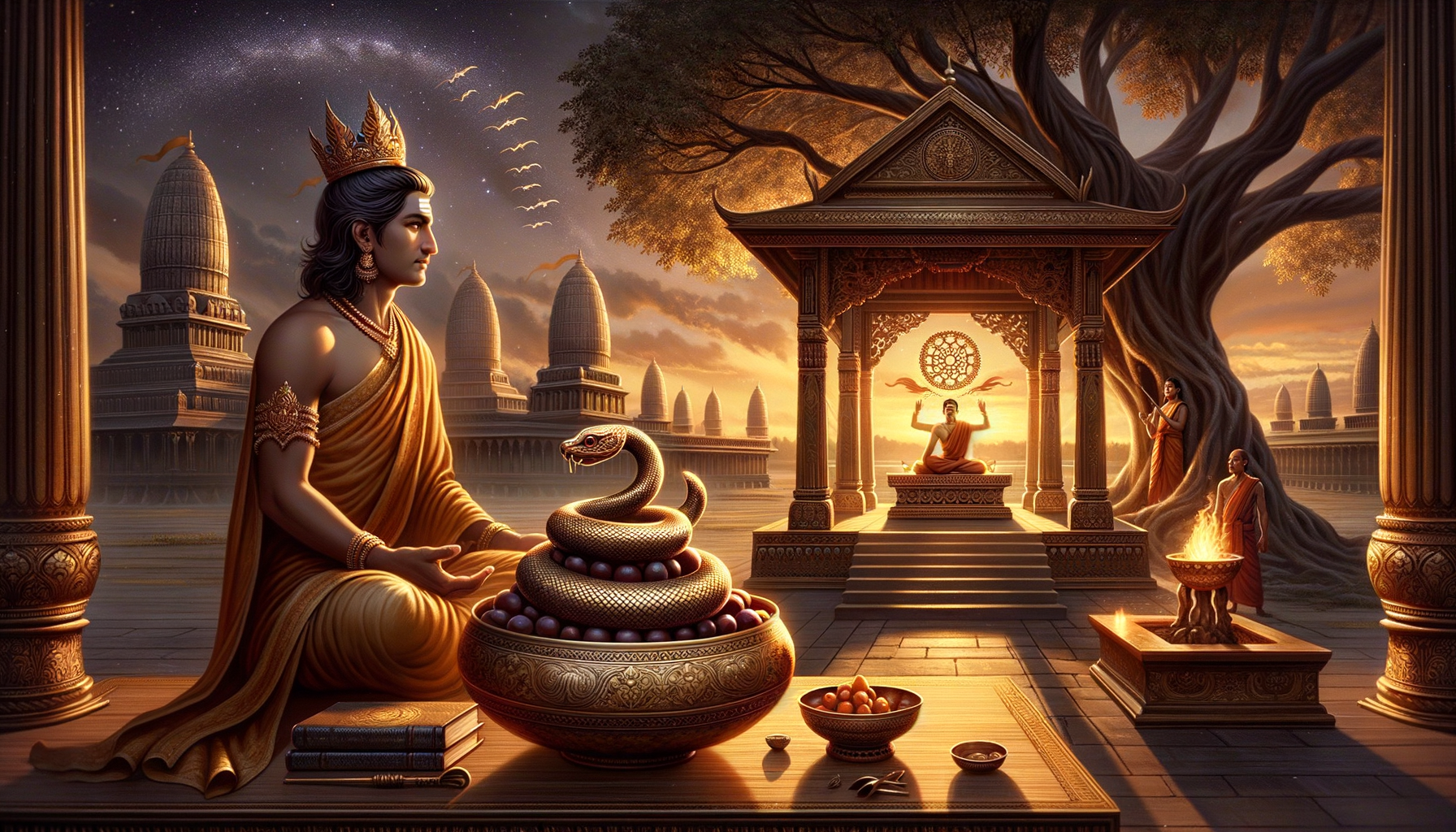
This article examines the complete story of Takshaka and King Parikshit through the lens of the Mahabharata, clarifying why the serpent king executed the curse and how older enmities shaped events. It traces the chain from Parikshit’s lapse with Sage Sameeka to Śṛṅgi’s curse, Takshaka’s calculated stratagem, and Janamejaya’s subsequent Sarpa Satra. Readers gain a…
-
Discover the Proven Secret of Bliss in the Senses: Panchadasi’s Fifteenth Chapter, Vishayananda

Panchadasi’s fifteenth chapter, Vishayananda, explains how everyday pleasures reflect the same ananda that shines as Brahman. By analyzing the role of the senses and the mind, it shows that pleasure arises when agitation pauses and awareness becomes momentarily still. This insight reframes ordinary enjoyment as a contemplative cue rather than an invitation to craving. The…
-
Essential Guide to Goddess Bala: Discover Shiva’s Sacred Creation in the Andhakasura War

Goddess Bala’s emergence during Shiva’s battle with Andhakasura illustrates how youthful clarity and compassionate strength neutralize chaos without compromising empathy. This guide situates Bala within Shaiva-Shakta traditions, highlighting her role alongside protective shaktis and the Saptamatrikas. Readers gain symbolic insight into Bala Tripurasundari, whose iconography conveys gentle mastery of the mind and disciplined desire aligned…
-
Master Time’s Secret in Śrīmad-Bhāgavatam: HH Prahlādānanda Swami’s Complete Insight
This exploration of Śrīmad-Bhāgavatam 4.12.1–3, as presented by HH Prahlādānanda Swami at ISKCON NYC, clarifies kāla (time) as an impartial, divine agency guiding creation, order, and transformation. It rejects fatalism and strengthens responsibility, showing how time frames ethical action within dharma. The discussion connects Buddhist impermanence, Jain understandings of kāla, Sikh insights on Hukam, and…
-
Indrajit and Shiva: The Complete Ramayana Mystery RevealedDiscover a Timeless Truth

Was Indrajit truly Shiva’s son? The Ramayana’s canonical account identifies Indrajit (Meghnad) as the son of Rāvaṇa and Mandodarī, while later traditions speak of him as Shiva’s ‘son’ in a spiritual sense. This analysis clarifies the difference between biological lineage and theological kinship through concepts like amsha and dīkṣā-putra. Readers gain a precise understanding of…
-
Complete Guide to Advaitananda: Discover the Bliss of Non-Dual Realization in Panchadasi 13

Advaitananda Prakarana, the thirteenth chapter of Panchadasi by Vidyaranya, explains how the bliss of non-dual realization is not produced by the mind but recognized as the true nature of self. It distinguishes fleeting sense-pleasure from brahmananda, the unconditioned bliss revealed through knowledge. Rooted in the Upanishads, the chapter maps a practical progressionsravana, manana, and nididhyasanatoward…
-
Complete Guide to Manu in Hinduism: Discover the Timeless Law-Giver Beyond Gender and Time

This article examines Manu as both archetype and title within Hindu cosmology, clarifying how fourteen Manus guide each kalpa and why the role is best understood as beyond gender and bound to time cycles. It situates Manusmriti within the broader Dharmashastra tradition, highlighting contextual interpretation and ongoing ethical refinement. The narrative of Vaivasvata Manu and…
-
Essential Insights on SB 3.19.28: Discover Varaha’s Triumph and Master Dharmic Courage

Delivered at the Hare Krishna temple in Alachua, Florida, this ISKCON Alachua class by Akuti devi dasi examines Srimad-Bhagavatam (Bhagavata Purana) Canto 3, Chapter 19, text 28. The session situates the verse within the Varaha avatāra narrative and clarifies how the Bhāgavata restores cosmic order and dharma. Key themes include steadfast devotion, humility before divine…