-
Maharishi Parashara Jayanti 2026: Sacred Date, Timeless Vedic Legacy, and Jyotisha Impact

Maharishi Parashara Jayanti 2026 falls on April 18, coinciding with Vaishakh Shukla Paksha Pratipada in North Indian (Purnimanta) calendars. The observance honors Parashara Maharshi’s far-reaching legacy across Purana theology, dharma discourse, and Jyotisha, especially through Vishnu Purana, Parāśara Smṛti, and the foundational Brihat Parashara Hora Shastra. Devotees observe the day with guru-vandana, parayana, study, dhyana–japa,…
-
When Power Outpaces Wisdom: Ancient Dharmic Insights to Heal a Wealthy, Wounded World

Modern society holds immense technological power and material wealth, yet faces crises born of its own momentum. Drawing on Hinduism, Buddhism, Jainism, and Sikhism, this analysis explains how shakti (power) must be yoked to viveka (wisdom) through dharma to restore ecological balance, social harmony, and inner clarity. It maps Purusharthas to contemporary dilemmas, applies yama–niyama…
-
Uragas vs. Nagas in Hinduism: Origins, Scriptural References, and Sacred Symbolism

Hindu texts distinguish clearly between uragas and nāgas. Uraga is a generic Sanskrit term for serpents—a poetic synonym alongside sarpa, ahi, and bhujaṅga—while nāga denotes a semi-divine class with genealogy, kingship, and realm (nāga-loka). Epic and Purāṇic narratives feature named nāga personages such as Śeṣa, Vāsuki, and Takṣaka, whose roles in cosmology and ethics far…
-
Madanaratna (Madanapradipa): The Timeless Dharmashastra Masterwork Illuminating Hindu Law

Madanaratna (also known as Madanaratnapradipa or Madanapradipa) is a major Dharmashastra digest attributed to Vishwanatha, son of Bhattapujya, that consolidates Hindu legal, ethical, and ritual norms into a practical jurisprudence. It organizes doctrine across achara, vyavahara, and prayaschitta while engaging classical Smriti sources and renowned commentaries such as Mitakshara and Dayabhaga. The work’s method honors…
-
Unveiling the Abhūtarājasas: Inside the Fifth Manvantara’s Forgotten Deva Gana

The Abhūtarājasas—also known as Abhutarayas or Abhutarajasas—are a fourteen-member deva-gana assigned to the fifth Manvantara under Raivata Manu, as preserved in Purāṇic sources such as the Viṣṇu Purāṇa and the Bhāgavata Purāṇa. This article clarifies their place in Hindu cosmology, explains the Manvantara framework, and unpacks the philology of their name as a guna-inflected descriptor.…
-
Decoding Gandharva Astra and Ratha Māyā: Strategic Illusion in the Mahabharata’s Dharma-Yuddha

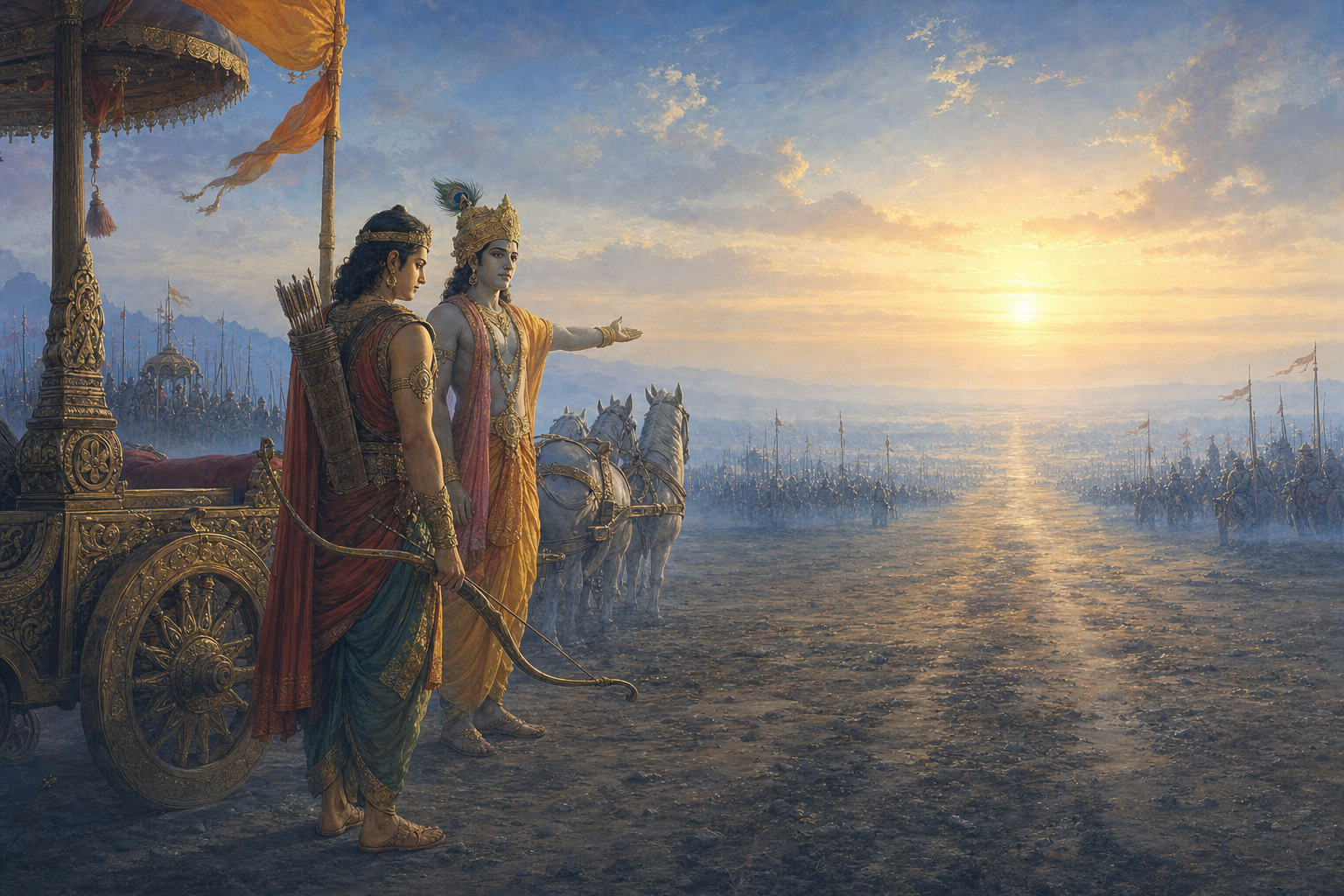
Gandharva Astra and Ratha Māyā reveal how the Mahabharata’s warfare valued perception, psychology, and ethics over brute force. Rather than destroy, these arts confound—multiplying phantom chariots, bending acoustics, and reshaping what enemies can trust. Grounded in dharma, they belong to a just-war ethos that prizes restraint and the principle of minimum violence. Case motifs from…
-
When the Lord Becomes a Son: Kardama Muni and the Descent of Real Knowledge (SB 3.24.30)

Srimad Bhagavatam 3.24.30 captures Kardama Muni’s address to the Lord, who descends to fulfill a sacred promise and inaugurate the dissemination of real knowledge in the heart of family life. The episode anticipates Kapila’s theistic Sankhya, where analytical clarity and bhakti-yoga form a coherent path to liberation. By highlighting divine fidelity—“to fulfill Your word”—the verse…
-
Agamas in Hinduism: A Definitive Guide to Temple Science across Shaiva, Vaishnava, Shakta Paths

Agamas in Hinduism are authoritative temple sciences that unite theology, meditation, ritual, architecture, and iconography into a single living system. This article clarifies what “Āgama” means, how it relates to Veda and Smṛti, and why Shaiva, Vaishnava (Pañcarātra and Vaikhānasa), and Shakta lineages each preserve distinct yet harmonious Agamic corpora. Readers gain a technical overview…
-
Laghu Vishnumurti Decoded: A Compact Dharmashastra Masterpiece Shaping Ancient Society

Laghu Vishnumurti (Laghu Vishnu Murti) condenses the dharmashastra tradition into five chapters and 114 verses, offering a precise window into ancient India’s social organization, legal procedure, and restorative ethics. The text’s laghu format enables quick consultation while preserving doctrinal depth, making it ideal for students of Hindu legal history. It balances universal norms with deference…
-
Vishkanya in Hindu Temples: Unmasking the Haunting Symbolism, Statecraft, and Ethics

The Vishkanya (Vishakanyaka), or “poison maiden,” is one of the most intriguing and misunderstood figures in Hindu temple iconography. This long-form analysis situates the motif within Arthaśāstra-inspired statecraft, narrative literature like Mudrārākṣasa, and the premodern study of toxicology (agada-tantra). It explains how specific sculptural cues—such as a scorpion on the thigh or serpent ornaments—transform a…
-
Decoding the Charchika Mudra: Chamunda’s Fearless Iconography and the Science of Inner Purification

The Charchika Mudra—Chamunda cleaning her teeth with the left little finger—condenses a complete Shakta theology of protection and purification into one subtle gesture. Read against the Devi Mahatmyam and Shakta iconography, it signifies post-conflict cleansing, non-attachment to the taste of violence, and disciplined speech and appetite. Jackals, cremation ground, and skull garlands frame a fearless…
-
Hamsa Gita in the Mahabharata: A Timeless Swan-Song of Self-Knowledge and Liberation

The Hamsa Gita in the Mahabharata’s Shanti Parva distills Hindu philosophy into a lucid teaching on witness-consciousness, ethical living, and liberation. It clarifies how ātman stands apart from body and mind, and why steady contemplation and virtue are indispensable for moksha. Read alongside the Bhagavata Purana’s Hamsa avatāra, it reveals a complementary synthesis of jñāna,…
-
Unveiling Kena’s Dual Identity: Why It’s the Talavakara Upanishad—and Why It Matters Today

The Kena Upanishad is called the Talavakara Upanishad because it is embedded in the Tālavakāra Brāhmaṇa of the Sāma Veda, reflecting its precise textual lineage. Its name “Kena” comes from the opening question—“by whom?”—that frames a profound inquiry into the source of mind, speech, and life. Structured in four sections—two metrical and two prose—it advances…
-
Kathaka Grhya Sutras: Unveiling Vedic Household Rites, Samskaras, and Living Dharma

The Kathaka Grhya Sutras, aligned with the Katha school of the Krishna Yajurveda, present a concise and authoritative guide to Vedic household rites and samskaras. As part of the Kalpa (Kalpasutra) literature within the Vedanga, the text distills domestic ritual wisdom into memorable aphorisms that balance mantra and action. Readers gain a clear view of…
-
Kashyapa Samhita & Smriti: Unraveling Dharma’s Timeless Blueprint for Ethical Life

Ancient Indian literature remembers the Kashyapa Samhita and Kashyapa Smriti through later citations, signaling their importance in the Dharmasastra tradition. Though not fully extant, these works likely addressed ritual, ethics, jurisprudence, and social duty, shaping the Hindu legal system and cultural heritage. Readers gain clarity on how dharma was transmitted intertextually—through compendia and commentaries that…