
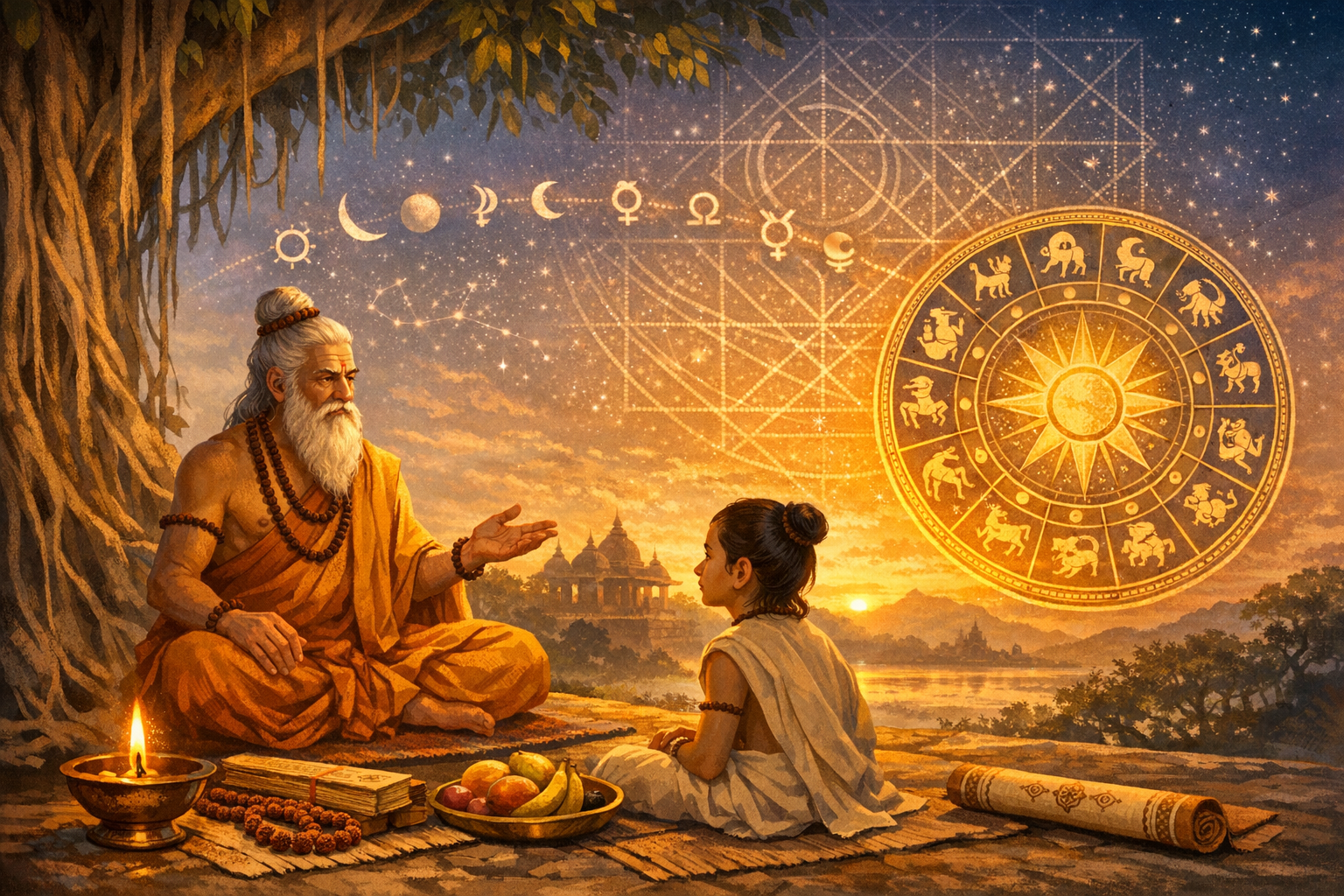
Maharishi Parashara Jayanti in 2026 is observed on April 18, marking Shukla Paksha Pratipada in the Vaishakh Month as followed in North Indian (Purnimanta) Hindu calendars. This Jayanti honors Parashara Maharshirevered as a Rishi of profound insight, a foundational voice in dharma and purana literature, and a seminal authority in Jyotisha (Vedic astrology). The observance foregrounds the continuity of the guru–shishya parampara and the shared civilizational memory that binds India’s dharmic traditions.
In the Hindu calendar 2026, the Jayanti is tied to the lunar tithi prevailing at local sunrise (udaya tithi), which is the standard rule for festival reckoning. While North Indian almanacs unanimously correlate the Jayanti with Vaishakh Shukla Pratipada, regional panchang computations can differ due to time-zone, longitude, and ayanamsa choices. Devotees may therefore verify local panchang details to align Sankalpa and morning puja with the correct tithi in their location.
Parashara Maharshi stands within a distinguished Vedic lineagegrandson of the seer Vasiṣṭha (through Śakti) and father of Kr̥ṣṇa Dvaipāyana (Veda Vyāsa). Classical sources present Parashara as both mantra-draṣṭā (seer of select Rigvedic hymns) and a systematizer whose teachings bridged Vedic revelation and later classical discourse. The Purāṇic tradition also associates Parashara with instructing Maitreya, framing a direct pedagogy that transmits cosmology, ethics, and theism across generations.
Three text traditions are central to Parashara’s legacy. First, Vishnu Purana is traditionally attributed to him and is structured as a complete synthesis of cosmology, theism, avatar doctrine, geography (including Bhārata-varṣa), and dynastic genealogies. Second, Brihat Parashara Hora Shastra (BPHS) forms the bedrock of classical Jyotisha, setting out grahas, rāśis, bhāvas, vargas, yogas, and daśā systems with unmatched scope. Third, Parāśara Smṛti (or Parāśara Dharmasāstra) conveys yuga-sensitive dharma guidance, often cited for its pragmatic, compassionate orientation suited to Kali Yuga.
BPHS, as preserved in the received manuscript tradition, outlines the core architecture of Vedic astrology: the nine grahas (Sūrya, Chandra, Maṅgala, Budha, Guru, Śukra, Śani, Rāhu, Ketu), the twelve rāśis and twelve bhāvas, and the shodasha varga (divisional charts) used for fine-grained analysis. It codifies essential evaluative frameworks such as graha dr̥ṣṭi, rāśi dr̥ṣṭi, shadbala (sixfold strength), and yogas (configurational outcomes), alongside predictive engines like Vimśottarī Daśā (the widely adopted 120-year life-cycle system). The text’s integration of karakas (significators), functional beneficence/maleficence, and house-specific results underpins much of contemporary Jyotisha practice.
Within this system, Parashara’s emphasis on daśā–bhukti sequencing, functional lordships based on the ascendant (Lagna), and varga corroboration offers a disciplined, multi-layered approach to phalita (prediction). The methodological claritybeginning with Lagna and rāśi assessment, refining with vargas, quantifying with shadbala, and timing with Daśā/Gochar (transits)remains a hallmark of classical practice and a benchmark for modern scholarship in Vedic astrology.
Vishnu Purana, theologically and philosophically rich, frames the cosmos through sarga (primary creation) and pratisarga (secondary creation), narrates avataras of Vishnu, and preserves extensive Itihasa–Purāṇa genealogies. Its systematic approach to cosmogony and dharma situates it as an indispensable Purāṇa for understanding Vaishnava theology and the civilizational narrative of Bharatavarsha. The dialogic formatParashara instructing Maitreyaencapsulates the pedagogical ethos that characterizes much of India’s sacred literature.
Parāśara Smṛti is notable for articulating dharma with a yuga-dharma sensitivity, often interpreted as allowing greater leniency and compassion under Kali Yuga conditions while safeguarding ethical essentials. The text’s approach to prāyaścitta (atonement), household duties, and social responsibility underscores a dharma framework that is both principled and adaptive. This dualityrootedness in śruti–smṛti authority and responsiveness to contexthelps explain Parashara’s enduring relevance in contemporary discourse on Hindu ethics.
The Jayanti’s observance typically includes guru-vandana (reverence to the lineage of teachers), parayana (recitation) from Vishnu Purana or selections from Parāśara Smṛti, and study of foundational BPHS chapters for students of Jyotisha. Many households and temples perform a simple puja with a ghee dīya, offer seasonal fruits and naivedya, and conclude with dāna such as annadāna. Practitioners often choose Brahma Muhurta for dhyana–japa and Abhijit Muhurta or an auspicious Choghadiya for sankalpa, aligning the day’s sadhana with favorable time windows indicated by the panchang.
Regional practice notes that festivals keyed to Shukla Paksha are best anchored to the tithi present at sunrise; where tithi changes close to dawn, local almanacs may advise a shift. Aligning with the udaya tithi standard ensures that Maharishi Parashara Jayanti is celebrated in harmony with the traditional rules of the Hindu calendar, while acknowledging regional panchang variations across India and the global diaspora.
The spiritual mood of the day is one of gratitude for transmitted wisdom. Devotees often report a palpable sense of clarity when approaching guru-tattva through study and contemplationparticularly when revisiting first principles in Jyotisha, or when reflecting on Vishnu Purana’s theistic vision. Such experiential resonance underscores why Jayantis of Rishis are not merely commemorative dates but catalysts for renewed sādhanā and ethical intention.
In the spirit of unity across dharmic traditions, the Jayanti also highlights shared reverence for teachers and transmitted wisdom found in Hinduism, Buddhism, Jainism, and Sikhism. The centrality of the guru, the primacy of disciplined learning, and the aspiration for liberation and ethical living form common strands. Observing Maharishi Parashara Jayanti with this ecumenical sensibility strengthens cultural harmony and mutual respect among these intertwined spiritual lineages.
From a historical perspective, attribution and textual dating merit scholarly nuance. The extant redactions of BPHS reflect layers of transmission across centuries; similarly, while the Vishnu Purana is traditionally ascribed to Parashara, academic studies often discuss later compilational strata. These critical observations do not diminish the tradition’s core claim: Parashara’s name and teachings symbolize a consolidated Vedic wisdom stream that shaped Purana theology, dharma discourse, and Jyotisha’s classical edifice.
Maharishi Parashara Jayanti, therefore, is not only a date on the calendar but an invitation to re-engage methodically with scripture, ethics, and astrological science. Whether through a careful reading of Vishnu Purana, a dharma reflection inspired by Parāśara Smṛti, or a structured return to BPHS fundamentals, the day offers a rigorous and uplifting pathway to deepen knowledge and cultivate devotion.
Key details for 2026 at a glance: Maharishi Parashara Jayanti falls on April 18, corresponding to Vaishakh Shukla Paksha Pratipada (North Indian, Purnimanta). Observances ideally begin at sunrise under the prevailing udaya tithi; local panchang consultation is recommended for those outside India or in regions with significant time-zone offsets.
Inspired by this post on Hindu Pad.
