
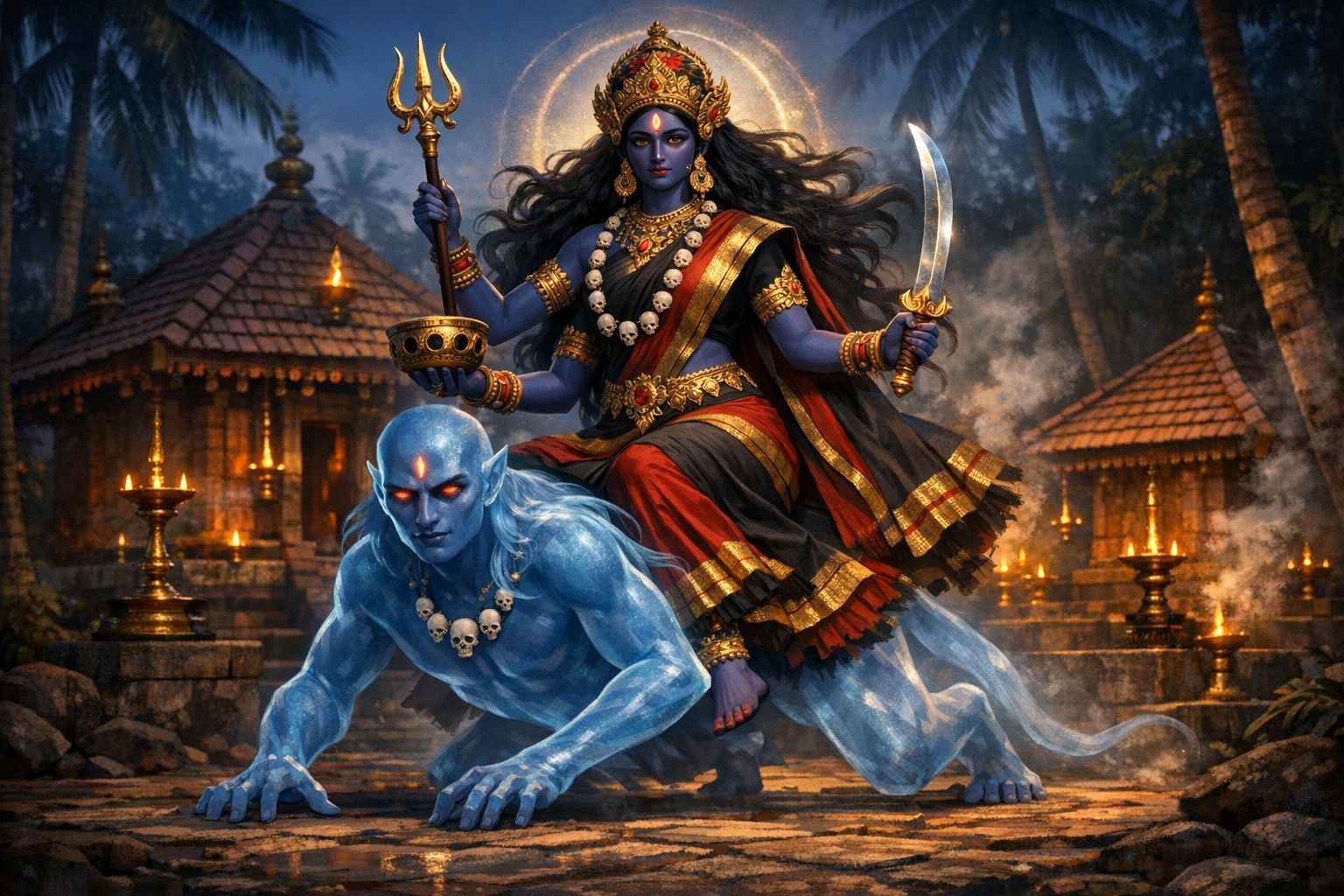
Kerala’s Shākteya tradition preserves a compelling and complex image of Bhadrakali: a goddess born of Shiva’s flaming third eye when the Saptamatrikas could not subdue the asura Darika, and a guardian who strides between life and death to restore cosmic balance. Within this regional archive of memory, one striking motif presents Bhadrakali with a vetalathe restless deadas her vahana (vehicle). Though not a pan-Indian standard, this Kerala-specific symbolism offers a profound hermeneutic on protection, justice, liminality, and the subjugation of untamed forces for the welfare of the world.
Vetala, in Sanskrit lore, is a spirit associated with cremation grounds and liminal spaces, known from narrative traditions such as the Baital Pachisi and from tantric lists of beingsbhūtas, pretas, and piśācaswho haunt thresholds between the living and the dead. In Shaiva-Shakta frames, vetalas often appear as subordinates of Bhairava or as components of the goddess’s wider retinue. When a regional tradition declares such a being to be the vahana of Bhadrakali, the statement is not merely pictorial; it is doctrinal, sociological, and soteriological. The vehicle signifies what a deity controls and to what purpose that power is directed. To ride a vetala is to harness the fearsome and the unassimilated, converting it into compassionate guardianship.
Kerala’s Shākteya ecosystemanchored by temples (kavu), kavus’ grove-sanctuaries, and performative rituals such as Theyyam, Kaliyattam, Padayani, and Mudiyettusupplies the living context for this imagery. Here Bhadrakali’s Darika-vadha (the slaying of Darika) is dramatized as a cosmic victory enacted for the village and forest alike, often accompanied by musical recitations (thottam pattu) that summon memories of cremation-ground deities and their spectral entourages. The goddess’s association with śmaśāna (cremation ground) motifsgarlands of skulls, a girdle of severed hands, disheveled hair, and the protruding tonguesituates the vetala vahana within a larger semiotic field of death-transcending sovereignty.
In textual terms, the pan-Indian Devi Mahatmya establishes the theological grammar of the Devi’s protective ferocity but does not prescribe a vetala vahana for Kali or Bhadrakali across the subcontinent. By contrast, Kerala’s liturgical and iconographic practices sometimes countenance variants in which a bhūta or vetala appears beneath the goddess’s feet, as her seat, or as her mount, echoing the wider tantric language of pretāsana (a corpse-seat) and the sadhaka’s panchamundi āsana (a seat consisting of five skulls). Such signifiers do not glorify death; they domesticate its terrors and bind its liminal agencies to dharmic oversight.
This distinction matters: a vahana is not simply a conveyance. In Hindu symbolism, the vahana condenses a metaphysics of relationship between a deity and the energies that shape the cosmos. Durga’s lion, Chamunda’s jackals, and Saraswati’s swan all naturalize this grammar. The vetala, as Bhadrakali’s vehicle in Kerala’s Shākteya imagination, marks the furthest frontier of that grammarthe threshold where the unquiet dead, social anxiety, and the risks of the forest and night are gathered under the compassionate authority of the Mother. It renders visible a difficult truth: protection requires mastery not just over obvious harms but over the liminal forces that unsettle communities from within and without.
Against this background, the Darika narrative is more than mythic combat. Darika embodies adharma amplified by boons and by liminalityforces that elude straightforward, juridical containment. Bhadrakali’s fiery emergence from Shiva’s third eye is the enabling of precise, ethical force. Riding a vetalasubjugating the very emblem of restless transgressionsignals that the Devi reorders chaos by incorporating its edges. This ordering is not annihilative; it is integrative. What threatens as an outsider energy is enrolled into guardianship.
The Kerala temple milieu underscores this integrative vision. Kavus act as ecological and social thresholds: groves hold serpents, shrines guard streams, and oracles (vellichappad) speak for the deity, mediating disputes and healings. In such liminal places, rites to pacify bhūtas and pretasbhūta-preta-śānticoexist with daily worship. When a ritual litany positions Bhadrakali as vetala-vahana, it anchors the community’s confidence that even the most disquieting presences stand within dharma’s ambit when bound to the Devi’s feet.
Kerala’s performative arts intensify the point. Mudiyettu stages the entire Darika-vadha cycle with elaborate masks and choreographies, dramatizing how the Devi’s fierce compassion brings law and healing to a world beset by transgression. Theyyam and Kaliyattam, too, often center cremation-ground aesthetics and the presence of otherworldly attendants. The vetala motif, while not ubiquitous in visuals, lives within the same ritual language: the goddess steps into fearful terrains, domesticates them, and returns their energies to village well-being.
Iconographically, the cluster around Bhadrakali in Kerala features a trident (triśūla), skull-cup (kapāla), sword, and shield; hair unbound; and a garland of heads (munda-māla). The goddess may be depicted trampling a figure that signifies pride or adharma, or enthroned upon a corpse-seata pretāsanathat amplifies the same meaning as the vetala vahana: domination of death’s unruliness and the transformation of fear into protection. In this light, the vetala is neither demonized nor celebrated for its own sake; it is sign and servant of a higher ethical order.
Comparatively, the motif of riding liminal or terrifying beings is hardly alien to the wider Dharmic imagination. Chamunda’s jackals and cremation-ground iconography, Bhairava’s canine companion, and Kali’s dancing upon the inert Shiva (as śava) all mark thresholds where the sacred reclaims what appears profane. The vetala vahana crystallizes this grammar in the form of a restless dead spirit pledged to service. It is a Kerala contribution to the broader language of Vehicles of Hindu Gods that emphasizes subduing and redirectingnot erasingliminality.
From a tantric perspective, this symbolism also maps onto the practitioner’s inner work. Just as the goddess rides the vetala, the sadhaka sits upon a panchamundi āsana to perform advanced practices, figuratively mastering fear, aversion, and death-anxiety. The cremation ground (śmaśāna) becomes a theatre of awakening rather than a zone of dread. Kerala’s Shākteya practices absorb this interiorized reading into temple and performance, presenting the goddess’s victory as simultaneously cosmic, communal, and psychological.
Kerala’s great sanctuariesKodungallur Bhagavathy, Thirumandhamkunnu, Attukal, and many kavus across Malabar and Travancoremodel this theology socially. Festivals such as Bharani at Kodungallur invert norms to expose and drain communal tensions, under the Devi’s supervision, before reconstituting order. The message beneath ritual inversion is straightforward: by approaching the messy, boundary-testing aspects of life through sacred frameworks, communities emerge more cohesive and resilient.
Read ethically, the vetala vahana forbids the exclusion of the marginal. Spirits of the edgewhether imagined as ghosts or understood as social discontentsare bound to service within a dharmic covenant. The goddess’s fierceness is never gratuitous; it is calibrated for protection of the vulnerable, correction of the arrogant, and restoration of balance. In Kerala’s lived religion, this translates into a tangible sense of safety that arises not from denial of danger but from its ritual domestication.
The unity of Dharmic traditions gives this symbolism further depth. Vajrayāna Buddhism’s charnel-ground yogas also enlist terrifying imagerydākinīs, piśācas, and vetāla-like beingsas supports for transforming fear into wisdom and compassion. Jain communities, while committed to ahimsa, have long maintained rites to pacify liminal presences without violence, emphasizing vows, mantra, and ethical rectitude. Sikh tradition honors a potent bir ras (heroic essence) in which righteous forcecelebrated, for example, in Chandi di Varis consecrated to justice and protection. Across these traditions, fierce symbols become vehicles of ethics, not of cruelty.
Linguistically and ritually, Kerala Tantra is attuned to this conversion of fear into guardianship. Keraliyatantric manuals, temple paddhatis, and oral recitations frequently enumerate rites for bhūta-preta-śānti, integrating them into daily and seasonal cycles. Even where specific visualizations of a vetala vahana are infrequent, the theological infrastructure that would make such a motif intelligible is omnipresent: the Devi presides over thresholds, and nothing truly remains outside her circle of order.
Historically, the vetala vahana can also be read as a negotiated settlement between older, local death cults and classical Shākteya theology. Rather than suppressing ancestral and forest-edge spirits, Kerala’s temples and kavus sanctified them. Over centuries, the unquiet dead were not expelled but enlistedritually sworn to the Mother and depicted, in some cases, as the very beings who carry her. This is not syncretism for its own sake; it is dharmic statecraft at the village scale.
The psychological consonance of this image is equally notable. Communities that ritualize their anxietiesnaming, staging, and reinscribing them within sacred formsdisplay greater resilience. On the individual plane, the image teaches that one’s “restless dead”unresolved memories, fears, and impulsescan be harnessed, not merely repressed. To see Bhadrakali mounted upon a vetala is to claim that even the world’s darkest thresholds can be made to serve compassion.
This Kerala-specific insight complements, rather than contradicts, pan-Indian iconography of the Devi. The lion of Durga, the swan of Saraswati, the owl of Lakshmi, and the peacock of Subrahmanya each educate different virtues. The vetala of Bhadrakali adds the virtue of liminal mastery: the courage to stand in the cremation ground of life and return with blessing. In a contemporary world that often seeks safety in denial, this older grammar counsels safety through truthful encounter and disciplined transformation.
In summary, Vetala as Bhadrakali’s vahana in Kerala’s Shākteya tradition is a concentrated symbol of protection, justice, and integration. It proclaims that the Devi’s compassion is not fragile but fierce, capable of recruiting the very forces that unsettle humanity. As a contribution to the larger language of Hindu symbols and the significance of vahanams of Hindu Gods and Goddesses, it stands out for its audacity and therapeutic clarity. By affirming unity across Dharmic traditionsconverging on the shared task of transforming fear into wisdomthe image offers a rigorous spiritual ethic: nothing is beyond the reach of dharma when the Mother herself rides at the frontier.
Inspired by this post on Hindu Blog.
