
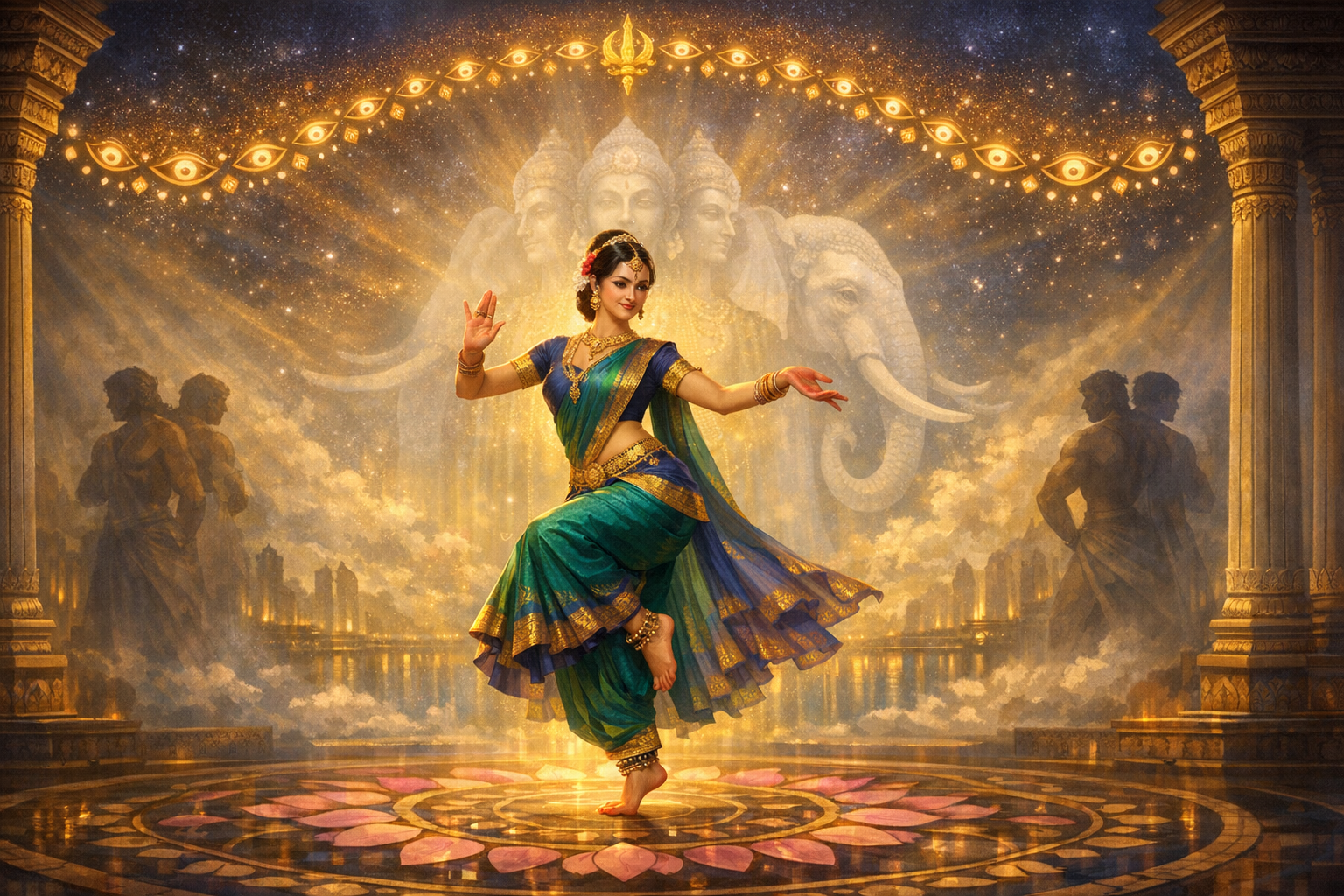
Among Hindu Stories preserved in the Mahabharata, few episodes are as evocative and symbolically layered as the account popularly remembered as “Indra’s Thousand Eyes: The Divine Transformation Through Tilottama’s Beauty.” It is an etiological tale that explains epithets such as Sahasranetra and Sahasraksha for Indra while illuminating the ethical interplay of desire, power, and restraint that sustains dharma across the three worlds. Read as history of ideas and mythic symbolism, the narrative also exemplifies how aesthetics, especially dance and beauty, can become calibrated instruments for restoring cosmic order.
The episode is framed by the cosmic problem of Sunda and Upasunda, two asura brothers whose fierce tapas secured them formidable boons. Rendered nearly invulnerable, they became engines of adharma, disrupting governance, tormenting beings in all realms, and destabilizing equilibrium across heaven, earth, and the intermediate spaces. In the epic’s political theology, their inseparable fraternal bond was precisely what made them unassailable by conventional force, compelling the devas to seek a non-martial remedy.
Classical accounts in the Mahabharata relate that the devas convened and appealed to Brahma for counsel. The solution did not arise from superior weapons but from superior wisdom: an upāya that would separate what could not be sundered by arms. On Brahma’s command, Viśvakarma fashioned an apsara of incomparable beautyTilottamaher very name glossed by commentators as tila + uttama, “the subtlest and finest,” suggesting she was woven from the most refined essences of the cosmos. In the language of Hindu mythology, she personified a strategic convergence of aesthetics and purpose.
Tilottama entered the asuras’ domain not as a warrior but as an embodiment of allure, grace, and dance. The brothers, whose mutual loyalty had seemed unbreakable, found themselves overwhelmed by kāma and moha. In witnessing her, they were compelled to turn against one another; each sought exclusive possession, dissolving the very unity that had ensured their invincibility. Their ensuing conflict led to mutual destruction, and with that, equilibrium and righteous governancedharmawere restored without violating the divine injunctions that restrained the devas from direct slaughter.
In parallel, the Mahabharata preserves a theologically suggestive scene that explains enduring divine epithets. As Tilottama moved among the celestials, Shiva manifested faces to behold her from every directionan expression of cosmic awareness rather than mere desirewhile Indra, struck by the same radiance, is said to have become Sahasranetra, “thousand-eyed,” so that no facet of her passage would escape his gaze. This is a characteristic epic device: the myth functions as an origin-story for names already known from earlier Vedic and epic usage, binding language, ritual memory, and theology.
Indic traditions also preserve a second well-known etiological thread associated with Indra’s thousand eyes: the Ahalyā episode. In those versions, Indra’s transgression incurs a curse that marks his body with a thousand yoni symbols, which, through divine grace or penance, are transformed into eyes. Read together, the two etiologies do not cancel one another; rather, they illustrate the polyvalence of mythic reasoningIndra’s sahasra-epithets can memorialize both the vigilance of cosmic sovereignty and the moral consequence of ungoverned desire. The coexistence of variants is a feature, not a flaw, in Hindu scriptures and Puranas.
Symbolically, Indra’s thousand eyes are an image of comprehensive awareness, royal vigilance, and protective oversightan antidote to the tunnel-vision that lets adharma spread. Aesthetics, in this rendering, becomes an ally of ethics. Tilottama’s beauty is not an objectifying spectacle; it is a calibrated upāya that confronts hubris with its own inner contradiction. The episode thus reads as political counsel encoded in myth: the might of the devas lies not only in the vajra but in psychological insight, timing, and the ethical selection of means.
This moral architecture resonates broadly across dharmic traditions. Buddhism emphasizes indriya-saṃvara, restraint of the senses, as a foundation for clear seeing; the narrative’s “thousand eyes” can be read as mindfulness that is panoramic rather than grasping. Jain philosophy underscores samyama and aparigrahaself-discipline and non-possessivenessprecisely the virtues Sunda and Upasunda lacked. Sikh thought identifies kām (lust) as one of the five thieves that cloud discernment; by contrast, the devas steer desire away from violation and toward the restoration of just order. The shared thread is unmistakable: mastery of attention and intention sustains dharma, while unbridled impulse defeats even the mighty.
Rasa and performance aesthetics are integral to this scriptural logic. The Natya tradition understands dance and music as extensions of sacred communication, capable of harmonizing disordered minds and societies. Tilottama’s mission demonstrates how the arts, entrusted to a righteous telos, can become a subtle statecraft that heals without humiliating, and resolves conflict without multiplying violence. In that sense, her dance is also a lesson in cultural power: beauty that clarifies, not confuses; allure that reveals, not conceals.
Philologically, Tilottama’s name encodes her metaphysics: tila suggests the tiniest grain, while uttama signals unsurpassed refinement. Apsara itself may derive from ap (waters) and √sṛ (to move), often interpreted as “she who moves in the waters/space,” reflecting their liminal, fluid presence between realms. Indra’s appellationsSahasraksha, Sahasranetraare Vedic and epic honorifics for a sovereign whose vision spans the cardinal and intermediate directions, fitting the guardian of the devas and wielder of the vajra.
Comparatively, Indra’s profile demonstrates civilizational continuity across the subcontinent’s spiritual map. In Vedic literature he is Purandara, lord of might and storms; in Buddhist sources he appears as Śakra Devānām Indra, the protector of the Trāyastriṃśa heaven; and in Jain cosmology, “Indra” functions as a title for the lords of celestial realms who honor Tirthankaras. Such cross-traditional attestations underscore a shared symbolic vocabularydevas, asuras, and apsarasthrough which Indian philosophy, art, and ethics have communicated for millennia.
Iconographically, Indra’s thousand eyes are not always rendered literally on images; instead, texts, liturgy, and epithets carry the meaning. The thunderbolt (vajra), Airāvata the elephant, and royal posture convey the same message: omnidirectional awareness in the service of protective governance. In temple and manuscript traditions, Shiva’s multi-faced manifestation in this narrative is treated not as carnal curiosity but as the ultimate witness-consciousness surveying all directions, an image of sovereignty over the senses rather than subservience to them.
Read as a guide for contemporary life, the story speaks to attention in an age of distraction. Thousand eyes can either scatter into restlessness or conjoin into integral vigilance. The devas model the latter: seeing clearly, choosing proportionate means, and restoring balance without excess. Sunda and Upasunda remind that power without inner governance courts self-destruction; Tilottama shows that art allied to dharma can accomplish what brute force cannot; and Indra’s eyes counsel the cultivation of panoramic, ethical awareness in personal, civic, and spiritual spheres.
Taken together, this Mahabharata saga remains a masterclass in Hindu mythology and ethics, harmonizing aesthetics, statecraft, and spirituality. It affirms a core dharmic intuition shared by Hinduism, Buddhism, Jainism, and Sikhism: that liberation from the tyranny of impulse and the consecration of perception to truth are the wellsprings of just order. In that consecration, a thousand eyes become not instruments of craving, but luminous emblems of vigilance, compassion, and restored dharma.
Inspired by this post on Hindu Blog.
