
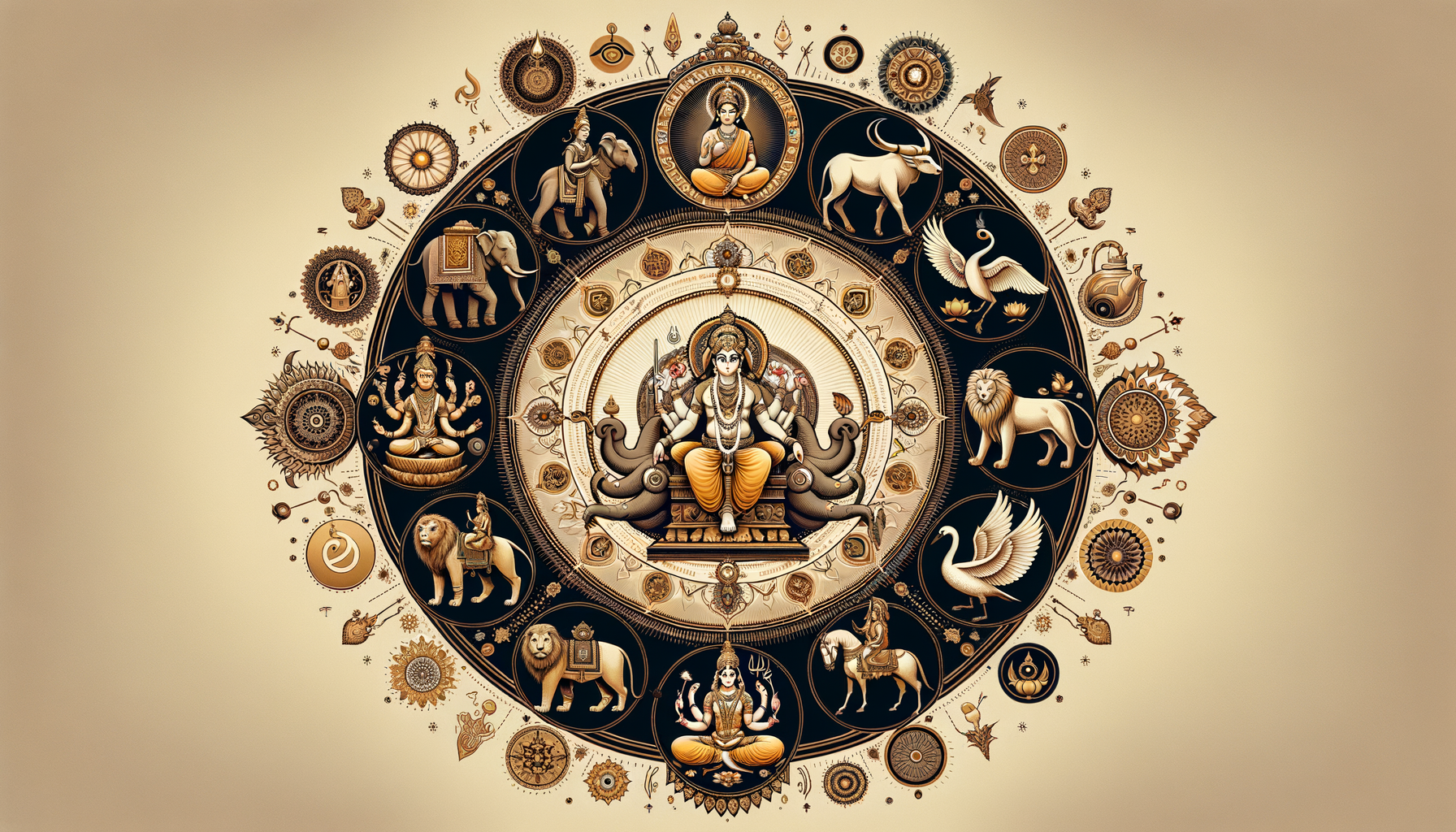
The question “What is the significance of the vahanams (vehicles) of Hindu gods and goddesses?” arises frequently among seekers. Within Hindu thought, a vahana (or vahanam) functions not as literal transport but as a layered symbol of energy, ethics, and inner psychology. Classical imagery, lived temple traditions, and contemporary satsangs converge on a shared understanding: each sacred vehicle illuminates a virtue to cultivate and an impulse to master, guiding everyday life toward dharma, compassion, and unity.
In Purāṇic and temple iconography, the deity and the vahana together present a complete teaching. The deity embodies the highest consciousness or cosmic principle; the vehicle depicts the tendencies of nature that consciousness bears, transforms, and harmonizes. Read this way, vahanas speak to ecological care, ethical restraint, and psychological balancevalues shared across the broader dharmic family of Hinduism, Buddhism, Jainism, and Sikhism.
Ganesha and the mouse (mooshika) exemplify intellect directing restlessness. The mouse, small and quick, symbolizes incessant sensory urges and the mind’s skittering thoughts; Ganesha’s serene mastery shows how discrimination and steadiness turn scattered energy into purposeful action. Devotees often reflect on this pairing when beginning new work, studies, or sadhana.
Shiva with Nandi, the bull, represents strength yoked to righteousness (dharma). Nandi’s unwavering gaze and stillness at Kailasa’s threshold teach patience, fidelity, and disciplined power. For many practitioners, Nandi becomes a reminder that true power is quiet, ethical, and service-oriented.
Vishnu upon Garuda, the eagle, conveys sovereignty, protection, and swift clarity. Garuda’s expansive wings suggest discernment that rises above confusion to secure justice and order. The pairing encourages courageous guardianshipof truth, community, and the vulnerable.
Durga with the lion or tiger embodies fearless compassion and protective action. The great cat signals courage sublimated into service, never aggression for its own sake. In times of adversity, devotees look to this image for the resolve to defend dharma while preserving dignity and care for all beings.
Saraswati with the hamsa (swan)and in some traditions the peacockteaches refined discernment (viveka) and aesthetic responsibility. The hamsa “separates milk from water,” symbolizing discrimination between truth and falsehood; the peacock cautions against vanity even as it celebrates beauty. Together they counsel scholarship, humility, and ethical speech.
Lakshmi and the owl (ulūka) remind practitioners that prosperity requires wisdom. The owl’s capacity to see in the dark suggests foresight in finance and generosity in success, warning against attachment and short-sighted greed. Devotees often interpret this pairing as a call to share wealth responsibly and to sustain community well-being.
Kartikeya (Subrahmanya, Murugan) with the peacock signals the sublimation of pride into valor and service. The peacock’s brilliance, when guided by leadership anchored in dharma, becomes courage without conceit. This imagery inspires disciplined youthfulness and noble action.
Surya’s chariot drawn by seven horses evokes vitality, time, and rhythm. The seven horses are linked to the seven meters of Sanskrit, the seven colors, and the seven levels of energy, suggesting harmony between cosmic order and daily routine. For many, Surya’s vahana becomes a reminder to align work, rest, and purpose with steady inner light.
Indra on Airavata, the white elephant, speaks to the stewardship of rain, protection, and responsible governance. The elephant’s strength paired with calm presence teaches leadership that nourishes rather than depletes, echoing ecological ethics in agrarian and urban life alike.
Other vahanas preserve equally clear teachings: Varuna with makara (crocodile) signifies depth, law, and the mysteries of the waters; Agni with the ram represents transformative courage; Vayu with the antelope points to agile life-force and breath; Yama with the buffalo teaches justice, limits, and the sanctity of time; Shani with the crow invites patience, accountability, and steady effort; Bhairava with the dog honors loyalty and guardianship at liminal thresholds; Chamunda with jackals confronts fear, ego, and the necessity of truth-telling. Together, they cultivate reverence for all creatures and the ecosystems they represent.
Regional traditions sometimes present variationsowl and elephant with Lakshmi in different contexts, or tiger and lion across forms of Devīyet the core insight stays intact: the vahana encodes a virtue and a vigilance. Diversity in depiction reflects the inclusivity and plural hermeneutics of Hindu practice, enriching rather than contradicting shared principles.
Psychologically, a vahana can be seen as a symbol of the “lower” or instinctual nature being borne and illumined by higher awareness. In daily sadhana, devotees contemplate the deity-vahana pair as an aid to cultivate one quality at a time: steadiness with Nandi, focus with the mouse, humility with the peacock, foresight with the owl. Such contemplations turn imagery into practical ethics.
Across dharmic traditions, cognate motifs appear. Buddhist lion imagery signals the Buddha’s fearless proclamation of truth; Jain Tirthankara emblems affirm ethical virtues and non-violence; Sikh teachings on seva and inner discipline mirror the same harnessing of power to compassion. While the vahana framework is distinctly Hindu, the underlying lessonsself-mastery, ecological humility, and serviceresonate across the dharmic spectrum, strengthening unity in spiritual diversity.
In satsangs, including those where seekers have posed this very question and teachers such as Sri Sri Ravishankar have offered reflections, the emphasis remains consistent: vahanas are functional symbols that map the many energies of one Consciousness. They help practitioners translate metaphysics into mindful choiceshow to speak, earn, protect, study, and lead.
Practical application is straightforward. Before study, reflect on Saraswati’s hamsa to refine discernment. When handling resources, recall Lakshmi’s owl to unite prosperity with prudence and generosity. In moments demanding courage, contemplate Durga’s lion or tiger; for ethical leadership, remember Vishnu’s Garuda and Indra’s Airavata; to steady the breath and rhythm, turn to Surya’s chariot and Vayu’s fleet antelope.
Ultimately, the vahanas of Hindu deities are living pedagogy. They guide attention from outer form to inner meaning, from instinct to insight, and from individual practice to shared dharmic values. Embracing their symbolism nurtures unity across traditions and fosters a compassionate, ecologically mindful, and ethically grounded life.
Inspired by this post on Hindu Pad.
