
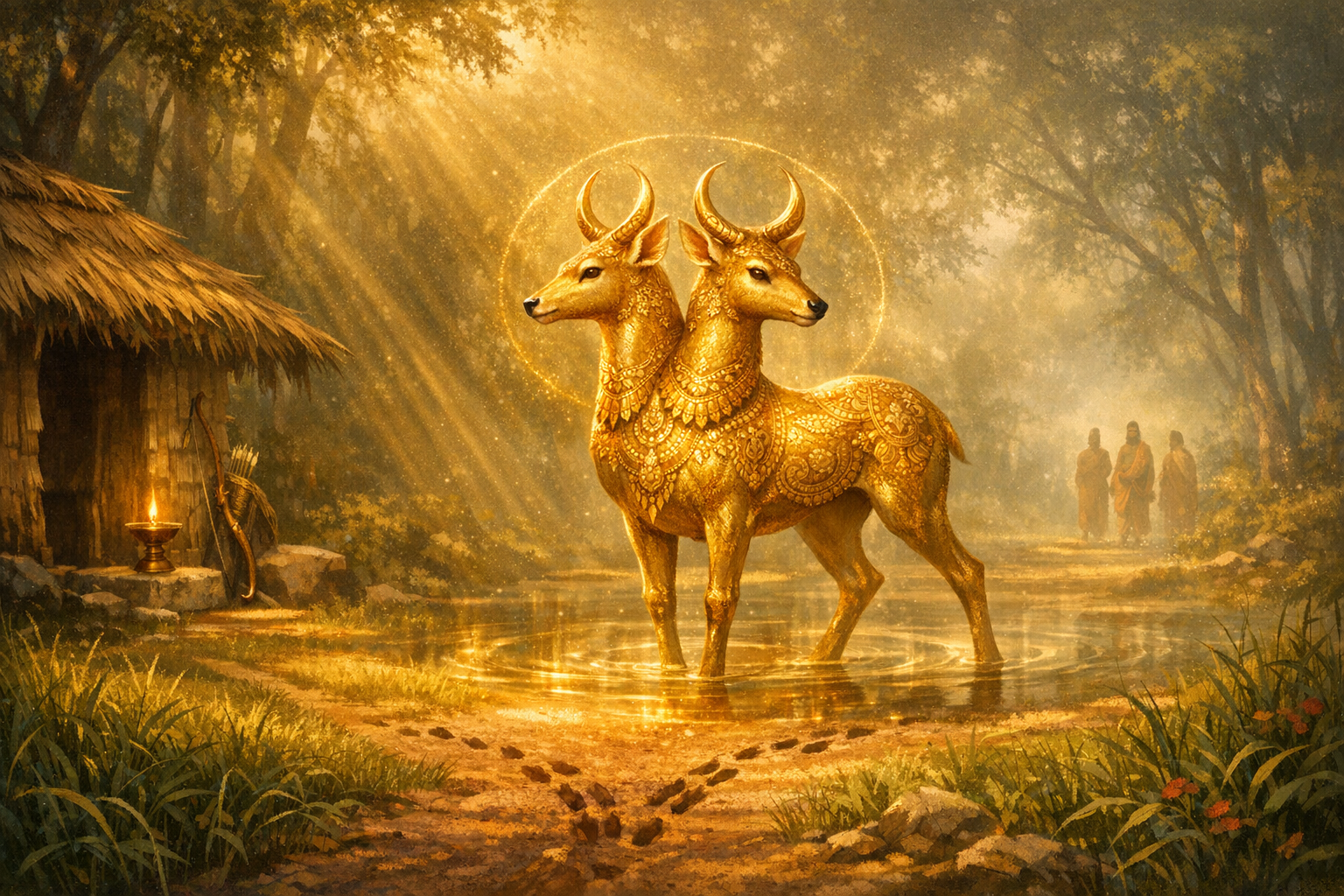
The Ramayana endures not as a single, fixed scripture but as a living, plural tradition that has taken root across South Asia in diverse languages, performances, and devotional practices. Within this vibrant landscape of retellings, the episode of Ravana’s abduction of Sita stands out for its striking local variations. One compelling motif recorded in select folk and performance traditions of Kerala and Tamil Nadu is the two-headed golden deer, an imaginative elaboration that recasts the well-known lure employed by Mārīca to draw Rama away from the hermitage.
In the pan-Indic narrative familiar from the Valmiki Ramayana (Aranya Kanda, roughly sargas 41–44), Mārīca, at Ravana’s behest, assumes the form of a preternaturally beautiful golden deer. Entranced by its impossible radiance, Sita urges Rama to capture it; Rama pursues the apparition, entrusts Sita to Lakshmana, and the fateful separation allows Ravana to abduct her. This canonical outline anchors the core theology and ethics of the episode: the deceptiveness of desire, the testing of discernment, and the inexorable workings of dharma.
Regional retellings reenchant this core with locally resonant imagery. In Tamil oral and performance idioms, the deer is sometimes remembered as an iru-thalai mAn, a two-headed deer whose doubled visage signals the intensification of maya. The image also circulates in Kerala’s performance and story-telling ecologies. While this two-headed feature is not part of the Valmiki description, its presence in select folk repertoires and performative exegesis reveals how communities amplify narrative symbolism to communicate the perils of illusion and the duplicity inherent in adharma.
Kamba Ramayanam, a monumental Tamil classic, is renowned for its luxuriant poetics and dramaturgy. Kamban often accentuates the otherworldly character of Mārīca’s disguise through hyper-real description, and within subsequent commentarial and performance lineages this hyper-reality is sometimes glossed in ways that align with the two-headed motif. Such elaboration functions less as contradiction than as commentary, sharpening the hermeneutic focus on the deer as an embodiment of maya and mrgatrishna, the mirage of desire.
Kerala’s devotional and performative ecosystems likewise transmit the golden deer with heightened wonder. In recitational and performance contexts shaped by Adhyatma Ramayanam Kilippattu and by kathakali and allied narrative arts, the deer’s qualities frequently exceed natural proportion, an aesthetic choice that underscores the anti-natural logic of rakshasa illusion. In some local oral accounts, this escalation yields depictions that echo the two-headed deer trope, magnifying the didactic message that evil often wears a dazzling mask.
The Tamil stage arts of therukoothu and kattaikkuttu, together with narrative song genres such as villupattu, regularly explore the Aranya Kanda with animated spectacle. Here, the two-headed golden deer surfaces as a theatrically effective device. By making the impossible palpably visible, performance traditions render moral philosophy experientially accessible: audiences feel the pull of appearance, the quickening of curiosity, and the unsettling recognition that what captivates the eye may betray the heart’s safety.
Symbolically, the two-headed golden deer clarifies three intertwined themes. First, duplicity: two faces, two directions, two promises, none trustworthy. Second, distraction: the multiplied gaze invites Rama’s pursuit, just as multiplied desires invite the mind’s scattering. Third, inversion of nature: the very structure of the deer confesses its artifice, reminding audiences that adharma requires the distortion of cosmic order to thrive. In this reading, the two-headed form mirrors Ravana’s strategy and state of mindbrilliant, ingenious, and fatally estranged from righteousness.
A dharmic, comparative lens situates this motif within a broader South Asian moral philosophy. Hindu expositions name the trap desire lays as kama cloaked in maya; Buddhist analyses describe the snare of trishna and the veils of avidya; Jain teachings warn against attachment and delusion as sources of bondage; Sikh wisdom counsels vigilance against haumai and the beguiling shimmer of worldly show. The two-headed golden deer, wherever it appears, becomes a shared pedagogical emblem: a reminder, across dharmic traditions, that ethical clarity requires seeing through dazzling appearances to unchanging principles.
Philologically and conceptually, the episode invites attention to key Sanskrit terms. Mrga, the deer, is a seeker; mrga-trishna, literally the deer’s thirst, names a mirage that promises water where none exists. Mārīca’s form is therefore a theater of cognition: the senses race after a projection, the mind ascribes value, and choice seals destiny. Doubling the deer’s head dramatizes that cognitive errortwo horizons of promise, doubly illusory, doubly compelling.
Material and visual cultures in South India occasionally echo this intensification. Mural cycles and illustrated manuscripts sometimes press the golden deer’s strangeness to a visual limit, signaling for viewers that the scene marks a threshold between forest and city, innocence and ordeal, order and its calculated disruption. Such stylization is not a departure from scripture’s truth but a regional strategy for teaching it with immediacy.
Performance studies help explain why this motif persists. Oral literature thrives by calibrating wonder to memory: the more impossible the image, the deeper its imprint in collective recall. A two-headed golden deer is easier to remember, simpler to recognize as symbolic, and more effective as a cue for the lesson that followsRavana’s guile, Sita’s vulnerability, Lakshmana’s dilemma, and Rama’s unwavering commitment to dharma even amid loss.
For contemporary readers and audiences, the image resonates beyond the stage. In a culture saturated with visual allurefrom advertising gloss to digital miragesthe two-headed deer names a familiar danger: the too-good-to-be-true offer. The episode thus becomes a practical ethics of attention. It asks how one discerns value under conditions engineered to exploit desire, and how communities can cultivate collective wisdom to resist predatory seductions.
Scholars of Ramayana studies, attentive to manuscripts, commentaries, and performance repertoires, have long noted that such local elaborations enrich rather than unsettle the tradition’s unity. Valmiki’s throughline remains firm: the abduction sequence tests virtue and reveals character. Regional RamayanasKamba Ramayanam in Tamil, Adhyatma Ramayanam Kilippattu in Malayalam, and allied folk traditionsoffer interpretive prisms that illuminate different ethical facets of the same jewel.
Crucially, these variations model a civility of interpretation aligned with dharmic pluralism: unity without uniformity. They demonstrate how communities can reaffirm shared moral endstruthfulness, restraint, compassion, and couragewhile allowing artistic means to vary. In this sense, the two-headed golden deer is not a contradiction to be corrected but a teaching instrument configured for particular audiences, languages, and sensibilities.
Placed back within the abduction arc, the motif sharpens causality and consequence. Mārīca’s deception separates the protagonists; Ravana exploits the breach; the forest’s fragile safety yields to Lanka’s formidable enclosure. Yet the very artifice that begins the ordeal also contains its antidote: recognizing illusion is the first step toward restoring order. As the narrative moves into Sundara Kanda, Hanuman’s clarity of aim countervails Mārīca’s obfuscationanother reminder that rightly trained attention is the dharmic response to spectacle.
In sum, the two-headed golden deer in select Kerala and Tamil traditions operates as a powerful hermeneutic amplification of a canonical scene. It intensifies the Ramayana’s warnings about desire and deception, renders philosophical insights theatrically palpable, and aligns with a broader dharmic pedagogy shared across Hindu, Buddhist, Jain, and Sikh thought. Far from fragmenting the epic’s message, such regional creativity sustains the Ramayana’s enduring capacity to guide ethical life in ever-changing worlds.
Inspired by this post on Hindu Blog.
