
Across Hindu philosophy and the wider dharmic traditions of Buddhism, Jainism, and Sikhism, Ultimate Reality is approached as That which exceeds definition yet pervades every experience. The Upanishads signify this horizon of meaning as “Tat”the ineffable ground of beingtoward which scripture, reasoning, and the Guru–Shishya Tradition can only point. The consensus is striking: Ultimate Reality cannot be taught as a concept; it is realized as direct, transformative Self-Realization (aparoksha-jnana). This essay examines why that is so, how the classical methods of learning support that realization, and why diverse paths across dharmic lineages converge on a shared commitment to experiential wisdom and unity.
To say that Ultimate Reality cannot be taught is not to claim that no teaching is possible. Rather, it distinguishes between informational knowledge (paroksha-jnana) and the direct, unmediated apprehension of reality (aparoksha-jnana). Concepts, arguments, and even inspired commentary clarify and remove obstacles, but they do not transfer realization itself. Just as no description can replace tasting honey, no discourse can substitute for awakening to Brahman–Atman. The Upanishadic mahavakya “tat tvam asi” and the apophatic method “neti neti” (not this, not this) work by deconstructing superimpositions and pointing inward, where the knower discovers the known as none other than the Self.
Hindu darshanas approach this with rigorous epistemology. Knowledge is authenticated by pramanasvalid means of knowledgeclassically including perception (pratyaksha), inference (anumana), and testimony (sabda). For Brahman, the primary pramana is sabdaśruti (the Upanishads)not as dogma but as a unique, liberating testimony that reveals what is always present yet overlooked. Sabda clarifies what perception and inference cannot fully deliver: that the innermost witness (Atman) is not an object, but the very subject and substratum of all experience. This revelation remains incomplete until it culminates in lived recognition, which is why teaching, however brilliant, remains a preparatory pointer.
Advaita Vedanta articulates a precise pedagogy: śravaṇa–manana–nididhyāsana. Śravaṇa is sustained listening to the Upanishadic teaching under a qualified Guru; manana is rigorous reflection that resolves doubts; nididhyāsana is deep contemplation that dissolves habitual misidentifications. Together they convert conceptual understanding into stable realization. The method of adhyaropa–apavadaprovisional superimposition followed by systematic negationguides the intellect beyond conceptual fixation, allowing direct recognition of the Self as free, full, and ever-present.
The role of the Guru is pivotal yet paradoxical. A Guru does not transmit Ultimate Reality like data; rather, skillful means (upaya) dismantle ignorance (avidya) and attune the student to what cannot be objectified. The traditional image of Guru Dakshinamurthy teaching through profound silence expresses this paradox: silence is not the absence of teaching but the presence of direct seeing, once conceptual noise subsides. In the Guru–Shishya Tradition, the teacher serves as a living pramana, a catalyst whose guidance enables the student to verify truth within, not merely accept it from without.
Classical Vedanta insists on adhikaritvamfitness for knowledgecultivated through sadhana-chatushtaya: viveka (discernment of the eternal from the transient), vairagya (dispassion), the shatsampat (śama, dama, uparati, titiksha, śraddha, samādhāna), and mumukshutva (earnest longing for liberation). These are not mere ethics adjuncts; they stabilize attention, soften egoic rigidity, and mature the inner instrument (antahkarana) so that insight becomes transformative. Complementary yogic practicesasana, pranayama, pratyahara, and dhyanasteady the mind, making nididhyāsana potent and natural.
Hindu spirituality also honors plural pathwaysKarma Yoga, Bhakti, Raja Yoga, and Jnana Yogawhose integration dissolves inner fragmentation. Karma Yoga refines motive through selfless action, reducing raga-dvesha (binding likes and dislikes). Bhakti purifies through devotion, orienting the heart toward the sacred. Raja Yoga calms mental fluctuations (citta-vritti-nirodha), preparing the ground for insight. Jnana Yoga inquires into the nature of the knower. The synergy is pragmatic: ethics and devotion open the heart, meditation steadies the mind, and inquiry reveals the Self, enabling moksha not as an attainment but as the recognition of what always is.
Dharmic unity becomes vivid when one compares these dynamics across traditions. Buddhism emphasizes prajna (wisdom) arising from sila–samadhi–prajna: ethics, concentration, and insight. Ultimate freedomnirvanais not teachable as a theory but realized via direct seeing (yathabhuta-jnana-darshana). Jainism speaks of kevala-jnana, omniscient knowledge unveiled through rigorous vows and inner purification; anekantavada (the doctrine of manifold aspects) encourages humility and non-absolutism, echoing the Vedantic refusal to reify partial truths. Sikhism affirms Ik Onkarthe indivisible Onerealized through Nam Simran (remembrance of the Divine Name) and the guidance of the Shabad Guru, where understanding ripens into lived anubhav (experience). Despite doctrinal distinctions, these lineages converge on a core principle: Ultimate Reality is verified in experience, not manufactured by instruction.
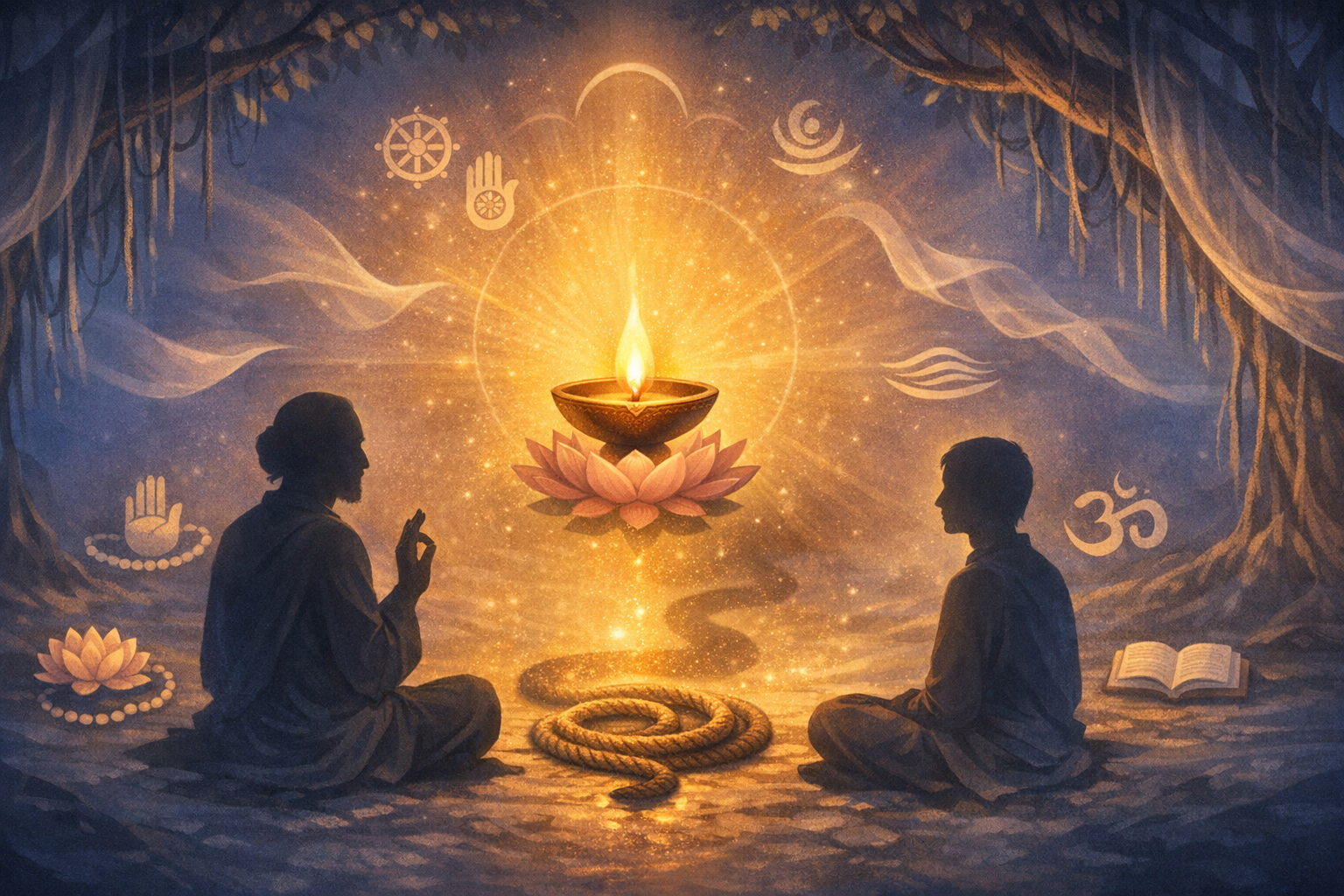
The classical rope-snake illustration clarifies why scripture is indispensable yet insufficient. In dim light a rope is mistaken for a snake; panic ensues until a lamp reveals the rope as rope. No amount of argument fully calms fear without the revealing light. Similarly, śruti and Guru turn on the lamp; conditioned fear fades not by importing a new object but by removing a misperception. The teaching liberates by canceling error, not by adding content; what remains is the Self, simple and self-effulgent.
Key Upanishadic dialogues demonstrate the pedagogy of realization. In the Katha Upanishad, Nachiketa’s fearless inquiry into death yields a vision of the Self as unborn, undying. The Chandogya narrates Satyakama’s journey, where truthfulness qualifies him more than lineage; instruction is delivered through nature’s voices until the mahavakya illuminates his heart. The Mandukya distills the entire Veda into Om and the four quarters of consciousness, using inquiry and contemplation rather than dogma. Such narratives portray teaching as transformative guidance, culminating in recognition rather than belief.
In the digital age, information about Vedanta, Yoga, and meditation is abundant, yet transformation remains rare. A practical framework helps: daily śravaṇa (systematic study of the Upanishads or a trusted prakarana text), followed by manana (writing, discussion, and reasoned doubt-resolution), and nididhyāsana (silent contemplation on mahavakyas). Complement this with Karma Yoga in ordinary tasks, Bhakti through kirtan or mantra japa, and stillness practices from Raja Yoga. Parallel frameworks across dharmic traditionsBuddhism’s sila–samadhi–prajna, Jainism’s vows-led purification, Sikhism’s simran and sevaillustrate a shared architecture: ethical clarity, mental steadiness, and insight into the real.
Common pitfalls deserve attention. Concept-attachment can masquerade as wisdom; premature absolutism may eclipse humility; spiritual bypassing avoids necessary psychological integration. Anekantavada offers a corrective: reality surpasses any single formulation. Ishta concept within Hinduism further affirms that individual dispositions vary; multiple valid approaches exist without mutual negation. Embracing diversity is not compromise but precision: different temperaments require different upayas, and unity in spiritual plurality is a hallmark of dharmic maturity.
Ultimately, the claim that Ultimate Reality cannot be taught safeguards both rigor and compassion. It prevents reducing the highest truth to slogans, insists on verifiability through anubhava (direct seeing), and honors the indispensable roles of ethics, contemplation, and discernment. It also nourishes interfaith amity within the dharmic family by recognizing a shared experiential core alongside rich doctrinal variety. When the mind grows still and inquiry becomes immediate, “neti neti” gives way to silent affirmationThat which is sought is the seeker’s very Self. In that clarity, unity is not an ideal but the living fact animating all paths.
Inspired by this post on Hindu Blog.
