
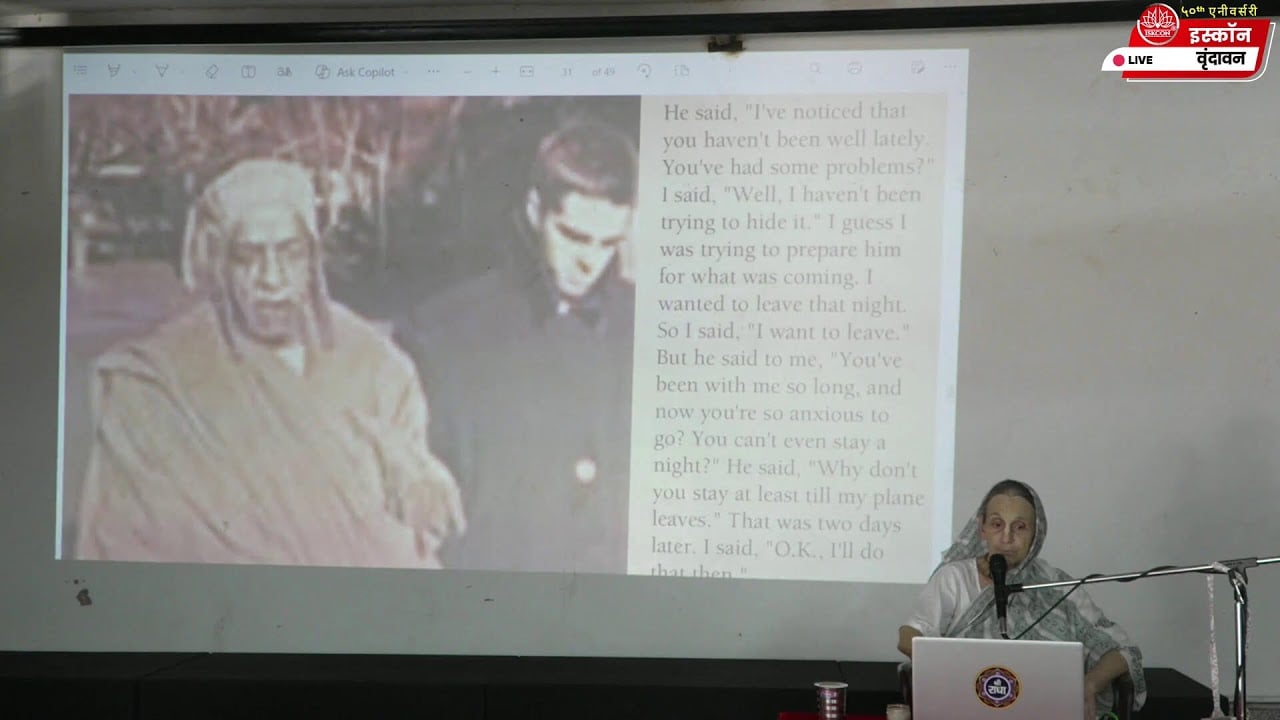
On 07.06.2026 at ISKCON Vrindavan, HG Daivi Shakti Mataji presented an incisive, source-aware exploration of Srila Prabhupada Lilamrita, the seminal devotional biography of A. C. Bhaktivedanta Swami Prabhupada, founder-acharya of the International Society for Krishna Consciousness (ISKCON). The discourse situated the text within Vrindavan’s sacred topography and the broader tradition of Gaudiya Vaishnavism, demonstrating how historical memory, spiritual practice, and institutional mission converge to shape living bhakti.
Srila Prabhupada Lilamritaauthored by Satsvarupa dasa Goswamidraws on diaries, letters, interviews, archives, and early ISKCON publications to present a multilayered portrait of a modern acharya. As a devotional biography (hagiography), it privileges the interpretive lens of liladivine playwhile still incorporating verifiable historical scaffolding. HG Daivi Shakti Mataji emphasized that the text’s value lies not only in data but in pedagogy: it models how guru, sadhu, and shastra (scriptural authority) interact within bhakti-yoga to inform practice, identity, and service.
The methodological core of Lilamrita is instructive. Rather than treating “history” and “holiness” as mutually exclusive, the work integrates empirical recollection with Vaishnava hermeneutics, where spiritual causality and parampara (disciplic succession) supply meaning. This makes it a useful case study for scholars of religion: it is simultaneously a chronicle of events and a theological commentary in narrative form, prioritizing transformation (parivartan) over detached reportage.
Key chronological anchors provide context. Born in Calcutta in 1896, Abhay Charan De encountered Srila Bhaktisiddhanta Sarasvati in 1922 and received the enduring mandate to present Krishna-bhakti in the English language. Decades of writing and outreach culminated in intensified literary service, sannyasa in 1959, and residence in the bhakti-culture of Vrindavan, where translation of Srimad Bhagavatam commenced with steadfast focus.
A decisive historical inflection came in 1965 with the transoceanic voyage aboard Jaladuta and the celebrated poem “Markine Bhagavata-dharma,” articulating a mission defined by humility, dependence on Krishna, and confidence in the potency of shastra. ISKCON’s formal incorporation in 1966 in New York catalyzed a swift, structured expansion grounded in congregational kirtan, prasadam distribution, and systematic study of Bhagavad Gita and Srimad Bhagavatam.
HG Daivi Shakti Mataji highlighted the acharya’s institutional clarity: a governance framework, a publishing-forward strategy, and training through the guru–shishya tradition established a replicable template for spiritual communities. In this model, books, temples, and sangha (community) operate synergisticallyscripture informs practice, practice generates realization, and realization fuels service.
Vrindavan’s role in this narrative is both geographical and hermeneutical. As Krishna’s lila-dhama, Vrindavan contextualizes the biography not merely as memory but as ongoing participation in sacred space. The samadhi-mandira and daily kirtan culture manifest what the text teaches: bhakti is historically grounded, communally embodied, and spiritually transmissible.
Thematically, Lilamrita advances a lucid articulation of guru-tattva (principles governing the teacher’s role), showing the acharya as a living commentary on shastra. Two technical distinctions surfaced repeatedly: anukarana (imitation) versus anusarana (following in essence), and the triadic evidence model of guru–sadhu–shastra (convergent testimony). Such concepts help readers discern between literal replication and principled continuity that adapts responsibly across cultures.
In pedagogical terms, the text demonstrates how bhakti-yoga integrates sravanam (hearing), kirtanam (chanting), smaranam (remembrance), and seva (service), mapping practice to psychology. Chanting the Hare Krishna maha-mantra, mindful consumption of prasadam, and satsang (association with devotees) are presented as mutually reinforcing disciplines that align cognition, emotion, and volition toward Krishna-bhakti.
A leadership and organization lens reveals how ISKCON developed as a transnational movement without sacrificing doctrinal core. Publishing pipelines, translation standards, and devotee education created a knowledge ecosystem where accessible English exposition carried the gravitas of Sanskritic tradition. The balance between uncompromising siddhanta (core doctrine) and cultural intelligibility is a signature insight echoed throughout HG Daivi Shakti Mataji’s exposition.
The biography’s historiographical contribution also lies in its documentation of cross-cultural transmission. It records how kirtan, prasadam, and philosophical clarity bridged generational and geographic divides, demonstrating that devotional aesthetics and ethical clarity can engage plural publics while staying rooted in Sanatan Dharma.
Importantly, the talk framed Lilamrita within a dharmic ecumene that honors shared civilizational values. While theological particulars differ across Hinduism, Buddhism, Jainism, and Sikhism, the tradition of kirtan and seva resonates with Sikh shabad kirtan and langar; the cultivation of karuna (compassion) and disciplined sangha echoes Buddhist practice; and the centrality of ahimsa and aparigraha in Jainism finds ethical kinship with sattva-driven living in Vaishnavism. Such convergences support “Unity in spiritual diversity” without erasing doctrinal nuance.
From that vantage, Srila Prabhupada Lilamrita becomes more than an ISKCON narrative; it is a case study in dharmic transmission that invites interfaith dialogue grounded in mutual respect. The text affirms a civilizational principle often summarized as Vasudhaiva Kutumbakamthe world as one familyencouraging collaboration on the shared platforms of compassion, truthfulness, and service.
For practitioners and readers, a structured approach enhances engagement. Begin with a chronological read-through to grasp the mission arc; annotate recurring themes such as surrender (saranagati), shastra-centered decision-making, and pastoral care; then revisit key episodeslike the Jaladuta voyage or early New York kirtansto extract leadership, pedagogical, and pastoral patterns applicable to contemporary community-building.
Many readers report a dual impact: affective uplift through kirtan-centered episodes and cognitive clarity through philosophical dialogues embedded in the narrative. This blend of head and heart is not accidentalit reflects bhakti’s epistemology, which validates realized knowledge (vijnana) arising from disciplined practice, ethical living, and service to guru and community.
HG Daivi Shakti Mataji also underscored the difference between inspiration and idealization. Where idealization can freeze a figure in unreachable perfection, inspiration catalyzes practical next stepsdaily japa, regular study of Bhagavad Gita and Srimad Bhagavatam, and tangible seva in local communities. The biography repeatedly shows transformation arising from consistent, humble practice rather than spectacular events.
From a research standpoint, Lilamrita benefits from triangulation with primary sourcesletters, lectures, diaries, and early periodicalspreserved in institutional archives. Treating it as a devotional primary source alongside independent historical materials strengthens both scholarly rigor and devotional appreciation, illustrating how hagiography and history can be read in mutually illuminating ways.
The text also models responsible cross-cultural communication. It showcases how articulate English transmission, accurate conceptual translation, and hospitality (prasadam culture) opened doors globally while safeguarding Vedic wisdom. This offers a transferable template for any dharmic community seeking to share heritage respectfully in plural societies.
In the spirit of unity among dharmic traditions, the discourse invited readers to honor distinct theological grammars while collaborating around shared ethical projects: ecological responsibility, compassionate service to the vulnerable, and education that cultivates character alongside knowledge. Such cooperation preserves diversity without diluting identity, echoing both the Ishta principlerespect for chosen spiritual pathwaysand the ethic of harmonious coexistence.
Read as a whole, Srila Prabhupada Lilamrita functions as a multi-genre text: biography, leadership manual, pedagogical guide, and contemplative companion. It equips seekers with a grammar of practice, leaders with a roadmap for mission-centered institutions, and scholars with a richly textured archive of modern bhakti’s global unfolding.
Concluding the session at ISKCON Vrindavan, HG Daivi Shakti Mataji returned to a simple, testable proposition: when guru–sadhu–shastra align in one’s life, clarity emerges, service deepens, and community flourishes. In this light, engaging Lilamrita becomes both study and sadhanaa disciplined reading that refines intellect, nourishes devotion, and strengthens unity across the dharmic family.
Inspired by this post on Dandavats.
