
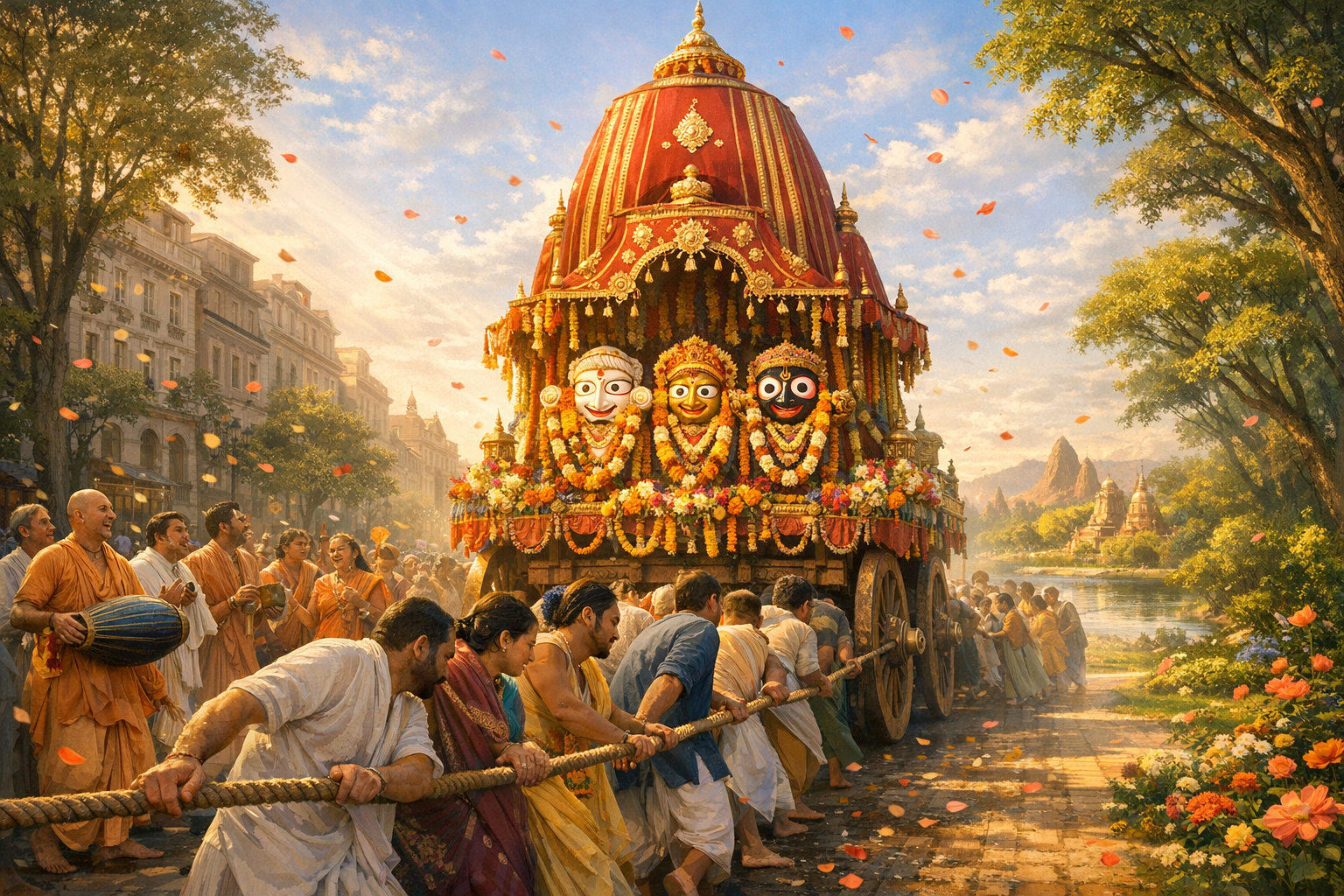
Within the contemporary bhakti landscape of Europe, a recent discourse at ISKCON Berlin (Krishna Berlin – ɪsᴋᴄᴏɴ) by HG Bhanu Nandini devi dasi explored the theme, “Lord’s Journey To Vrindavan.” Framed in the Vaishnava theological tradition, the presentation clarified how the “journey” names both a sacred procession embodied in Ratha-yatra and a transformative interior path described by the Bhagavad-Gita and Srimad Bhagavatham. The exposition situated classical pilgrimage (tirtha-yatra) within living practicekirtan, japa, and sevaso that devotion culminates in prema-bhakti. The result is a study in lived religion that engages devotees, scholars, and seekers from across dharmic traditions.
In Gaudiya Vaishnava understanding, the “Lord’s Journey to Vrindavan” poetically interprets Lord Jagannath’s annual movement during Ratha-yatra as Krishna’s return to the intimacy of Vraja. The chariot’s progress from Nilachala to the Gundicha Temple is read as a ritual reenactment of the devotional desire to draw the Lord from opulent public settings into the simple, love-saturated groves of Vrindavan. This arc mirrors the emotional dialectic of separation (vipralambha) and union (sambhoga) central to raganuga-bhakti as elaborated in Gaudiya literature. The procession thus becomes a moving commentary on devotional aesthetics (rasa-tattva).
Scriptural anchors lend precision to this vision. The Bhagavad-Gita articulates the ontology of worshipcentering consciousness on Krishnawhile the Bhagavata Purana narrates the personal pastimes of the Lord in Vraja. Gaudiya narratives preserve how Sri Chaitanya revealed the inner purpose of Ratha-yatra by guiding kirtan that invites Jagannath toward the mood of Vrindavan. Theology here becomes kinesthetic: through footsteps, melody, and intention, the Lord is carried along the city’s route as the practitioner is carried inward toward Vrindavan.
The material components of the procession are catechetical in their own right. The towering chariot signifies the Lord’s all-accommodating grace; the great wheels evoke the unstoppable movement of compassion; and the ropes, clasped by countless hands, figure the collective longing of sadhakas. Sound (kirtan), touch (ropes, prasada), sight (darshan), and motion (pulling, dancing) converge to form a multimodal pedagogy. The ritual technology thus transmits bhakti not only through doctrine but through coordinated, embodied remembrance.
Vrindavan, consequently, is more than a geographic node; it is the theological epicenter of spontaneous loving devotion in the Vaishnava imagination. Its sacred geographyGovardhan, the Yamuna, Nandagram, Barsanaindexes distinctive devotional moods, and its temples express an enduring conversation between architecture and love. When the Lord is drawn toward Vrindavan in festival time, the practitioner witnesses the triumph of intimacy over grandeur and tenderness over protocol. The victory here is that of unalloyed affection over formal piety.
HG Bhanu Nandini devi dasi highlighted the pedagogy of longing cultivated by Ratha-yatra. The mood recalls the Gopis’ plea to Krishna to return from the public arena of Kurukshetra to the forest bowers of Vrindavan. In this light, the procession is prayer rather than spectacle, and the street becomes a sanctified parikrama-marg. Participants interiorize this prayer through synchronized breath and voice in mahamantra kirtan, aligning with the ninefold limbs of bhakti: śravaṇam, kīrtanam, smaraṇam, pāda-sevanam, arcanaṁ, vandanam, dāsyaṁ, sakhyam, and ātma-nivedanam.
Technically, the “journey” dramatizes sambandha, abhidheya, and prayojanathe triadic map of Gaudiya Vedanta. Sambandha clarifies the soul’s eternal relationship with Sri Krishna and the reality of Vrindavan-dhama; abhidheya operationalizes practice through hearing, chanting, and service; prayojana culminates in prema, unobstructed love. Pulling the chariot outward parallels moving the heart inwardfrom forgetfulness to loving remembrance. This hermeneutic explains why a single festival, rightly approached, can recalibrate devotional priorities for an entire year.
The Berlin setting exemplified the global portability of tirtha-yatra. While Vrindavan’s dusty lanes, ghats, and shrines animate North India, diaspora communities re-create sacred space through public kirtan, prasada, and scriptural reflection. Ratha-yatra collapses distance: Jagannath’s mobile sanctum approaches devotees where they live, making bhakti accessible to those unable to travel. Urban plazas become classrooms in which the Bhagavad-Gita and Bhagavata Purana are encountered not only as texts but as practices.
The communal psychology of procession is notable. Large-scale kirtan induces synchrony and prosocial bonding often described as “collective effervescence.” Devotees frequently report reduced anxiety and deepened purpose after sustained kirtan and seva, outcomes consonant with contemplative research on rhythmic chanting and breath regulation. Within a dharmic frame, these shifts are experienced as the clearing of anarthasa “Gundicha Marjana” of the heartso that the Lord may be welcomed without obstruction.
The aesthetics of devotion add further granularity. Rasa theory, as codified by Gaudiya acharyas, frames bhakti as a structured affect: a sthayi-bhava (enduring mood) supported by vyabhicari-bhavas (transitory emotions), anubhavas (expressive acts), and alambana (the sacred support, i.e., Krishna and His devotees). Ratha-yatra curates these in real time: Jagannath is the alambana; clapping, dancing, and singing are anubhavas; tears and goosebumps arise as vyabhicari-bhavas; and one’s chosen devotional relationship matures as sthayi-bhava. The procession thus operates as a living laboratory of devotion.
Because this platform seeks unity among dharmic traditions, the Vrindavan journey can be seen as part of a shared civilizational grammar. Pilgrimage is common ground: Buddhist circuits around Sarnath and Bodh Gaya cultivate compassion and mindful presence; Jain tirthas such as Shatrunjaya enact ahiṁsā and disciplined simplicity; Sikh yatras to the Harimandir Sahib translate devotion into seva and communal langar. The convergencesremembrance, restraint, service, and sacred songaffirm “Unity in spiritual diversity” while maintaining each path’s integrity.
ISKCON’s accessible pedagogy furthers this inclusivity. Public kirtan invites respectful participation regardless of background; prasada democratizes sacred hospitality; and classes on the Bhagavad-Gita and Srimad Bhagavatham welcome inquiry from multiple perspectives. Such efforts harmonize with interfaith dialogue that prizes authenticity over syncretism and clarity over caricature. In cities like Berlin, cultural curiosity is thereby transmuted into informed appreciation.
Cultural heritage dimensions intensify the narrative. Vrindavan’s historic templesassociated with Rupa Goswami, Sanatana Goswami, and their spiritual descendantsdemonstrate how theology informs urban design, iconography, music, and daily ritual. The “Hindu Temples” of the Vrindavan–Mathura region form a pedagogical landscape in which architecture teaches metaphysics and ritual choreography encodes memory. When Ratha-yatra ceremonially draws the Lord toward that landscape, it renews a living archive that spans the Bhagavata Purana to contemporary practice.
The ethical arc of the festival is essential to its meaning. Practitioners are encouraged to cultivate satya (truthfulness), daya (compassion), and self-regulation in the weeks surrounding Ratha-yatraeschewing exploitative consumption, deepening gratitude, and engaging in service to others. This preparation parallels the inner “Gundicha Marjana”: as the temple is cleaned before the Lord’s arrival, habits are refined so the heart becomes a fitting dwelling. In this manner, ethical embodiment secures permanence for insights that might otherwise fade after the drums fall silent.
For newcomers, several stabilizing practices consolidate the festival’s momentum. Daily japa of the mahamantra focuses attention and softens reactivity; regular hearing and discussion of the Bhagavad-Gita and Bhagavata Purana clarifies understanding and guards against sentimentality unmoored from siddhanta; and tangible sevasupporting a local ISKCON center, preparing prasada, or assisting in community outreachtranslates devotion into character. These disciplines convert a festival encounter into a sustained spiritual trajectory. In this way, occasional participation matures into a consistent path of growth.
Modern skepticism asks whether symbolic festivals can address contemporary fragmentation. The Berlin gathering indicated that Ratha-yatra functions as a social integrator: families, students, and professionals from varied backgrounds converge in a shared act of reverence, while quiet reflection remains available at the procession’s periphery. The public square becomes a commons in which diversity is not merely tolerated but harmonized through coordinated song. In this respect, the procession is not a parade; it is pedagogy in motion.
From a comparative philosophy vantage, the journey articulates a threefold movement: from dispersion to recollection, from recollection to offering, and from offering to belonging. The first resonates with pratyahara (drawing the senses inward), the second with ishvara-pranidhana (dedicated action), and the third with seva (identity discovered through service). Vrindavan, in this model, names a stable interior center realized through disciplined remembrance. The chariot’s path maps that interior cartography.
Pilgrimage, moreover, is not escapism. Historically, tirtha-yatra catalyzes community service, care for the vulnerable, and stewardship of cultural heritage. Many Ratha-yatra observances couple celebration with blood-donation drives, clean-street initiatives, and interfaith hospitality. When devotion matures into public virtue, society perceives the pragmatic fruits of spiritual discipline.
Reflecting on the message associated with HG Bhanu Nandini devi dasi, several outcomes stand out for practitioners and observers alike. The festival clarifies the primacy of Vrindavan-bhakti in Gaudiya Vaishnavism; reframes urban life as a stage for sacred remembrance; equips seekers with simple, replicable disciplines; and models civically minded spirituality. These gains are not parochial; they resonate across the dharmic ecosystem that values compassion, self-restraint, and service. The result is a robust pathway from inspiration to integration.
Ultimately, the “Lord’s Journey to Vrindavan” is an invitation. Communities are called to pull togetherliterally and figurativelyso that the ropes of shared intention move the chariot of consciousness. When city streets become extensions of the parikrama path and homes become small temples of attention and kindness, the boundary between festival day and everyday begins to soften. In that softening, an old teaching gains new immediacy: where attentive remembrance and loving service abide, there is Vrindavan.
Inspired by this post on Dandavats.
