-
Indrajit Samhara Moorthy: Lakshmana’s Slaying of Meghanada and the Dharma of the Ramayana

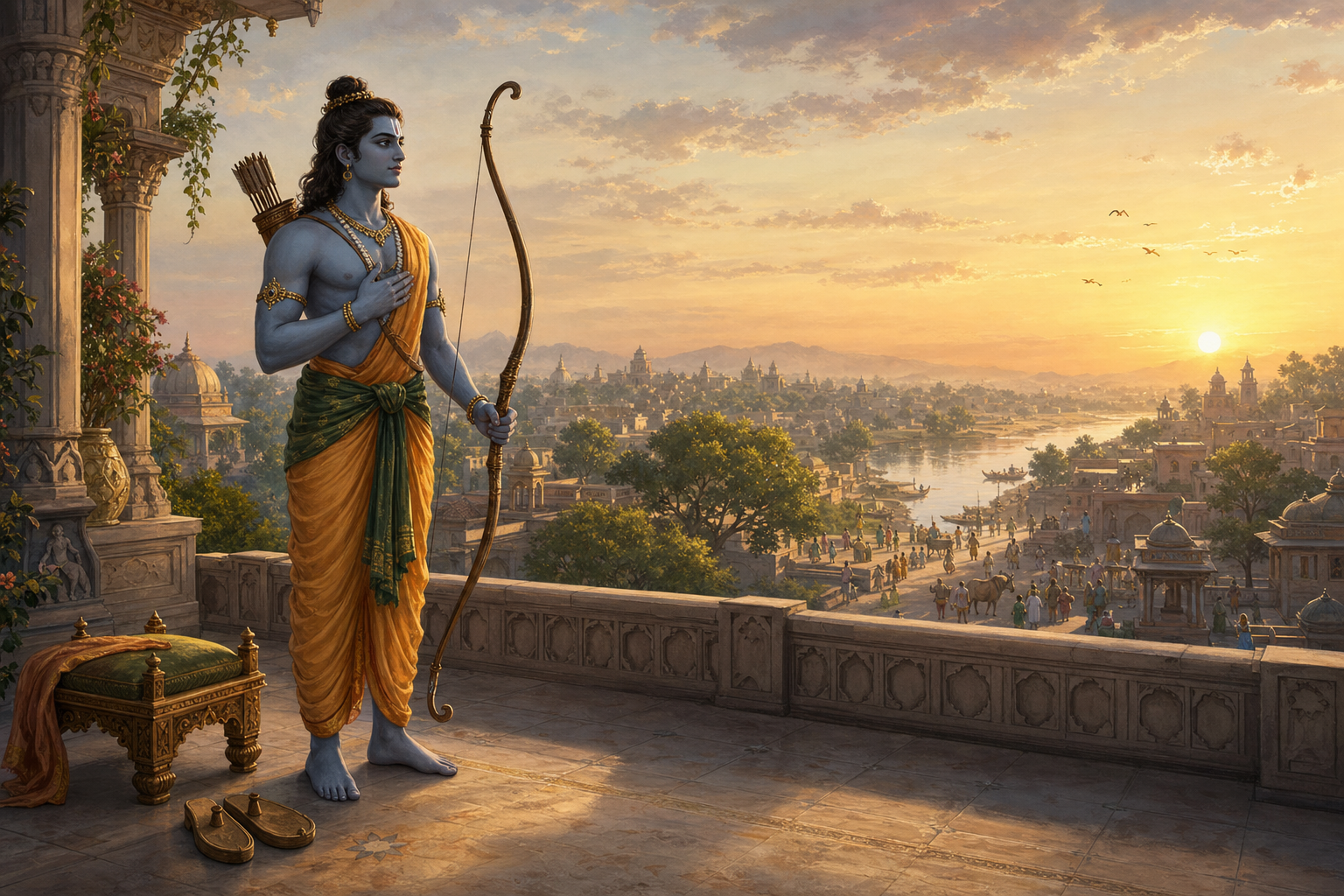
Lakshmana’s epithet “INDRAJIT SAMHARA MOORTHY” commemorates his defeat of Indrajit (Meghanada) during the Lanka war in the Ramayana. The episode centers on the Nikumbila yajna (yagna), where Lakshmana, supported by Hanuman and guided by Vibhishana, intervened to prevent an invincibility boon and then prevailed in open combat. Ethically, the act aligns with Dharma-Yuddha principles: stopping…
-
Shattering the ‘Good Person’ Mask: From Approval-Seeking to Boundaries and Authentic Seva

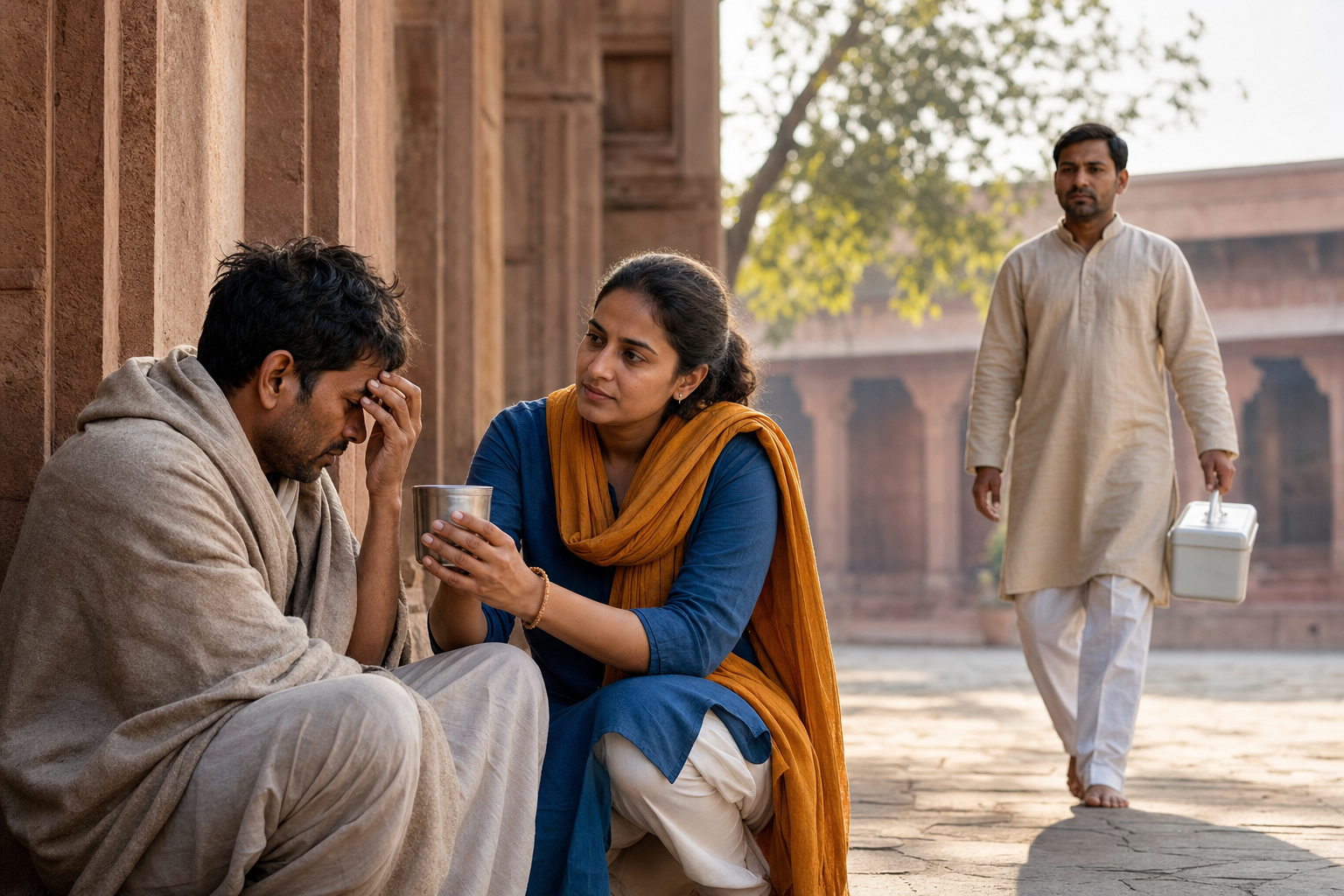
Many spiritual practitioners unintentionally tie self-worth to a “good person” identity measured by constant seva, positivity, and visible devotion. This narrative shows how approval-seeking and people-pleasing create guilt, resentment, and fragile boundaries. By asking honest questions and releasing the internal scoreboard, service shifts from pressure to presence. The result is authentic compassion, healthier boundaries, and…
-
Decoding Andal’s Parrot (Shuka): Vaishnava Iconography of Love, Voice, and Divine Bhakti Power

Andal’s parrot (Shuka) is a potent Vaishnava symbol that unites love, voice, and sacred memory in a single, graceful image. The iconography presents Andal as a serene, poetic devotee whose companion bird evokes messenger-love central to Tamil Bhakti. The Shuka’s association with mantra and nama-sankirtana highlights how disciplined speech transforms echo into wisdom. By recalling…
-
Kalita Tandava Unveiled: Shiva’s Eight-Armed Cosmic Dance of Balance, Time, and Renewal
Kalita Tandava, an eight-armed manifestation of Shiva’s cosmic dance, illuminates the cycles of creation, preservation, and dissolution through a precise symbolic grammar. Readers gain a clear map of its iconography—damaru, agni, triśūla, and protective mudrās—and how these elements encode the pañcakṛtya and expanded functions of grace and discernment. The article connects Vedānta, Kashmir Śaivism, and…
-
Abhyasa Yoga Explained: Master the Mind with Steady Practice and Dharmic Unity

Abhyasa Yoga emphasizes disciplined, continuous practice that steadies attention and prepares the mind for dhyana and samadhi. Grounded in Patanjali’s Yoga Sutra and the Bhagavad Gita, it integrates yama, niyama, asana, pranayama, pratyahara, and focused meditation into a coherent path. Practitioners benefit from small, consistent sessions that build cognitive clarity, emotional balance, and ethical insight.…
-
Bhutapataye Bhairava: Timeless Protector of the Five Elements and Pathway to Fearlessness

Bhutapataye Bhairava signifies the protective sovereignty of Bhairava over the five elements and subtle realms, uniting cosmology, ethics, and practice. The name encodes sacred stewardship of panchabhuta and compassionate guardianship of space, aligning with Tantric and Shaiva insights. Practitioners consistently describe greater grounding, clarity, and fearlessness through mantra, japa, and vrata. Iconography—dog, kapala, and trishula—teaches…
-
Kubera and Mammon Unveiled: How Icons of Wealth Shape Ethics, Society, and Spiritual Life

Wealth has long stirred both aspiration and anxiety. This comparative study of Kubera in Hinduism and Mammon in the Aramaic and Christian traditions clarifies how cultures transform riches into ethical guidance. It shows how Hindu texts situate prosperity within dharma and community welfare, while biblical teachings personify Mammon to warn against greed. Readers gain practical…
-
Lord Caitanya’s Radical Compassion: Redeeming Jagai–Madhai and Uniting Dharmic Hearts

An episode from Navadvipa in the Gaudiya Vaishnava tradition reveals Lord Caitanya’s radical yet disciplined compassion. Nityananda Prabhu and Haridasa Thakura confront public disorder caused by Jagai and Madhai, whose decline stems from corrosive association. The response—welcome paired with a vow to renounce harm—embodies a Bhakti model that balances mercy and personal responsibility. Readers gain…
-
Srila Prabhupada’s Daring Voyage and Enduring Legacy: How One Sage Ignited Global Bhakti

Srila Prabhupada’s achievement stands out as a singular moment in global religious history: at seventy, with no resources or contacts, he catalyzed the Hare Krishna movement across cultures. Thomas Hopkins’s assessment underscores the uniqueness of this feat in a foreign social landscape. The movement’s accessible practices—kirtan, prasadam, and study—blend devotional depth with public engagement. Readers…
-
When Srila Prabhupada Mastered a Dictaphone: Shattering Assumptions About Tradition and Tech

A brief, vivid episode with a Dictaphone reveals Srila Prabhupada’s calm mastery of electronics, overturning the common assumption that spiritual leaders resist modern tools. Recounted by Gargamuni Das, the scene demonstrates discernment, adaptability, and confidence in service of the Hare Krishna movement’s mission. Readers gain a practical model for integrating technology without compromising spiritual purpose.…
-
Judge by Their Ideals: Swami Vivekananda’s Transformative Call to Empathy and Dharmic Unity

Swami Vivekananda’s teaching urges a shift from judging others by personal standards to understanding them by their own ideals, fostering empathy and fairness. Rooted in dharmic pluralism, this principle resonates with Ishta in Hinduism, compassion in Buddhism, Anekantavada in Jainism, and seva in Sikhism. Applied to work, family, and public discourse, it reduces polarization and…
-
Maa Durga’s Transformative Grace: Conquer the Inner Fortress, Heal Shadows, Find Clarity

This reflection presents the “inner fortress” (Durgam) as a structure built from fear, greed, anger, and falsehood, and explains how Maa Durga’s symbolism provides a practical map for dismantling it. Drawing on Navadurga, the piece outlines a stepwise ascent from stability to grace and shows how meditation, pranayama, svadhyaya, truthfulness, and seva weaken entrenched patterns.…
-
Lakshmana’s Defining Victory: Indrajit Samhara Moorthy and Dharma’s Triumph in the Ramayana

Lakshmana is revered as INDRAJIT SAMHARA MOORTHY for defeating Indrajit (Meghanada) during the Ramayana war, shortly after interrupting the yagna at Ma NIKUMBILA. This turning point affirms dharma’s triumph over adharma and highlights disciplined strategy, moral clarity, and steadfast courage. The episode’s ethical resonance extends beyond a single tradition, reflecting values cherished across Hindu, Buddhist,…
-
When Young Sikhs Drift Away: Rebuilding Trust Through Gurmat and Dharmic Unity

Many communities observe young Sikhs drifting from institutional life, often due to a trust gap shaped by rapid social change and perceived value-practice mismatches. This piece outlines how Gurmat offers a rigorous, practical framework—rooted in sat, seva, nimrata, and sarbat da bhala—to restore confidence and participation. Readers gain actionable steps: youth-led arth vichaar, participatory budgeting,…
-
Chardi Kala and Bhana: Sikh Ideals for Unshakable Joy, Resilience, and Surrender to Hukam

“Chardi Kala and Bhana” distills a Sikh way of life into two powerful ideals: resilient optimism and loving acceptance of hukam. Chardi Kala sustains an ever-rising spirit through simran, seva, and sangat, transforming adversity into purposeful compassion. Bhana aligns the heart with Divine Will, encouraging ethical action without attachment to outcomes. Together, they balance courage…
-
Staying Present When Life Defies Expectations: Mindfulness, Aging, Belonging, and Purpose

This reflective essay examines what it means to practice mindfulness and presence when life does not deliver the expected arrival. It traces one person’s experience of aging, identity, parenting, and belonging, highlighting the dissonance between lived values and external recognition. It names a common yet quiet fear—being an understated embarrassment—and reframes it through acceptance and…
-
Ravana Anugrahamurti: Shiva’s Compassionate Power and the Transformative Lesson of Humility

Ravana Anugrahamurti reveals Lord Shiva’s grace transforming Ravana’s pride into devotion, offering a clear ethical lesson for modern life. The narrative emphasizes humility, restraint, and responsibility—core values in Hindu philosophy and resonant across Buddhism, Jainism, and Sikhism. Readers gain practical insights for daily practice, from reflective chanting to mindful leadership. The iconography highlights compassion over…
-
Uma (Gauri) Tandava: Shiva’s Cosmic Dance of Grace – Symbolism, Yogic Balance, Compassion

Uma or Gauri Tandava portrays Shiva’s cosmic dance in its most compassionate register, emphasizing balance, disciplined energy, and grace. This gentle form highlights Shiva’s unity with Uma (Shakti), showing how strength is refined by tenderness and moral clarity. Iconography—such as abhaya and varada gestures—invites assurance and generosity, while yogic readings link the dance to calm…
-
Dakshinachara Demystified: How the Right‑Hand Path Nurtures Unity in Dharmic Traditions

Dakshinachara, the right-hand path in Hinduism, aligns sacred devotion with ethical conduct and community-centered worship. Drawing on the puranas, agamas, and tantras—especially the Shakti-oriented tantras—it interprets ritual practice through a sāttvic, dharma-guided lens. In everyday life, it appears in temple ārati, japa, vrata, and pilgrimage, making profound teachings accessible to householders and renunciants alike. Philosophically,…
-
Inside ISKCON London, 1968–69: Srila Prabhupada’s Swift Training and Shared Memories

This study traces the early history of ISKCON’s London mission (1968–1969) through HG Kusha Mataji’s synthesis of Jamuna Devi’s and Shyamasundar’s recollections alongside letters from Srila Prabhupada. Juxtaposing memoirs and correspondence reveals how swift, precise training empowered a small devotee circle to build resilient community practices. Convergences in memory highlight key milestones, while nuanced differences…