
-
Rakshasa Linga Explained: How Fierce Tapas Wins Shiva’s Non‑Discriminating Grace

This in-depth exploration clarifies what a Rakshasa Linga is and why it matters: a Shivalinga worshipped or installed by a Rakshasa in Purana and sthala-mahatmya traditions. It explains how Skanda Purana and Shiva Purana preserve narrativessuch as Gokarna’s Atma Linga and Baidyanath Jyotirlingathat highlight Ravana’s fierce tapas and Shiva’s impartial grace. It situates these accounts…
-
Asansol Loudspeaker Compliance Drive Turns Violent: Police Outpost Vandalized, Appeal for Calm

Asansol, West Bengal, saw brief unrest during a loudspeaker regulation drive when stone pelting and vandalism damaged a police outpost. This analysis explains the legal frameworkthe Noise Pollution (Regulation and Control) Rules, 2000and the Calcutta High Court’s emphasis on uniform, permission-based use of amplified sound across religious and secular settings. Readers gain a clear timeline…
-
Memento Mori as Dharmic Practice: Urgent Living, Clear Priorities, and Courageous Leadership

This article presents a disciplined, Dharmic approach to mortality contemplation as a practical technology for urgent living and ethical leadership. It synthesizes insights from Hinduism, Buddhism, Jainism, and Sikhismmaranasati, pratikraman, simran, and dharmato convert awareness of impermanence into decisive action. A step-by-step protocol guides breath awareness, a regrets inventory, value-based reprioritization, and execution of one…
-
Shiva’s Damaru: Decoding the Cosmic Rhythm of Creation, Balance, and Transformation

This long-form exploration decodes Shiva’s Damaru as a compact, technical map of creation, balance, and transformation in Hindu philosophy. It explains Nāda-Brahma, the A-U-M schema, and the panchakritya while situating the drum’s meaning within linguistic tradition via the Maheshvara Sutras and Panini’s grammar. Readers gain an acoustical and yogic understanding of the instrument, including how…
-
Beneath the Conqueror’s Shadow: Unflinching South Asian History and Dharmic Resilience

This long-form analysis interprets South Asian history through five “folds” of the Conqueror’s Shadowmaterial, institutional, ritual, intellectual, and ethicalshowing how Hindu, Buddhist, Jain, and Sikh communities adapted with resilience rather than rupture. It synthesizes inscriptions, archaeology, and historiography to avoid simplistic narratives while honoring lived memory. Readers gain clear frameworks for understanding revenue systems, sacred…
-
As You Believe, So You Live: Hindu Dharma’s Science of Mindset, Health, and Longevity

This long-form analysis explores how dharmic wisdomHinduism, Buddhism, Jainism, and Sikhismanticipated modern findings on the mind-body connection by showing that belief (śraddhā, bhāva) measurably shapes healthspan and longevity. It integrates Bhagavad Gita and Yoga Sūtra insights with Ayurveda’s sattvavajaya and rasāyana, and aligns them with contemporary stress biology, autonomic regulation, and immune resilience. Practical guidance…
-
Sahasramukharavana’s Fierce Tapas: Decoding the Thousand-Headed Ravana’s Cosmic Power

Sahasramukharavana, the thousand-headed Ravana, expands the Ramayana’s ethical and metaphysical concerns through the language of tapas, number symbolism, and cosmic sovereignty. The figure is situated in later and regional narrative ecologies, where a thousand heads and two thousand hands encode cognition and agency magnified to the edge of hubris. Anchored in the wider Indic use…
-
From Riyadh to Tehran: How Srila Prabhupada’s Vedic Wisdom Inspires Unity and Hope

Interest in India’s ancient knowledge has expanded across Arab and Persian cultural spheres, especially during periods of uncertainty. This article examines why Srila Prabhupada’s books resonate in these contexts: philosophical clarity, rigorous translation, and accessible practice. It explains how Arabic and Persian editions preserve Vedic nuance while remaining readable for university courses and interfaith study…
-
Panchamukhi Ganapati Explained: Five Faces, Five Elements, and Mastery of the Senses

Panchamukhi Ganapati symbolizes the integration of the five elements and the five senses, aligning personal practice with Vedic cosmology. Drawing on the Ganapati Atharvashirsha, this exploration shows how Ganesha is identified with Earth, Water, Fire, Air, and Ether. The five faces are read as guardians of perception, action, and awareness, mapped by many iconographers to…
-
Laghu Shyamala: The Enigmatic Dark Goddess of Shakti, Speech, and Fertile Creation in Hinduism

Laghu Shyamala is honored as a dark-hued, esoteric form of the Divine Mother whose power concentrates knowledge, speech, creativity, and fertility. The name reveals an accessible pathway to Shakti, pairing the generative symbolism of “Shyamala” with the concise, practical emphasis of “Laghu.” Iconographyveena, parrot, book, and japa-malamaps a theology of cultured eloquence and compassionate learning.…
-
Bageshwar Dham’s Bold Challenge: Dhirendra Krishna Shastri Invites Critics to Witness ‘Divine Knowledge’

Pandit Dhirendra Krishna Shastri’s open challenge at Bageshwar Dham invites critics to witness ‘divine knowledge’ firsthand, creating an unusual opportunity for transparent observation in a public darbar. This analysis frames the event through Dharmic epistemologypratyaksha, anumana, and shabdawhile drawing on Anekantavada and Sikh Gurmat to promote interpretive humility and ethical evaluation. It outlines practical, consent-driven…
-
Radha-Krishna Idols Near Toilets in Delhi: Respectful Removal, Law, and Harmony

Idols of Radha-Krishna were found near a toilet at Indian Cottage Industry in Mehrauli, Delhi, prompting a swift, respectful removal by Youths Stand For Society (YSS) and a commitment to prevent recurrence. The episode highlights why sacred imagery across Hinduism, Buddhism, Jainism, and Sikhism should never be placed adjacent to sanitation areas and how such…
-
Ripples on the Cosmic Ocean: Turn Life’s Fleeting Moments into Dharma, Wisdom, Oneness

Hinduism likens each life to a ripple on a boundless ocean, a metaphor that dignifies impermanence and intensifies responsibility. Read how Advaita Vedānta, Sāṅkhya-Yoga, and the Bhagavad Gita converge on ethical action, contemplation, and realization of unity. Discover parallel insights in Buddhism’s anicca and dependent arising, Jainism’s anekāntavāda, and Sikhism’s Ik Onkārdiverse paths that affirm…
-
Bhagavan Alone Is Real: Timeless Vedanta, Living Bhakti, and the Joy of Dharmic Unity

This article unpacks the aphorism “Know that Bhagavan alone is real. Nothing else matters” through the lenses of the Upanishads, Bhagavad Gita, and major Vedanta schools (Advaita, Vishishtadvaita, Dvaita). It clarifies Bhagavan as the sat-chit-ananda ground of being and explains why the phrase does not deny ethical life but re-centers it in the Real. Readers…
-
Trailblazing Women of Pakistani Punjab: Five Brilliant Academics Transforming South Asian Scholarship

Pakistani Punjab’s universities and research centers have nurtured a generation of women scholars whose work reshaped debates in history, education, languages, religion, and civil–military relations. This article profiles five eminent academicsAyesha Jalal, Rubina Saigol, Arfa Sayeda Zehra, Riffat Hassan, and Ayesha Siddiqaemphasizing their methodological rigor, curricular influence, and public engagement. Readers gain a panoramic view…
-
Bengaluru cancels Munawar Faruqui show after HJS, Sri Ram Sena objections: a law-and-order analysis

Munawar Faruqui’s Bengaluru show, scheduled for 18 April 2026, was cancelled after objections by Hindu Janajagruti Samiti (HJS) and Sri Ram Sena and a formal complaint to the Bengaluru Police. This balanced analysis explains what is known, what remains unspecified, and how Indian constitutional principles frame such decisions. It outlines the law-and-order context, discusses the…
-
Transform Craving into Ruci: Mastering Taste, Seva-Anxiety, and Detachment in Krsna Bhakti

Is it wrong to desire a taste (ruci) in Krsna consciousness? Not at all. This analysis distinguishes spiritual taste from sense gratification by clarifying motive: serving Krsna versus serving the senses. It explains why “anxiety for Krsna” is a healthy, service-centered concern and how taste develops after purification (anartha-nivrtti) to become the engine of steady…
-
Ananya Sharan Bhaava: Mastering Unshakeable Devotion and Inner Surrender in Dharmic Life

Ananya Sharan Bhaava, or single-minded devotion, is best understood as something uncovered rather than acquired. Dharmic traditionsHinduism, Buddhism, Jainism, and Sikhismconverge on a shared architecture: ethical grounding, attentional training, and devotion that matures into surrender. Practical methods include clarifying a chosen refuge (Ishta or central ideal), adopting regular sadhana (japa, Naam Simran, dhyana), and aligning…
-
Kumbhakarna’s Counsel to Ravana: Timeless Dharma, Restraint, and Leadership Beyond Passion

Kumbhakarna’s counsel to Ravana in the Ramayana distills a core dharmic principle: restraint must govern power. The episode situates kāma (unchecked passion) as the chief contaminant of judgment and urges restitutionreturning Sitaas both moral necessity and strategic prudence. Read through niti and rajadharma, the advice anticipates classical statecraft: choose conciliation before force and align policy…
-
Restore Historical Clarity: HJS urges NCERT to reinstate Maratha Empire map in Class 8 textbook
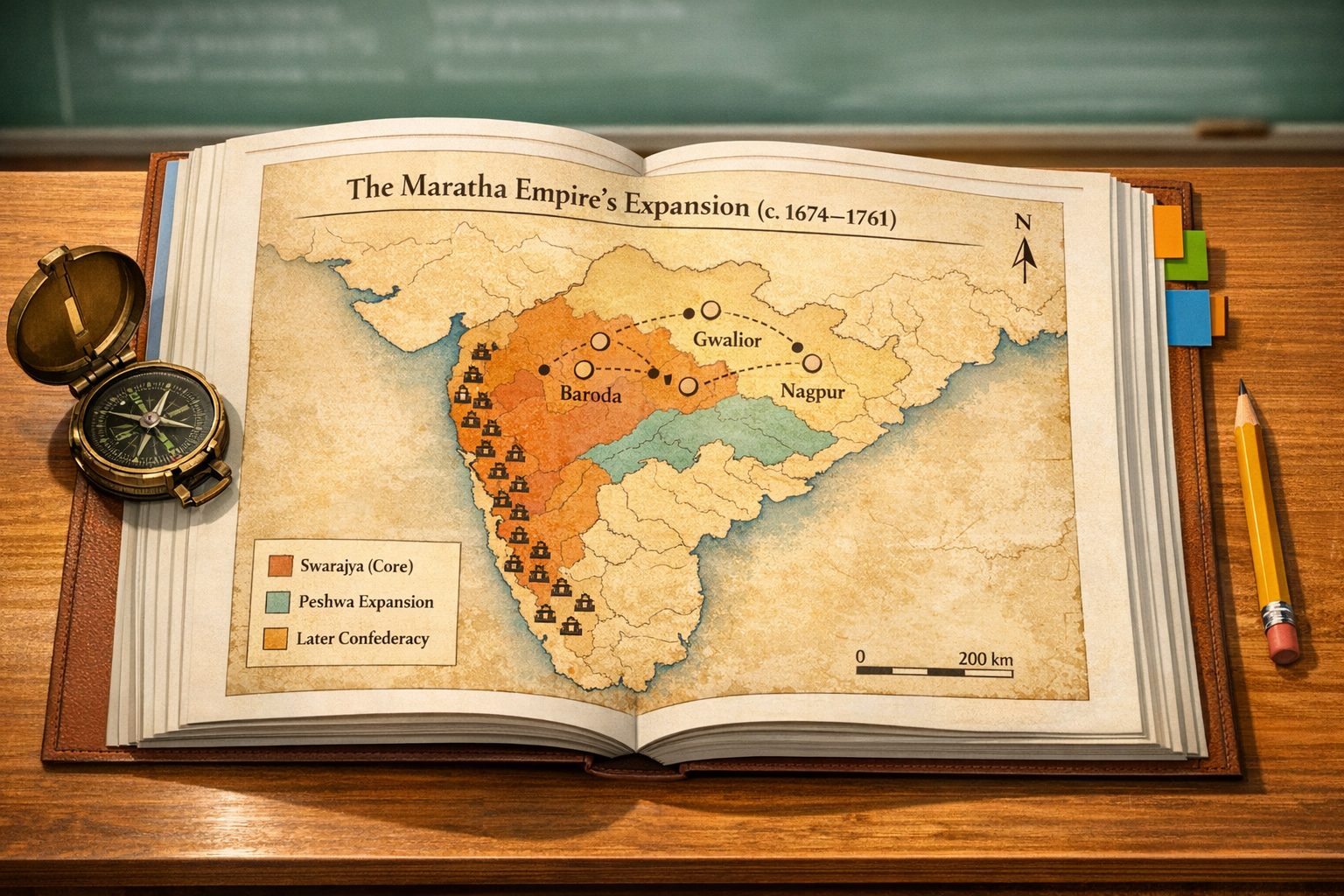
Hindu Janajagruti Samiti (HJS) has requested that NCERT reinstate the Maratha Empire expansion map in the Class 8 history textbook to improve historical accuracy and learning outcomes. Maps help Class 8 learners anchor timelines in geography, making complex eighteenth-century political formations intelligible. A carefully annotated Maratha map would depict core territories, confederal expansions, and key…