
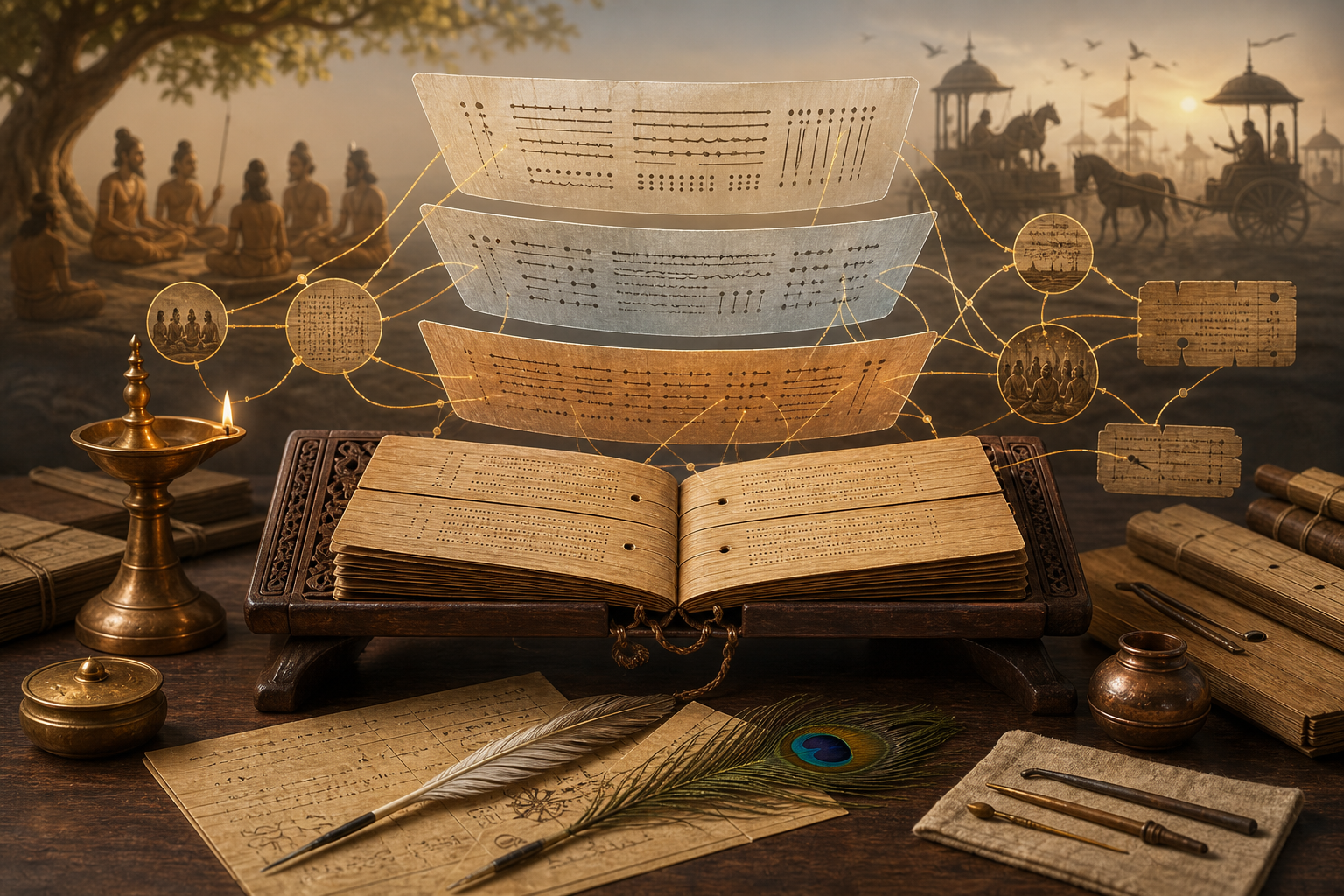
The popular claim that the Mahabharata began as a small war poem called Jaya, later expanded into Bharata and then into the one-hundred-thousand-verse Mahabharata, has become one of the most repeated summaries of the Sanskrit epic’s textual history. It is neat, memorable, and easy to teach. Yet the very neatness of the claim should invite caution. The Mahabharata is not a modern book with a clean publication history; it is an itihasa, a vast Sanskrit epic preserved through oral, scholastic, regional, and manuscript traditions. Its own opening chapters present multiple names, recitation settings, summaries, and verse counts, but they do not straightforwardly describe a simple three-step evolution from Jaya to Bharata to Mahabharata.
A more careful reading shows that Jaya, Bharata, and Mahabharata are not merely labels for three successive editions. They are names, literary gestures, interpretive frames, and textual descriptions used within a tradition that understood the epic in both concise and expansive forms. The question is not whether the Mahabharata has a layered history. Almost every serious student of the epic accepts that it has passed through complex processes of transmission, arrangement, interpretation, and regional preservation. The real issue is whether the specific modern formula of 8,800 verses becoming 24,000 verses and then becoming 100,000 verses is actually what the Mahabharata itself teaches. The evidence is much less certain than the popular version suggests.
The first point concerns the word Jaya. The famous opening invocation, known across many recensions, begins by bowing to Narayana, Nara, and Saraswati, and then says that jaya should be uttered. In traditional recitation, this is not merely a title page. It is an auspicious beginning: victory is invoked before the narration of dharma, conflict, loss, wisdom, and liberation. To convert this liturgical and literary word into the title of an earlier, independent, 8,800-verse war text requires an interpretive step. That step may be discussed as a scholarly hypothesis, but it should not be presented as a plain statement made by the epic itself.
The second point concerns the much-cited number 8,800. In the Adi Parva, Sauti says that he knows 8,800 verses, that Suka knows them, and that perhaps Sanjaya knows them as well. The surrounding explanation matters. These are described as difficult, closely knotted, or deeply layered verses whose meaning is hard to penetrate. Traditional interpretation often takes these as kuta-shlokas, difficult or cryptic verses embedded within the composition. In that reading, the number does not refer to the full size of an original text called Jaya. It refers to a body of especially challenging verses within the larger work. The distinction is crucial because an isolated number has been made to carry more historical weight than the passage can safely bear.
The third point concerns the number 24,000. The Mahabharata says that Vyasa composed the Bharata in 24,000 verses, excluding the upakhyanas, the subsidiary narratives or episodes. This statement is often treated as proof of a second stage called Bharata, supposedly larger than Jaya but smaller than Mahabharata. Yet the wording more naturally indicates a compact form of the Bharata narrative without the additional episodes. It does not necessarily say that this compact form historically replaced an 8,800-verse Jaya and was then replaced by a 100,000-verse Mahabharata. It may instead describe an abridged or core recension known to the learned, alongside fuller tellings that included narrative expansions, genealogies, philosophical discourses, pilgrimage accounts, and dharma teachings.
The Mahabharata itself is aware of such plurality. It speaks of detailed and abridged forms. It mentions different starting points, including Manu, Astika, and Uparichara Vasu. It refers to recitation by Vaisampayana at Janamejaya’s snake sacrifice and by Sauti before the sages in Naimisha forest. These layered narrative frames are a hallmark of Indian epic literature. They create a sacred and pedagogical setting for transmission. They do not automatically prove that each narrator enlarged the text in a linear sequence. The guru-shishya framework is not the same thing as a modern editorial timeline.
This matters because the Mahabharata is frequently approached through assumptions inherited from modern textual criticism without adequate attention to how the tradition describes itself. A manuscript scholar may speak of redaction, interpolation, recension, and accretion. A traditional commentator may speak of meaning, dharma, hidden intent, narrative authority, and the relation between the core story and its upakhyanas. Both approaches can be valuable, but they should not be collapsed into one simplified slogan. The epic is neither a frozen single manuscript nor a random pile of additions. It is a disciplined civilizational text whose architecture holds war narrative, philosophy, statecraft, ethics, devotion, renunciation, social reflection, and metaphysics together.
The Bhandarkar Oriental Research Institute’s Critical Edition, prepared over decades by comparing a vast manuscript base, is often used in modern Mahabharata studies. Its work demonstrates both the richness and difficulty of the textual tradition. The Critical Edition does not make the epic simple; it makes responsible study more precise. It shows that manuscripts vary, that passages have histories, and that the oldest recoverable form is not identical with an imagined original spoken once and then mechanically copied. This is why cautious scholarship distinguishes between what can be inferred from manuscript evidence, what is stated by the epic, and what has become a convenient classroom narrative.
The formula of Jaya, Bharata, and Mahabharata becomes misleading when it is repeated as settled fact. It suggests that the Mahabharata was once merely a battlefield poem about the Kurukshetra War and only later became a dharma-shastra-like encyclopedia. But the epic’s own self-understanding resists such reduction. Even its war story cannot be separated from dharma. The conflict is framed by kinship, vows, succession, rajadharma, personal weakness, divine counsel, and the moral cost of victory. The Bhagavad Gita, Vidura-niti, Bhishma’s teachings, Draupadi’s questions, Yudhishthira’s dilemmas, and the many reflections on karma and moksha are not decorative excess in a merely martial tale. They are central to why the Mahabharata has endured.
The name Bharata itself carries layered meaning. It refers to the lineage of Bharata, the descendants whose conflicts shape the epic narrative. It also evokes a civilizational memory that later generations associated with Bharatavarsha. Mahabharata, the great Bharata, is therefore not only a longer title. It is a claim about scale, seriousness, and comprehensiveness. The epic expands from a family conflict into a meditation on society, kingship, cosmic order, and the human condition. Its greatness lies not merely in the number of verses but in its capacity to hold contradiction without losing moral intensity.
The number 100,000 must also be read with care. In the epic’s own account, there are references to a larger cosmic scale of transmission, including versions known in divine, ancestral, and other realms, while the human world receives the hundred-thousand-verse form. Such statements function within a sacred literary universe. They communicate magnitude, authority, and completeness. They should not be handled as if they were publisher’s word counts. Ancient Indian textual culture often uses number symbolically, structurally, and pedagogically. The Mahabharata’s fondness for grand numerical frames should therefore be interpreted with sensitivity rather than flattened into modern statistics.
A technical reading of the issue depends on several Sanskrit categories. An upakhyana is a subsidiary tale, but subsidiary does not mean irrelevant. A parva is a book or division, but the epic’s division into parvas is also part of its literary ordering. A shloka is a metrical unit, but verse counts vary across recensions and traditions. A kuta-shloka may be difficult, knotty, or deliberately layered, requiring interpretive skill. Once these categories are kept in view, the simplistic evolutionary model becomes less persuasive. The Mahabharata is better understood as a tradition with core and expanded forms, not as a straight ladder from a lost booklet to a massive compilation.
This does not require rejecting all historical development. The epic almost certainly grew, circulated, and stabilized over time. Its oral and manuscript transmission involved regional memory, recensional variation, and scholastic preservation. However, growth does not automatically mean disorder, and plurality does not mean inauthenticity. Indian knowledge systems often preserve meaning through layered teaching. A concise sutra, a fuller bhashya, a narrative illustration, and a lived ritual context can all belong to one intellectual ecosystem. The Mahabharata should be studied with a similar sense of layered coherence.
For readers raised on the epic through family narration, temple discourse, television adaptations, Sanskrit study, regional literature, or philosophical commentary, this distinction can feel personal as well as academic. The Mahabharata is not encountered only as an ancient text; it is encountered as a mirror. Different readers remember different entrances into it: Bhishma’s vow, Draupadi’s humiliation, Arjuna’s hesitation, Krishna’s counsel, Karna’s anguish, Vidura’s clarity, Kunti’s endurance, or Yudhishthira’s burden after victory. A theory that reduces the epic to an original war poem with later religious additions often fails to explain why these ethical and spiritual dimensions feel inseparable from the narrative itself.
The dharmic significance of the Mahabharata also extends beyond sectarian ownership. It is a Hindu itihasa rooted in Vedic and Puranic worlds, yet its reflections on karma, self-mastery, non-attachment, compassion, discipline, truth, violence, renunciation, and responsibility have resonated across the broader dharmic landscape that includes Hindu, Buddhist, Jain, and Sikh traditions. Each tradition has its own theology, texts, and practices, but they share a civilizational seriousness about dharma, ethical action, and liberation from ignorance. Reading the Mahabharata carefully can therefore support unity among dharmic traditions by encouraging disciplined inquiry rather than inherited slogans.
The common model also risks producing a subtle hierarchy: Jaya is treated as pure and original, Bharata as intermediate, and Mahabharata as late and overloaded. Such framing can make the philosophical and devotional portions appear secondary, even burdensome. Yet the epic’s own tradition does not apologize for its breadth. It presents itself as containing teachings on dharma, artha, kama, and moksha. It includes stories within stories because human life itself is layered. Political action cannot be separated from family duty; family duty cannot be separated from desire and pride; desire and pride cannot be separated from suffering; suffering cannot be separated from the search for wisdom.
A more accurate formulation would be this: the Mahabharata tradition recognizes the names Jaya, Bharata, and Mahabharata; it knows concise and expanded forms; it gives significant verse counts such as 8,800, 24,000, and 100,000; and it preserves multiple narrative frames of transmission. What it does not plainly provide is a modern historical chart in which an 8,800-verse text called Jaya, limited only to the Kurukshetra War, was successively expanded by named narrators into Bharata and then Mahabharata. That chart is an interpretation, not a direct statement of the epic.
The strongest approach is therefore neither blind traditionalism nor careless skepticism. It is textual humility. The Mahabharata should be read with attention to Sanskrit terms, traditional commentarial insight, manuscript scholarship, and the lived continuity of recitation. Such humility does not weaken historical study; it improves it. It prevents modern readers from mistaking a useful hypothesis for a proven fact. It also protects the epic from being reduced to a crude before-and-after story.
The debate over Jaya, Bharata, and Mahabharata ultimately reveals a larger lesson about Indian epics. Their names are not accidental. Their structures are not merely editorial debris. Their repetitions, frames, and embedded stories are part of how meaning is carried. The Mahabharata is a battlefield narrative, a dynastic history, a dharma text, a philosophical inquiry, a political warning, and a spiritual companion. Its greatness is not explained by expansion alone. It is explained by the depth with which it transforms victory into a question: after winning the world, what has truly been gained?
Inspired by this post on Hindu Post.
