
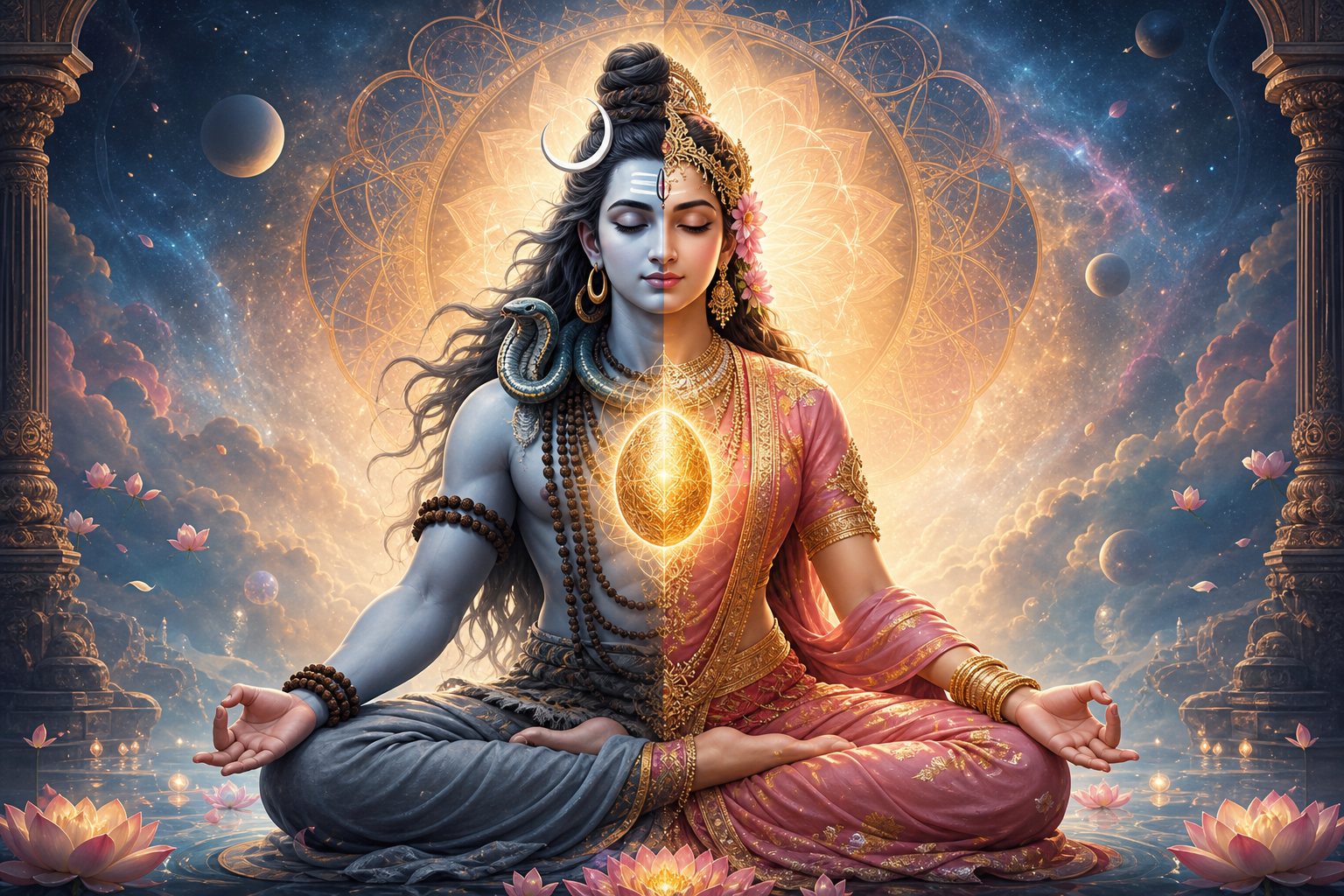
Ardhanarinaravapuh is a profound expression in Hindu religion and Hindu philosophy, describing a sacred form in which masculine and feminine principles appear in one indivisible body. The word is best understood through its Sanskrit components: ardha, meaning half; nari, meaning woman; nara, meaning man; and vapuh, meaning body or form. Together, the expression points to a body that is both female and male, not as a contradiction, but as a theological statement about wholeness.
In Hindu scriptures and cosmological thought, such imagery does not merely describe physical duality. It expresses a deeper metaphysical insight: existence is sustained through complementary forces. Creation, preservation, fertility, consciousness, movement, stillness, order, and transformation are understood through paired principles that are distinct yet inseparable. Ardhanarinaravapuh therefore becomes a language of unity, balance, and sacred interdependence.
The concept is closely related to the better-known image of Ardhanarishvara, the form of Lord Shiva united with Goddess Parvati or Shakti. In that iconographic tradition, Shiva represents pure consciousness, stillness, transcendence, and the witnessing principle, while Shakti represents energy, manifestation, dynamism, creativity, and embodied power. The two are not presented as rivals. They are shown as a single reality perceived through two complementary modes.
The reference to Hiranyagarbha, the golden womb or cosmic egg, places Ardhanarinaravapuh within the wider framework of Hindu cosmology. Hiranyagarbha is one of the great Vedic and post-Vedic symbols for the origin of the universe. It suggests that creation emerges from a luminous, undifferentiated source in which all possibilities are held together before becoming manifest. In this context, the union of male and female principles is not a later social idea imposed upon theology; it belongs to the very architecture of cosmic origin.
Hiranyagarbha is important because it prevents a narrow reading of gender symbolism. The cosmic womb is not simply a biological metaphor. It is a philosophical image for potentiality, gestation, unity, and emergence. From the unmanifest comes the manifest; from unity comes plurality; from stillness comes movement. Ardhanarinaravapuh belongs to this same vocabulary of sacred emergence, where the universe itself is understood as arising through complementary principles held in balance.
Hindu thought often uses symbolic forms to communicate truths that ordinary prose cannot fully contain. A deity with multiple arms, a cosmic serpent, a lotus emerging from the navel of Vishnu, or a half-male and half-female divine body should not be reduced to fantasy. These forms operate as philosophical diagrams. They allow devotees, students, and scholars to contemplate reality through image, ritual, poetry, and metaphysics at the same time.
Ardhanarinaravapuh is especially significant because it challenges rigid binaries. It does not erase difference, but it refuses to turn difference into division. The masculine and feminine are held together in one sacred form, suggesting that fullness requires relationship, reciprocity, and integration. This insight is central to many Hindu traditions, where truth is rarely confined to a single linear category.
At the philosophical level, the form can be read through the categories of Purusha and Prakriti. In several strands of Indian philosophy, Purusha denotes consciousness, witnesshood, and the principle of awareness, while Prakriti denotes nature, materiality, activity, and the field of manifestation. Though different schools interpret these terms in different ways, their pairing helps explain why a combined male-female sacred form carries such enduring theological force.
In Shaiva traditions, the relationship between Shiva and Shakti provides one of the most powerful frameworks for understanding this unity. Shiva without Shakti is often described as inert, while Shakti without Shiva lacks the grounding of pure consciousness. This does not imply hierarchy. It conveys interdependence. The divine is not complete when imagined only as stillness or only as action; it is complete when consciousness and power are seen as one reality.
This is why Ardhanarinaravapuh should not be interpreted as a mere curiosity in Hindu religion. It is a compact theological teaching. It speaks about creation, gender, sacred embodiment, social harmony, and spiritual realization. Its visual and linguistic power lies in its ability to hold many meanings without collapsing them into one simplistic explanation.
There is also a devotional dimension to this idea. For many practitioners, the image of a united male-female divine form evokes a sense of emotional balance. It gives sacred language to experiences of incompleteness, longing, relationship, family, partnership, and inner integration. In ordinary life, people often experience tension between firmness and tenderness, discipline and compassion, contemplation and action. Ardhanarinaravapuh suggests that spiritual maturity does not require rejecting one side of life, but harmonizing both.
The image also has social implications, though these should be handled carefully and historically. Hindu traditions have not always expressed gender equality in a uniform social manner across regions and centuries. Yet the theological presence of the Sacred Feminine is undeniable. Shakti, Devi, Durga, Lakshmi, Saraswati, Parvati, Kali, and many regional forms of the Goddess occupy central positions in Hindu worship. Ardhanarinaravapuh strengthens this broader recognition that feminine divinity is not peripheral to Hindu spirituality.
In temple art and sacred sculpture, the half-male and half-female form communicates balance through posture, ornament, gesture, and bodily proportion. The masculine side may be marked by matted hair, ascetic symbols, or attributes associated with Shiva. The feminine side may carry ornaments, graceful curvature, or symbols associated with Parvati and Shakti. The purpose is not theatrical contrast. It is theological precision rendered through visual art.
Such iconography also reflects the Hindu ability to think in layered symbols. The same image can be devotional for a worshipper, artistic for a sculptor, metaphysical for a philosopher, and cultural for a historian. This layered nature is one of the reasons Hindu symbols have remained durable across centuries. They are not exhausted by a single reading.
Ardhanarinaravapuh also resonates with the wider dharmic emphasis on unity without sameness. Hinduism, Buddhism, Jainism, and Sikhism differ in theology, practice, scripture, and institutional history, yet all have contributed to a civilizational environment where inner discipline, ethical conduct, self-transformation, and respect for truth are central. A symbol like Ardhanarinaravapuh can be appreciated within Hindu religion while also encouraging a broader dharmic sensitivity toward complementarity and balance.
In the context of Hinduism, the symbol is not an argument for dissolving all distinctions. Dharma often depends on recognizing distinctions clearly: between the eternal and the temporary, wisdom and ignorance, restraint and excess, compassion and cruelty. Ardhanarinaravapuh teaches something subtler. It shows that distinction need not become fragmentation. Difference can remain meaningful while still belonging to a higher unity.
This principle has practical relevance. Families, communities, and institutions often suffer when one quality dominates all others. Excessive rigidity can become harshness. Excessive softness can become disorder. Action without reflection can become restlessness. Reflection without action can become paralysis. The sacred union of masculine and feminine principles offers a disciplined way to think about balance in personal and collective life.
The term also invites reflection on the nature of the body in Hindu thought. The divine body is not merely physical. It is symbolic, cosmic, and pedagogical. A form such as Ardhanarinaravapuh uses the body as a sacred text. Each feature teaches. Each side reveals. The body becomes a map of metaphysics, showing that the universe itself is embodied through paired energies.
From a scriptural perspective, Hindu literature often speaks of creation through division and reunion. The one becomes many, and the many seek the one. This movement appears in Vedic hymns, Upanishadic speculation, Puranic cosmology, Tantric theology, and temple ritual. Ardhanarinaravapuh belongs to this larger pattern. It is a reminder that multiplicity does not negate unity; rather, multiplicity reveals the richness of unity.
The symbolism of Hiranyagarbha deepens this reading. The golden womb suggests that before the world appears as separate beings, names, forms, genders, elements, and experiences, it exists as an undivided potential. Ardhanarinaravapuh expresses that primordial wholeness in a visible form. The masculine and feminine are not accidental additions to creation; they are woven into the very logic of manifestation.
Modern readers may be tempted to interpret Ardhanarinaravapuh only through contemporary debates about gender identity. Such conversations may find resonance in the symbol, but the traditional meaning is broader and older. The form speaks first about cosmic unity, sacred polarity, divine completeness, and the inseparability of consciousness and energy. Its relevance to modern questions is strongest when its original theological depth is respected.
At the same time, the symbol can encourage humility in modern discussions. It shows that Hindu religion has long possessed a sophisticated vocabulary for complexity. Human identity, divine power, and cosmic structure are not always captured by rigid categories. Ardhanarinaravapuh therefore invites careful thought rather than quick slogans. It asks the mind to become spacious enough to hold complementarity.
The emotional appeal of this concept lies in its reassurance that wholeness is possible. Many people experience life as divided: reason against emotion, duty against desire, solitude against relationship, spiritual aspiration against worldly responsibility. The sacred form of Ardhanarinaravapuh suggests that the aim is not self-rejection, but integration under dharma. A balanced life is not a weak compromise; it is a disciplined harmony.
In this sense, Ardhanarinaravapuh is not only a theological idea but also a contemplative tool. Meditating on such a form can help cultivate reverence for both stillness and movement, both knowledge and compassion, both strength and grace. The image encourages the devotee to see the divine not as distant abstraction, but as the living unity behind apparent opposites.
The concept also enriches the understanding of Hindu deities. Hinduism does not treat divinity as confined to a single form, name, or gender. The divine may be worshipped as mother, father, child, teacher, friend, beloved, light, sound, principle, or formless absolute. Ardhanarinaravapuh stands within this expansive theological imagination, where different forms reveal different aspects of the same ultimate reality.
This plurality is one of Hinduism’s greatest intellectual strengths. It allows philosophy and devotion to coexist. It allows temple worship and abstract metaphysics to speak to each other. It allows householders, monks, poets, artists, ritual specialists, and philosophers to approach truth through different temperaments. Ardhanarinaravapuh belongs to this tradition of sacred inclusiveness rooted in disciplined thought.
For students of Hindu philosophy, the term offers a valuable entry point into larger questions: How does the one become many? How does consciousness relate to matter? How does divine transcendence relate to embodied life? How should society understand the dignity of both masculine and feminine energies? These questions make the concept relevant far beyond a brief dictionary definition.
For devotees, the meaning is more immediate. Ardhanarinaravapuh can be approached as a form of reverence, reminding the heart that the divine is complete and that human life becomes healthier when it reflects that completeness. Devotion to such a form can nurture respect for women, honor for men, reverence for the Sacred Feminine, and recognition that power and consciousness must remain aligned.
In cultural terms, the concept has influenced sculpture, poetry, ritual imagination, and philosophical reflection. The endurance of this form in Hindu art shows that Indian civilization developed subtle ways of representing unity without flattening diversity. The image is beautiful because it is intellectually serious; it is intellectually serious because it is spiritually alive.
Ardhanarinaravapuh therefore deserves to be read as a major symbol of Hindu wisdom. It is connected to Hiranyagarbha and cosmic origin, to Shiva and Shakti, to Purusha and Prakriti, to temple iconography, and to the lived search for balance. It teaches that creation is not born from isolation, but from relationship. It teaches that difference is not a defect, but a mode through which unity becomes visible.
The enduring lesson is simple yet profound: the masculine and feminine principles are not enemies, and neither is complete when severed from the other. Ardhanarinaravapuh presents wholeness as sacred truth. In a fragmented age, this ancient Hindu symbol continues to offer a disciplined, compassionate, and deeply relevant vision of unity.
Inspired by this post on Hindu Blog.
