
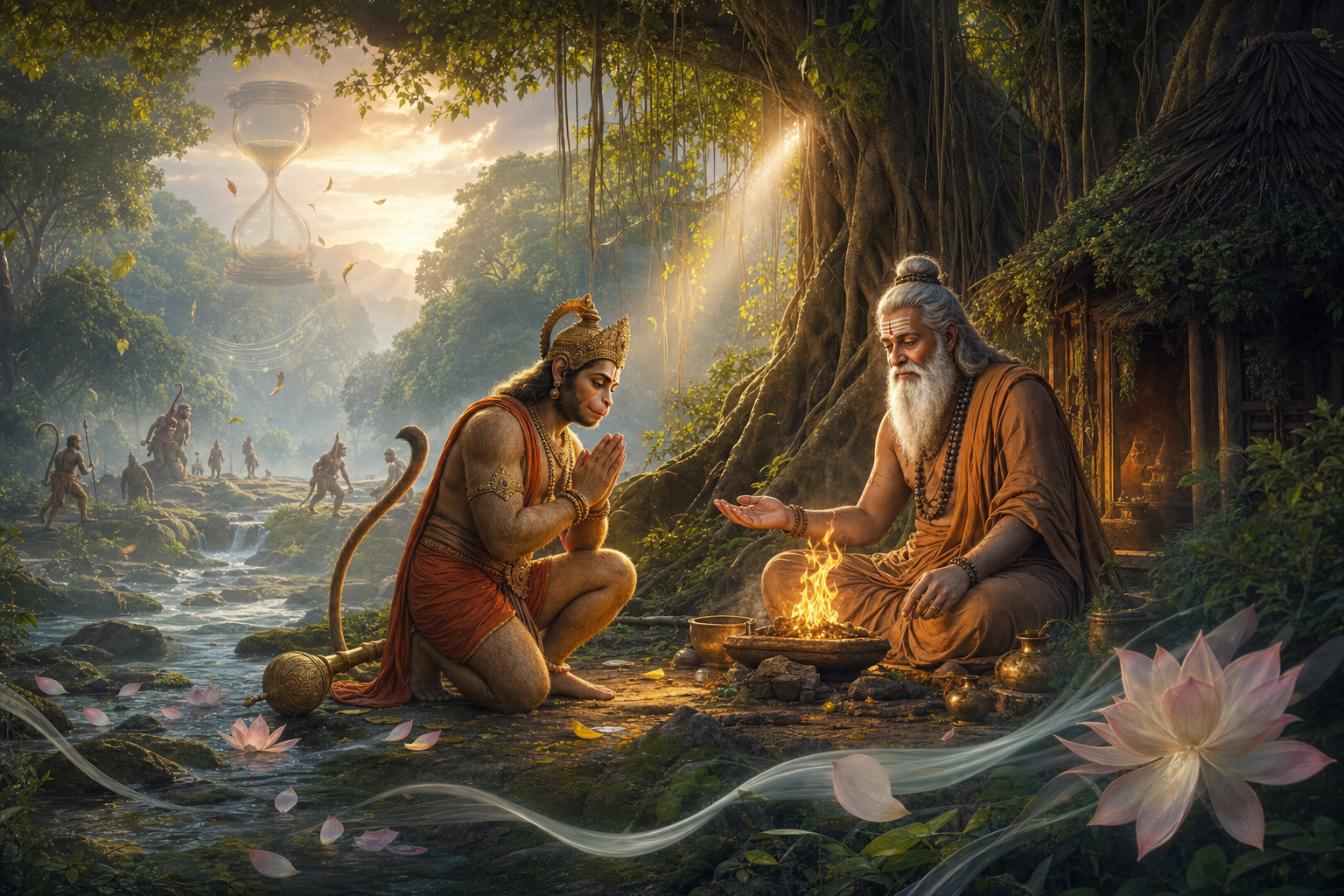
The meeting of Hanuman and Sage Kandu, remembered in later Ramayana traditions during the search for Mata Sita, presents one of the most searching reflections on grief, anger, time, and the fragile nature of worldly attachment. The episode is not as widely discussed as Hanuman’s leap across the ocean or his discovery of Sita in Lanka, yet its spiritual depth is unmistakable. It places before the reader a grieving sage, a mission-driven servant of Sri Rama, and a profound teaching on how sorrow can either destroy clarity or become the beginning of wisdom.
In the larger narrative setting, Hanuman is moving through the southern direction with the vanara search party. Their task is urgent: Mata Sita has been abducted by Ravana, Sri Rama is waiting in anguish, and every moment appears to carry the weight of dharma itself. The forest, in such episodes, is never merely a physical landscape. It becomes a field of testing, where fatigue, fear, doubt, hunger, and despair reveal the inner condition of those who walk through it.
Sage Kandu appears in this setting as a figure marked by tapas, austerity, and deep spiritual power, yet he is also shown as vulnerable to grief. This detail is important because Hindu scriptures rarely present sages as flat symbols of perfection. They may possess knowledge, discipline, and spiritual merit, but they still inhabit the dramatic tension between realization and human emotion. Kandu’s sorrow therefore does not diminish him; it makes the teaching more realistic and more compassionate.
The story is traditionally associated with the death of the sage’s son, an event that leaves Kandu overwhelmed by grief and anger. The loss of a child is among the most devastating experiences described in sacred literature. It breaks ordinary categories of justice, expectation, and continuity. In that state, even a wise person can experience the world as hostile, meaningless, and unbearable. The episode recognizes this psychological truth with unusual sensitivity.
When Hanuman encounters Sage Kandu, the sage’s grief has become more than private sorrow. It has turned into a force that disturbs his perception of reality. This movement from grief to anger is one of the central insights of the narrative. Sorrow by itself can soften the heart, but when it hardens into rage, it begins to demand an enemy. It seeks a target, a cause, a person, a world, or even destiny itself to blame.
The Ramayana repeatedly studies this danger. Ravana’s desire becomes arrogance; Kaikeyi’s insecurity becomes destructive ambition; Sugriva’s fear delays duty; Vali’s pride clouds justice. In Sage Kandu’s case, grief threatens to become anger against the structure of existence itself. The story therefore does not condemn grief, but it examines what grief can become when it loses the guidance of dharma, knowledge, and self-restraint.
Hanuman’s presence in this episode is deeply significant. He is not merely a warrior or messenger. He is a disciplined servant of dharma whose strength is governed by humility, devotion, and discernment. Hanuman is capable of burning Lanka, uprooting mountains, and confronting mighty beings, yet his highest greatness lies in knowing how to speak, when to act, and when to bow before wisdom. His meeting with Kandu shows this quieter dimension of Hanuman’s character.
In many Ramayana episodes, Hanuman’s intelligence is as important as his physical strength. He measures the mood of Sita before speaking in Ashoka Vatika. He studies Lanka before taking action. He offers counsel to Ravana without arrogance. He consoles, observes, reasons, and acts with precision. In the encounter with Sage Kandu, this same intelligence becomes moral and spiritual intelligence: the ability to stand before another person’s pain without becoming impatient, dismissive, or reckless.
The central philosophical theme of the episode is the transience of worldly experience. Time devours all forms, relationships, bodies, victories, possessions, and griefs. This is not presented as a cold doctrine meant to belittle human love. Rather, it is a corrective to the illusion that anything embodied can be permanently possessed. Hindu philosophy often calls this misperception maya, not in the simplistic sense that the world does not exist, but in the deeper sense that the world is not what attachment imagines it to be.
Maya is not merely external illusion. It is also the mind’s habit of treating the temporary as absolute, the dependent as independent, and the changing as permanent. A person does not suffer only because things change; one suffers because the heart demands that changing things remain fixed. The grief of Sage Kandu dramatizes this conflict between love and impermanence. The love is real, but the expectation of permanence becomes the source of torment.
This teaching closely echoes the Bhagavad Gita’s reflections on the embodied self. The body is born, grows, declines, and dies, while the atman is not destroyed by the destruction of the body. Such teachings do not ask human beings to become emotionless. They ask them to distinguish between the eternal and the temporary, between the soul and the body, between dharma and emotional compulsion. In that distinction lies the beginning of freedom.
The Ramayana’s treatment of grief is therefore not escapist. Sri Rama himself grieves for Sita. Dasharatha dies in sorrow after separation from Rama. Bharata laments the consequences of Kaikeyi’s actions. Sita experiences loneliness, insult, and danger in Lanka. The epic does not deny pain; it gives pain a moral and spiritual context. Grief is real, but it must not be allowed to overthrow truth, duty, and inner balance.
Sage Kandu’s grief also raises a subtle question: if even a sage can suffer, what does spiritual discipline actually accomplish? The answer suggested by the tradition is that tapas and knowledge do not make one immune to experience in a mechanical way. They create the capacity to return to clarity. A disturbed mind may arise even in the disciplined, but discipline gives the person a path back from disturbance to insight.
Hanuman becomes the catalyst for that return. His role is not to erase Kandu’s pain, because no sincere spiritual tradition treats bereavement so casually. Instead, he helps redirect the sage’s attention from the immediate wound to the larger truth. This is one of the most compassionate forms of guidance. It does not say that loss is trivial. It says that loss, however terrible, is not the whole of reality.
The episode also teaches that anger often disguises helplessness. When human beings confront death, they meet the limit of personal control. No power, scholarship, wealth, family status, or intellectual brilliance can fully command time. Anger rises because the ego cannot accept this limit. Sage Kandu’s crisis therefore becomes a mirror for anyone who has asked why the world does not obey moral expectation or personal longing.
From the standpoint of dharma, the answer is not fatalism. Hindu thought does not teach passive indifference to suffering. It teaches right action without delusion. One must protect, serve, mourn, remember, and perform duties, but one must also recognize that the world is governed by karma, time, and divine order in ways that exceed individual preference. To act without this recognition is to become bitter; to recognize it without compassion is to become cold. Dharma holds both truths together.
The southern search for Sita gives this teaching practical urgency. Hanuman and the vanaras cannot remain trapped in despair, though their mission seems impossible. They cannot allow the vastness of the forest, the absence of clues, or the pain of Sri Rama to paralyze them. The meeting with Kandu thus reflects their own inner challenge. They too must learn how to continue righteous action under the pressure of uncertainty.
This is why Hanuman’s example is so powerful for spiritual life. He does not abandon action in the name of philosophy, nor does he abandon philosophy in the name of action. His devotion to Sri Rama expresses itself through disciplined effort. His wisdom does not make him inactive; it makes his action pure, focused, and free from selfish agitation. In him, bhakti, jnana, and karma are harmonized.
The story of Sage Kandu also offers an important lesson for contemporary readers. Modern life often treats grief as either a private psychological event or a problem to be managed quickly. Sacred narratives take a wider view. Grief is emotional, ethical, metaphysical, and communal. It raises questions about love, identity, mortality, memory, attachment, and the meaning of human life. The Ramayana gives language to these questions without reducing them to sentiment.
Many people experience a form of Kandu’s sorrow when relationships change, when a loved one dies, when a family breaks, when health fails, or when cherished plans collapse. The mind often says, in effect, that the world should not have been this way. That reaction is understandable. Yet the wisdom of the episode suggests that healing begins when the mind stops demanding permanence from impermanent forms and begins seeking refuge in the eternal.
In Sanatana Dharma, that refuge may be approached through remembrance of the atman, devotion to Bhagavan, performance of dharma, mantra, seva, satsanga, meditation, and scriptural reflection. These paths need not be seen as competing methods. They are complementary disciplines that support the same movement from fragmentation to wholeness. This inclusive spiritual framework also resonates with the wider dharmic emphasis found across Hinduism, Buddhism, Jainism, and Sikhism: self-mastery, compassion, truthfulness, and liberation from ego-bound suffering.
The unity of dharmic traditions becomes visible in the way they diagnose attachment. Hindu darshanas speak of avidya and maya; Buddhist traditions examine impermanence and craving; Jain teachings emphasize karma, restraint, and purification of the soul; Sikh wisdom reminds the seeker of hukam, naam, seva, and the need to overcome haumai, ego-centeredness. The vocabulary differs, but the ethical movement is similar: grief must be honored, yet the self must not be imprisoned by possessiveness and anger.
Seen in this light, Hanuman’s meeting with Sage Kandu is not only a Hindu story but a dharmic meditation on the human condition. It teaches that the heart may break, but it need not become cruel. The mind may be shaken, but it need not become deluded. The world may change, but the search for truth, compassion, and liberation remains meaningful. This is why such narratives retain their force across generations.
The technical structure of the teaching may be understood through three linked concepts: anitya, the impermanence of worldly forms; moha, the delusion born of attachment; and viveka, the discernment that separates the eternal from the temporary. When anitya is ignored, moha becomes stronger. When moha dominates, grief turns into anger. When viveka is awakened, grief can mature into wisdom rather than violence or despair.
Hanuman embodies viveka in action. He knows that the mission to find Sita is urgent, but he also knows that a suffering sage cannot be treated as an obstacle. His strength does not make him insensitive. His devotion does not make him narrow. His discipline allows him to recognize the sacredness of the moment before him. This quality is central to Hanuman’s enduring appeal in Hindu spirituality: he is mighty because he is mastered from within.
Sage Kandu, meanwhile, embodies the sincere seeker who must pass through the fire of loss. His grief is not romanticized. It is shown as dangerous when it becomes anger, yet meaningful when it opens into inquiry. The transformation of Kandu’s consciousness is the real movement of the episode. The outer meeting becomes an inner turning, from agitation toward acceptance, from accusation toward insight, and from attachment toward truth.
The theme of time is especially important. Kala, or time, is one of the most powerful realities in Indian thought. Time ripens karma, dissolves bodies, ends kingdoms, and humbles pride. Even great heroes must act within time. The Ramayana’s grandeur lies partly in its refusal to let worldly power escape this law. Ravana’s strength, Lanka’s wealth, and even the sorrow of the noble must all pass through the current of time.
Yet time is not portrayed only as destruction. It is also the field in which dharma is practiced. Without time, there would be no patience, repentance, service, pilgrimage, learning, or transformation. Sage Kandu’s grief occurs in time, but so does his recovery of insight. Hanuman’s mission unfolds in time, but so does the revelation of his greatness. Time wounds, but time also reveals what is enduring beneath the wound.
The illusion of the world, therefore, does not mean that love, duty, or relationship are worthless. The Ramayana would never support such a conclusion. Sri Rama’s love for Sita, Lakshmana’s service to Rama, Bharata’s loyalty, and Hanuman’s devotion are all treated as sacred. The illusion lies not in loving, but in mistaking the form of love for its eternal essence. True love must finally lead beyond possession toward reverence, service, and liberation.
This distinction is vital. Detachment in dharmic thought is not emotional poverty. It is purified relationship. A detached person does not love less; such a person loves without making the beloved an object of egoic control. Hanuman’s devotion to Sri Rama is the highest example. He is attached in the language of love, but detached in the language of ego. He wants nothing for himself, and therefore his love becomes strength rather than bondage.
The story also offers a corrective to superficial readings of anger. Anger is not always born from hatred; sometimes it emerges from wounded love. However, once anger takes command, it distorts the original love that gave rise to it. Kandu’s grief over his son may begin in love, but it risks becoming destructive when filtered through rage. The dharmic response is not suppression but purification: the emotion must be understood, disciplined, and returned to truth.
For this reason, the episode can be read as a study in emotional dharma. Emotions are not rejected; they are educated. The mind is not treated as an enemy; it is trained. The heart is not mocked for grieving; it is guided toward a wider horizon. Such a vision remains deeply relevant in an age that often separates spirituality from emotional life. The Ramayana insists that spiritual wisdom must enter precisely where the heart suffers most.
There is also a social lesson in the encounter. Communities often meet grief awkwardly, either by offering shallow consolation or by avoiding the grieving person altogether. Hanuman’s conduct suggests another way. Presence, humility, and truth must come together. Compassion without truth can become sentimentality; truth without compassion can become harshness. Hanuman’s wisdom lies in holding both.
The episode further clarifies why Ramayana narratives remain central to Hindu teachings. They do not function only as legends of the past. They are frameworks for ethical reflection, psychological insight, and spiritual practice. Their characters become mirrors through which readers examine the condition of their own minds. The meeting of Hanuman and Kandu asks a direct question: when loss comes, will consciousness contract into anger or expand into wisdom?
From a literary perspective, the episode also deepens the atmosphere of the southern search. The vanaras are not merely moving across geography; they are passing through layers of human and cosmic experience. Their journey includes exhaustion, hunger, sacred places, strange beings, hidden knowledge, and unexpected teachers. In such a structure, the search for Sita becomes simultaneously a search for clarity, courage, and grace.
Sita herself represents more than a lost queen. She is dharma under assault, purity under pressure, and sacred order hidden in the realm of arrogance. The search for her is therefore a search for restored harmony. In this context, Sage Kandu’s grief is not a diversion from the main narrative. It echoes the larger disorder created by separation, loss, and adharma. Hanuman’s response to Kandu anticipates the healing role he will later play in Sita’s despair.
When Hanuman finally meets Sita in Lanka, he does not merely deliver information. He restores hope. The encounter with Kandu prepares the reader to understand that Hanuman’s greatness includes the power to steady the suffering. He becomes a bridge between despair and courage, between separation and reunion, between human pain and divine assurance. This is why Hanuman remains one of the most beloved figures in Hindu spirituality.
The philosophical conclusion of the story is not that grief disappears when truth is known. Rather, grief is placed in its proper metaphysical frame. The body is transient, relationships are sacred but changing, karma is subtle, time is irresistible, and the atman is not annihilated by death. When these truths are contemplated deeply, grief loses its power to become blind rage. It becomes remembrance, humility, and prayer.
This is the practical value of the narrative. It teaches that one may mourn and still remain aligned with dharma. One may feel pain and still speak truthfully. One may suffer loss and still serve. One may be shaken and still return to remembrance of the eternal. Such balance is not easy, but the Ramayana never presents dharma as a path of convenience. It presents dharma as the path that keeps consciousness noble under pressure.
Hanuman and Sage Kandu together reveal two sides of the spiritual journey. Kandu shows the vulnerability of embodied life, where even the disciplined can be pierced by sorrow. Hanuman shows the possibility of strength governed by devotion and wisdom. Their meeting becomes a sacred dialogue between pain and clarity. It is a reminder that every human crisis can become either a fall into delusion or a doorway into deeper understanding.
In the end, the story’s enduring power lies in its refusal to simplify life. The world is beautiful, but impermanent. Love is sacred, but cannot be possessed. Time is relentless, but not meaningless. Grief is natural, but anger must be purified. Dharma is demanding, but it is also compassionate. Hanuman’s encounter with Sage Kandu therefore remains a profound Ramayana teaching for anyone seeking spiritual wisdom in the midst of loss.
Inspired by this post on Hindu Blog.
