
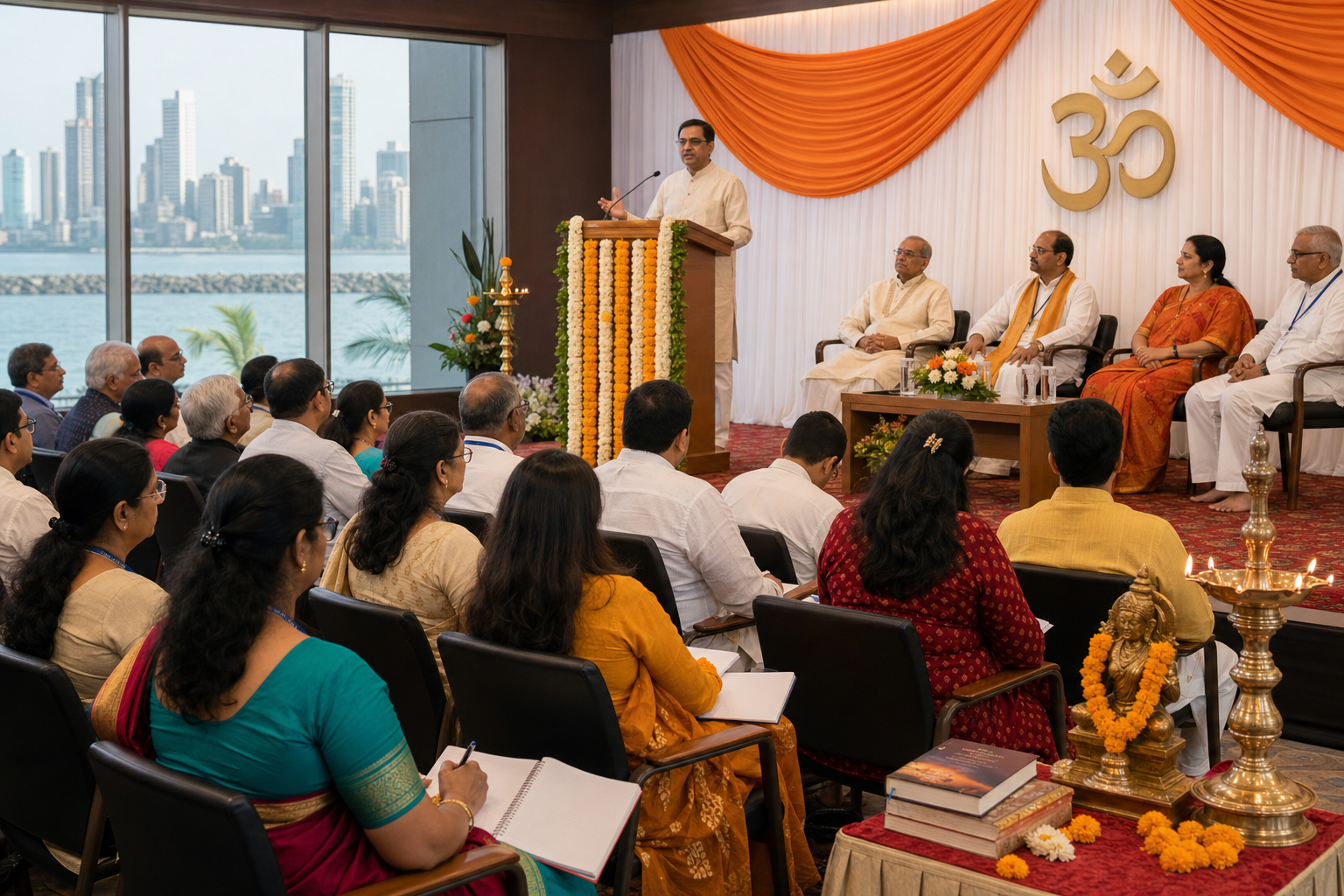
The Regional Hindu Rashtra Adhiveshan in Mumbai brought together more than 100 devout Hindus and community-minded participants who resolved to work collectively for Hindu Rashtra, Dharma-rakshan, and the wider interests of Hindu society. The gathering, as described in the available source material, was not merely a ceremonial meeting but a forum for disciplined reflection on organisation, social preparedness, and the responsibilities that arise when a community seeks to protect its spiritual and cultural inheritance.
In the contemporary Indian context, such an Adhiveshan carries significance because it reflects a growing concern among sections of Hindu society about cultural continuity, religious rights, institutional coordination, and the need for organised civic participation. The phrase Hindu Rashtra is understood by its supporters as a civilisational aspiration rooted in Sanatan Dharma, social duty, ethical governance, and respect for sacred traditions. Any serious discussion of it therefore requires academic clarity, restraint, and attention to the way participants themselves connect it with Dharma, service, and community responsibility.
The Mumbai Adhiveshan appears to have focused on three broad themes: organisation, Dharma-rakshan, and preparedness. Organisation refers to the ability of individuals, families, local groups, temples, and cultural institutions to work in coordination rather than isolation. Dharma-rakshan, or protection of Dharma, refers not only to ritual preservation but also to the safeguarding of religious freedom, cultural memory, ethical conduct, and the dignity of Hindu practices in public life. Preparedness suggests a practical awareness that communities must be able to respond calmly, legally, and collectively to social challenges.
The presence of leaders from various fields indicates that the gathering was not limited to religious instruction alone. Hindu society has historically drawn strength from the cooperation of scholars, spiritual practitioners, social workers, legal minds, educators, artists, administrators, and householders. When such voices meet in a common forum, the discussion naturally moves beyond abstract sentiment and toward practical questions: how should awareness be spread, how should local communities be strengthened, how should temples and cultural spaces be protected, and how should younger generations be educated in Hindu heritage?
An academic reading of the Adhiveshan suggests that its importance lies in its attempt to convert devotion into organised action. Devotion, when confined only to private feeling, can become socially fragile. When devotion is connected with study, discipline, service, and ethical public conduct, it becomes a source of cultural resilience. This is especially relevant in a society where rapid urbanisation, digital media, changing family structures, and political contestation often reshape how communities understand their traditions.
The emotional dimension of such a gathering should also be recognised. For many Hindus, Dharma is not an abstract ideology but a lived inheritance received through festivals, temple visits, family samskaras, stories from the Ramayana and Mahabharata, reverence for gurus, and daily practices of puja, seva, and self-discipline. A meeting dedicated to Hindu interests therefore evokes more than strategy; it evokes memory, belonging, and responsibility. The concern is not only about what is inherited from the past, but also about what will be transmitted to future generations.
At the same time, the objective of Dharma-rakshan must be understood in a manner consistent with the deeper principles of Dharmic civilisation. Hinduism has long accommodated multiple sampradayas, forms of worship, philosophical schools, regional customs, and spiritual disciplines. A constructive approach to Hindu unity therefore does not require uniformity. It requires mutual respect among Shaiva, Vaishnava, Shakta, Smarta, tribal, folk, and regional traditions, as well as a broader civilisational respect for Buddhism, Jainism, and Sikhism as Dharmic traditions with their own distinctive histories and spiritual insights.
This point is essential because unity among Dharmic traditions cannot be built on narrowness. Hindu Rashtra, when discussed as a civilisational idea, must be evaluated through the ethical grammar of Dharma: justice, restraint, compassion, truthfulness, protection of the vulnerable, reverence for knowledge, and respect for diverse spiritual paths. These values prevent cultural assertion from becoming exclusionary and instead guide it toward responsible social renewal.
The Adhiveshan’s emphasis on preparedness is also worth examining. Preparedness in a democratic society should mean lawful awareness, community education, documentation, social service, temple management, disaster response, legal literacy, and the ability to address misinformation with calm evidence. It should not be reduced to reactionary anger. A mature Dharmic society is measured by its ability to remain rooted without becoming reckless, confident without becoming contemptuous, and vigilant without losing compassion.
Organisation is equally important at the local level. Many Hindu communities possess enthusiasm but lack structured coordination. Temples may function independently, youth groups may lack guidance, and cultural initiatives may remain scattered. A regional forum can help convert scattered energy into disciplined networks. Such networks can support Sanskrit learning, Hindu education, festival coordination, heritage preservation, legal awareness, social welfare, and intergenerational transmission of cultural values.
The Mumbai setting adds another layer of meaning. Mumbai is one of India’s most diverse and dynamic urban centres, shaped by commerce, migration, cinema, labour, education, and political movements. In such a city, Hindu identity is expressed through grand public festivals, neighbourhood temples, family rituals, bhajan mandals, charitable institutions, and countless informal practices. A Regional Hindu Rashtra Adhiveshan in Mumbai therefore reflects the urban challenge of preserving rootedness in a fast-moving environment.
From a cultural perspective, the pledge to work together for Hindu interests should be understood as a call for collective responsibility. Hindu interests include the protection of temples, the preservation of sacred sites, the dignity of Hindu rituals, the education of children in Hindu philosophy and history, the defence of religious freedom, and the strengthening of social harmony. They also include the ethical obligation to serve society through annadanam, education, medical support, environmental care, and assistance to those in distress.
The relationship between Dharma and social service is especially important. Sanatan Dharma has never been limited to metaphysical speculation alone. It also concerns right conduct, duties, relationships, community obligations, and the pursuit of loka-sangraha, the welfare and cohesion of society. When participants in such a gathering speak of Dharma-rakshan, the most constructive interpretation is one that combines cultural protection with service, discipline, and moral responsibility.
A serious discussion must also acknowledge that the term Hindu Rashtra is politically and emotionally charged. For some, it represents civilisational self-respect and decolonisation. For others, it raises concerns about pluralism and constitutional equality. An academically responsible approach does not ignore these tensions. Instead, it asks how any vision of Hindu public life can remain aligned with Dharma, constitutional methods, peaceful civic action, and respect for India’s diversity.
The most enduring contribution of such an Adhiveshan would be the cultivation of disciplined civic character. A community that wishes to protect Dharma must first embody Dharma. This means truthfulness in speech, fairness in action, respect for women, reverence for elders, protection of children, care for the poor, ecological responsibility, and intellectual seriousness. Without these qualities, slogans remain shallow. With them, cultural awakening becomes meaningful.
The gathering of more than 100 participants may appear modest when compared with large public rallies, yet smaller assemblies often perform a different function. They create space for focused dialogue, leadership development, strategic clarity, and personal commitment. In many social movements, durable change begins not with spectacle but with disciplined circles of people who agree on duties, methods, and long-term responsibilities.
The pledge made at the Mumbai Regional Hindu Rashtra Adhiveshan therefore deserves to be read as a commitment to organised Dharma-oriented public life. Its value will depend on how participants translate their resolve into constructive work: building community cohesion, strengthening Hindu education, supporting temples, defending religious rights through lawful means, promoting unity among Dharmic traditions, and contributing to the moral health of society.
Ultimately, the Adhiveshan reflects a broader question facing Hindu society today: how can ancient spiritual inheritance be carried into modern public life with confidence, intelligence, and compassion? The answer lies neither in passive nostalgia nor in unrestrained reaction. It lies in organised service, cultural literacy, ethical conduct, and a generous but firm commitment to Dharma. In that sense, the Mumbai gathering stands as a reminder that Hindu unity, when guided by wisdom, can become a force for social stability, cultural preservation, and Dharmic renewal.
Inspired by this post on Hindu Jagruti Samiti.
