
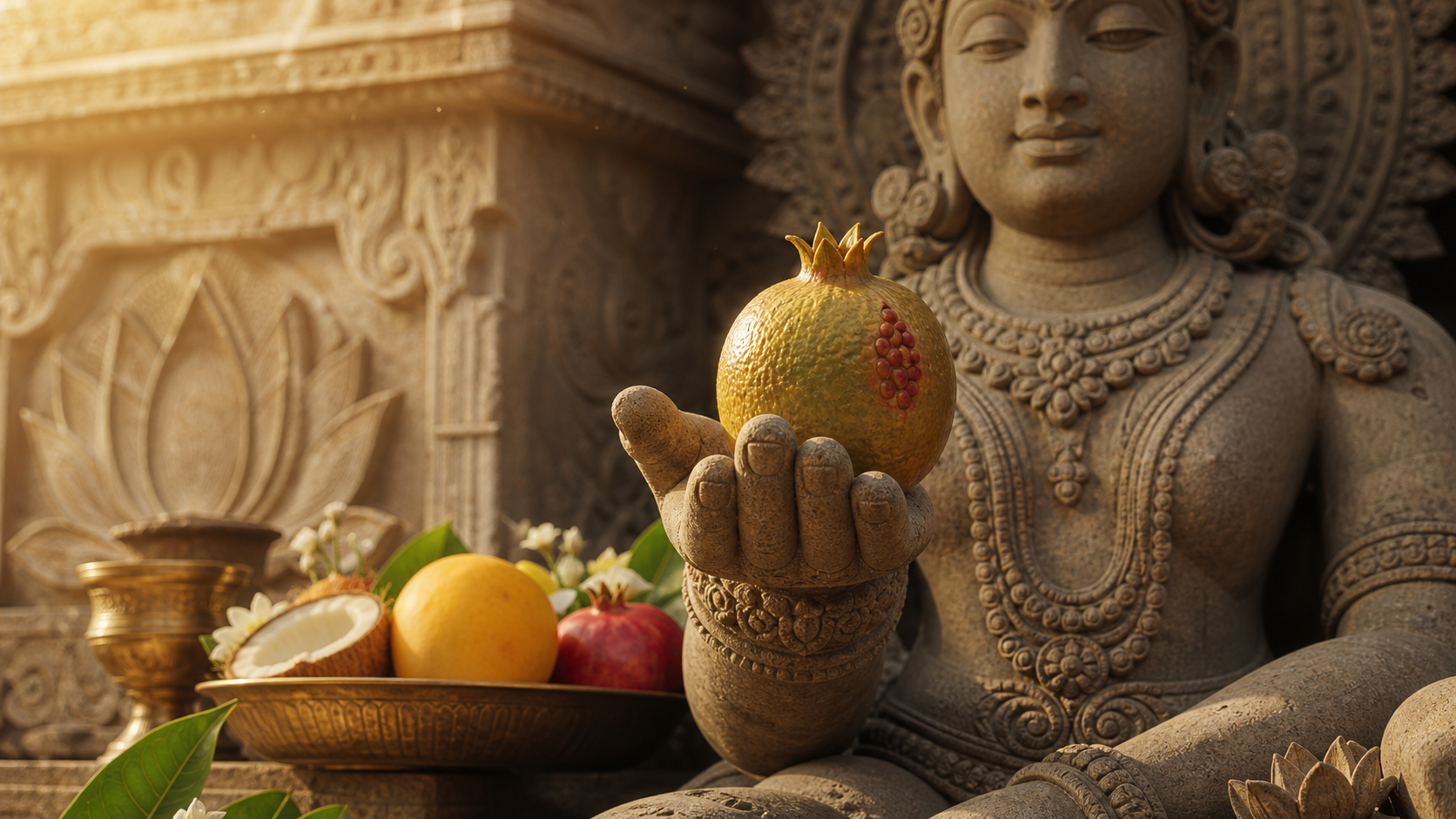
The sacred fruit in Hindu sculpture
In the visual language of Hindu sculptures, the smallest object can carry a large theological meaning. A lotus, a conch, a discus, a book, a rosary, a water pot, a serpent, or a fruit is never merely decorative. Each belongs to a disciplined iconographic vocabulary through which stone and bronze communicate dharma, divine qualities, cosmology, ritual practice, and the inner life of the devotee. Within this vocabulary, the phala, or fruit, occupies a quiet but powerful place.
The phala does not announce itself with the force of a weapon or the formal authority of a ritual implement. It often rests modestly in the palm of a deity, yaksha, goddess, guardian, or attendant figure. Yet its symbolism is expansive. It speaks of abundance, fertility, nourishment, prosperity, ripened karma, spiritual fruition, and the grace that transforms an offering into prasada. In Hindu art and temple sculpture, the fruit becomes a compact image of completion: the seed has matured, the tree has fulfilled its nature, and effort has reached its visible result.
The Sanskrit word phala means fruit, result, consequence, or fruition. This range of meaning is essential. In everyday life, fruit is food. In ritual life, fruit is an offering. In philosophical language, fruit becomes karma-phala, the result of action. In spiritual practice, it can suggest sadhana-phala, the fruit of disciplined effort. In temple sculpture, all these meanings can converge in a single carved object held by a divine figure.
Hindu iconography is built on the principle that form reveals function. A deity may be identified by posture, number of arms, vehicle, ornament, gesture, crown, weapon, attendant, and hand attribute. The phala belongs to this system of hand attributes. Its presence may identify a specific form of a deity, indicate a regional tradition, or deepen the theological mood of the image. A fruit held in the hand can signal prosperity in Lakshmi iconography, fertile abundance in goddess imagery, ripened wisdom in narratives associated with Ganesha and Murugan, and royal wealth in images linked with Kubera.
Phala as result and spiritual fruition
The deepest meaning of the phala is not agricultural alone. It is metaphysical. Hindu thought repeatedly uses the language of seed, growth, ripening, and fruit to explain the moral and spiritual structure of existence. An action is a seed. Its consequence is fruit. A vow is a seed. Its fulfilment is fruit. Devotion is a seed. Grace is fruit. Knowledge is cultivated, discipline is protected, and the final result appears only when the hidden process has matured.
This is why the fruit is such an effective symbol in sacred art. It makes an invisible law visible. Karma cannot be carved directly, but a ripened fruit can be carved. Inner discipline cannot be weighed in the hand, but a sculpted fruit can suggest the outcome of discipline. The phala therefore becomes a visual bridge between the seen and the unseen, between the outer icon and the inner teaching.
In this sense, the phala in Hindu sculpture also resonates with Buddhist and Jain uses of the same term. In Buddhism, phala can signify the fruition of the path. In Jain traditions, sacred art often uses fruit-bearing imagery to express auspiciousness, non-violence, prosperity, and spiritual attainment. This shared vocabulary across dharmic traditions does not erase their distinct philosophies. Rather, it shows a civilizational habit of thinking through nature, growth, consequence, and disciplined transformation.
The fruit as offering and prasada
Fruit is one of the most familiar offerings in Hindu worship. It is clean, nourishing, fragrant, seasonal, and complete in itself. A devotee may offer a banana, mango, coconut, pomegranate, citron, or other fruit during puja. The offering is not a transaction in a crude sense. It is an act of surrender, gratitude, and participation in divine order. What is grown from the earth is returned to the divine source, then received back as prasada.
When a deity is sculpted holding a fruit, the ritual movement appears to reverse. The devotee usually offers fruit to the deity, but the icon shows the deity holding fruit toward the world. This reversal is theologically rich. It suggests that the source of nourishment is ultimately divine. The human being offers what is already received from cosmic abundance. The divine hand holding the phala therefore becomes a gesture of blessing, fulfilment, and reciprocal grace.
The fruit also differs from weapons in sacred imagery. Weapons such as the chakra, trishula, sword, bow, and mace often represent protection, cosmic order, the destruction of adharma, or the cutting of ignorance. The phala communicates through another register. It is not forceful. It is generative. It belongs to the language of nourishment, continuity, sweetness, and ripening. It reminds the viewer that divine power is not only martial or corrective; it is also sustaining, fertile, and compassionate.
Specific fruits and their iconographic meanings
Not every sculpted fruit is meant to be understood in a generic way. Traditional iconography often distinguishes particular fruits such as the citron, pomegranate, mango, coconut, wood apple, or banana. In practice, however, the identification can be difficult. Stone erodes, regional sculptural conventions differ, and small hand attributes are sometimes simplified. A round object may be a fruit, a jewel, a sweet, a seed vessel, or a ritual object depending on the deity and context.
The matulinga, usually understood as citron, is among the most important fruits in Hindu iconography. It is often associated with auspiciousness, fullness, medicinal value, fragrance, and prosperity. In some regional traditions, Mahalakshmi is shown holding a matulinga, connecting the fruit with abundance and sovereign fortune. Its many-seeded interior and strong outer form make it a natural emblem of fertility, protection, and stored potential.
The pomegranate is another important symbolic fruit. Its many seeds make it a powerful emblem of fertility, multiplicity, and prosperity. In several forms of Ganesha, including some tantric and regional forms, a pomegranate may appear among the attributes. Its meaning suits Ganesha well: the remover of obstacles is also the lord of beginnings, thresholds, growth, and successful completion. A seed-filled fruit in his hand suggests that auspicious beginnings contain many possible futures.
The mango carries a different emotional tone. It is associated with sweetness, ripeness, spring, desire, fertility, and fulfilled longing. In the well-known narrative of the jnana palam, the fruit of wisdom is linked with Ganesha, Murugan, Shiva, Parvati, and the sacred geography of Palani. The story teaches that wisdom is not merely speed, conquest, or external travel. It is the recognition of truth at the center of one’s own world. The fruit becomes a reward for insight rather than physical victory.
The coconut has an especially strong ritual role. It is offered in temples, broken in acts of dedication, and understood as a sign of purity, self-surrender, and auspicious beginning. Although not every coconut in ritual corresponds to a sculpted hand attribute, the broader cultural meaning of fruit offerings helps explain why fruit imagery was so meaningful to sculptors and patrons. Fruit belongs to the threshold between nature, ritual, and theology.
Phala in Lakshmi and goddess iconography
In goddess imagery, the phala frequently communicates abundance in a direct and intuitive way. Lakshmi, the goddess of prosperity, auspiciousness, beauty, fertility, and royal fortune, is most famously associated with the lotus, elephants, gold, and overflowing vessels. Yet in some regional forms, the fruit also becomes part of her iconographic language. When Mahalakshmi holds a fruit such as the matulinga, prosperity is shown not as abstract wealth but as living abundance.
This is an important distinction. Wealth in dharmic thought is not merely accumulation. It is connected with nourishment, responsibility, generosity, household stability, temple patronage, and social continuity. The fruit in Lakshmi’s hand suggests prosperity that ripens, feeds, multiplies, and blesses. It is wealth made organic and ethical. It is not only treasure in a vault; it is grain in a field, fruit on a tree, food in a home, and prasada in a temple.
Many mother-goddess and yakshi figures in early Indian art are associated with vegetation, trees, flowering branches, and fruit. These figures reveal an ancient layer of sacred imagination in which fertility and divine presence are intertwined. A fruit-bearing tree, a female figure touching a branch, or a goddess holding a fruit expresses the same basic insight: life is sacred because it generates more life.
The same visual grammar appears across Hindu, Jain, and Buddhist artistic environments. Jain Ambika, for example, is often associated with mangoes, children, and a lion, emphasizing fertility, protection, and auspicious motherhood. Buddhist art also preserves guardian and prosperity figures whose attributes include fruit, jewels, or abundance-giving objects. These shared motifs demonstrate the cultural unity of dharmic art while allowing each tradition its own doctrinal interpretation.
Phala in Ganesha, Kubera, and prosperity imagery
Ganesha’s iconography is especially rich because his forms absorb domestic, philosophical, royal, tantric, and folk layers of meaning. He may hold a broken tusk, noose, goad, axe, rosary, sweet, lotus, sugarcane, rice sprig, fruit, or bowl of delicacies. The fruit in his hand is not isolated from these other attributes. It participates in a larger symbolic field: obstacles are removed, effort is guided, desire is disciplined, and the auspicious result is granted.
In Ganesha imagery, the distinction between fruit and sweet can sometimes be visually subtle. The modaka, a sweet associated with Ganesha, is not a fruit, but it also signifies the sweetness of spiritual reward. A pomegranate or mango, by contrast, emphasizes natural fertility and ripened abundance. Both belong to the broader idea of divine nourishment. The devotee sees in them the promise that discipline and devotion do not remain barren.
Kubera, the lord of wealth and guardian of the north, also belongs to the symbolic world of abundance. His imagery may include a money bag, jewel pot, mace, mongoose, or fruit such as the pomegranate. In this context, the phala is related to artha, the legitimate pursuit of material well-being within dharma. The fruit signals stored value, but unlike coins or jewels, it also carries the sense of organic increase. Wealth must circulate, nourish, and support life.
This connection between phala and artha helps explain why fruit appears so naturally in temple sculpture. Temples were not only ritual centers. They were also cultural, artistic, economic, educational, and social institutions. A fruit in the hand of a deity could speak simultaneously to farmers, merchants, householders, kings, ascetics, and pilgrims. Each could see a different layer of meaning: harvest, wealth, offspring, merit, wisdom, or liberation.
How sculptors made fruit readable
The technical challenge for sculptors was to make small hand attributes legible without disturbing the balance of the icon. In stone, a fruit had to be connected securely to the hand so that it would not break. In bronze, the object had to survive casting, polishing, ritual handling, and processional use. The result is often stylized rather than botanically exact. Sculptors emphasized the essential form: roundness, fullness, seed-bearing texture, a pointed end, a crown-like calyx, or a curved mango-like outline.
Context is therefore crucial for interpretation. A round object in Lakshmi’s hand may be read differently from a round object in Ganesha’s hand. A similar object in Kubera’s hand may suggest pomegranate, jewel, or money bag depending on form and tradition. A fruit held by a yakshi beneath a tree may emphasize fertility and vegetation. A fruit held by a deity in a strict Agamic image may identify a prescribed form. Iconography is never only the study of objects; it is the study of relationships among objects, bodies, gestures, and sacred narratives.
Regional styles also matter. South Indian bronzes often refine hand attributes into elegant, compact forms suited to ritual movement and visual clarity. Hoysala and Chalukya stone sculpture may render ornament and attributes with dense surface detail. Pala and Sena images from eastern India often integrate fruit, jewels, and ritual objects into highly ordered compositions. Odisha temple sculpture places divine and semi-divine figures within a living architectural skin of dancers, guardians, foliage, and auspicious motifs. Across these regions, the phala remains small but meaningful.
Phala, purushartha, and the ethics of abundance
The fruit also relates to the four purusharthas: dharma, artha, kama, and moksha. As artha, fruit suggests prosperity and resources. As kama, it suggests sweetness, beauty, fertility, and fulfilled desire. As dharma, it becomes an offering governed by ritual purity, gratitude, and right relationship. As moksha, it points toward the final fruit of knowledge and liberation. Few symbols move so gracefully through all four aims of life.
This is why the phala cannot be reduced to fertility alone. Fertility is one layer, but the symbol is broader. The same fruit can represent household continuity, agricultural abundance, royal prosperity, ritual offering, karmic consequence, spiritual wisdom, and divine grace. Hindu art often prefers symbols that carry several truths at once. The phala is one such symbol: simple enough for immediate recognition, deep enough for philosophical reflection.
It also offers an ethical lesson. A fruit is the result of time, season, soil, water, sunlight, care, and patience. No fruit appears instantly. The sculpted phala therefore encourages a mature understanding of spiritual life. Devotion ripens. Knowledge ripens. Character ripens. Communities ripen through shared practice and memory. The image quietly opposes the impatience that seeks results without cultivation.
A dharmic symbol of unity
The phala is also valuable because it supports unity among dharmic traditions. Hinduism, Buddhism, Jainism, and Sikhism each speak in distinctive ways about action, consequence, discipline, compassion, and spiritual attainment. The language of fruit and fruition appears across these traditions because it is rooted in lived experience. Seeds become plants. Effort produces results. Conduct has consequences. Inner cultivation bears visible and invisible fruit.
In Hindu sculpture, the fruit held by a deity can therefore be read not as a sectarian boundary marker but as a shared civilizational metaphor. It honors the agricultural, ritual, ethical, and contemplative imagination of India. It reminds viewers that sacred art is not only about difference among deities and traditions; it is also about the underlying patterns of life that dharmic traditions recognize together.
This perspective is especially important for modern readers and museum visitors. A person standing before a temple sculpture may first notice the face, crown, ornaments, or dramatic posture. The fruit may seem secondary. Yet careful looking changes the experience. The small object in the hand begins to open a larger world: harvest, worship, prasada, karma, prosperity, wisdom, and liberation. The icon becomes not a static artifact but a teaching in visual form.
Why the phala still matters
The sacred fruit in Hindu sculptures matters because it preserves a worldview in which material life and spiritual life are not enemies. Food can become offering. Prosperity can become service. Desire can be refined. Action bears consequence. Nature becomes scripture when read with attention. The phala condenses all of this into a form that even a child can recognize, while still rewarding serious iconographic study.
For scholars, the phala invites technical analysis of iconographic manuals, regional styles, deity attributes, and ritual practice. For devotees, it evokes prasada, blessing, and the sweetness of divine grace. For artists, it demonstrates how Indian sculptors created meaning through small details. For the broader dharmic community, it stands as a symbol of shared reverence for life, nourishment, effort, and spiritual fruition.
The phala may be small in the hand of a stone or bronze deity, but its meaning is vast. It is the fruit of action, the fruit of worship, the fruit of wisdom, the fruit of prosperity, and the fruit of liberation. To notice it is to enter the subtle grammar of Hindu iconography, where nothing is accidental and where even the quietest emblem can carry the fullness of Sanatan Dharma.
Selected references for further study include overviews of Hindu iconography, phala as a Sanskrit term, Ganesha and Mahaganapati iconography, Kubera iconography, and the jnana palam tradition: https://en.wikipedia.org/wiki/Hindu_iconography, https://en.wikipedia.org/wiki/Phala, https://en.wikipedia.org/wiki/Mahaganapati, https://en.wikipedia.org/wiki/Kubera, and https://en.wikipedia.org/wiki/Jnana_Palam.
Inspired by this post on Hindu Blog.
