
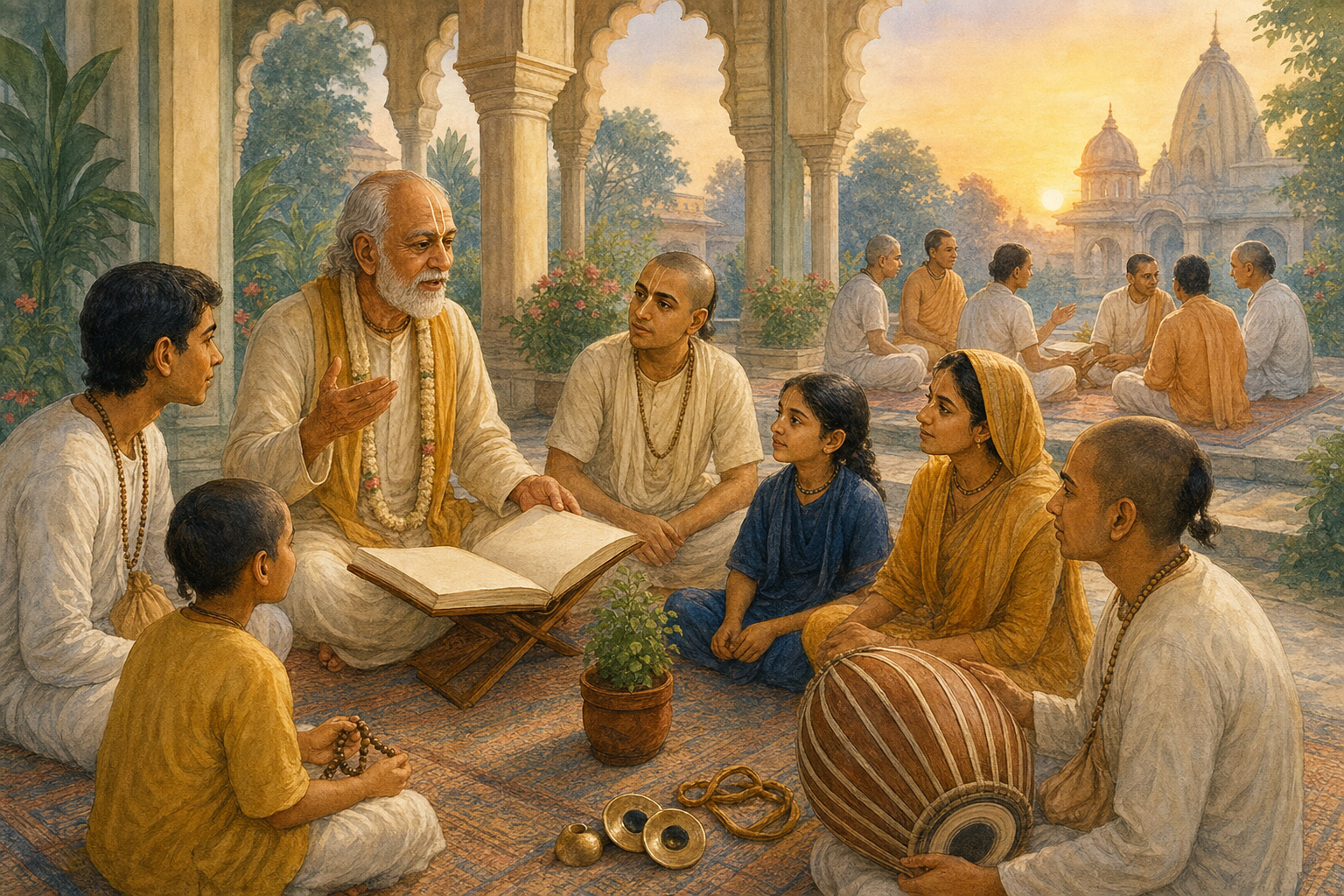
Gaudiya Vaishnava teaching becomes clearer when its parts are viewed together: theology defines the reality toward which devotion is directed, sacred hearing shapes consciousness, disciplined practice embodies the teaching, and lineage preserves its meaning across generations.
Four source accounts illuminate this system from different angles. Their subjects range from a public lecture and Krishna-katha to the remembered life of Srila Prabhupada and a focused explanation of Śrī Caitanya-caritāmṛta. Read together, they show why bhakti is neither doctrine alone nor emotion without structure.
One tradition viewed at four interconnected scales
The accounts do not document the same event or answer the same question. Instead, each describes a different scale at which a devotional tradition lives. DharmaRenaissance Blog reports that Prahladananda Swami spoke at ISKCON Warsaw on 28 June 2026, placing contemporary teaching within a European temple community. Its account emphasizes the lecture as oral pedagogy, communal practice, and an expression of a lineage that has crossed linguistic and national boundaries.
A second DharmaRenaissance Blog article discusses a Krishna-katha session identified with Vijaya Dasa, the same date, and ISV. It presents sacred narration as a mode of attentive hearing in which Krishna’s names, qualities, teachings, relationships, and pastimes become material for contemplation and ethical formation. Importantly, that source says its underlying public record was limited to a title, date, speaker, and image; its theological discussion therefore provides context rather than a transcript of the speaker’s words.
The account associated with Daivi Shakti Mataji shifts from discourse as an event to the remembered life of an acharya. Its subject, Srila Prabhupada Lilamrita, treats biography as instruction: the teacher’s perseverance, study, worship, translation, travel, and institution-building demonstrate what sustained discipleship can look like in practice. The Dandavats report on Deena Bhandu Prabhu’s 29 June 2026 class at ISKCON Vrindavan moves to a still more concentrated level, interpreting Śrī Caitanya-caritāmṛta, Ādi-līlā 5.43 as a metaphysical statement about spiritual energy, pure existence, and Vaikuṇṭha.
These are complementary rather than competing perspectives. The scriptural verse supplies an ontological foundation; Krishna-katha makes that worldview hearable and memorable; the acharya’s life displays it as conduct; and the temple lecture carries it into a particular community. Theology, pedagogy, biography, and institution are therefore not separate subjects so much as different stages in the movement from revealed teaching to lived culture.
Bhakti aims at a change of center, not simply better behavior
Across the four accounts, bhakti is described as an ordered reorientation of consciousness toward Sri Krishna. Hearing, chanting, remembering, worship, service, prayer, association, and regulated conduct matter because they redirect attention and desire. Ethical improvement belongs to this process, but it is not presented as the final measure of spiritual realization.
The report on Ādi-līlā 5.43 sharpens that distinction through the term śuddha-sattva. It explains that ordinary sattva-guṇa denotes the material quality associated with clarity and harmony, whereas śuddha-sattva refers to pure spiritual existence beyond the material qualities. The verse is presented as saying that the Vaikuṇṭha abodes consist of this spiritual reality, a manifestation of the Lord’s internal conscious potency, or cic-chakti.
This distinction prevents spiritual life from being reduced to respectable temperament. Calmness, knowledge, restraint, or kindness may support devotion, yet the source argues that they remain incomplete when organized around prestige, fear, possession, or subtle self-importance. The deeper goal is for ability, knowledge, affection, and responsibility to become transparent to service rather than instruments of ego.
Krishna-katha addresses the same transformation through sacred relationship. The relevant source describes Krishna as both supreme and personally approachable: teacher, protector, friend, beloved, and recipient of service. Narrative consequently does more than illustrate abstract propositions. It trains devotional perception by placing moral difficulty, dependence, affection, correction, and surrender within a Krishna-centered frame.
The synthesis is significant: Gaudiya Vaishnava theology does not ask practitioners merely to think that a spiritual realm exists. It joins that claim to a discipline intended to make consciousness receptive to spiritual relationship. Metaphysics states what is ultimately real; sādhana seeks to bring the practitioner’s attention, motives, and habits into alignment with it.
Parampara makes transmission both personal and accountable
Lineage, or parampara, is the connective tissue among these forms of teaching. The Warsaw account locates ISKCON within the Brahma-Madhva-Gaudiya disciplic succession and describes the contemporary teacher as accountable to scripture, practice, and inherited instruction. On this understanding, lineage is not merely a historical list of names. It is a disciplined method for receiving, interpreting, embodying, and transmitting knowledge.
The source on Srila Prabhupada gives this principle a modern institutional form. It reports that his mission was rooted in texts including the Bhagavad Gita, Srimad Bhagavatam, and Chaitanya Charitamrita, and that he understood his work as service to the instruction of Srila Bhaktisiddhanta Sarasvati Thakura. According to that account, his translations and commentaries became an intellectual foundation for ISKCON, while temples, kirtan, prasadam distribution, education, worship, and regulated practice gave the teaching a durable communal setting.
This combination of text, teacher, student, and practice clarifies the guru-shishya relationship described in the sources. Discipleship is not passive admiration of a charismatic figure. It requires careful hearing, study, service, regulation, willingness to receive correction, and eventual responsibility for what is passed onward. The remembered life of a teacher has authority insofar as it reveals fidelity under the pressures of actual work.
Oral and written transmission consequently perform different but mutually supporting tasks. A canonical or commentarial text stabilizes theological vocabulary. A qualified speaker explains its application. Krishna-katha gives doctrine narrative and emotional intelligibility. Biography tests ideals against conduct. Community practice then allows listeners to discover whether hearing is reshaping speech, priorities, relationships, and service.
Global continuity depends on fidelity and local embodiment
The locations and formats reported by the sources reveal how Gaudiya Vaishnava teaching now circulates: a temple lecture in Warsaw, a Krishna-katha session, an online video centered on Srila Prabhupada, and scriptural instruction from Vrindavan. Digital circulation expands access, but the accounts also imply that transmission requires more than making devotional material visible. A title, image, or recording can preserve an event while providing only limited evidence about what was actually taught.
That limitation is especially important for responsible religious reporting. Where the public record contains only metadata, broad theological context should not be presented as a speaker’s verbatim message. Where a specific verse anchors a class, as in the Dandavats account, the interpreter can examine how the explanation relates to the passage and its immediate textual setting. Clear separation between documented content and contextual interpretation protects both the teacher and the reader.
Local embodiment presents another test. The Warsaw article portrays a temple outside India as a place where worship, study, kirtan, prasadam, and community make dharma tangible. The Prabhupada account similarly depicts cultural translation as the preservation of central practices while using modern travel, publication, recording, festivals, and organization. On the evidence supplied, successful transmission is neither cultural erasure nor the unexamined reproduction of every historical form. It is continuity of theological center expressed through practices a community can actually sustain.
This also explains why institutional structure matters without becoming the essence of bhakti. Organization can preserve books, train teachers, maintain worship, and create regular opportunities for service. Yet the teaching on śuddha-sattva supplies a necessary critique: capability, visibility, and authority are spiritually meaningful only when purified of self-centered purpose. Lineage gives an institution memory; devotional accountability keeps that memory from becoming mere branding.
Key takeaways
- Gaudiya Vaishnava teaching forms an integrated system: theology defines spiritual reality, hearing communicates it, sādhana internalizes it, and community gives it continuity.
- Śuddha-sattva, as explained in the report on Ādi-līlā 5.43, means more than material clarity or moral decency; it identifies a mode of existence grounded in spiritual potency and devotion.
- Krishna-katha is presented as disciplined sacred hearing rather than religious entertainment, joining narrative, philosophy, emotion, and ethical reflection.
- Parampara preserves interpretation through accountable relationships among scripture, teacher, student, conduct, and service; it is not simply a claim of historical pedigree.
- Srila Prabhupada’s reported example connects fidelity to inherited teaching with translation, institution-building, public practice, and cross-cultural communication.
- Responsible coverage must distinguish documented statements from theological context, especially when an event is represented only by a title, date, speaker, or image.
Future teaching and reporting will best serve this lineage when they preserve that full chain of meaning: precise textual grounding, transparent attribution, disciplined practice, trustworthy teachers, and communities in which devotion becomes visible as service.

References
- DharmaRenaissance Blog — Prahladananda Swami in Warsaw: A Powerful Guide to Bhakti, Dharma, and Unity
- DharmaRenaissance Blog — Krishna Katha: Powerful Lessons in Bhakti, Dharma, and Inner Transformation
- DharmaRenaissance Blog source video — Srila Prabhupada Lilamrita: Powerful Lessons in Devotion, Discipline, and Grace
- Dandavats — Pure Goodness in Vaikuṇṭha: Deena Bhandu Prabhu’s Deep CC Ādi 5.43 Insight