
-
Vidyaranya Jayanti 2026: Date, Puja Guide, and the Timeless Legacy of Vijayanagara’s Sage
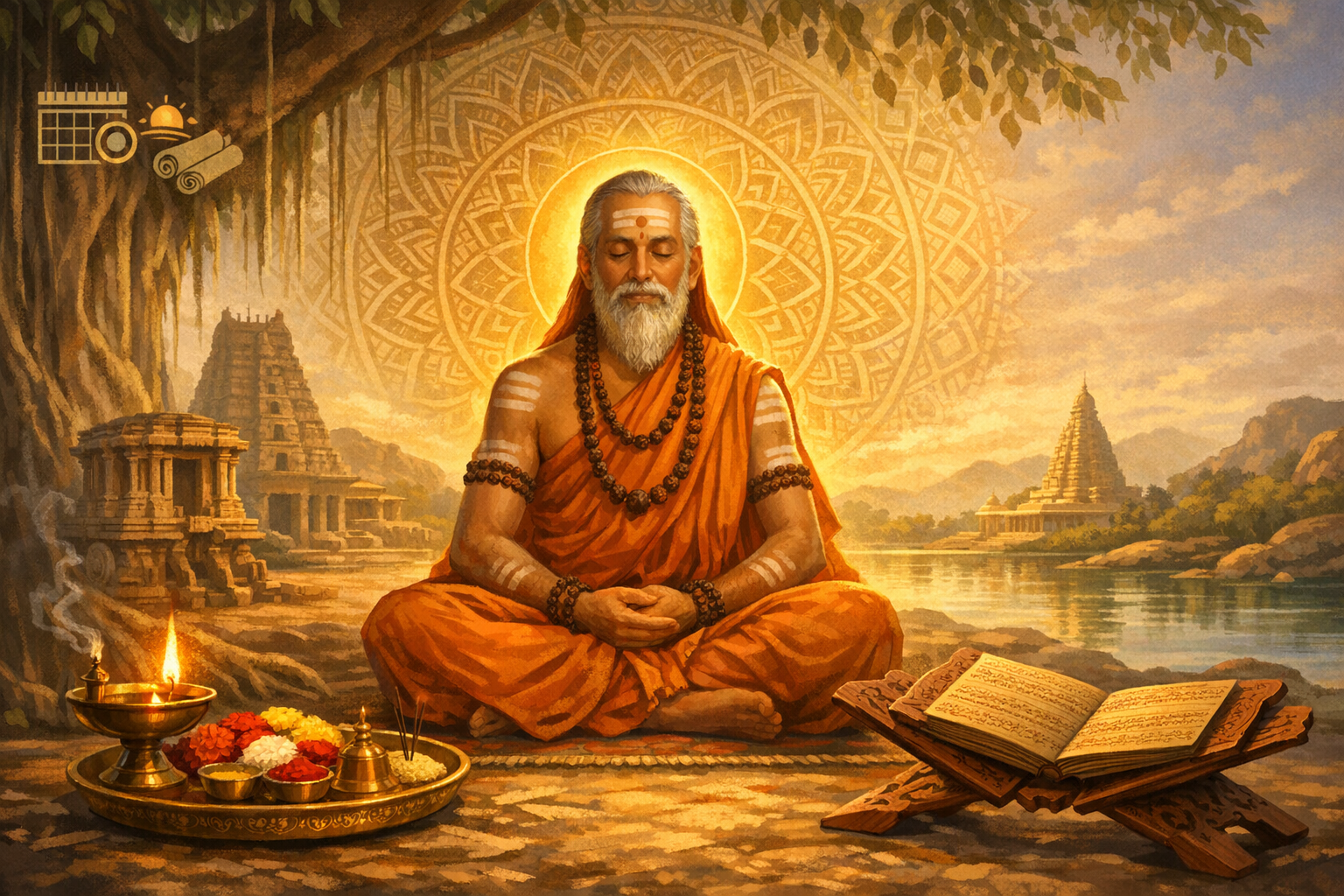
Vidyaranya Jayanti 2026 will be observed on April 23 (Vaishakha Shukla Saptami), honoring Swami VidyaranyaMadhavacharya (Madhava Vidyaranya)the Advaita luminary and rajaguru of the early Vijayanagara Empire. This long-form guide outlines historical context, key texts (Panchadasi, Jivanmuktiviveka, Sarvadarśanasaṅgraha), and his association with Sringeri Sharada Peetham. Readers gain a practical puja framework for home observance, guidance on…
-
Rajjusarpa Nyaya Explained: Rope–Snake Illusion, Maya, and Non-Dual Reality in Vedanta

Rajjusarpa Nyayathe rope–snake maximclarifies Advaita Vedanta’s account of Maya, avidya, and Brahman by showing how compelling illusions arise and how true knowledge sublates them. The analogy situates three orders of reality, explains error through adhyasa and anirvachaniya khyati, and illuminates the method of adhyaropa–apavada used by Sankara. It engages parallel insights in Buddhism, Jainism, and…
-
Karma and the Realized Soul in Hinduism: Sanchita, Prarabdha, Agami and Jivanmukti Explained

This article explains how the threefold classification of karma in Hinduismsanchita, prarabdha, and agamioperates for both seekers and the realized person in Advaita Vedanta. It shows why Self-knowledge nullifies sanchita, prevents the accrual of agami, and yet allows prarabdha to complete its course until the body’s end. Readers gain scriptural grounding from the Bhagavad Gita…
-
When Darkness Becomes Light: Dharmic Perspectives for Clarity, Compassion, and Unity

This essay unpacks the metaphor “Darkness from one side is light from the other side” through Hindu philosophy and its sister Dharmic traditionsBuddhism, Jainism, and Sikhism. Drawing on the Upanishads, the Bhagavad Gita, Advaita Vedanta, Nyaya, Samkhya, and Yoga, it explains why perspectives diverge and how disciplined methods convert contradiction into clarity. Jain Anekantavada and…
-
Unmasking Anavamala in Shaivism: Break the Ego Illusion and Reclaim Shiva-Nature

Anavamala, the primordial contraction in Shaivism, explains how the jiva falsely identifies with the body–mind and forgets its Shiva-nature. This long-form exploration clarifies its etymology, its role within the triad of malas, and how different Shaiva traditionsShaiva Siddhanta and Kashmir Shaivismdiagnose and remedy this subtle veiling. The discussion distinguishes ontological contraction (mala) from cognitive error…
-
Vidyaranya Jayanti 2026: Date, Puja Guide, and the Timeless Legacy of Vijayanagara’s Sage

Vidyaranya Jayanti 2026 will be observed on April 23 (Vaishakha Shukla Saptami), honoring Swami VidyaranyaMadhavacharya (Madhava Vidyaranya)the Advaita luminary and rajaguru of the early Vijayanagara Empire. This long-form guide outlines historical context, key texts (Panchadasi, Jivanmuktiviveka, Sarvadarśanasaṅgraha), and his association with Sringeri Sharada Peetham. Readers gain a practical puja framework for home observance, guidance on…
-
Why Nothing Is Ever Lost: Dharmic Wisdom to Transform Grief into Clarity and Peace

This long-form exploration explains why, across Hinduism, Buddhism, Jainism, and Sikhism, nothing is ever truly lostforms change while meaning, memory, and value continue. It clarifies Vedanta’s two levels of truth, showing how the atman remains untouched even as prakriti transforms. It integrates Buddhist dependent origination, Jain Anekantavada, and Sikh Hukam to present a unified dharmic…
-
Nyāyasudhā of Jayatirtha: The Masterwork that Fortified Dvaita Vedānta and Vedic Realism
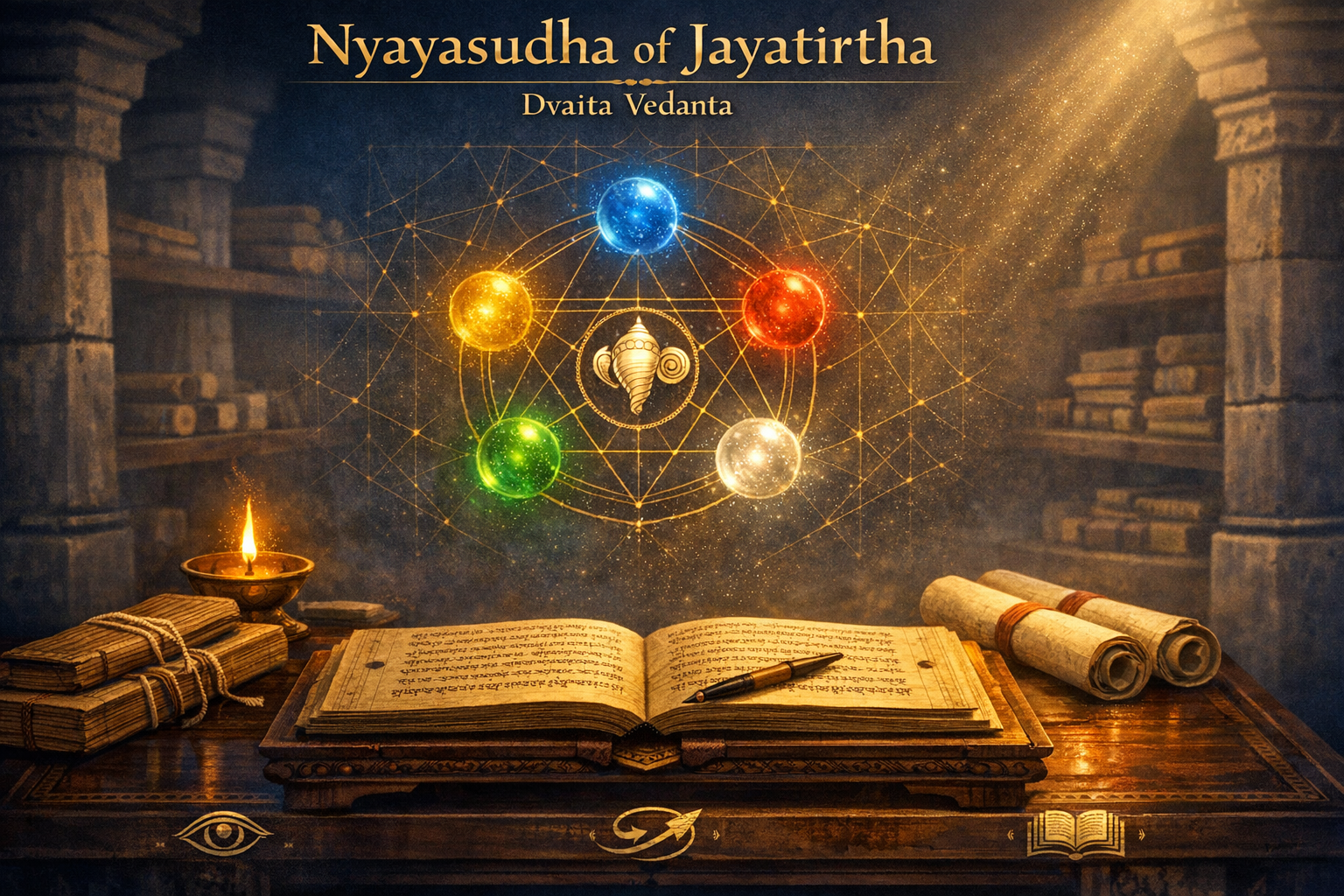
Nyāyasudhā, Jayatirtha’s classic commentary on Madhvacharya’s Anuvyākhyāna, is a cornerstone of Dvaita Vedānta and Vedic realism. It integrates scriptural testimony, disciplined reason, and experience to defend a plural, theistic ontology centered on Viṣṇu-sarvottama. The work clarifies pañcabheda, reinterprets nirguṇa in a theologically coherent way, and presents mokṣa as everlasting personal bliss grounded in bhakti and…
-
Vedanta’s Three Kinds of Difference: A Clear, Unifying Guide to Vijātiya, Sajātiya, and Svagata

Vedanta distinguishes three kinds of differenceVijātiya, Sajātiya, and Svagatato clarify how unity and plurality coexist in scripture, philosophy, and practice. Understanding these categories resolves common confusions about whether Brahman can have peers, attributes, or internal parts. Advaita denies all three in Brahman at the ultimate level while allowing difference provisionally in experience. Vishishtadvaita affirms one…
-
Jada Bharata vs. Kali Yuga: Unmasking Algorithmic Gurus and Reclaiming Timeless Dharma

Jada Bharata’s encounter with the modern attention economy offers a precise lens for navigating Kali Yuga’s spiritual noise. Grounded in the Bhagavata Purana, the sage’s teachings on vairagya, mauna, sakshi-bhava, and nishkama-karma map cleanly onto today’s influencer culture and consumer spirituality. Clear criteria from the Upanishads and the Gita help distinguish authentic guidance from spectacle…
-
He Is Myself and I Am He: Timeless Vedanta on Atman-Brahman Unity and Liberation

This article unpacks the Vedantic insight behind “He is myself and I am He,” explaining how the Upanishads reveal the identity of atman and Brahman. It surveys Advaita Vedanta alongside Vishishtadvaita, Dvaita, Gaudiya Vaishnavism, and Kashmir Shaivism to show complementary ways of understanding unity and difference. It bridges Hindu philosophy with related aims in Buddhism,…
-
Ignorance Is Its Nemesis: A Definitive Advaita Vedanta Guide to Avidya, Jnana, and Moksha
This long-form, academically grounded exploration clarifies how Advaita Vedanta understands avidya (ignorance) as the root of bondage and jnana (knowledge) as its precise antidote. Drawing on the Upanishads and the Bhagavad Gita, it explains key conceptsadhyasa, maya, sadhana-chatushtaya, and sravana–manana–nididhyasanawhile detailing how knowledge functions as a pramana for Brahman. The discussion situates Advaita within a…
-
Unlocking the Hidden in Hindu Philosophy: Arthapatti and the Power of Postulation in Mimamsa

Arthapatti (postulation) is a distinctive Mimamsa pramana that posits an unperceived fact when established data would otherwise be incoherent. Classic examples such as the stout Devadatta who does not eat by day illustrate how explanatory necessity (anyathā-anupapatti) drives this cognition. The article clarifies how arthapatti differs from ordinary inference, outlines its two forms (drshtārthapatti and…
-
Unmasking Avidya: Adi Shankaracharya’s Advaita roadmap to the wonders within the Self
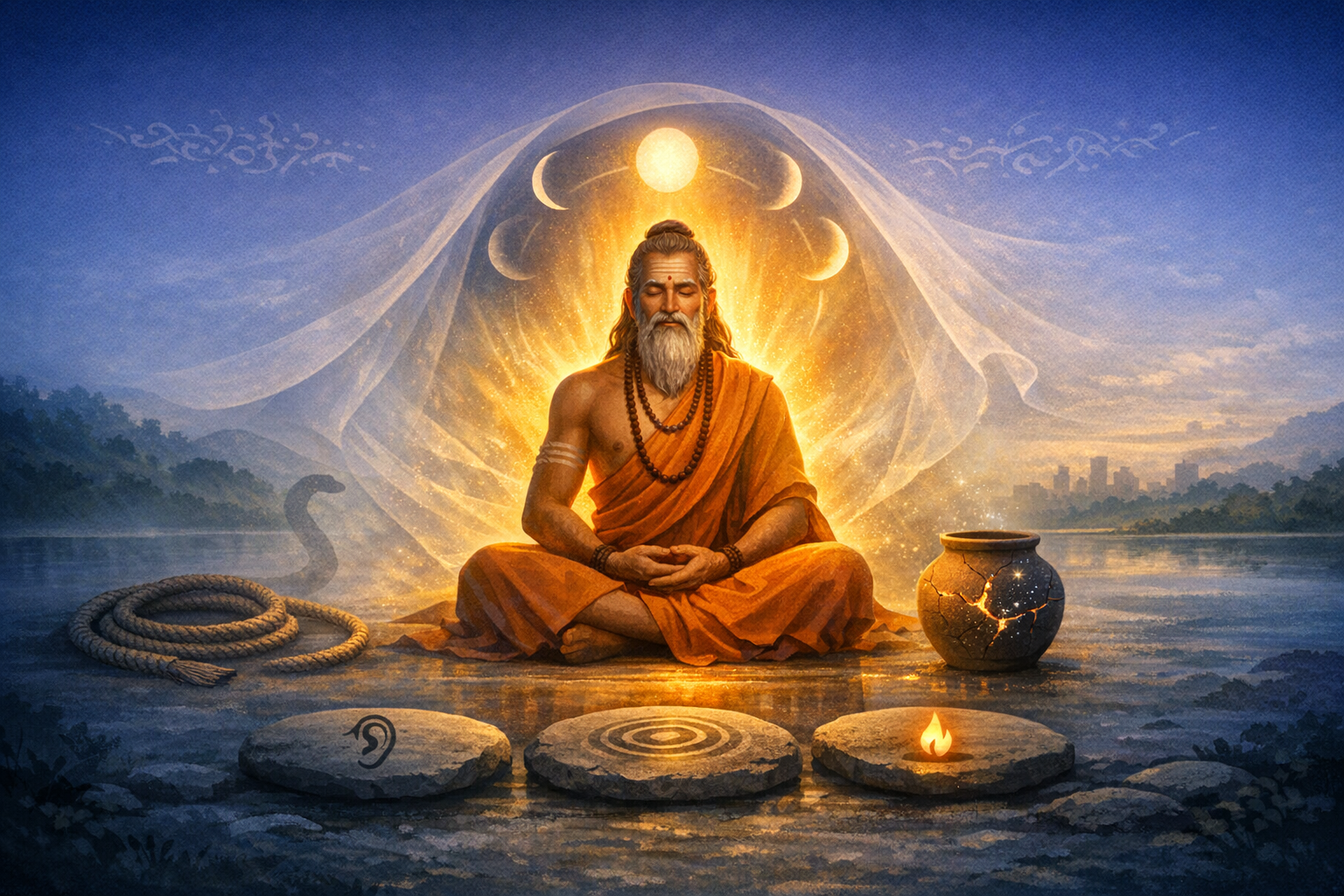
This article presents an academically grounded overview of how Adi Shankaracharya diagnoses human suffering as avidya and prescribes Advaita Vedanta as a precise remedy. It explains adhyāsa, the superimposition error, and shows how Upanishadic mahāvākyas remove ignorance rather than create divinity. Readers learn the graded reality framework, the role of śruti as pramāṇa, and the…
-
Why Questioning Is Sacred in Hinduism: A Deep Dive into Dharmic Philosophy and Pluralism

This article examines why questioning is sacred in Hinduism and the wider dharmic traditions, showing how inquiry anchors both philosophy and spiritual practice. It explains how the Upanishads, the Bhagavad Gita, and the classical darshanas institutionalize rigorous debate, evidence, and contemplative verification. Readers learn practical tools from pramana theory to navigate misinformation, and from disciplines…
-
Sri Ramanujacharya Jayanti 2026: Date, Puja Guide, and the Timeless Vishishtadvaita Legacy
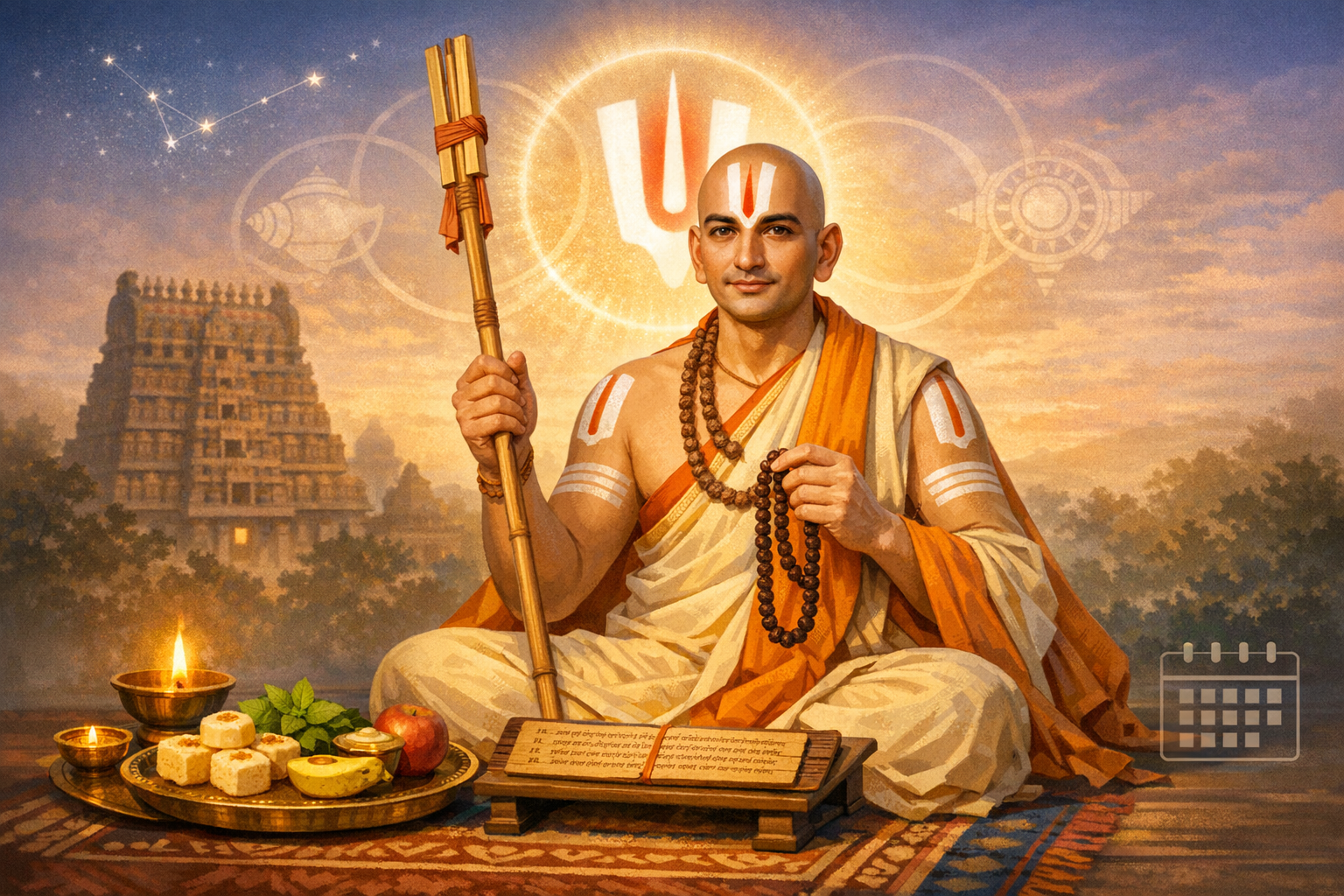
Sri Ramanujacharya Jayanti 2026 will be observed on 22 April 2026, honoring the birth anniversary of the foremost exponent of Vishishtadvaita Vedanta. The guide explains how the date arises from the Hindu calendar and why regional observances may track either the Chaitra Shukla Paksha tithi or Thiruvadirai (Ardra) nakshatra in Chithirai Masam. It outlines temple…
-
Cut Through the Noise: Yoga Vasistha’s Radical Call for Direct Experience over Debate
Yoga Vasistha confronts the overload of modern discourse with a precise remedy: shift from argument to direct experience. Framed as a dialogue between Vasishta and Rama, this classical Hindu scripture privileges aparoksha-anubhutiimmediate realizationover conceptual accumulation. It maps a practical path through dispassion, inquiry, meditation, and ethical alignment, showing how transformation is verified in everyday equanimity…
-
Ramanuja Jayanthi 2026: Date, Rituals, and Vishishtadvaita Legacy of Sri Ramanujacharya

Ramanuja Jayanthi 2026 falls on 22 April, aligning with Chaitra Shukla Panchami and, in several traditions, the Tiruvadirai (Ardra) Nakshatra. The observance honors Sri Ramanujacharya’s Vishishtadvaita Vedanta and his inclusive Sri Vaishnava legacy that unites devotion, knowledge, and service. Temples at Srirangam, Sriperumbudur, Melkote, and Tirumala typically conduct parayanam, special alankara, and annadanam, while households…
-
Knower of the Field: Cutting-Edge Insights into Consciousness, Experience, and Dharmic Unity

This essay examines consciousness through the Bhagavad-Gita’s kshetra–kshetrajna lens and connects it with current neuroscience and philosophy of mind. It clarifies arousal versus awareness, reviews global neuronal workspace and integrated information theory, and explains how predictive and recurrent processing shape experience. Drawing on cell biology, it traces how neuronal excitability, glial modulation, and plasticity ground…
-
Person or Energy? Find Clarity in a Dharmic Synthesis across Vedanta, Buddhism, Jainism, Sikhism

This essay clarifies whether the Divine is best understood as Person or Energy by synthesizing perspectives from Vedanta, Buddhism, Jainism, and Sikhism. It defines key terms (Brahman, purusha, shakti, prana) and shows how saguna–nirguna, nirgun–sargun, and anekantavada converge in a coherent framework. Readers gain a precise yet accessible model that honors both devotional intimacy and…