
-
Devaki’s Six Sons and Krishna’s Grace: The Harivamsa Tale of Curse, Karma, and Redemption

This long-form exploration synthesizes Harivamsa, Mahabharata, and Purana traditions to explain why Devaki’s first six sons were slain by Kamsa and how Krishna’s grace ultimately redeemed them. Readers gain a clear map of the narrative’s variants, from the Shadgarbha’s primordial transgression and curse to their rebirth in Mathura and liberation after Kamsa’s fall. The essay…
-
From Impermanence to Eternal Service: A Clear Path through Dharma, Devotion, and Liberation
The essay reframes the modern pursuit of longevity through a dharmic lens, showing how Hinduism, Buddhism, Jainism, and Sikhism converge on training attention, purifying intention, and embodying seva. Instead of biological duration, it emphasizes the continuity of rightly directed consciousness and compassionate action. Technical concepts are clarifiedatman, saṁsāra, karma, ahaituky apratihata, mokshawhile practical disciplines (śravaṇa,…
-
Shattering the Myth: Why Enlightenment Demands ActionDharma, Karma Yoga, and Sacred Work
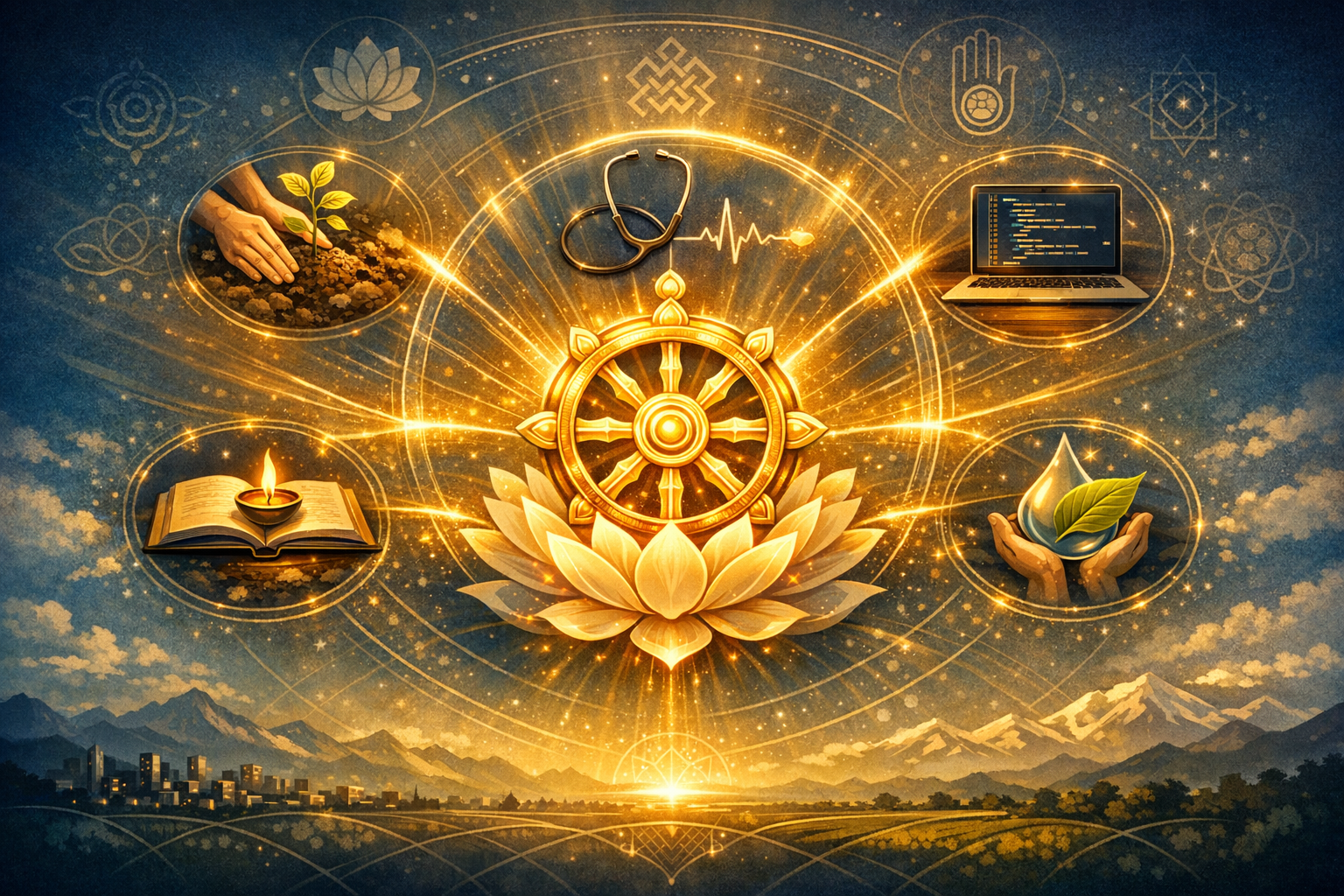
Many assume enlightenment frees a person from work; Hindu philosophy and its dharmic counterparts show the opposite. The Bhagavad Gītā teaches that action is unavoidable and must be transformed through Karma Yoga into selfless service. Dharma aligns individual role and aptitude with the common good, while prārabdha karma explains why even the realized remain outwardly…
-
Krishna’s Birth Reimagined: Jain Mahabharata on Karma, Kamsa, Jarasandha, and Destiny

The Jain Mahabharata reframes Krishna’s birth through the lenses of karma, Anekantavada, and ethical responsibility while honoring narrative motifs cherished across India. It presents Krishna as a Vasudeva, Balarama as a Baladeva, and Jarasandha as a Prativasudeva, aligning familiar events with a precise moral taxonomy. Rather than divine interruption, the sequence unfolds as the fruition…
-
Beyond Heaven and Hell: Karma, Consciousness, and Self-Reward in Dharmic Philosophy
This essay explains, in clear academic terms, why Dharmic traditions reject an externalized reward-and-punishment model after death while affirming a rigorous moral universe. It clarifies karma-phala using concepts like sanchita, prarabdha, and agami, and links Mimamsa’s apurva and Nyaya–Vaisheshika’s adrishta to a self-executing moral order. Hindu philosophy, Buddhism, Jainism, and Sikhism are presented in harmony:…
-
How Free Are We, Truly? Karma, Neuroscience, and Moral Choice across Dharmic Paths

Are human choices truly free or fixed by forces beyond control? This analysis surveys determinism, libertarianism, and compatibilism; integrates current neuroscience on readiness potentials, predictive decoding, and conscious veto; and then synthesizes insights from Hinduism, Buddhism, Jainism, and Sikhism. Readers gain a clear, practical model of bounded freedom grounded in karma, dependent origination, Anekantavada, and…
-
When Do Our Karmas Ripen? A Dharmic, Evidence‑Based Guide to Prarabdha, Agami, Sanchita
This article addresses a common spiritual question: if current experiences reflect past-life karma, when do the karmas of this life bear fruit? Drawing on the clarification by Sri Sri Ravi Shankar”That is not how it is!”it explains why karmic results arise on multiple horizons: immediate, near-term within this life, and across future births. It provides…
-
When Do Our Actions Bear Fruit? Unraveling Karma’s Timing with Profound Dharmic Insights
A perennial dharmic question asks when the actions of this lifetime truly bear fruit. Drawing on Hindu sources such as the Bhagavad Gita, Upanishadic thought, the Yoga Sutras, and dharmashastra, this analysis explains how outcomes may manifest immediately, over time, or in future births through the interplay of sanchita, prarabdha, and agami karma. It integrates…
-
Beyond Ashes: Dharmic Wisdom on Death, Rebirth, and Why Restraint Sustains Our World

Modern discourse often assumes that death ends consciousness. Dharmic traditionsHinduism, Buddhism, Jainism, and Sikhismoffer a rigorous alternative: the body returns to elements while awareness continues in accordance with karma. This article explains the classical Vedic framework (sthula, sukshma, and karana sharira), unpacks the memorable triad of the body’s material endstool, ashes, or earthand situates it…
-
Facing Life’s Final Examination: Gita 8.6 on Consciousness at Death ISKCON Insights

This in-depth analysis distills HH Guru Prasad Swami’s “final examination” metaphor for Bhagavad-gita 8.6, showing how consciousness at death reflects a lifetime of formation, not a last-minute tactic. It explains key Sanskrit terms and situates the verse within Gita 8.5–8.14 to emphasize abhyāsa (practice) integrated with bhakti (devotion). Practical guidance translates classical Hindu philosophy into…
-
Decoding ‘Om krato smara kritam smara’: karma, memory, and the art of conscious dying
“Om krato smara kritam smara” from the Īśāvāsya Upaniṣad condenses the Upanishadic path into one imperative: let the sovereign will remember what has been done. The mantra sits at a pivotal moment in the text (Vājasaneyi Saṁhitā 40.17), pairing ethical clarity with the acknowledgement of impermanence. A brief philological reading clarifies ‘krato’ (will/intellect), ‘smara’ (remember),…
-
Learning Without Chains: Hindu-Dharmic Wisdom to Turn Past Mistakes into Clarity and Power

This essay examines how Hinduism and allied dharmic traditions treat the past as a teacher rather than a burden. It integrates Hindu concepts such as karma, saṃskāra, smṛti, and karma-yoga with Yogic psychology (abhyāsa, vairāgya), Buddhist mindfulness (sati), Jain Anekantavada with Pratikraman, and Sikh teachings on hukam and Naam simran. Readers gain a clear, compassionate…
-
Who Is the Real Father? Dharmic Wisdom on Body, Soul, Karma, and the Supreme Source
What distinguishes a living person from a lifeless body points directly to the dharmic insight at the heart of the Hare Krishna Movement: the living self (atman) is distinct from matter, and its ultimate source is the Supreme. This article presents a rigorous, compassionate exploration of “Who is the real father?” across ISKCON’s Gaudiya Vaishnava…
-
Why Nothing Is Ever Lost: Dharmic Wisdom to Transform Grief into Clarity and Peace

This long-form exploration explains why, across Hinduism, Buddhism, Jainism, and Sikhism, nothing is ever truly lostforms change while meaning, memory, and value continue. It clarifies Vedanta’s two levels of truth, showing how the atman remains untouched even as prakriti transforms. It integrates Buddhist dependent origination, Jain Anekantavada, and Sikh Hukam to present a unified dharmic…
-
Embracing Sukha and Dukha: Dharma’s Transformative Science of Resilience and Freedom

This essay explains why Sanatana Dharma views Sukha (happiness) and Dukha (distress) as complementary threads woven into the fabric of life. Drawing on the Bhagavad Gita, the Yoga Sutra, and convergent insights from Buddhism, Jainism, and Sikhism, it shows how Dharma transforms hardship into clarity and compassion. Readers learn practical methodsKarma Yoga, Bhakti, Jnana, Raja…
-
Who Is the Real Father? ISKCON and Gita on the Soul, Death, and the Supreme Source
This essay explores the Hare Krishna (ISKCON) understanding of who the “real father” is by distinguishing bodily from spiritual parenthood through the lens of the Bhagavad Gita. It explains why everyday bereavement language“he has gone”implicitly recognizes the self (ātmā) as distinct from the body. Drawing on key verses (Gita 14.4, 2.13, 2.20, 15.7), it shows…
-
Life After Death in Hinduism: A Clear, Compassionate Guide to Karma, Rebirth, and Moksha
Hindu philosophy portrays life after death as an ethically coherent, compassionate continuum shaped by karma, guided by dharma, and culminating in moksha. Core ideas from the Upanishads, the Bhagavad Gita, and Puranic literature explain how the atman journeys onward through subtle and causal bodies, modulated by sanchita, prarabdha, and agami karma. Temporary states such as…
-
Unveiling the Soul’s Journey: Life After Death in HinduismKarma, Yama, Moksha

Hinduism presents life after death as a just, compassionate, and educative journey governed by karma and oriented toward moksha. Foundational textsthe Upanishads, Bhagavad Gita, and Puranasaffirm that the immortal ātman continues through realms (lokas) or returns via reincarnation according to ethical causality. Lord Yama Dharma embodies impartial moral order, while rites such as antyeṣṭi, śrāddha,…
-
Curses and Redemption in Srimad Bhagavatam (SB 3.15.37): Jaya–Vijaya’s Return
SB 3.15.37 shows how the words of Hindu sageswhether blessings or cursescarry real moral force yet can be redirected by sincere repentance and divine compassion. The Jaya–Vijaya narrative demonstrates that modified, not erased, consequences can accelerate liberation. Case studies such as Narada’s reform of Nalakūvara and Maṇigrīva, Durvasa Muni’s reconciliation with King Ambarisha, and Vṛtrāsura’s…
-
Jara’s Arrow and Krishna’s Departure: Time, Dharma, and the Eternal Law of Transformation

The narrative of Jara’s arrow and Krishna’s departure, preserved in the Mahabharata and Bhagavata Purana, encodes a rigorous meditation on time, dharma, and karmic causality. By exploring the Sanskrit semantics of jarā (old age) and the story’s careful framing within prophetic and ethical horizons, the episode becomes a study of impermanence and intentional closure. It…