
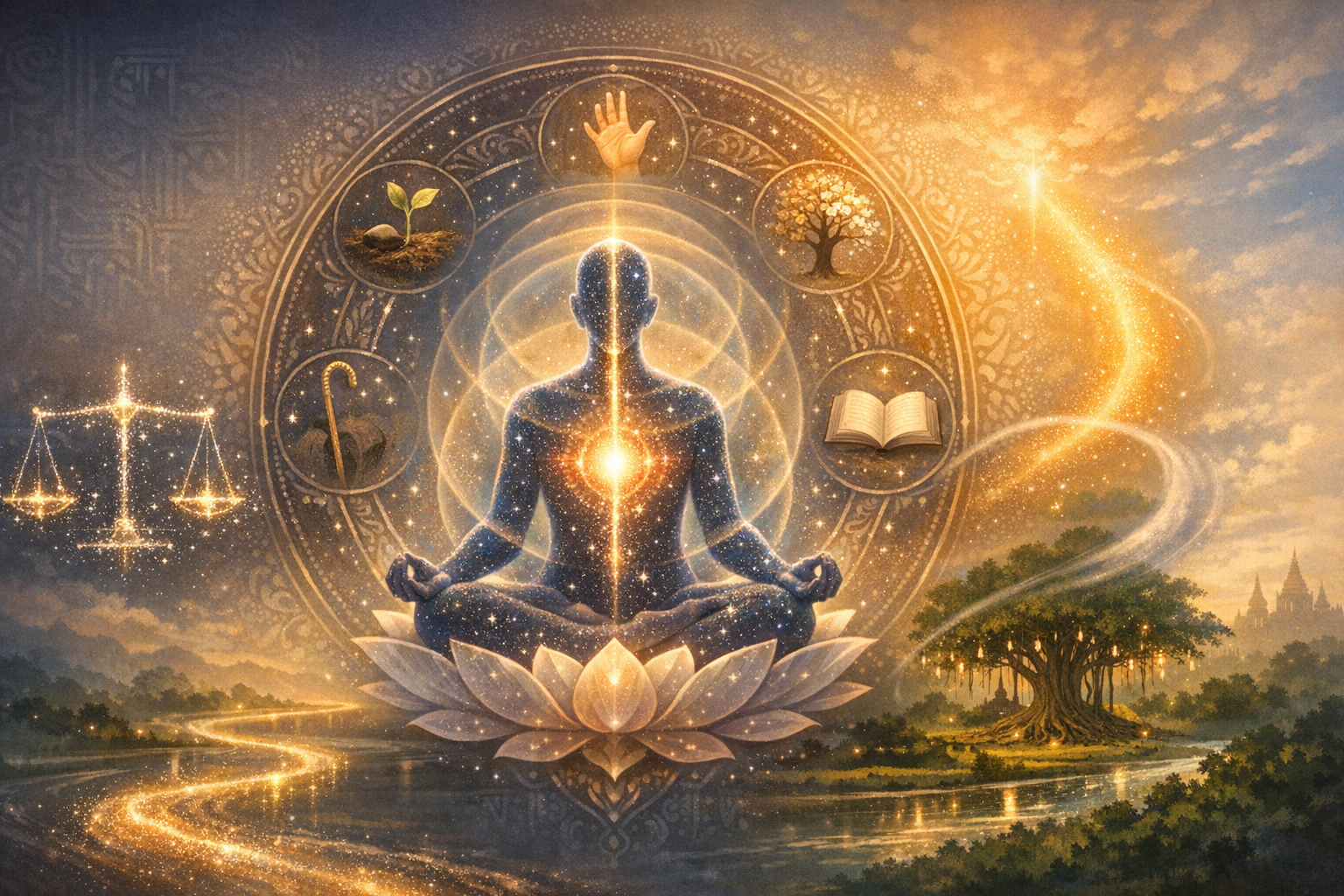
Across cultures and eras, people inevitably pause to ask what follows the final heartbeat. Hindu thought addresses this perennial question with a remarkably systematic, compassionate, and philosophically rigorous vision of life after death. Rather than a single judgment or immutable fate, existence is portrayed as an ongoing journey of the atman (self), ethically shaped by karma, guided by dharma, and ultimately oriented toward moksha, the freedom from the cycle of birth and death. Within this vision, Yama Dharma Rajaoften symbolically described as the cosmic adjudicatorembodies the moral architecture of the universe rather than a figure of dread.
Foundational texts, including the Upanishads, the Bhagavad Gita, and Puranic literature, converge on a few core ideas: the atman is deathless; embodiment is cyclical; action (karma) has consequences that outlast a single lifetime; and liberation (moksha) remains the ultimate human aspiration. In this frame, the question is not whether there is life after death, but how consciousness continues, what shapes that continuity, and how one can relate wisely to it in this very life.
Hindu philosophical analysis describes the human constitution through the tri-layered model of the sthula sharira (gross body), sukshma sharira (subtle body), and karana sharira (causal body). Complementing this is the Pancha Kosha Viveka of the Taittiriya Upanishad, which maps five sheathsannamaya (physical), pranamaya (vital), manomaya (mental), vijnanamaya (intellectual), and anandamaya (bliss)that veil the atman. Death, in this view, is a transition in which the gross body is relinquished, while the subtle and causal bodies carry forward latent impressions (vasanas) and karmic accounts.
Karma theory provides the ethical engine of continuity. Three categories are classically distinguished: sanchita (the storehouse of past actions), prarabdha (that portion currently bearing fruit and shaping the present embodiment), and agami (new actions generated now that will fructify later). Prarabdha sustains the present life until death dissolves the gross body; sanchita and agami then condition what follows. Far from fatalism, this framework emphasizes moral agency, aligning conduct with dharma to refine future possibilities and hasten spiritual maturation.
The passage at death is described with psychological and yogic precision. The Bhagavad Gita teaches that one’s final remembrance (antim smriti) influences the next state of being, underscoring the value of steady practice (sadhana) that naturalizes remembrance of the Divine. Yogic anatomy adds that as prana withdraws from the senses, attention turns inward; advanced contemplatives train to stabilize awareness, sometimes described as centering in the heart or along the sushumna nadi. These descriptions, whether taken symbolically or literally, highlight the central role of cultivated attention and character.
Classical sources portray Yama Dharma Raja as the custodian of cosmic justice, not a punitive despot. In the Garuda Purana and allied texts, the so-called “court” of Yama is best read as a pedagogical image for moral causality: every deed, intention, and habit leaves a trace that shapes experience. Temporary states of heaven (svarga) and hell (naraka) are remedial environments in which consequences are processed. They are not eternal residences; when the relevant karmas are exhausted, movement continues within samsara or culminates in moksha according to one’s spiritual attainment.
Upanishadic teaching further outlines two archetypal trajectories. The devayana, or archiradi marga (the “path of light”), is associated with those established in higher knowledge and dispassion; it culminates in non-return to the mortal realm. The pitriyana, or dhumadi marga (the “path of smoke”), leads through refined but finite realmssuch as pitri-lokabefore returning to embodied life. These are not rigid tracks but frameworks indicating how inner quality (guna balance) and spiritual insight modulate post-mortem transit.
Rebirth (punarjanma) is then described as ethically intelligible. The subtle body bears vasanas and samskaras that resonate with specific circumstancesa family, culture, body, and life lessonsmost conducive to working through karmic momentum. Sattva, rajas, and tamas, the three gunas, tint cognition and desire, inclining one toward clarity, dynamism, or inertia. Rebirth is neither reward nor punishment; it is a learning continuum within which consciousness evolves toward freedom.
Hindu traditions nuance liberation with distinctive emphases. Advaita Vedanta points to identity with Brahman, where the realized no longer returns because ignorance (avidya) is dispelled. Vishishtadvaita and other Vaishnava schools cherish eternal service and loving participation in the divine abode (Vaikuntha or Goloka), often describing fivefold mokshasalokya, samipya, sarupya, sarshti, and sayujyawith preferences varying by lineage. Shaiva traditions describe ascent to Shiva-loka or abiding awareness of Shiva as one’s inmost Self, while Shakta traditions articulate liberation through and as the power of Devi. Differences in language conceal a shared telos: abiding freedom, love, and wisdom beyond compulsion.
Ritual life supports this passage with care and precision. Antyeshti, the final samskara, entrusts the body to Agni through cremation, acknowledging impermanence and assisting the subtle body’s onward movement. The period immediately following death is traditionally observed with rites that address the preta state, guiding the departed and consoling the living. Shraddha, tarpan, and pinda danaperformed on designated tithis and annuallynurture bonds with ancestors (pitrs), express gratitude, and align familial life with dharma. Even when their metaphysics is approached symbolically, these rites demonstrably provide psychological integration and communal solidarity during grief.
Texts such as the Garuda Purana offer vivid portrayals of post-mortem journeys; contemporary readers may read these as metaphors for ethical memory and inner climate more than as cartography. The pedagogical power of these imagesclarifying consequences, inspiring virtue, and dissuading harmremains durable. The consistent message across genres is clear: conduct matters, compassion protects, truth purifies, and devotion or contemplative insight liberates.
Importantly, the dharmic family of traditions shares a deep kinship on the core dynamics of moral causality and liberation. Buddhism articulates dependent origination and rebirth without positing a permanent self, emphasizing cessation of suffering through insight and compassion; Tibetan sources retain imagery of Yama as a karmic mirror. Jainism presents an exacting analysis of the jiva bound by karmic particles (pudgala) and prescribes ahimsa and austerity for release. Sikh teachings speak of the cycle of janam-maran and the grace-laden path of Naam, Hukam, and seva that brings union and freedom. Across these paths, ethical refinement, disciplined practice, and love for the Real converge in a shared aspiration: liberation for all beings.
Several practical and ethical implications follow from Hindu teachings on life after death. First, living by dharmatruthfulness, non-harm, generosity, fidelity, and responsibilitydirectly shapes one’s inner landscape now and the journey hereafter. Second, steady sadhanajapa, meditation, study of the Upanishads and the Bhagavad Gita, and selfless servicecultivates the remembrance and clarity emphasized for the moment of death. Third, honoring samskaras and ancestral observances fortifies family resilience, gratitude, and continuity, offering solace that is both spiritual and psychosocial.
Common questions are addressed within this framework. Are heaven and hell eternal? Hindu scriptures answer no; they are remedial and temporary, while moksha alone ends recurrence. Must cremation be followed strictly? While cremation is the norm for householders, traditions also recognize exceptions (for example, for sannyasis), and contemporary ethics affirm the dharmic nobility of organ donation. Are near-death experiences relevant? Modern reports are not definitive proof, yet they interestingly echo many cross-cultural motifs: continuity of awareness, moral review, and the primacy of love and truth.
At a deeper level, the doctrine of karma and rebirth is not meant to induce anxiety but to restore meaning. Suffering is neither random nor final; goodness is never wasted; and every sincere effort to align with truth bears fruit. In this light, Yama Dharma Raja can be contemplated as the personification of a just universeone that patiently educates, heals, and uplifts through the grammar of consequence and the grace of insight.
Ultimately, life after death in Hinduism is less a distant speculation than a call to live well now. By maturing ethics, deepening understanding, and remembering the Divine, individuals reshape both present experience and future trajectory. Whether one resonates most with Advaita’s nondual clarity, Vaishnava devotion, Shaiva-Shakta mysticism, or the allied paths of Buddhism, Jainism, and Sikhism, the shared promise endures: the cycle of samsara can be transcended, and freedommokshais the birthright to be realized.
Inspired by this post on Hindu Pad.
